
The Anti Corruption Commission in Bangladesh (ACC, or Durnity Daman Commission) can summon you, demand your documents, order a statement of your assets and file a case that ends before a Special Judge. Knowing how its powers work, and where their limits lie, is the best protection for officials, business owners and companies alike.
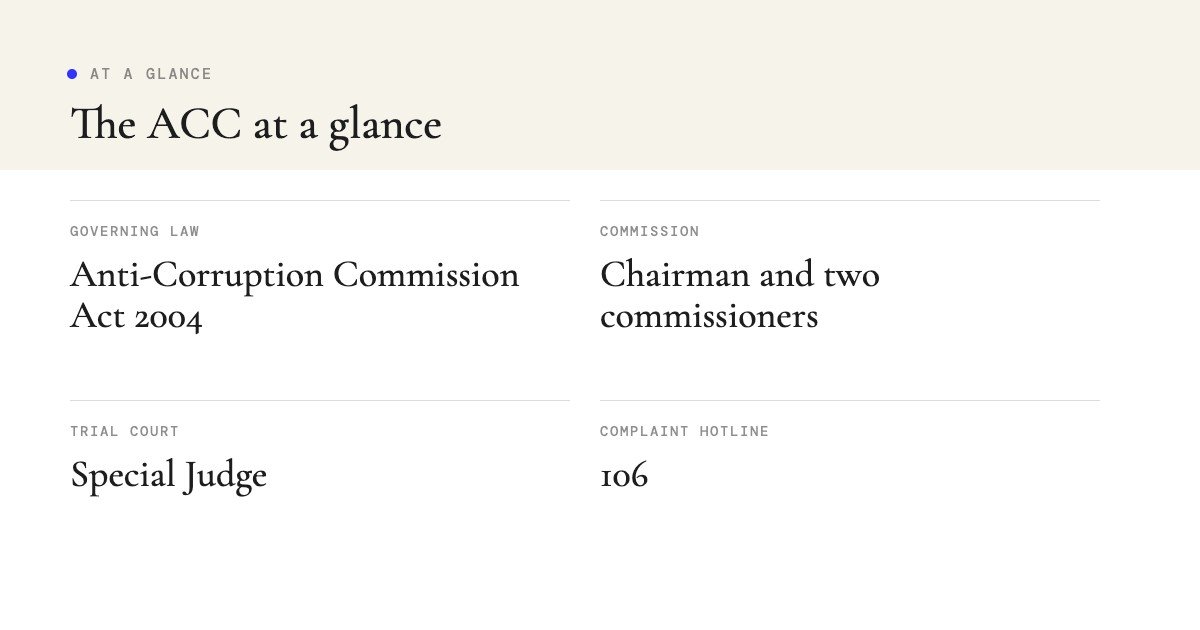
- The ACC operates under the Anti-Corruption Commission Act 2004 and the ACC Rules 2007. An amendment ordinance made in December 2025 lapsed on 11 April 2026, so the 2004 Act applies again in its earlier form.
- A new three-member commission, chaired by Justice A K M Asaduzzaman, was appointed on 17 August 2026 after a vacancy of more than five months.
- The ACC has civil-court style powers to summon witnesses and call for documents, and its officers have the powers of a police officer in charge when investigating.
- Failing to file a wealth statement when ordered, or filing a false one, is a separate offence; holding assets beyond known lawful income carries three to ten years' imprisonment.
- ACC cases are tried only by a Special Judge, and no court can take cognizance without the Commission's sanction.
What the Anti Corruption Commission in Bangladesh is
The ACC was established by the Anti-Corruption Commission Act 2004, replacing the old Bureau of Anti-Corruption. The Act declares the Commission independent and impartial. It consists of three commissioners, one of whom the President appoints as chairman, chosen from names recommended by a five-member search committee that includes judges of both divisions of the Supreme Court, the Comptroller and Auditor General, the chairman of the Public Service Commission and a recently retired cabinet secretary.
The functions of the Anti Corruption Commission in Bangladesh under section 17 include inquiring into and investigating scheduled offences, filing and conducting cases, reviewing laws and systems that allow corruption, research and public awareness. It works through a head office in Dhaka and integrated district offices across the country.
The 2025 ordinance and the April 2026 lapse
Following the ACC Reform Commission's report in January 2025, the interim government issued an amendment ordinance in December 2025. It would have extended jurisdiction to Bangladeshis abroad, defined "known income" as lawful income, changed the appointment process and introduced district-level scrutiny of complaints.
Parliament did not pass the ordinance. Along with a dozen other ACC-related ordinances, it lapsed on 11 April 2026, thirty days after the new Parliament first sat, and the 2004 Act took effect again in its earlier form. Commentary written in late 2025 that describes the ordinance as current law is now out of date, so check the date of anything you rely on.
The new commission
The previous chairman and both commissioners resigned on 3 March 2026. Without a commission, the ACC could not approve new cases or charge sheets, although existing investigations and trials continued. A search committee was formed in June 2026, and on 17 August 2026 the government appointed Justice A K M Asaduzzaman, a former Appellate Division judge, as chairman, with two commissioners. They took office on 19 August 2026, and the backlog of approvals is now being worked through.
Which offences the ACC can investigate
The Anti Corruption Commission in Bangladesh does not investigate every crime. Its jurisdiction is limited to the offences listed in the Schedule to the 2004 Act and to offences created by the Act itself.
| Offence group | Source | Typical example |
|---|---|---|
| Bribery and illegal gratification | Penal Code 1860, sections 161 to 165A | A public servant taking money to approve a file; a person offering it |
| Criminal breach of trust by public servants | Penal Code 1860, section 409 | Misappropriating government or bank funds entrusted to an official |
| Criminal misconduct | Prevention of Corruption Act 1947 | Abuse of office for personal gain |
| Related forgery and cheating | Penal Code 1860, where linked to a scheduled offence | False documents used to obtain a loan or contract |
| Disproportionate assets and false wealth statements | ACC Act 2004, sections 26 and 27 | Owning property that lawful income cannot explain |
| Money laundering linked to corruption | Money Laundering Prevention Act 2012 | Hiding bribe money through relatives, property or offshore accounts |
Since the 2015 amendment to the money laundering law, the ACC investigates laundering only where the predicate offence is corruption or bribery; other laundering cases go to the CID, NBR and other agencies. We explain that framework in our guide to compliance and risk matters.
Powers of the Anti Corruption Commission in Bangladesh
Section 19 of the Act gives the Commission, for an inquiry or investigation, powers similar to a civil court: to summon and enforce the attendance of witnesses and examine them on oath, to require any document to be found and produced, to take evidence on affidavit, to requisition public records from any court or office, and to issue commissions for examining witnesses and documents.
Obstructing an officer of the Anti Corruption Commission in Bangladesh, or refusing without lawful excuse to comply with a lawful order under section 19, is itself an offence carrying up to three years' imprisonment, a fine, or both. That is why an ACC notice should never simply be ignored, even if you believe the allegation is baseless.
Investigation powers
For investigation, ACC officers authorised by the Commission have the powers of an officer in charge of a police station under the Code of Criminal Procedure 1898. They can record statements, search, seize documents and property, and arrest in appropriate cases. A case is formally recorded as a first information report at an ACC office.
Inquiry versus investigation
The distinction matters for anyone dealing with the Anti Corruption Commission in Bangladesh. An inquiry (anusandhan) is a preliminary fact-finding exercise before any case exists. An investigation (tadanta) follows the formal lodging of a case and leads to a charge sheet or a final report. Many matters that start as inquiries are closed without a case ever being filed, so the inquiry stage is the best moment to put your documents forward.
Wealth statements and disproportionate assets
Two provisions give the Anti Corruption Commission in Bangladesh unusual reach into private finances. Under section 26, if the Commission has reason to believe, after inquiry, that a person or someone on their behalf holds property inconsistent with known sources of income, it can order that person to submit a statement of their assets and liabilities in the form and within the time it specifies.
Failing to submit the statement, or submitting one that is false or misleading, is punishable by up to three years' imprisonment, a fine, or both. Under section 27, a person who owns or possesses property that is not consistent with known sources of income, and who cannot give a satisfactory account of it, faces rigorous imprisonment of not less than three and up to ten years and a fine, and the property is liable to be confiscated.
Most section 26 and 27 cases are won or lost on paperwork. Tax returns, wealth statements filed with the NBR, sale deeds, bank statements, gift deeds and inheritance documents must tell the same story. Assemble them before you file the statement, not after a case is lodged.
Known sources of income
The lapsed ordinance would have defined "known income" expressly as lawful income. Under the 2004 Act as it now stands there is no such definition, and the meaning has been developed by the courts. Income disclosed in tax returns is the usual starting point, but disclosure alone does not prove that money was lawfully earned.
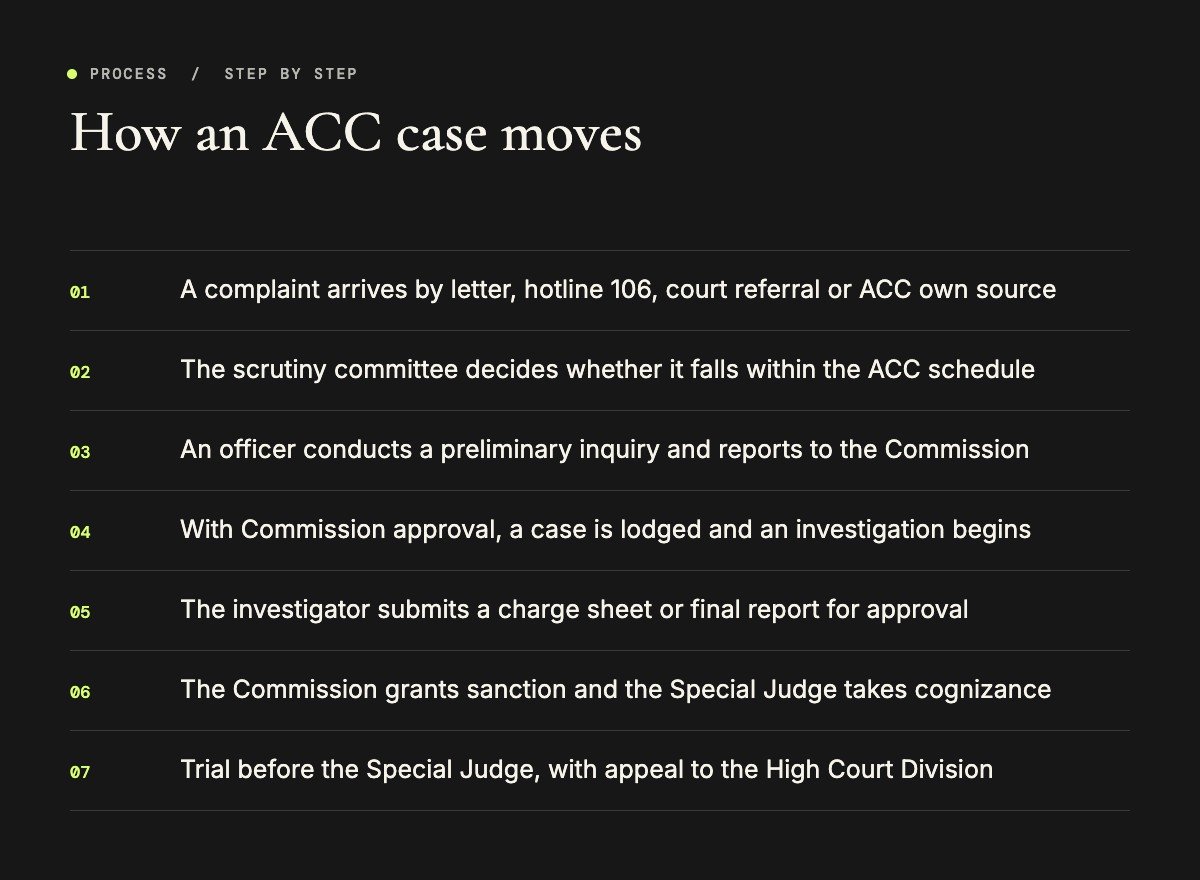
How an ACC case moves from complaint to trial
The procedure the Anti Corruption Commission in Bangladesh follows, set out below, reflects the 2004 Act and the ACC Rules 2007. Timings vary widely in practice.
- Complaint. Information reaches the ACC by written complaint, the 106 hotline, media reports, referral from a court or government office, BFIU intelligence, or the ACC's own sources.
- Scrutiny. A scrutiny committee checks whether the allegation concerns a scheduled offence and is specific enough to act on. Vague or out-of-scope complaints are filed away or referred elsewhere.
- Inquiry. An assigned officer collects records, writes to banks and land offices, may call the person concerned to give a statement, and reports with a recommendation.
- Case filing. If the Commission approves, the officer lodges a case and a formal investigation begins.
- Investigation. The investigating officer gathers evidence within the time limit set by the Act, which can be extended. Courts have held that delay does not automatically end a case.
- Charge sheet or final report. The Commission approves either a charge sheet, if there is a prima facie case, or a final report closing the matter.
- Sanction and trial. Under section 32, no court takes cognizance without the Commission's sanction. The case is tried by a Special Judge under the Criminal Law Amendment Act 1958, with appeal to the High Court Division.
Arrest, bail, travel bans and asset freezes
Once a case is lodged, the investigating officer can arrest an accused person where the law allows. Bail is decided by the Special Judge or, on appeal, the High Court Division. Because of the seriousness with which corruption cases are treated, bail is often contested and the outcome depends heavily on the facts, the amount involved and the conduct of the accused during the inquiry.
The Anti Corruption Commission in Bangladesh regularly applies to the court for orders preventing an accused person from leaving the country, and for freezing or attaching bank accounts, shares and land pending trial. These orders are made by the court, not by the ACC itself. They can be challenged, and a well-documented application to vary an order, for example to allow payment of salaries from a frozen corporate account, often succeeds.
Public servants and the question of prior sanction
A 2013 amendment inserted a provision requiring government approval, in line with section 197 of the Code of Criminal Procedure, before the ACC could file a case against a judge or public servant. In January 2014 the High Court Division declared that provision illegal and unconstitutional as contrary to equality before the law. The December 2025 ordinance would have repealed it expressly, but that ordinance lapsed.
A separate issue arises under the Government Service Act 2018, which required prior permission before arresting a public servant on a criminal charge after a charge sheet. The High Court Division declared that requirement unconstitutional in August 2022, and the state said it would appeal. Anyone advising a public servant should check the current status of both points before relying on them.
Companies and private individuals
Corruption cases usually centre on a public servant, but the Anti Corruption Commission in Bangladesh routinely names private parties too. A business owner who pays a bribe, a contractor who joins in inflated billing, a borrower who conspires with bank officials, or a relative who holds property for an official can all be accused as principals, abettors or conspirators.
Bank loan fraud is a major area of work for the Anti Corruption Commission in Bangladesh. Where officials of a state-owned or private bank sanction loans in breach of rules, the ACC can treat the officials and the borrower together under section 409 of the Penal Code and the Prevention of Corruption Act. Directors of borrowing companies should expect to be asked how the funds were used.
Foreign-owned companies
Subsidiaries of foreign groups face a double exposure. Conduct in Bangladesh can lead to an ACC case and, at the same time, to liability for the parent under laws such as the UK Bribery Act 2010 or the US Foreign Corrupt Practices Act. A coordinated response, with privilege protected in both places, is essential.
Responding to a notice from the Anti Corruption Commission in Bangladesh
Most people first meet the Anti Corruption Commission in Bangladesh through a letter. How you respond in the first two weeks often shapes everything that follows.
A notice to appear
Read the notice carefully: it should state the reference, the date and place of appearance and, in general terms, the subject. Take advice before attending. Prepare a short written statement and a bundle of documents, keep copies, and note the names of the officers present. If the date is impossible, write promptly asking for a new date and explaining why.
A request for documents
Companies often receive requests for contracts, tender files, board minutes or bank records. Provide what is asked for, in an indexed form, against a signed receipt. Do not volunteer unrelated material, and do not destroy or alter anything once a request has arrived, which can itself amount to an offence.
A wealth statement order
Use the prescribed form, meet the deadline, and make sure every figure can be supported by a document. Include assets held through family members if they were acquired with your money. Inconsistencies with past tax returns should be explained, not hidden.
Never contact the complainant or witnesses to "settle" the matter, and never offer anything of value to an ACC officer. Both can turn a weak inquiry into a strong prosecution.
Challenging ACC action in court
The courts supervise the Anti Corruption Commission in Bangladesh in several ways. A notice issued without jurisdiction, or a proceeding that is plainly malicious or without legal basis, can be challenged by writ petition in the High Court Division under Article 102 of the Constitution. Our guide to writs in Bangladesh explains how these petitions work.
After a charge sheet, an accused may apply to the High Court Division under section 561A of the Code of Criminal Procedure to quash the proceedings where, taking the allegations at face value, no offence is disclosed. The accused can also seek discharge before the Special Judge at the charge hearing. Courts are cautious with these remedies, so they are best used where there is a clear legal defect rather than a factual dispute.
Building an anti-corruption compliance programme
Bangladesh does not have a corporate "failure to prevent bribery" offence of the UK kind, but a documented programme still reduces risk and helps when the Anti Corruption Commission in Bangladesh asks questions. For companies, the core elements are:
- A clear policy. Zero tolerance for bribes and facilitation payments, approved by the board.
- Gifts and hospitality rules. Thresholds, approvals and a register.
- Third-party checks. Due diligence on agents, customs brokers and consultants who deal with officials.
- Accurate books. Every payment supported by an invoice and an approval trail.
- Speak-up channel. A confidential way for staff to raise concerns.
- Training and review. Regular training for staff in procurement, licensing and government relations.
Frequently asked questions about the Anti Corruption Commission in Bangladesh
Which law governs the Anti Corruption Commission in Bangladesh today?
The Anti-Corruption Commission Act 2004 and the ACC Rules 2007. The December 2025 amendment ordinance lapsed on 11 April 2026 without being passed by Parliament, so the earlier text applies.
Can I bring a lawyer when the ACC calls me?
You should take legal advice before attending and can ask for your lawyer to accompany you. Whether a lawyer may sit in on questioning is at the officers' discretion, so prepare to answer yourself, with a written statement settled in advance.
How do I make a complaint to the ACC?
Call the hotline 106, write to the head office or an integrated district office, or use the complaint channel on the ACC website. Give specific facts, names, dates and any documents; vague complaints are rarely taken forward.
Does the ACC investigate private companies?
Yes, where a scheduled offence is involved, such as bribing a public servant, conspiring in bank loan fraud or laundering corruption proceeds. Purely private commercial disputes fall outside its jurisdiction.
What happens if I ignore a wealth statement order?
Failure to submit, or submitting a false statement, is an offence under section 26 of the 2004 Act punishable by up to three years' imprisonment, a fine, or both, and it usually leads to a disproportionate assets case.
How we can help
We represent individuals and companies at every stage of an ACC matter: responding to notices and summonses, preparing wealth statements, handling interviews, applying for bail and to vary freezing orders, and defending cases before the Special Judge and the High Court Division. We also build anti-bribery programmes for local and foreign-owned businesses. Learn more about our anti-corruption and bribery practice.
Received a notice from the ACC?
Talk to us before you reply or attend. We review the notice, assemble the documents and prepare your statement.
Book a consultationAnti-corruption practicePrimary sources: the Anti-Corruption Commission Act 2004, the Penal Code 1860 and the Criminal Law Amendment Act 1958 on the Laws of Bangladesh portal; the Anti-Corruption Commission; the Supreme Court of Bangladesh.
This article is general information about Bangladeshi law as of October 2026 and is not legal advice. Laws and procedures change, and the ACC framework is under active reform; confirm the current position with a qualified lawyer before acting.



0 Comments