
Anti money laundering in Bangladesh is no longer a concern for banks alone. The Money Laundering Prevention Act 2012 reaches insurers, brokers, real estate developers, jewellers, NGOs, lawyers and accountants, and the Bangladesh Financial Intelligence Unit expects each of them to know their customers, keep records and report suspicion promptly.

- The Money Laundering Prevention Act 2012 (MLPA), the Money Laundering Prevention Rules 2019 and BFIU circulars together set the AML rules; terrorist financing is covered by the Anti-Terrorism Act 2009.
- Section 25 of the MLPA requires every reporting organisation to identify customers, keep records for at least five years after the relationship ends, supply information on request and report suspicious transactions on its own initiative.
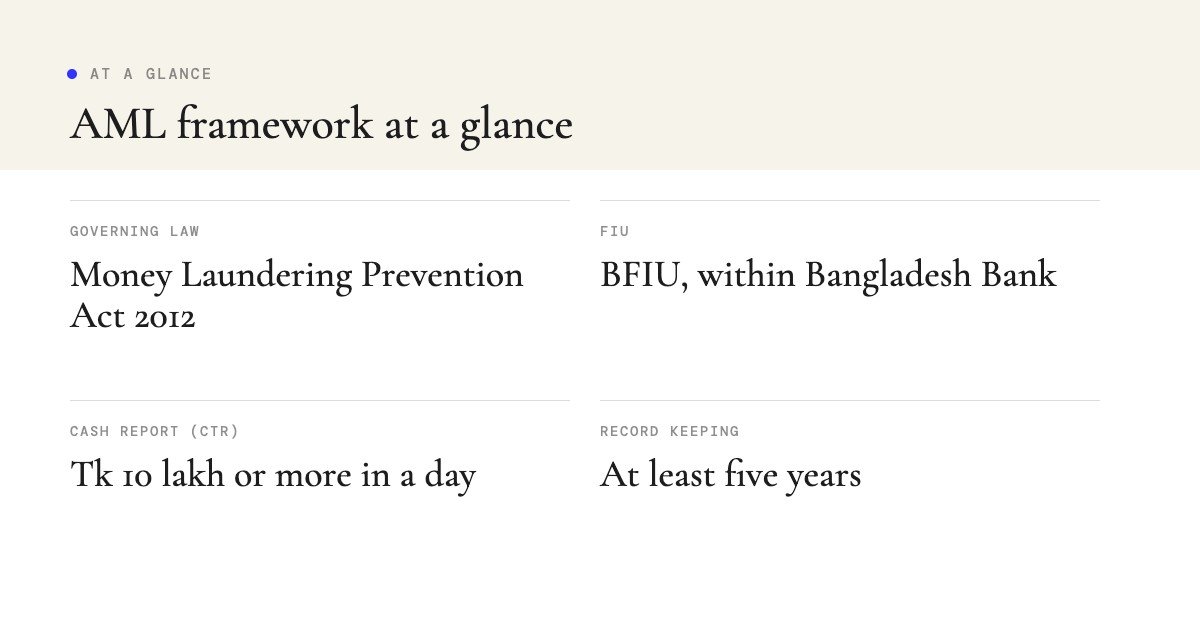
- Cash deposits or withdrawals of Tk 10 lakh or more in one account in a single day must be reported to BFIU as a cash transaction report (CTR).
- A reporting organisation that breaches its duties can be fined between Tk 50,000 and Tk 25 lakh by BFIU, and its licensing authority can be asked to act.
- A wide amendment to the MLPA was proposed in January 2026; check whether it has been enacted before relying on older summaries.
How anti money laundering in Bangladesh is structured
The legal framework for anti money laundering in Bangladesh rests on four layers. At the top is the Money Laundering Prevention Act 2012, which replaced the 2009 ordinance-era law and was substantially amended in 2015. It defines the offence, sets the penalties, creates the Bangladesh Financial Intelligence Unit (BFIU) and lists the duties of reporting organisations.
Below the Act sit the Money Laundering Prevention Rules 2019, which give detail on customer due diligence, risk assessment, record keeping and which agency investigates which offence. Terrorist financing is dealt with separately under the Anti-Terrorism Act 2009 and its rules, although BFIU supervises both regimes together.
The third layer is the one most businesses meet day to day: BFIU circulars and guidelines. BFIU issues sector-specific instructions for banks, financial institutions, insurers, capital market intermediaries, mobile financial service providers and designated non-financial businesses. The fourth layer is each organisation's own board-approved AML policy, which must translate the law and the circulars into internal procedures.
Recent and pending reforms
In January 2026 the Finance Ministry placed a draft amendment to the MLPA before the advisory council. As reported at the time, it proposed action against property whose owner cannot show a lawful source, a presumption that the accused must rebut, faster freezing of assets abroad, trade-based laundering such as over- and under-invoicing as an expressly listed predicate offence, and direct contact between BFIU, the ACC and foreign counterparts.
We could not confirm whether that draft was promulgated and later re-enacted by Parliament after April 2026. Until you have checked the current text on the Laws of Bangladesh portal, treat these as proposals, not settled law. BFIU has kept issuing sector circulars through 2026, including a detailed instruction to insurers in October 2026.
What counts as money laundering under the MLPA 2012
The Act, which is the starting point for anti money laundering in Bangladesh, defines money laundering broadly. It covers knowingly moving, converting or transferring proceeds of crime to conceal their illegal source, helping someone escape the legal consequences of a predicate offence, smuggling money or property out of Bangladesh, and transferring or retaining property in a way designed to avoid reporting rules. Conspiracy, attempt and abetment are covered too.
The underlying crime is called a predicate offence. The list in the Act runs to more than two dozen categories, including corruption and bribery, fraud, forgery, counterfeiting, extortion, drug and arms trafficking, human trafficking, smuggling, tax and customs offences, insider trading and market manipulation, environmental crime and terrorism. Foreign offences can count where the conduct would be an offence in Bangladesh.
No conviction for the predicate offence is needed
Prosecutors do not have to secure a conviction for the predicate offence before charging money laundering. They must still show that the property came from a predicate offence, but the two cases can run in parallel or the laundering case can stand alone. This matters for businesses because a customer who has never been convicted of anything can still be the subject of a laundering investigation that reaches your records.
Penalties for the offence
Section 4 of the MLPA sets the core penalties. An individual faces imprisonment of at least four and up to twelve years, together with a fine of twice the value of the property involved or Tk 10 lakh, whichever is greater. An entity faces a fine of at least twice the value of the property or Tk 20 lakh, whichever is greater, and its registration can be cancelled. The court can also order the property to be forfeited to the state.
Who must comply: reporting organisations
Duties under anti money laundering in Bangladesh fall on "reporting organisations", a term defined in the MLPA and expanded over the years. If your business is on the list, the section 25 duties apply whether or not you have ever seen a suspicious transaction.
| Sector | Examples | Main supervisor alongside BFIU |
|---|---|---|
| Banking and finance | Scheduled banks, finance companies, money changers, remittance firms, mobile financial services | Bangladesh Bank |
| Insurance | Life and non-life insurers | IDRA |
| Capital market | Stock dealers and brokers, merchant bankers, portfolio and asset managers, custodians | BSEC |
| Real estate and valuables | Real estate developers, dealers in precious metals and stones | BFIU directly, with sector bodies |
| Professionals | Lawyers, notaries and accountants handling property, funds or company transactions for clients | BFIU, with professional regulators |
| Trust and company services | Providers who form companies, act as nominee or provide a registered address | BFIU |
| Non-profit sector | NGOs, non-profit organisations and cooperative societies | NGO Affairs Bureau, Department of Cooperatives |
Lawyers and accountants
Professionals fall within anti money laundering in Bangladesh only for certain activities: buying and selling real estate, managing client money or assets, managing bank or securities accounts, organising contributions for companies, and creating or running companies or other legal arrangements. Ordinary litigation and legal advice are not caught in the same way, and legal professional privilege remains relevant, but the boundary needs care on each file.
The role of the BFIU
The Bangladesh Financial Intelligence Unit was created under the MLPA 2012 as the national centre for receiving and analysing financial intelligence. It sits within Bangladesh Bank and has been a member of the Egmont Group of financial intelligence units since 2013, which allows it to exchange information with foreign FIUs.
Its powers under the Act make BFIU the central supervisor for anti money laundering in Bangladesh. BFIU can call for documents and information from any reporting organisation, inspect it on site, issue instructions and guidelines, impose fines, and suspend or freeze an account or transaction where it has reason to suspect laundering. A freeze runs initially for up to 30 days and can be extended in stages to a maximum of six months.
When BFIU's analysis finds grounds, it passes an intelligence report to the relevant investigating agency. It does not itself prosecute. That separation matters: a BFIU query or freeze is a warning sign, not a charge, and it can often be resolved quickly with complete, well-organised documents.
When a client account is frozen, the fastest route out is usually a prompt, documented explanation of the source of funds to the bank and BFIU, not a writ petition. Litigation has its place, but only after the factual record is complete.
Core duties under section 25 of the MLPA
Section 25 lists four basic obligations that sit at the centre of anti money laundering in Bangladesh. Every other AML requirement, from the BFIU master circulars to your internal manual, builds on these duties.
Customer due diligence and beneficial ownership
Reporting organisations must keep complete and correct information about the identity of each customer while the relationship lasts. In practice that means identifying and verifying the customer from reliable, independent sources, understanding the purpose of the relationship, and identifying the natural persons who ultimately own or control a company customer.
BFIU instructions generally use 20 percent ownership as the beneficial ownership threshold; the October 2026 circular for insurers uses the same figure. Anonymous, fictitious or pseudonymous accounts are prohibited. For low-risk retail customers, BFIU's electronic KYC guidelines allow simplified onboarding using national ID verification.
Politically exposed persons and high-risk customers
Customers who are politically exposed persons (PEPs), their family members and close associates require enhanced due diligence: senior management approval, a source of wealth and source of funds check, and closer ongoing monitoring. The same applies to other high-risk customers identified by your risk assessment, such as cash-intensive businesses or complex offshore structures.
Record keeping
Good record keeping is the least glamorous part of anti money laundering in Bangladesh, but often the one inspectors test first. Records of customer identity and transactions must be kept for at least five years after the account or relationship ends. Keep them in a form that can be produced quickly to BFIU or a court, because response deadlines in information requests are short.
Responding to information requests
BFIU and investigating agencies regularly ask for account statements, KYC files and transaction details. Section 25 requires reporting organisations to provide information as requested, and failure to supply it is itself sanctionable.
Reporting to the BFIU: STRs, SARs and CTRs
Reporting is the core of anti money laundering in Bangladesh. The MLPA requires a reporting organisation to report any suspicious transaction to BFIU immediately and on its own initiative. BFIU distinguishes a suspicious transaction report (STR), tied to a specific transaction, from a suspicious activity report (SAR), which covers behaviour or attempted transactions.
Separately, banks and other designated institutions file cash transaction reports (CTRs) covering cash deposits or withdrawals totalling Tk 10 lakh or more in one account in a single day, whether in one transaction or several. CTRs are filed monthly; under the October 2026 instruction to insurers they are due within seven working days of the following month. Reports are submitted through goAML, BFIU's online reporting platform.
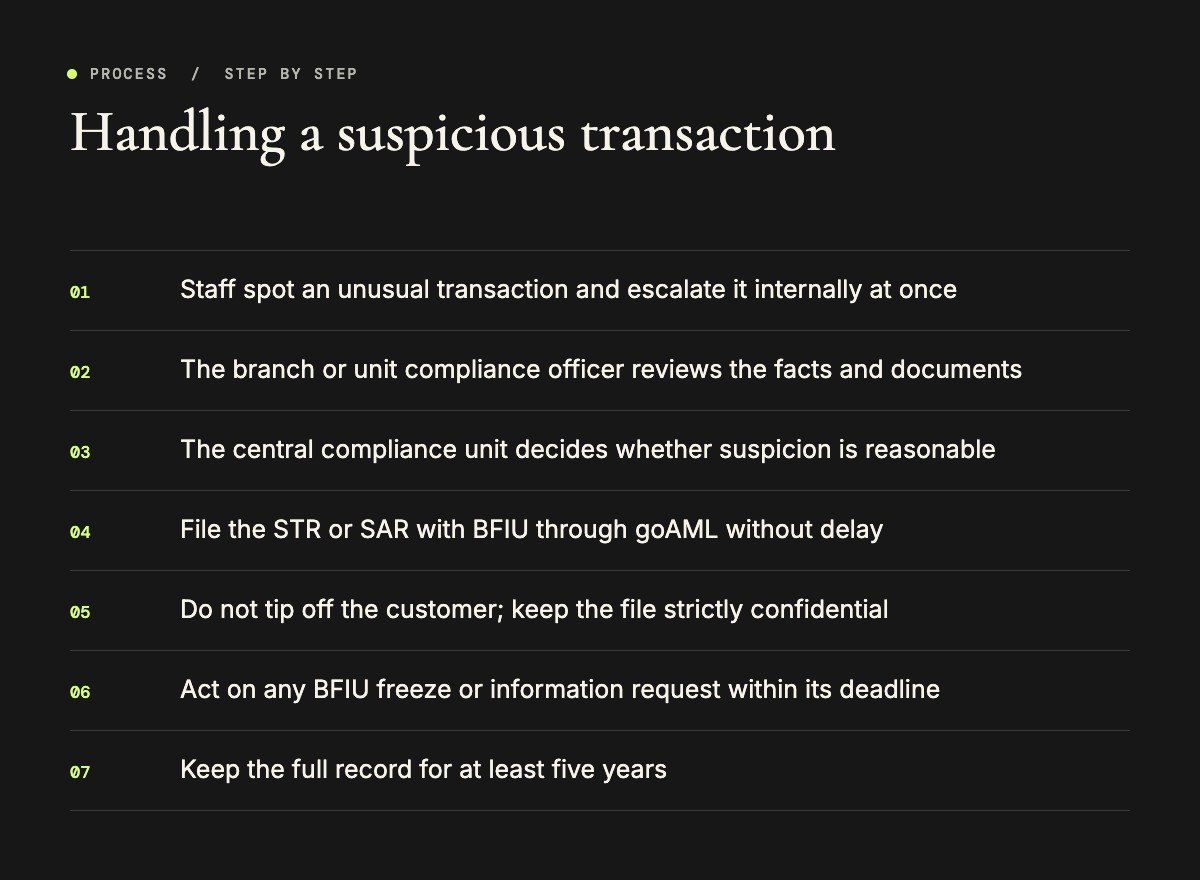
- Spot and escalate. Front-line staff who see unusual activity record it and escalate to the branch or unit compliance officer the same day.
- Review internally. The compliance officer gathers KYC data, transaction history and any explanation already on file.
- Decide centrally. The central compliance unit, led by the chief anti-money laundering compliance officer, decides whether there are reasonable grounds for suspicion.
- File the report. Submit the STR or SAR to BFIU through goAML, with a clear narrative explaining why the activity is suspicious.
- Avoid tipping off. Do not tell the customer or any third party that a report has been or may be filed.
- Follow up. Act on any freeze order or further request from BFIU within the deadline it sets.
- Keep the record. Retain the internal assessment and the report for at least five years.
What makes a good STR
BFIU receives thousands of reports a year, and the quality of reporting is now a measure of how seriously a firm takes anti money laundering in Bangladesh. Reports that simply say "large cash deposit" add little. A useful STR explains who the customer is, what their expected activity is, what actually happened, why it does not fit, and what documents support the concern. Good reporting also protects the organisation if its decision is later questioned.
Building an AML compliance programme
For anti money laundering in Bangladesh, BFIU circulars expect each reporting organisation to run a documented programme, scaled to its size and risk. Regulators look at whether the programme works in practice, not just whether a manual exists. The building blocks are consistent across sectors:
- Board-approved policy. A written AML and CFT policy, reviewed regularly and approved by the board or equivalent body.
- Compliance officer. A senior chief anti-money laundering compliance officer (CAMLCO) with a central compliance unit and enough authority and resources.
- Risk assessment. A documented assessment of customer, product, channel and geographic risk, refreshed periodically.
- Screening. Checks against United Nations Security Council sanctions lists and domestic lists of proscribed persons and entities.
- Transaction monitoring. Rules or systems that flag activity inconsistent with the customer's profile.
- Training. Regular, recorded training for staff, with more depth for front-line and compliance teams.
- Independent testing. Internal audit or external review of the programme, with findings reported to the board.
Many banks and insurers also submit periodic self-assessment reports to BFIU. Treat these as a chance to fix gaps before an inspection finds them. Our regulatory compliance practice helps clients map these duties against their wider licensing obligations.
Investigation and prosecution of money laundering
Investigation of anti money laundering in Bangladesh offences is shared between agencies. Since the 2015 amendment, the Anti-Corruption Commission is no longer the only investigator. The Money Laundering Prevention Rules 2019 allocate offences by predicate crime: the ACC handles laundering linked to corruption and bribery, the Criminal Investigation Department of police handles most other predicates, and bodies such as the National Board of Revenue, the Department of Narcotics Control and BSEC handle offences in their own fields.
Money laundering cases are tried by a Special Judge. During an investigation, the court can order property to be frozen or attached on the investigating agency's application, which can include property abroad through mutual legal assistance. For businesses, this means that a request from the ACC, CID or NBR for documents should be handled with the same care as a BFIU request.
Where a corruption allegation is the starting point, the ACC's own powers under the Anti-Corruption Commission Act 2004 also apply. We discuss that process in our anti-corruption and bribery practice.
Penalties for reporting organisations and staff
Beyond the main offence, the law on anti money laundering in Bangladesh creates separate offences and administrative sanctions that are more likely to affect a compliant business that slips up.
| Breach | Provision | Sanction |
|---|---|---|
| Failure to meet section 25 duties (KYC, records, information, reporting) | MLPA s.25(2) | Fine of Tk 50,000 to Tk 25 lakh imposed by BFIU; licensing authority may be asked to act |
| Tipping off a customer or third party | MLPA s.6 | Up to 2 years' imprisonment, fine up to Tk 50,000, or both |
| Obstructing an investigation | MLPA s.7 | Up to 1 year's imprisonment, fine up to Tk 25,000, or both |
| Giving false information | MLPA s.8 | Up to 3 years' imprisonment, fine up to Tk 50,000, or both |
| Breaching a freeze or attachment order | MLPA s.5 | Imprisonment of up to 3 years, a fine, or both |
BFIU can also fine responsible officers personally and require disciplinary action. Figures are as stated in the Act as amended in 2015; check the current text, because the 2026 reform proposals may change them.
Sector notes for anti money laundering in Bangladesh
Banks and finance companies
Banks carry the heaviest load under anti money laundering in Bangladesh: full CDD, CTR and STR reporting, trade-based laundering controls on import and export transactions, correspondent banking checks and wire transfer rules. Trade finance is a recurring BFIU focus, especially over- and under-invoicing. Our banking and finance practice advises on these controls.
Insurers
BFIU's October 2026 circular to insurers bars anonymous and fictitious policies, requires identity verification from reliable sources, checks on anyone acting for a policyholder, enhanced due diligence for PEPs, sanctions screening, 20 percent beneficial ownership identification, monthly CTRs and a central compliance unit at head office. The instructions took effect immediately.
Real estate developers and jewellers
Property and gold are classic laundering channels, and enforcement of anti money laundering in Bangladesh has increasingly turned to them. Developers and dealers should identify buyers, record payment routes, be wary of large cash payments and third-party payers, and report suspicion. A sale price far below or above market value is a recognised red flag.
NGOs and non-profits
Non-profits face terrorist financing risk as well as laundering risk, and donors increasingly ask how they meet the rules on anti money laundering in Bangladesh. Know your donors and partners, keep proof of how funds were spent, and route foreign donations through approved banking channels.
Common mistakes we see
These are the failings that most often lead to BFIU findings on anti money laundering in Bangladesh:
- Paper policies. A manual copied from another institution that staff have never read and that does not match actual products.
- Weak beneficial ownership checks. Accepting a company's shareholder list without tracing who stands behind corporate shareholders.
- Late STRs. Internal debate that delays a report for weeks; the Act requires immediate reporting once suspicion is formed.
- Tipping off by accident. Relationship managers telling a customer that compliance is "looking at" their account.
- Thin records. KYC files that cannot be produced within the time BFIU allows.
- Ignoring DNFBP status. Developers, jewellers and professionals who do not realise they are reporting organisations at all.
Frequently asked questions about anti money laundering in Bangladesh
Which law governs anti money laundering in Bangladesh?
The Money Laundering Prevention Act 2012, as amended in 2015, together with the Money Laundering Prevention Rules 2019 and BFIU circulars. Terrorist financing is covered by the Anti-Terrorism Act 2009. A further amendment was proposed in January 2026, so check the current text.
Is a small business a reporting organisation?
Only if it falls within a listed category, such as a real estate developer, a dealer in precious metals or stones, a money changer or a professional handling client transactions. Ordinary trading companies are not reporting organisations, but their banks will still apply KYC checks to them.
What is the CTR threshold?
Cash deposits or withdrawals of Tk 10 lakh or more in one account in a single day, whether in one transaction or several, must be reported to BFIU as a cash transaction report.
Can BFIU freeze a bank account without a court order?
Yes. Under the MLPA, BFIU can suspend or freeze an account or transaction for up to 30 days at first, extendable in stages to a maximum of six months. Longer restraint requires a court order on an investigating agency's application.
Will the customer be told that an STR was filed?
No. Disclosing that a report has been or may be filed is the offence of tipping off under section 6 of the MLPA, punishable by up to two years' imprisonment, a fine, or both.
How long must AML records be kept?
At least five years after the account or business relationship ends, under section 25 of the MLPA. Some circulars and internal policies require longer.
How we can help
We advise banks, insurers, capital market firms, developers, NGOs and foreign-owned companies on anti money laundering in Bangladesh: drafting AML policies, running risk assessments, training staff, responding to BFIU queries and freezes, and representing clients in investigations by the ACC, CID and NBR. Learn more about our compliance and risk practice.
Facing a BFIU query or building an AML programme?
We review your AML policy against the MLPA 2012 and current BFIU circulars, and help you respond to information requests and account freezes.
Book a consultationCompliance practicePrimary sources: the Money Laundering Prevention Act 2012 and the Anti-Terrorism Act 2009 on the Laws of Bangladesh portal; circulars and guidelines from the Bangladesh Financial Intelligence Unit; Bangladesh Bank; the Anti-Corruption Commission.
This article is general information about Bangladeshi law as of October 2026 and is not legal advice. Laws, circulars and thresholds change; confirm current requirements with BFIU, your regulator or a qualified lawyer before acting.

0 Comments