
The Bangladesh Labour Act 2006 sets the minimum terms on which almost every private employer in the country must hire, pay, protect and dismiss its workers. It was substantially amended in 2025 and 2026. This guide sets out the core employer obligations and the practical steps that keep a business on the right side of the law.
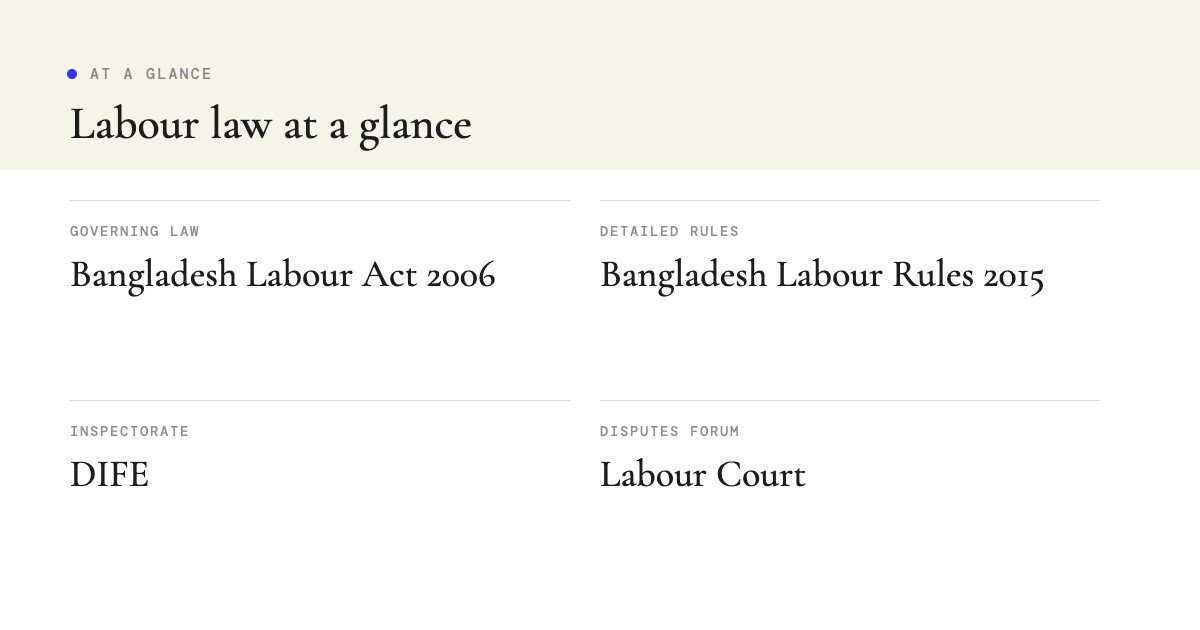
- The Act applies to most private shops, commercial establishments and industrial units, with detail in the Bangladesh Labour Rules 2015; EPZ enterprises follow a separate law.
- Every worker must receive an appointment letter and identity card, and employers must keep service books and statutory registers.
- Hours, overtime, weekly holidays, leave and the timing of wage payments are fixed by statute and cannot be reduced by contract.
- Larger companies have additional duties, including the workers' participation fund, group insurance, safety committees and harassment complaint committees.
- The Labour (Amendment) Ordinance 2025 and the Labour (Amendment) Act 2026 widened coverage, union rights and several benefits, so older HR manuals need review.
Who the Bangladesh Labour Act 2006 covers
The Bangladesh Labour Act 2006 consolidated more than twenty older labour laws into a single code. It governs employment, wages, working hours, leave, health and safety, welfare, compensation for injury, trade unions, industrial disputes and the labour courts. The Bangladesh Labour Rules 2015, as amended, fill in the procedure and the forms.
The Act applies across Bangladesh to shops, commercial establishments, factories and industrial establishments. Certain bodies are excluded, such as government offices and some institutions. Enterprises inside export processing zones are governed by the Bangladesh EPZ Labour Act 2019 rather than the main Act, so a company with units both inside and outside a zone may run two regimes.
Who counts as a worker
Most protections in the Bangladesh Labour Act 2006 attach to a "worker". Historically, staff employed mainly in managerial, administrative or supervisory roles were excluded. The 2025 Ordinance and the 2026 amendment Act revised the definition so that it turns more clearly on the nature of the work actually done, and brought sales and business development roles within reach. Job titles alone no longer settle the question.
In practice, many officers and executives that companies treated as managers may now be workers, entitled to overtime and statutory termination benefits. We recommend reviewing appointment letters and actual duties for every role on the borderline.
The 2025 and 2026 amendments were drafted and reported quickly, and commentaries differ on some details. Before changing policies, check the gazetted text of the Bangladesh Labour (Amendment) Act 2026 on the official laws portal, together with any new rules.
Hiring under the Bangladesh Labour Act 2006
Compliance with the Bangladesh Labour Act 2006 begins on day one. The Act requires every employer to give each worker a letter of appointment and an identity card with a photograph. The appointment letter should state the worker's name, designation, classification, wage and allowances, and the main terms of service.
Employers must also maintain a service book for each worker, recording personal details, service history, wages, leave and conduct. Statutory registers, including the register of workers, wage register and leave register, must be kept and produced on inspection.
Classification of workers
The Bangladesh Labour Act 2006 recognises several categories: apprentice, badli (substitute), casual, temporary, probationer, permanent and seasonal workers. Classification matters because notice periods, termination benefits and leave entitlements depend on it.
A probationer becomes permanent automatically if the employer does nothing at the end of the probation period. The standard probation is six months for clerical work and three months for other work, with a limited extension for skilled workers in specified cases. Keeping workers on rolling "temporary" status to avoid permanent rights is a common practice that labour courts view with suspicion.
Contract terms that cannot override the Act
An employment contract may give better terms than the statute, but never worse. A clause waiving overtime, cutting annual leave or shortening the statutory notice period is unenforceable to that extent, even if the worker signed it. Company policies and handbooks are read in the same way.
Working hours, overtime and holidays
The working-time rules are among the most frequently inspected parts of the Bangladesh Labour Act 2006, especially in manufacturing.
| Topic | General rule | Practical point |
|---|---|---|
| Daily hours | Normally 8 hours; up to 10 with overtime | Rest or meal intervals are required during long shifts |
| Weekly hours | Normally 48; overtime may take the total higher within statutory limits | Track weekly totals, not only daily hours |
| Overtime pay | Twice the ordinary rate of basic wage plus dearness allowance | Record overtime in the register and on payslips |
| Weekly holiday | One day for factories; one and a half days for shops and commercial establishments | Substitute holidays are needed if a worker works on the weekly holiday |
| Casual leave | 10 days a year with full wages | Not normally carried forward |
| Sick leave | 14 days a year with full wages, on medical certificate | Not carried forward |
| Annual leave | Earned by days actually worked, at statutory rates that differ by sector | Unused leave can accumulate and is paid out on separation |
| Festival holidays | 11 days a year with wages | Workers required to work get compensatory leave and pay |
The Bangladesh Labour Act 2006 also sets special rules for adolescent workers, night work by women and specific industries. Employers should also check sector notifications, because the government can grant exemptions or impose conditions for particular industries.
Maternity benefit
The Act provides paid maternity leave for women workers who meet the service condition, divided between the period before and after delivery. Before 2025 the total was sixteen weeks. The 2025 Ordinance and the 2026 amendment Act extended the entitlement and changed how maternity pay is calculated; current commentaries put it at 120 days. Confirm the exact period in the gazetted text and update your leave policy accordingly. Dismissing a woman during the protected period around childbirth is prohibited.
Wages and payroll under the Bangladesh Labour Act 2006
Wages must be paid in full and on time. Under the Bangladesh Labour Act 2006, the wage period may not exceed one month, and wages must be paid within seven working days after the end of the wage period. Deductions are permitted only for the purposes the Act allows, such as fines imposed lawfully, absence, advances, income tax and provident fund contributions.
Minimum wages are set sector by sector by the government on the recommendation of the Minimum Wage Board. Where a minimum wage notification covers your industry, paying less is a criminal offence, and the penalties for this offence were increased by the 2026 amendments. The amendments also shortened the cycle for revising minimum wages, so expect more frequent reviews.
Paying through bank channels
The labour law permits payment in cash, by bank deposit or by electronic transfer, but tax law now pushes employers firmly towards bank payment, because salary paid in cash can be disallowed as a business deduction. A single, bank-based payroll with payslips showing basic wage, allowances, overtime and deductions satisfies both regimes and is the best evidence if a wage claim arises.
Equal pay and non-discrimination
The recent amendments added express prohibitions on discrimination, including in wages, on grounds such as gender and disability. Pay structures should be based on objective criteria, documented and applied consistently across comparable roles.
Health, safety and welfare duties
The health and safety chapters of the Bangladesh Labour Act 2006 impose detailed duties on factories and establishments: cleanliness, ventilation, lighting, drinking water, latrines, fire precautions, safe machinery, protective equipment and safe structures. After major industrial disasters, enforcement in this area has become much stricter.
Thresholds that trigger extra duties
Several welfare duties depend on workforce size. Establishments above specified thresholds must provide a canteen, a childcare room where enough women are employed, first-aid facilities and a welfare officer. A safety committee is required in larger factories, and the 2026 amendments extended the requirement to establishments with fifty or more workers. Group insurance must be maintained where an establishment has at least one hundred permanent workers.
Compensation for injury and the right to refuse dangerous work
Under the Bangladesh Labour Act 2006, employers are liable to pay compensation for death or injury caused by an accident arising out of and in the course of employment, at the rates set by the Act. The recent amendments added a worker's right to refuse work that poses an imminent danger to life or health without retaliation, extended the list of occupational diseases, and provided for a fund to support injured workers.
Inspectors from the Department of Inspection for Factories and Establishments look first at documents: licences, fire safety plans, safety committee minutes, accident registers and drills. A business with sound practices but no paperwork often fares worse in an inspection than one with a complete file.
Workers' participation fund and provident fund
The workers' participation and welfare fund is one of the most commercially important obligations under the Bangladesh Labour Act 2006, and one of the most commonly overlooked by foreign-owned companies.
A company is covered if, on the last day of its accounting year, its paid-up capital or the value of its fixed assets exceeds the thresholds set in the Act. A covered company must pay five per cent of its net profit, within the time allowed after the end of the year, into a participation fund, a welfare fund and the Bangladesh Workers' Welfare Foundation Fund in the ratio the Act prescribes. The funds are managed by a board of trustees that includes worker representatives.
Some sectors, such as certain export-oriented industries, operate under separate arrangements, and there has been long-running debate about how the rules apply to financial institutions and to companies whose staff are mostly managers. Take advice before concluding that your company is outside the scheme, because arrears accumulate with each year of profit.
Provident fund
Historically, a provident fund became compulsory only when a set proportion of permanent workers asked for one. The 2025 Ordinance made a provident fund mandatory for establishments with one hundred or more permanent workers, with the national universal pension scheme as an alternative. Commentaries on the 2026 Act indicate the final position should be checked against the gazetted text, so verify the threshold before acting.
Harassment, discrimination and grievance procedures
The 2025 and 2026 amendments wrote into the Bangladesh Labour Act 2006 obligations that previously came mainly from High Court guidelines on sexual harassment. Employers must adopt a written policy against violence and harassment, and establishments must constitute a complaint committee, led by a woman and with a female majority, to deal with complaints of discrimination, violence and harassment.
Alongside the committee, the Act's general grievance procedure still applies. A worker with a grievance about dismissal or other matters covered by the Act may raise it in writing with the employer within the statutory period; if it is not resolved, the worker can apply to the Labour Court.
Trade unions and anti-union practices
The amendments substantially lowered the membership required to register a union, replacing the old percentage test with fixed numbers that rise with workforce size. They also prohibited blacklisting and strengthened the rules against unfair labour practices, such as dismissing union officers or sponsoring rival unions. Employers should train managers on these rules before any organising activity begins.
Termination under the Bangladesh Labour Act 2006
Ending employment lawfully is where most labour disputes arise. The Bangladesh Labour Act 2006 provides several distinct routes, each with its own notice and benefit rules.
- Termination simpliciter by the employer. A permanent worker may be terminated without cause on the statutory notice, or pay in lieu, together with termination benefits based on years of service.
- Retrenchment. Redundancy requires notice to the worker and the authorities and compensation per year of service, applied on a last-in, first-out basis within the category.
- Dismissal for misconduct. Requires a written charge, an opportunity to explain, an inquiry and a written order. If any step is skipped, the dismissal is open to challenge.
- Discharge. For physical or mental incapacity or continued ill health, certified by a registered medical practitioner.
- Resignation. A permanent worker may resign on notice. The 2026 amendments revised the benefits payable on resignation, reducing the qualifying service and grading the benefit by years of service.
- Layoff. Workers laid off for want of materials, power or similar reasons are entitled to compensation, and the amendments reduced the qualifying service.
Our detailed guide to termination of employment in Bangladesh explains each route and the calculation of benefits.
Final settlement
All dues on separation, including unpaid wages, leave encashment and termination benefits, must be paid within the time limit after employment ends. Delay is itself a ground for complaint and often turns a simple separation into a Labour Court case.
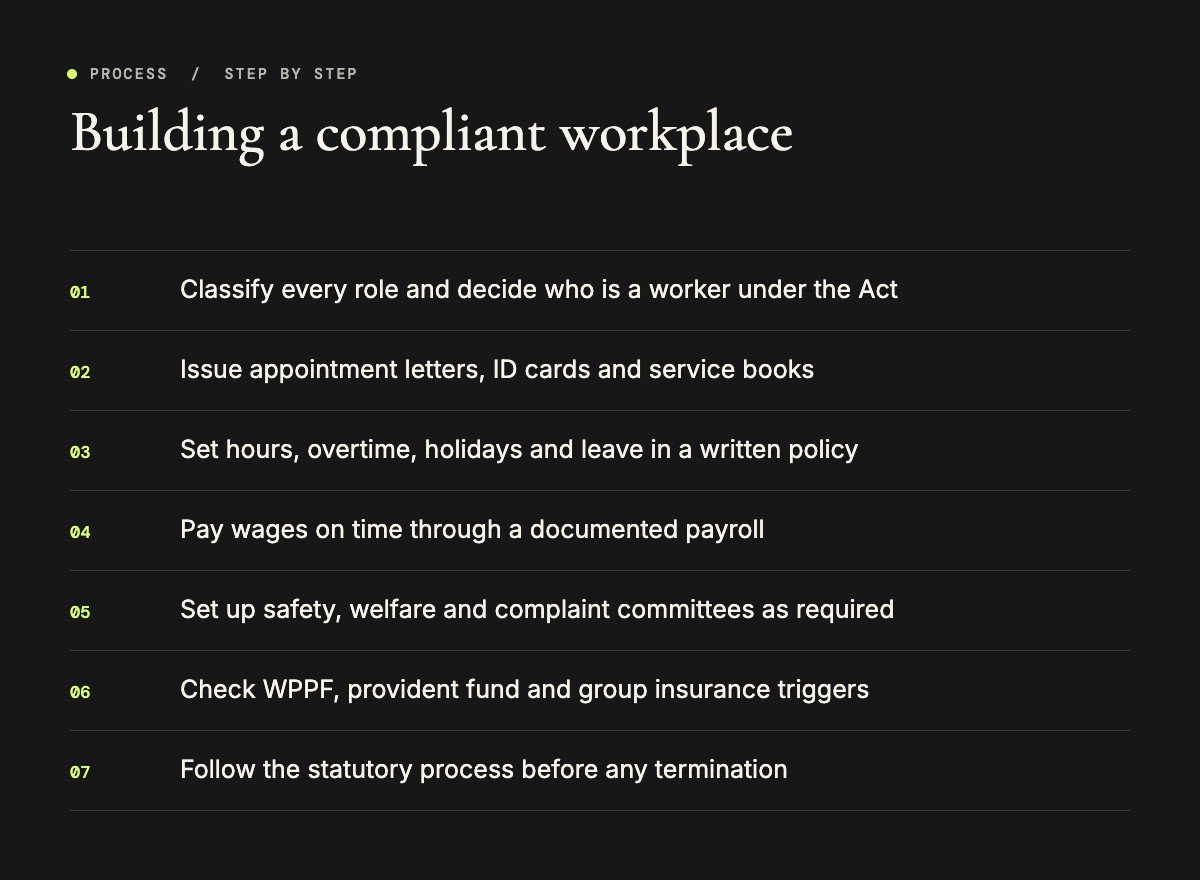
A compliance roadmap under the Bangladesh Labour Act 2006
For new employers, and for established ones updating policies after the 2026 amendments, we use the following sequence.
- Classify roles. List every position, describe the real duties and decide which staff are workers under the amended definition.
- Paper the relationship. Issue appointment letters, identity cards and service books, and open the statutory registers.
- Write the policies. Adopt service rules covering hours, overtime, holidays, leave, discipline, harassment and grievance, consistent with the Act and the Rules.
- Run a compliant payroll. Pay through banks within the statutory deadline, apply minimum wage notifications and keep payslips.
- Form the committees. Set up safety, participation and harassment complaint committees wherever the thresholds are met.
- Check fund and insurance triggers. Test WPPF, provident fund and group insurance obligations each year against capital, assets and headcount.
- Control exits. Use a checklist for every separation so that notice, procedure and final settlement follow the Act.
Factory licensing, fire licences and trade licences sit alongside these duties. For a broader checklist see our guide to legal requirements for a new business.
Inspections, penalties and the Labour Court
The Department of Inspection for Factories and Establishments (DIFE) enforces the Bangladesh Labour Act 2006, inspects workplaces, issues licences for factories and can bring prosecutions. Offences under the Act are punishable by fines and, for serious breaches, imprisonment. The 2026 amendments raised several penalties, including those for non-payment of minimum wages and for unfair labour practices, and increased the punishment for safety breaches that cause death or serious injury.
Individual and collective disputes are heard by the Labour Courts, with appeals to the Labour Appellate Tribunal. The amendments also provide for an alternative dispute resolution authority for labour disputes, which may not yet be fully operational, so check its status before relying on it.
Why records decide cases
In wage, overtime and termination claims, the employer is expected to hold the records. If registers, payslips or inquiry papers are missing, the court is likely to accept the worker's account. Good compliance under the Bangladesh Labour Act 2006 is therefore as much about documentation as about behaviour.
Frequently asked questions about Bangladesh Labour Act 2006
Does the Bangladesh Labour Act 2006 apply to office-based companies?
Yes. Commercial establishments, including offices of service and technology companies, are covered. The question is usually which staff count as workers, not whether the Act applies to the business.
Are managers protected by the Act?
Staff whose work is genuinely managerial, administrative or supervisory are generally outside the worker definition, but the 2025-26 amendments focus on actual duties. Titles alone do not exclude anyone, and the employment contract still governs their rights.
Can an employment contract offer less leave than the Act?
No. The statutory entitlements are minimums. A contract or policy may be more generous but cannot reduce statutory leave, overtime or notice.
Does my company have to pay into the workers' participation fund?
It depends on paid-up capital and fixed assets at the end of the accounting year and on your sector. If the thresholds are met, five per cent of net profit must be paid into the funds each year.
What happens if we dismiss a worker without an inquiry?
The dismissal is likely to be set aside or converted by the Labour Court, with reinstatement or compensation and back wages. The statutory steps must be followed even where misconduct is obvious.
Do EPZ factories follow this Act?
No. Enterprises in export processing zones are governed by the Bangladesh EPZ Labour Act 2019 and BEPZA's rules, though many concepts are similar.
How we can help
We advise employers on the Bangladesh Labour Act 2006 and the 2026 amendments, from service rules and appointment letters to WPPF reviews, harassment policies, restructurings, terminations and Labour Court cases. Learn more about our employment and labour practice.
Need an HR compliance review?
We audit appointment letters, policies, payroll and committees against the amended Labour Act and Rules, and fix gaps before an inspection or dispute.
Book a consultationEmployment practicePrimary sources: the Bangladesh Labour Act 2006 and its amendments on the Laws of Bangladesh portal; inspection and licensing information from the Department of Inspection for Factories and Establishments; policy notices from the Ministry of Labour and Employment.
This article is general information about Bangladeshi law as of 2026 and is not legal advice. Labour law was amended in 2025 and 2026 and rules may follow; confirm current requirements with DIFE or a qualified lawyer before acting.


0 Comments