
For years there was no dedicated commercial court in Bangladesh: business claims competed for time with land and family suits in ordinary civil courts. The Commercial Court Ordinance 2026 changed that, but specialist forums such as money loan courts, the company bench and arbitration still matter. Choosing the right route decides how fast you recover.

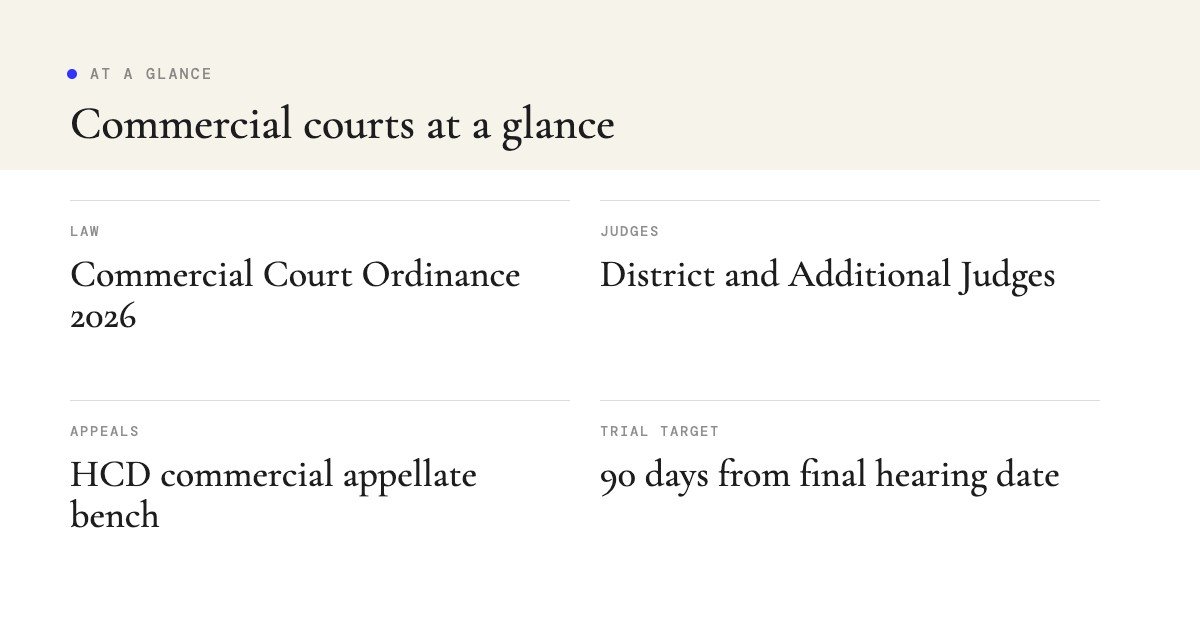
- The Commercial Court Ordinance 2026 (Ordinance No. 1 of 2026) set up specialised district-level commercial courts, and 75 were notified in February 2026.
- Appeals and revisions go to commercial appellate benches of the High Court Division formed by the Chief Justice.
- Bank and financial institution recovery claims, company law petitions and admiralty claims still have their own forums.
- Pre-suit mediation is part of the new regime; skipping a required step can delay or derail a claim.
- An arbitration clause usually takes the dispute out of court altogether, apart from supportive applications.
Is there a commercial court in Bangladesh?
Until 2026, the honest answer was no. Commercial suits for unpaid invoices, breach of supply contracts or joint venture disputes were filed in the ordinary civil courts under the Code of Civil Procedure 1908, before an Assistant Judge, Senior Assistant Judge or Joint District Judge depending on value. Those courts also hear land, partition and family cases, and commercial claims routinely took many years.
The Commercial Court Ordinance 2026 (Ordinance No. 1 of 2026) was signed by the President and published in an extraordinary gazette on 1 January 2026, with immediate effect. It provides for a specialised commercial court in Bangladesh at district level that hears only commercial disputes, staffed by District Judges and Additional District Judges, with preference for judges trained or experienced in commercial law.
The status of the ordinance
Many ordinances made by the interim government in 2024 to 2026 were placed before the new Parliament in April 2026, which re-enacted, amended or dropped them. We could not confirm from official sources whether the Commercial Court Ordinance 2026 has been re-enacted as an Act or amended. Before filing, check the current text on the official laws portal and any Supreme Court practice directions.
How the new commercial court in Bangladesh works
The ordinance builds each commercial court in Bangladesh on top of the Code of Civil Procedure, with commercial-specific changes. The points below come from the gazette reporting and published commentary on the ordinance; read the operative text for the detail that applies to your claim.
Courts and territorial jurisdiction
The government fixes the number of courts and their territorial jurisdiction in consultation with the Supreme Court. A notification of 3 February 2026 established 75 commercial courts: 11 in metropolitan areas, including three for the Dhaka metropolitan area and two for Chattogram, and the rest at district level, including a separate court for Dhaka district outside the metropolitan area.
Which disputes are commercial
The ordinance lists more than twenty categories of commercial dispute. They include ordinary transactions of merchants, bankers and financial institutions, the interpretation of mercantile documents, export and import of goods and services, carriage of goods, construction and infrastructure contracts including tenders, joint venture and shareholder agreements, insurance, intellectual property, franchising and subscription contracts, and aircraft sale, lease and financing. The list can be extended by notification.
A commercial court in Bangladesh does not hear matters where another law limits or excludes civil court jurisdiction. That carve-out matters for loan recovery and company petitions, discussed below.
Value threshold
The Supreme Court's September 2025 proposal suggested that commercial suits valued at Tk 50 lakh or more should go to the new courts, with power for the government to revise the figure. We have not been able to confirm the threshold in the final ordinance, so verify the specified value before choosing between a commercial court and an ordinary civil court.
Speed and case management
The ordinance requires a commercial court in Bangladesh to conclude the trial within 90 days from the date fixed for final hearing. Commentary on the ordinance reports stricter pleading timelines, case management hearings and a cap of three adjournments. Hearings can be held virtually under the Use of Information and Communication Technology by Courts Act 2020.
Appeals
Appeals from a commercial court in Bangladesh do not go to the District Judge. The Chief Justice forms one or more commercial appellate benches in the High Court Division to hear appeals and revisions from commercial court judgments and orders. Further appeal lies to the Appellate Division in the usual way.
Comparing the routes for commercial disputes
A commercial court in Bangladesh is now the default court for many business claims, but it is one of several routes. The right forum depends on who the parties are, what the contract says and what you want at the end.
| Route | Typical disputes | Legal basis | Key point |
|---|---|---|---|
| Commercial court | Trade, supply, construction, joint venture, IP and insurance claims | Commercial Court Ordinance 2026 | Pre-suit mediation and trial timelines |
| Money loan court | Recovery suits by banks and financial institutions | Artha Rin Adalat Ain 2003 | Exclusive forum for lender recovery claims |
| High Court Division, company bench | Winding up, minority oppression, scheme approvals, rectification | Companies Act 1994 | Original jurisdiction sits with the High Court Division |
| Admiralty court | Ship arrest, cargo, collision, necessaries claims | Admiralty Court Act 2000 | High Court Division exercises admiralty jurisdiction |
| Arbitration | Any arbitrable contract dispute with an arbitration clause | Arbitration Act 2001 | Private, final award with narrow challenge grounds |
| Cheque dishonour complaint | Bounced cheques given for a debt | Negotiable Instruments Act 1881 | Criminal route with strict notice deadlines |
| Mediation | Any dispute the parties are willing to settle | CPC, special laws and contract | Fast and confidential if both sides engage |
Bank and financial institution claims: money loan courts
Recovery suits by banks and financial institutions go to the Artha Rin Adalat, the money loan courts set up under the Artha Rin Adalat Ain 2003. Because that Act gives these courts exclusive jurisdiction over such claims, they are unlikely to move to the new commercial courts, although borrower claims against lenders on other grounds may be commercial disputes.
The money loan court process has its own features: a settlement conference or mediation stage, restrictions on borrowers obtaining stays, and a requirement to deposit part of the decretal amount before an appeal. Execution follows under the same Act. Borrowers and guarantors should take advice early, because procedural defaults in these courts are hard to cure later.
Company and shareholder disputes
Under the Companies Act 1994, the "court" for most company matters is the High Court Division, which sits as the company bench. Winding-up petitions, applications by minority members complaining of oppression or mismanagement, rectification of the share register and schemes of arrangement start there.
Shareholder disputes that are purely contractual, such as a claim for damages for breach of a shareholders agreement, may be filed before a commercial court in Bangladesh. Where the relief sought is a statutory company remedy, the company bench remains the forum. Our guide to winding-up cases under company law explains that route.
Frame the relief before you choose the forum. The same facts can support a damages claim in a commercial court, an oppression petition in the High Court Division and an arbitration under a shareholders agreement. Filing in two places at once invites stay applications and wasted costs.
Cheque dishonour as a recovery tool
Where a debtor has given a cheque that bounces, section 138 of the Negotiable Instruments Act 1881 creates a criminal offence. The payee must send a written demand within 30 days of learning of the dishonour; the drawer then has 30 days to pay; and a complaint must be filed before the court within one month after that period expires.
On conviction the court may impose imprisonment of up to one year, a fine of up to three times the cheque amount, or both, and fine money can be paid to the complainant. The route runs in parallel with any civil or commercial claim and is often what brings a reluctant debtor to the table. See our guide to cheque dishonour remedies for the procedure.
Arbitration as an alternative to a commercial court in Bangladesh
If your contract contains an arbitration clause, the starting point is arbitration, not a commercial court in Bangladesh. Under section 10 of the Arbitration Act 2001, a court must refer the parties to arbitration if the defendant applies before filing a written statement, unless the agreement is void, inoperative or incapable of being performed.
Arbitration is private, the parties choose the tribunal and the award can be enforced abroad under the New York Convention. Courts still play a supporting role through interim measures, setting aside and enforcement. Commentary suggests that commercial courts may handle arbitration-related applications in commercial matters, but confirm the forum at the time of filing. Our guide to the arbitration process covers the steps.
Mediation before and during litigation
Mediation is now built into several routes. The Commercial Court Ordinance 2026 provides for pre-suit mediation, which reporting describes as a precondition to filing a suit before a commercial court in Bangladesh. The detailed procedure, including who mediates and how long the process may take, should be checked in the ordinance and any rules or practice directions.
In ordinary civil suits, section 89A of the Code of Civil Procedure allows mediation after the written statement is filed, and the money loan courts have their own settlement stage. A signed settlement reached through a court-recognised process can be recorded and enforced, which makes mediation more than a courtesy step.
Interim relief and protecting assets
Winning a judgment is pointless if the defendant's assets have gone. The Code of Civil Procedure gives commercial litigants two main tools, and we expect commercial courts to apply them in the usual way.
- Temporary injunctions. Under Order XXXIX, the court can restrain a party from disposing of property, drawing on a bank guarantee in breach of contract or acting in breach of a negative covenant.
- Attachment before judgment. Under Order XXXVIII, where a defendant is about to remove or dispose of property to defeat a decree, the court can require security or attach property.
- Arbitration support. Where there is an arbitration clause, interim measures come from the tribunal or the court under the Arbitration Act 2001.
Urgent applications need evidence: correspondence, bank statements, title documents and a clear explanation of the risk.
Choosing your route: a practical sequence
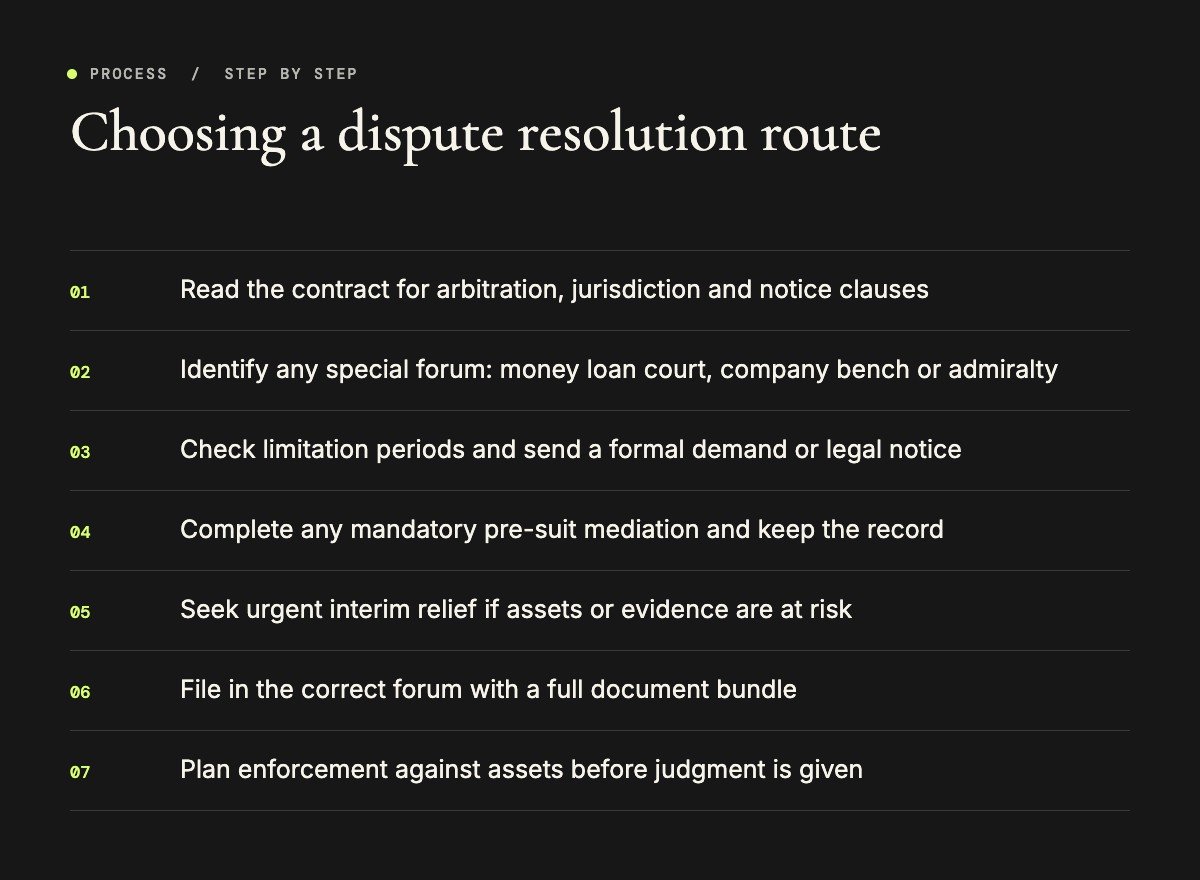
Before you file, work through the following steps. They apply whether the claim ends up before a commercial court in Bangladesh, a money loan court, the company bench or a tribunal.
- Read the contract. Look for arbitration, exclusive jurisdiction, governing law, notice and limitation clauses before anything else.
- Identify any special forum. Lender recovery, company petitions and admiralty claims each have their own court.
- Check limitation. Under the Limitation Act 1908, many contract claims must be filed within three years; diarise the date early.
- Send a demand. A precise legal notice creates a record, triggers cheque dishonour timelines and often prompts settlement.
- Complete required mediation. Follow any pre-suit mediation step and keep written proof that it was attempted.
- Protect assets. Apply for injunctions or attachment where the risk of dissipation is real.
- File and plan enforcement. Prepare a full document bundle and identify assets you can execute against once you win.
Preparing a strong commercial claim
A commercial court in Bangladesh with trial deadlines rewards preparation. A claim that is not ready at filing is unlikely to catch up once the 90-day clock is running from the final hearing date.
Documents
Assemble the contract and all amendments, purchase orders, invoices, delivery records, emails and messaging records, bank statements and board approvals. Documents in a foreign language need translations, and foreign documents may need notarisation and attestation before they can be relied on.
Witnesses and experts
Identify witnesses who dealt with the transaction directly and confirm they are available. Construction, valuation and accounting disputes often turn on expert evidence, which takes time to commission and should start before filing.
Costs and outcomes
Court fees in Bangladesh are generally calculated on the value of the claim under the Court-fees Act 1870, subject to caps; confirm the current schedule before filing. Factor in lawyers' fees, expert costs and the time needed to enforce. A realistic budget helps you judge when a settlement offer is worth accepting.
Enforcing a judgment or decree
A decree from a commercial court in Bangladesh is executed under Order XXI of the Code of Civil Procedure, in the same way as other civil decrees. The decree-holder files an execution case identifying the judgment debtor's assets and the mode of execution sought.
Execution tools
The usual tools are attachment and sale of land and buildings, attachment of bank accounts and debts owed to the judgment debtor, delivery of specific movable property and, in limited cases, civil detention. Execution is often where commercial cases slow down again, so identify bank accounts, receivables and registered property early, ideally before filing the suit.
Judgments from abroad
A foreign court judgment is not automatically enforceable in Bangladesh. Section 44A of the Code of Civil Procedure allows execution of decrees from superior courts of countries notified as reciprocating territories; otherwise, the judgment creditor usually has to bring a fresh suit on the foreign judgment. This is one reason many cross-border contracts choose arbitration, because foreign awards can be enforced under the New York Convention through the Arbitration Act 2001.
Settlement after judgment
Many commercial judgments end in negotiated payment plans rather than auctions. A settlement recorded before the executing court, with clear default consequences, often recovers more money faster than a contested sale of property.
Frequently asked questions about a commercial court in Bangladesh
Are commercial courts already operating?
The ordinance took effect in January 2026, and 75 courts were notified in February 2026. Check the current list of courts, any practice directions and whether Parliament has re-enacted or amended the ordinance before filing.
Do bank recovery suits go to the commercial courts?
Recovery suits by banks and financial institutions belong to the money loan courts under the Artha Rin Adalat Ain 2003, and the new courts do not take matters where another law excludes civil court jurisdiction.
Is mediation compulsory before filing?
Reporting on the ordinance describes pre-suit mediation as part of the commercial court process. Confirm the exact requirement and procedure in the current text before you file.
Where do appeals go?
To the commercial appellate benches of the High Court Division formed by the Chief Justice, with a further appeal to the Appellate Division.
Can a foreign company sue in a commercial court?
Yes. Foreign companies can sue and be sued in Bangladesh, usually acting through a local lawyer under a properly executed power of attorney.
Does an arbitration clause stop a commercial court case?
Usually yes. If the defendant applies under section 10 of the Arbitration Act 2001 before filing a written statement, the court must refer the dispute to arbitration unless the clause is void, inoperative or incapable of being performed.
How we can help
We advise businesses, lenders and investors on which forum to use, run pre-suit mediation, seek urgent interim relief and conduct claims before the commercial courts, money loan courts, the company bench and arbitral tribunals. Learn more about our commercial litigation practice.
Have a commercial dispute to resolve?
We review your contract and evidence, map the available forums and build a route to recovery that fits your commercial goals.
Book a consultationCommercial litigationPrimary sources: statutes including the Code of Civil Procedure 1908, Artha Rin Adalat Ain 2003 and Arbitration Act 2001 on the Laws of Bangladesh portal; notices and practice directions of the Supreme Court of Bangladesh; lender guidance from Bangladesh Bank.
This article is general information about Bangladeshi law as of 2026 and is not legal advice. The commercial court regime is new and may change; confirm the current law, forum and procedure with official sources or a qualified lawyer before acting.

0 Comments