
A hospital licence in Bangladesh is issued by the Directorate General of Health Services (DGHS) under the Medical Practice and Private Clinics and Laboratories (Regulation) Ordinance 1982. Every private hospital, clinic and diagnostic centre needs one before it treats patients. Regular enforcement drives have closed hundreds of unlicensed facilities, so investors and doctors opening a facility need to get the licence, and the many permits around it, right from the start.

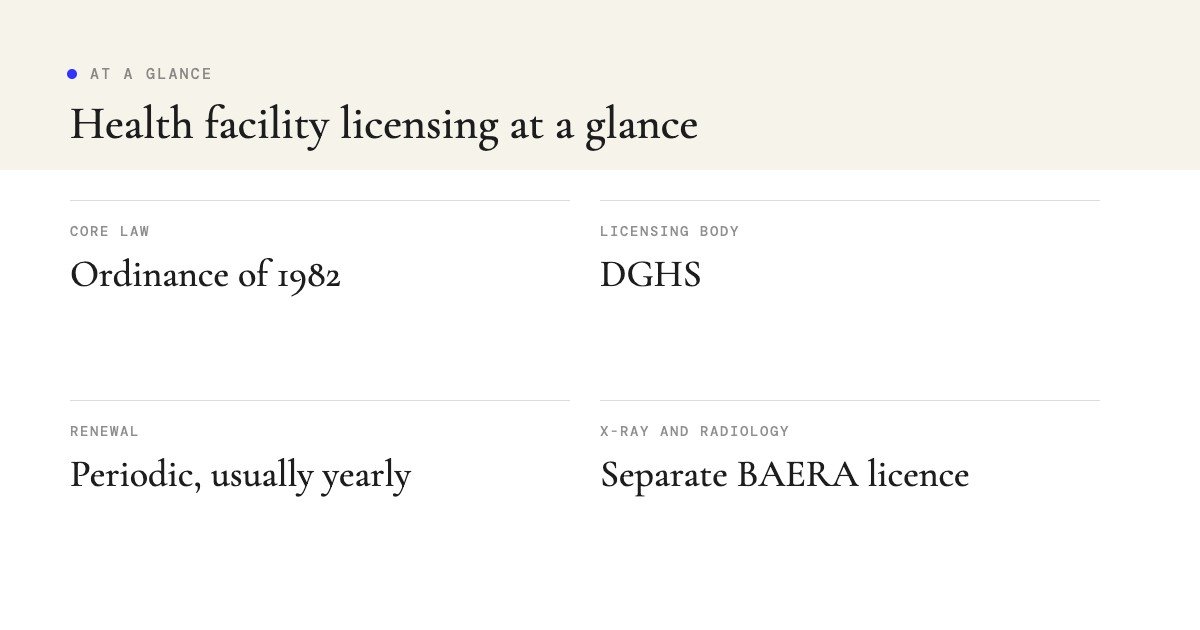
- Private hospitals, clinics and diagnostic laboratories must be licensed by DGHS under the 1982 Ordinance, and licences must be renewed periodically.
- DGHS sets minimum requirements for space, beds, doctors, nurses, technologists, equipment and services according to the facility's category.
- Applications are made online through the DGHS registration system, followed by inspection.
- Other permits are also needed: trade licence, fire safety, environmental clearance, medical waste arrangements, drug and narcotics licences, and radiation licences for imaging.
- Running an unlicensed facility or one with an expired licence can lead to sealing, fines and prosecution.
The legal basis for a hospital licence in Bangladesh
The Medical Practice and Private Clinics and Laboratories (Regulation) Ordinance 1982 prohibits operating a private clinic, hospital or laboratory without a licence from the government, and regulates the fees, standards and conduct of private medical practice. DGHS, under the Ministry of Health and Family Welfare, administers the licensing system. A hospital licence in Bangladesh therefore rests on this Ordinance, supported by DGHS circulars and standards on staffing, equipment and services.
The Ordinance is old, and successive governments have discussed replacing it with a modern healthcare services law covering patient rights, quality standards and stronger penalties. Until a new law is enacted and in force, the 1982 Ordinance and DGHS rules remain the framework. Our healthcare and pharmaceuticals practice tracks these developments for clients.
Which facilities need a licence
| Facility | Licence needed | Notes |
|---|---|---|
| Private hospital or clinic with beds | DGHS hospital or clinic licence | Category depends on beds and services |
| Diagnostic centre or laboratory | DGHS diagnostic licence | Pathology, imaging and other tests |
| Specialised hospital (cardiac, eye, dental, dialysis) | DGHS licence plus specialty standards | Additional equipment and staff rules |
| Hospital pharmacy | Drug licence | Issued by DGDA |
| X-ray, CT and other radiation equipment | Radiation licence | Issued by BAERA |
| Doctor's private chamber | BMDC registration and local permits | Not a hospital licence, but practice rules apply |
Minimum standards DGHS expects
DGHS standards vary by category, such as the number of beds and the range of services. In general, an applicant for a hospital licence in Bangladesh must show:
- Space. Adequate floor area per bed, separate operation theatres, labour rooms, emergency areas, wards and support areas, with proper ventilation and sanitation.
- Staff. Full-time registered doctors, including round-the-clock duty doctors, and registered nurses in the prescribed ratio to beds, plus qualified technologists and support staff.
- Equipment. Essential medical equipment for the services offered, including emergency and resuscitation equipment, sterilisation and operation theatre equipment.
- Services. Pathology and imaging arrangements, pharmacy, ambulance access, generator back-up, oxygen supply and records management.
- Waste. Segregation, storage and disposal of medical waste through approved arrangements.
Doctors and nurses must be registered with the Bangladesh Medical and Dental Council and the Bangladesh Nursing and Midwifery Council respectively, and DGHS inspectors check registration certificates, appointment letters and duty rosters.
Applying for a hospital licence in Bangladesh
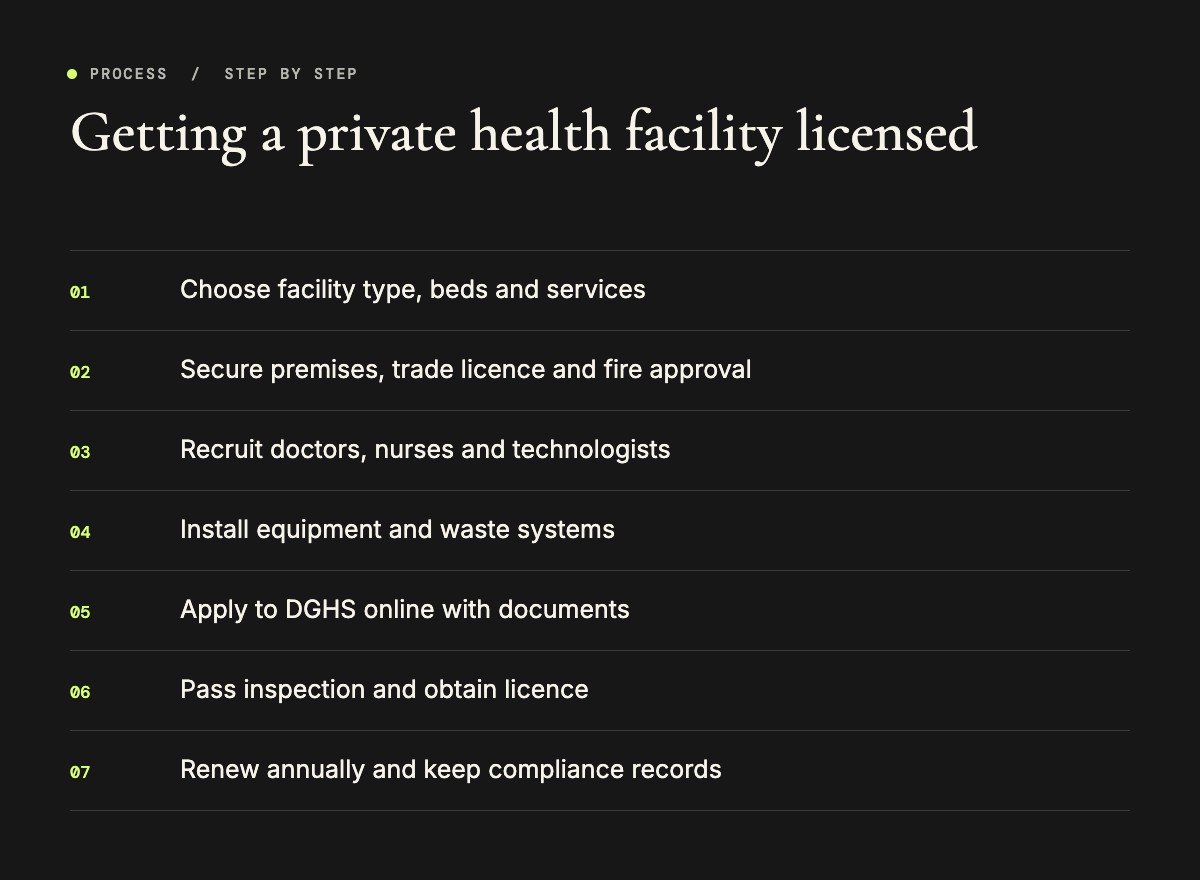
- Plan the facility. Decide the category, number of beds and services, and design the premises to meet DGHS standards and the building code.
- Form the entity. Most investors use a private limited company registered with RJSC, though individuals and partnerships can also apply.
- Obtain local permits. Secure the trade licence from the city corporation or municipality, the fire safety certificate and, where required, environmental clearance.
- Recruit and equip. Appoint registered doctors, nurses and technologists, and install the required equipment.
- Apply online. Submit the application through the DGHS online registration system with documents and the prescribed fee.
- Inspection. DGHS or the civil surgeon's office inspects the premises, staff and equipment.
- Licence and display. On approval, the licence is issued and should be displayed at the facility.
Applicants should keep a full set of documents ready, including the company's incorporation papers, trade licence, tax registration, lease or title documents, fire and environment certificates, staff lists with registration numbers and equipment lists.
Renewal and continuing obligations
A hospital licence in Bangladesh is not permanent. Licences must be renewed within the period DGHS prescribes, usually yearly, and the facility must continue to meet the standards on which the licence was granted. DGHS has periodically set deadlines for unlicensed or expired facilities to regularise their status, followed by enforcement drives that seal non-compliant facilities.
Continuing obligations include displaying the licence and fee charts, maintaining patient records, reporting notifiable diseases and data to DGHS, keeping staff and equipment at required levels, and complying with directions on pricing and services issued from time to time.
Expansion without approval is a common breach. Adding beds, an ICU, a new operation theatre or diagnostic services that were not covered by the licence can make the facility non-compliant even though it holds a valid licence. Apply for amendment before expanding.
Other permits around the licence
A hospital licence in Bangladesh sits within a wider permit framework:
- Environmental clearance. Under the Environment Conservation Rules 2023, hospitals and diagnostic centres are classified by environmental risk and may need site and environmental clearance from the Department of Environment.
- Medical waste. The Medical Waste (Management and Processing) Rules 2008 require segregation, safe storage and disposal through authorised means.
- Fire safety. The Fire Prevention and Extinguishing Act 2003 requires fire safety approval and certificates, and hospitals face strict scrutiny.
- Drugs. A hospital pharmacy needs a drug licence from the Directorate General of Drug Administration.
- Narcotics. Use of controlled drugs such as certain anaesthetics and painkillers requires licences from the Department of Narcotics Control.
- Radiation. X-ray, CT, nuclear medicine and similar equipment require licences from the Bangladesh Atomic Energy Regulatory Authority.
- Building approval. The building must be approved for hospital use and meet the national building code.
Foreign investment in hospitals
Healthcare is open to foreign investment, and several hospitals in Bangladesh involve foreign sponsors or management partners. Foreign investors usually establish a local company, register the investment with Invest Bangladesh (formerly BIDA) and bring capital through banking channels so that profits can be repatriated. Foreign doctors and specialists need registration or permission from BMDC to practise, and work permits for foreign staff follow the usual process. See our foreign direct investment practice for structuring advice.
Liability and patient complaints
Holding a licence does not protect a facility from liability. Patients can bring civil claims for negligence, complaints to BMDC against doctors, and in serious cases criminal proceedings under the Penal Code. Consumer complaints about overcharging or deficient services may go to the Directorate of National Consumer Rights Protection. Courts have also issued directions to DGHS on licensing and standards in public interest cases.
Good governance reduces these risks: clear consent procedures, proper records, clinical audits, complaint handling and insurance. A facility that can show it met DGHS standards is in a much stronger position when a dispute arises.
Penalties for operating without a licence
Operating a clinic, hospital or laboratory without a valid licence, or in breach of its conditions, is an offence under the 1982 Ordinance and can lead to fines, imprisonment and closure. In practice, mobile courts and DGHS enforcement teams have sealed unlicensed facilities and imposed fines on the spot. Beyond formal penalties, closure causes immediate loss of revenue and reputation, and can leave patients stranded. Securing and renewing a hospital licence in Bangladesh on time is therefore a basic business protection.
Practical checklist for investors
- Choose premises approved for hospital use and compliant with fire and building rules.
- Budget for staff and equipment at DGHS levels before opening, not after inspection.
- Line up environmental, waste, drug, narcotics and radiation permits in parallel.
- Apply online early and track inspection dates.
- Calendar renewal deadlines and keep compliance files current.
- Seek approval before adding beds or services.
Choosing the right legal structure
The legal structure of the operator affects licensing, investment and liability. A sole proprietorship is simple but exposes the owner personally to every claim against the facility. A partnership spreads ownership but still leaves partners personally liable and can be unstable when doctors fall out. A private limited company is the usual choice for hospitals and larger diagnostic centres because it limits liability, allows outside investment and makes it easier to borrow from banks and finance companies.
Whatever structure is chosen, the applicant named on the hospital licence in Bangladesh must match the entity that actually runs the facility, holds the lease and employs the staff. Mismatches between the licence holder, the trade licence and the bank accounts cause problems at renewal and during inspections. Where doctors invest together, a shareholders' agreement should deal with management control, clinical governance, profit sharing, non-compete terms and exit, so that disputes do not threaten the licence. Our guide to private limited company registration explains the company formation steps.
Timeline and costs
The time needed to obtain a hospital licence in Bangladesh depends mostly on how ready the facility is. Where premises, staff, equipment and permits are in place, the DGHS process can move relatively quickly after the online application, subject to the inspection schedule. Delays usually come from incomplete documents, missing fire or environmental certificates, staff shortages identified at inspection or premises that do not meet space standards.
Costs include DGHS application and licence fees according to the facility category, trade licence and fire fees, environmental clearance fees, equipment, fit-out and staff salaries before opening. Investors should treat the pre-opening period as a significant capital cost and plan cash flow accordingly.
Buying an existing hospital or clinic
Acquiring an operating facility can be faster than starting from scratch, but the hospital licence in Bangladesh is granted to a specific operator for specific premises, so a change of ownership or location may require DGHS approval or a fresh licence. In a share purchase of the operating company, the licence stays with the company, but DGHS and other authorities may still need to be informed of changes in management or ownership.
Due diligence should check that the licence and all related permits are valid and cover the services actually provided, that staff are properly registered and employed, that equipment is owned or properly leased, that radiation and drug licences are current, and that there are no pending negligence claims, sealing orders or regulatory notices. Our mergers and acquisitions practice advises on healthcare acquisitions.
Quality standards and accreditation
Beyond the minimum licensing requirements, many private hospitals pursue national or international quality accreditation to attract patients, insurers and corporate clients. Accreditation programmes focus on patient safety, infection control, clinical governance and continuous improvement. While accreditation is voluntary, the systems it requires, such as incident reporting, clinical audits and documented protocols, also make it easier to satisfy DGHS inspectors and to defend negligence claims. A facility that holds a hospital licence in Bangladesh and also invests in quality systems is better placed to grow and to work with health insurers.
Frequently asked questions about hospital licence in bangladesh
Who issues hospital licences in Bangladesh?
The Directorate General of Health Services, under the Medical Practice and Private Clinics and Laboratories (Regulation) Ordinance 1982.
Can I apply online?
Yes. DGHS operates an online registration system for private hospitals, clinics and diagnostic centres, followed by inspection.
How often must the licence be renewed?
Licences must be renewed periodically as DGHS prescribes, usually yearly. Operating with an expired licence is treated like operating without one.
Does a diagnostic centre need a separate licence?
Yes. Diagnostic centres and laboratories need DGHS licences, and imaging equipment also needs a radiation licence.
Can foreigners invest in a private hospital?
Yes, through a local company with investment registered with Invest Bangladesh and capital brought through banking channels.
What happens if a facility is found unlicensed?
It can be sealed and fined, and those responsible may be prosecuted under the 1982 Ordinance.
How we can help
We advise investors, doctors and healthcare groups on the hospital licence in Bangladesh: entity structuring, DGHS applications and renewals, environmental and radiation permits, foreign investment, regulatory notices, sealing orders and patient disputes. Learn more about our healthcare and pharmaceuticals practice.
Opening or expanding a hospital or diagnostic centre?
We map every licence and permit you need, prepare your applications and keep your facility compliant.
Book a consultationHealthcare practicePrimary sources: the Medical Practice and Private Clinics and Laboratories (Regulation) Ordinance 1982 and Fire Prevention and Extinguishing Act 2003 on the Laws of Bangladesh portal; licensing information from the Directorate General of Health Services; drug licensing from the Directorate General of Drug Administration; environmental clearance from the Department of Environment.
This article is general information about Bangladeshi healthcare licensing as of October 2026 and is not legal or medical advice. DGHS standards, fees and enforcement policy change; confirm current requirements with DGHS or a qualified lawyer before acting.


0 Comments