
An independent director in Bangladesh is a board member with no material ties to the company, its sponsors or its management, appointed to protect minority shareholders and keep the board honest. For listed companies the role is mandatory under the BSEC Corporate Governance Code 2018, which sets strict rules on who can serve and how they are appointed.
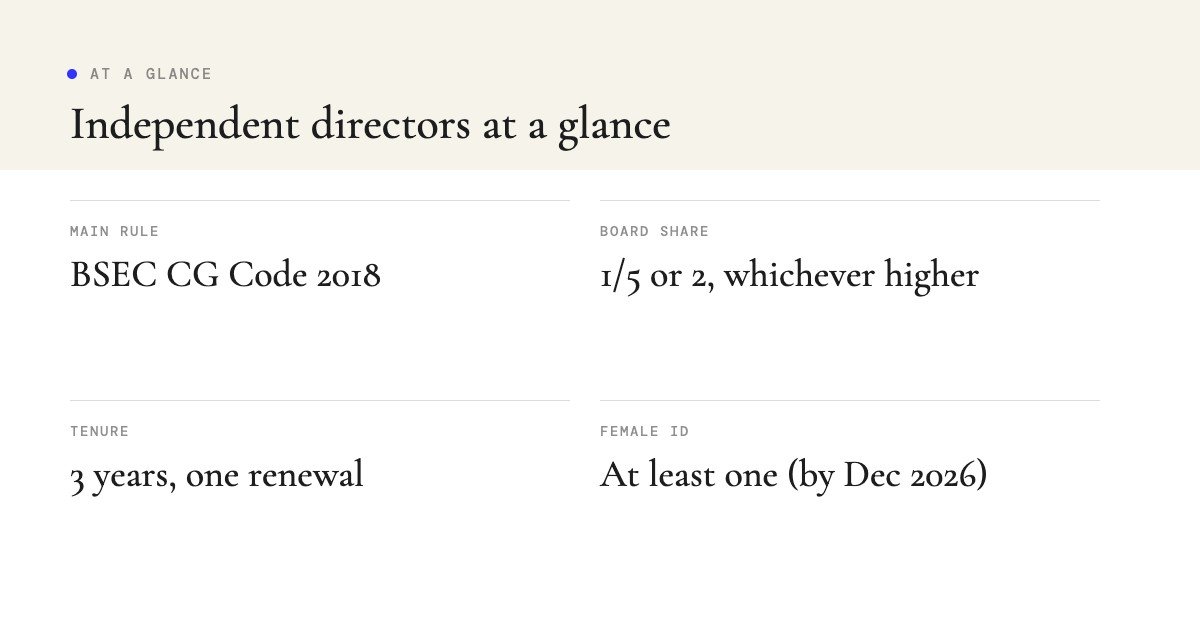
- Listed companies must have independent directors forming at least one-fifth of the board, or at least two, whichever is higher, under condition 1(2)(a) of the BSEC Corporate Governance Code 2018.
- At least one independent director must be a woman; BSEC extended the compliance deadline to December 2026 after more than 100 listed companies had not complied.
- Candidates must fall within listed professional categories with at least ten years' relevant experience and pass ten independence tests, including no defaulter status in the CIB report.
- The board appoints on the nomination and remuneration committee's recommendation, with prior BSEC consent, and shareholders approve at the AGM.
- Tenure is three years, renewable once; banks and other regulated entities have additional rules from their own regulators.
Why the independent director in Bangladesh matters
For anyone considering the role of independent director in Bangladesh, context matters: most Bangladeshi companies, including many listed ones, are controlled by a founding family or group. Sponsor-directors often hold executive roles, and related-party transactions are common. In that setting, independent directors are the main structural check on the board. Their job is to bring objective judgement, chair the key committees and speak for shareholders who have no seat at the table.
The role became formal through BSEC corporate governance guidelines from 2006 onwards and was codified in the Corporate Governance Code issued by BSEC notification on 3 June 2018. That Code, as amended, still governs the independent director in Bangladesh for listed companies in 2026. Banks, insurers and finance companies face further requirements from their sector regulators.
Who must appoint independent directors
The Corporate Governance Code applies to companies listed on the Dhaka and Chittagong stock exchanges. Private limited companies and unlisted public companies are not required by the Companies Act 1994 to have independent directors, although many appoint them voluntarily, often at the request of investors or lenders. Banks must follow the Bank Company Act 1991 and Bangladesh Bank requirements, and insurers follow the Insurance Development and Regulatory Authority.
How many independent directors are required
Condition 1(2)(a) of the Code requires that at least two directors, or one-fifth of the total number of directors, whichever is higher, be independent, with any fraction rounded up to the next whole number. A board of ten therefore needs at least two independent directors; a board of eleven needs three.
The Code also requires at least one independent director in Bangladesh listed companies to be female. In July 2026, BSEC extended the deadline for this requirement from December 2025 to December 2026, after reports that more than 100 listed companies had not yet complied, citing difficulty in finding qualified candidates. Companies that still lack a female independent director should treat this as a priority.
| Board size | Minimum independent directors | Of whom female |
|---|---|---|
| 5 to 10 | 2 | At least 1 |
| 11 to 15 | 3 | At least 1 |
| 16 to 20 | 4 | At least 1 |
The table applies the one-fifth or two rule with rounding up; confirm the calculation for your board under the current Code and any later BSEC directive.
Independence tests for an independent director in Bangladesh
Condition 1(2)(b) sets out who counts as independent. A candidate must satisfy all the tests, not just most of them. In summary, an independent director in Bangladesh must:
- Hold no shares in the company, or less than one percent of its paid-up shares.
- Not be a sponsor of the company, or connected with any sponsor, director or shareholder holding one percent or more, including through family relationships.
- Not have been an executive of the company in the immediately preceding two financial years.
- Have no other pecuniary relationship with the company or its subsidiaries or associates.
- Not be a member, TREC holder, director or officer of a stock exchange.
- Not be a shareholder, director (other than as an independent director) or officer of any stock exchange member, TREC holder or capital market intermediary.
- Not have been a partner or executive of the company's statutory audit firm or certifying firm in the preceding three years.
- Not be an independent director in more than five listed companies.
- Not be shown as a loan defaulter in the latest Credit Information Bureau report of Bangladesh Bank.
- Not have been convicted of a criminal offence involving moral turpitude.
Family connections are where most independence problems hide. The Code's definition of family is broad. Ask candidates for a written declaration covering their relatives' shareholdings, directorships and business relationships with the company and its sponsors, and refresh it every year.
Qualifications under the Code
Condition 1(3) requires an independent director to be knowledgeable, of integrity, and able to ensure compliance with financial laws, regulatory requirements and corporate laws, and to make a meaningful contribution to the business. The candidate must fall within one of several categories:
- Business leader. A person who is or was a promoter or director of an unlisted company with a minimum paid-up capital set by the Code, or of a listed company.
- Corporate leader. A person who is or was a top-level executive, such as a managing director, chief executive, CFO or company secretary, of a company meeting the Code's thresholds.
- Former government official. A former official not below a specified grade in the national pay scale.
- University teacher. A teacher with an educational background in economics, commerce, business studies or law.
- Professional. An advocate practising in the High Court Division, or a chartered accountant, cost and management accountant, chartered financial analyst, chartered certified accountant, certified public accountant or chartered secretary, or equivalent.
The Code requires at least ten years of experience in the relevant category. BSEC may relax the qualification requirement in special cases, but only with its prior approval. The thresholds and grades are set out in the Code; check the current text when assessing borderline candidates.
What boards actually look for
Beyond the formal tests, a good independent director in Bangladesh brings financial literacy, sector knowledge and the willingness to ask difficult questions. Boards that appoint retired officials or friends purely to satisfy the rule find that the audit committee becomes a formality, which regulators and investors notice.
Appointment process and BSEC consent
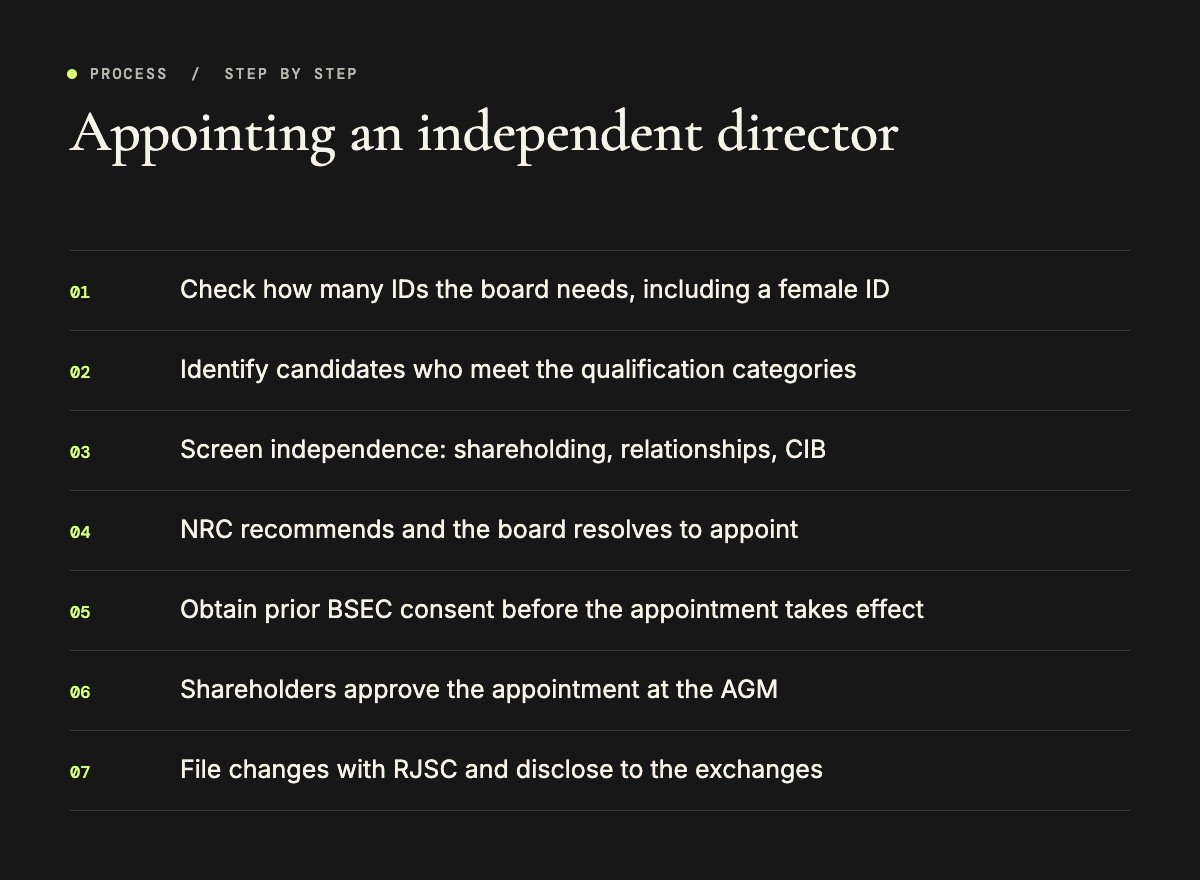
Condition 1(2)(c) provides that independent directors are appointed by the board, subject to the recommendation of the nomination and remuneration committee, and approved by shareholders at the annual general meeting. The Code also makes the appointment subject to prior consent of BSEC, which reviews the candidate's qualifications and independence.
- Assess the board. Count required seats, including the female independent director, and identify gaps in skills.
- Search and shortlist. Identify candidates in the qualifying categories with relevant experience and no conflicts.
- Due diligence. Obtain declarations, CV, educational and professional certificates, CIB clearance and confirmation of other directorships.
- NRC recommendation. The nomination and remuneration committee evaluates candidates and recommends to the board.
- Board resolution and BSEC application. The board resolves to appoint and applies to BSEC for consent with the supporting documents.
- Shareholder approval. The appointment is placed before the next AGM for approval.
- Filing and disclosure. Notify RJSC on Form XII and make the disclosures required by the listing regulations of the exchanges.
Our guide to the board resolution process explains how to minute appointment decisions properly.
Vacancies
Under condition 1(2)(d), the post of an independent director in Bangladesh cannot remain vacant for more than ninety days. Companies should keep a pipeline of potential candidates, because the BSEC consent process takes time and an unplanned resignation can quickly put the company in breach.
Tenure and removal
Condition 1(2)(e) sets the tenure of an independent director at three years, which may be extended for one further tenure only. After two terms, the person must step down, and a former independent director can generally be reappointed only after a cooling-off period of one tenure, as set out in the Code.
Removal follows the Companies Act 1994 and the articles, subject to the Code. Because the appointment required BSEC consent, removing an independent director without good reason attracts regulatory attention. Resignations should be disclosed promptly with reasons where the director raises governance concerns.
Committees and duties
The Code gives independent directors central roles in the board's committees:
- Audit committee. The audit committee must include at least one independent director and be chaired by an independent director. It oversees financial reporting, internal control, internal audit and the relationship with the external auditor.
- Nomination and remuneration committee. The NRC must include independent directors and be chaired by one. It sets policies on board composition, director and executive remuneration and evaluation.
- Chair of the board. The Code requires the chair and the managing director or CEO to be different people, and the chair to be elected from among non-executive directors.
Independent directors also share the general duties of all directors under company law: to act in good faith, with due care, and in the interests of the company. They must attend meetings, read papers, ask questions and record dissent where they disagree. An independent director in Bangladesh who simply signs what management puts forward offers little protection to shareholders or to themselves.
Related-party transactions are the most common source of disputes. The audit committee should review them before approval, insist on arm's length terms and make sure they are disclosed. Minutes should show the review, not merely the approval.
Liability and protection
Independent directors are not shielded from liability merely by their title. In regulatory investigations, BSEC has examined the conduct of the whole board, and independent directors can be exposed where they knew of or ignored misconduct. Liability may arise under the Securities and Exchange Ordinance 1969, BSEC rules, the Companies Act 1994 and, for banks, the Bank Company Act 1991.
For an independent director in Bangladesh, practical protections include directors' and officers' liability insurance, a clear deed of indemnity from the company to the extent the law allows, access to independent professional advice at the company's expense, and accurate minutes recording their questions and dissent. A careful independent director in Bangladesh also keeps a personal record of key board papers and concerns raised.
Remuneration
Independent directors usually receive meeting fees and may receive a fixed honorarium approved by the board and disclosed in the annual report. Remuneration should not be linked to company performance in a way that compromises independence, and independent directors should not participate in employee share schemes intended for executives.
Banks, insurers and finance companies
Regulated financial institutions face extra layers for each independent director in Bangladesh. For banks, the Bank Company Act 1991, as amended, and Bangladesh Bank circulars govern the number, qualifications and approval of independent directors, and Bangladesh Bank's approval is required for director appointments. Insurers follow requirements set by the Insurance Development and Regulatory Authority, and finance companies follow the Finance Company Act 2023 and Bangladesh Bank rules.
Where a bank or insurer is also listed, both the sector regulator's rules and the BSEC Code apply. In case of conflict, the stricter requirement is generally followed, and companies often seek regulatory guidance. Since 2024, Bangladesh Bank has also reconstituted the boards of several troubled banks, appointing independent directors directly in some cases under its resolution powers.
Compliance reporting
Listed companies must report compliance with the Code, including every rule on the independent director in Bangladesh, in their annual report, with a certificate from a practising professional confirming compliance. The annex to the annual report lists each condition and whether it was complied with. Non-compliance must be explained, and persistent failures can lead to BSEC action against the company and its directors.
Investors and analysts increasingly read this annex closely. Statements such as "will be approved at the next AGM" or long-unfilled vacancies are red flags that suggest weak governance.
Independent director in Bangladesh: unlisted and family companies
Although the Code applies only to listed companies, many unlisted businesses benefit from appointing an independent director in Bangladesh. Family groups preparing for an IPO, joint ventures with foreign partners and companies with private equity investors often appoint one or two independent board members to build credibility and prepare for listing standards.
For these companies, the articles of association and any shareholders agreement decide how the independent director is appointed, removed and paid. It is sensible to mirror the Code's independence tests, so that the director remains eligible if the company later lists. Investors may also ask for the independent director to chair an audit committee even before it is legally required.
Practical checklist
- Recalculate the required number of independent directors whenever board size changes.
- Confirm a female independent director is in place before the December 2026 deadline.
- Run full independence and qualification checks, including CIB clearance, before nomination.
- Apply for BSEC consent early and keep the AGM timetable in mind.
- Track tenure and plan successors before second terms expire.
- Make sure committees are properly constituted and chaired.
- Review declarations annually and record them in board minutes.
Frequently asked questions about independent director in bangladesh
Does a private limited company need an independent director?
No. The Companies Act 1994 does not require one. The requirement applies to listed companies under the BSEC Corporate Governance Code 2018, and to banks and other regulated entities under their own rules.
How many independent directors must a listed company have?
At least one-fifth of the board or two, whichever is higher, with fractions rounded up, and at least one must be female.
Is BSEC approval needed?
Yes. The Code makes the board's appointment subject to prior BSEC consent, followed by shareholder approval at the AGM.
How long can someone serve as an independent director?
Three years, extendable for one further tenure only, after which a cooling-off period applies before any reappointment.
Can an independent director hold shares?
Only less than one percent of the company's paid-up shares, and the director must not be connected with sponsors or major shareholders.
What is the deadline for appointing a female independent director?
BSEC extended the deadline to December 2026 in a directive reported in July 2026.
How we can help
We advise listed companies, banks and investors on every aspect of the independent director in Bangladesh: board composition, independence and qualification checks, BSEC consent applications, committee charters, compliance reporting and director liability. Learn more about our corporate governance practice and our BSEC regulatory work.
Strengthening your board?
We review your board against the Corporate Governance Code and manage independent director appointments through BSEC consent and the AGM.
Book a consultationCorporate governancePrimary sources: the Corporate Governance Code 2018 (BSEC notification of 3 June 2018) and directives published by the Bangladesh Securities and Exchange Commission; the Companies Act 1994 and Bank Company Act 1991 on the Laws of Bangladesh portal; listing information from the Dhaka Stock Exchange; reporting in The Financial Express (27 July 2026).
This article is general information about Bangladeshi corporate governance rules as of October 2026 and is not legal advice. BSEC may amend the Code or issue new directives; confirm current requirements with BSEC or a qualified lawyer before acting.


0 Comments