
Murabaha financing in Bangladesh is the workhorse of Islamic banking: instead of lending money at interest, the bank buys an asset and sells it to the customer at an agreed, disclosed profit, payable later. It looks simple, but the order of steps, the documents and the security decide whether the deal is both Shariah-compliant and enforceable.
- Murabaha is a sale, not a loan: the bank must own the goods and bear their risk, however briefly, before selling them to the customer at cost plus a disclosed profit.
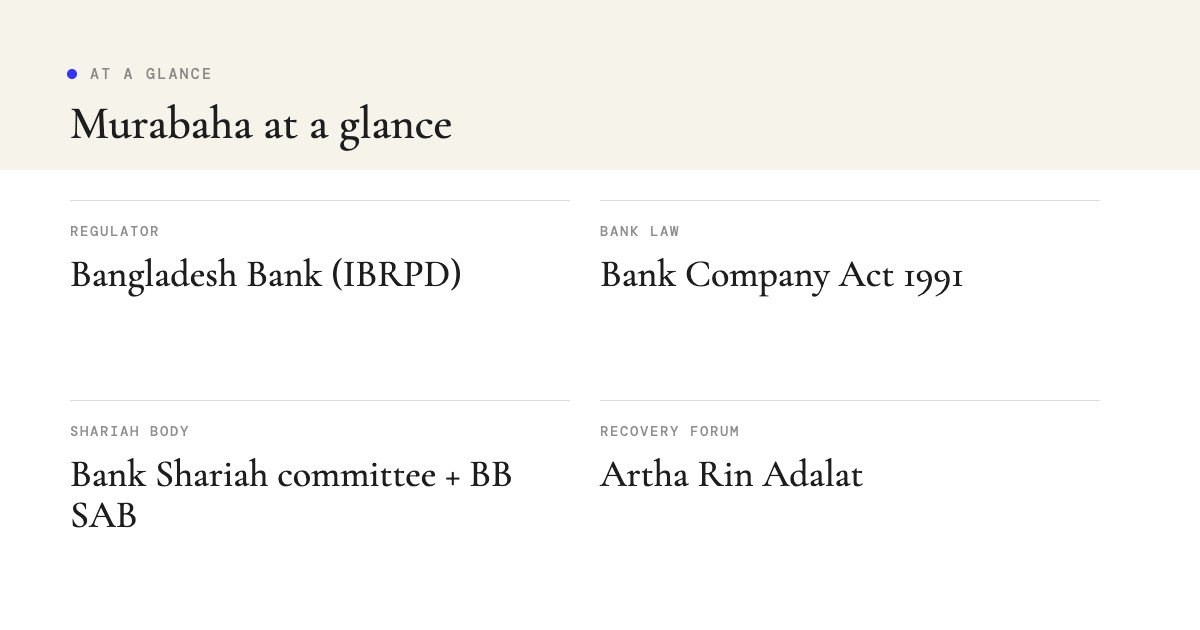
- Islamic banks and Islamic windows are licensed under the Bank Company Act 1991 and supervised by Bangladesh Bank, which has run a dedicated Islamic Banking Regulation and Policy Department and approved its own Shariah Advisory Board in October 2025.
- Once agreed, the murabaha price cannot be increased for late payment; any late payment amount is usually paid to charity under Shariah rules.
- Security is taken in the usual way: hypothecation, mortgage, guarantees and post-dated cheques, with company charges registered at RJSC within 21 days.
- Defaulted murabaha debts are recovered through the Artha Rin Adalat like other bank dues, so the paper trail of the sale matters in court.
What murabaha financing in Bangladesh means
Murabaha is a classical Islamic sale contract in which the seller tells the buyer what the goods cost and adds an agreed profit. In banking practice, the customer needs an asset, such as raw materials, machinery, a vehicle or stock in trade. The bank buys the asset and resells it to the customer at a marked-up price. The customer pays that fixed price later, in one sum or in instalments.
The economic result resembles a loan, which is why critics call it "interest by another name". The legal and Shariah difference is that the bank earns profit from a sale of an asset it owned and whose risk it carried, not from lending money. That difference is real only if the steps are done in the right order and recorded properly.
Bai-murabaha and bai-muajjal
Bangladeshi banks use several labels. Bai-murabaha usually describes a sale where the cost and profit are disclosed. Bai-muajjal describes a sale on deferred payment, which in practice is often combined with murabaha disclosure. Many banks also run murabaha trust receipt and murabaha post-import facilities for importers. The names vary between banks; what matters is that the contract actually follows the sale structure.
The regulatory framework
There is no separate Islamic banking statute in Bangladesh. Full-fledged Islamic banks, Islamic banking branches and windows of conventional banks are licensed under the Bank Company Act 1991 and supervised by Bangladesh Bank. Bangladesh Bank's Guidelines for Conducting Islamic Banking, first issued in 2009, set out the main modes of investment, including murabaha, bai-muajjal, ijarah and musharaka, and the governance expected of Islamic banks.
For murabaha financing in Bangladesh, Bangladesh Bank also has a dedicated Islamic Banking Regulation and Policy Department. Its circulars now cover new products too: on 27 September 2026 it issued guidelines on Islamic credit card operations, issued under section 45 of the Bank Company Act 1991. A separate Islamic banking law has been discussed for years, but as of October 2026 we are not aware of one being enacted.
Shariah governance
Each Islamic bank must have a Shariah supervisory committee that approves products, reviews documents and reports on compliance. In October 2025, Bangladesh Bank's board approved a policy to form a Shariah Advisory Board at the central bank, with power to resolve doubtful matters, set industry-wide standards and vet new products. Press reports linked its legal basis to the Bank Resolution Ordinance 2025; Parliament passed a Bank Resolution Bill in April 2026, so check the final Act when relying on that basis.
The Shariah committee's approval of a product template does not cure a transaction that skipped a step. If the bank pays the supplier after the customer has already received and used the goods, the deal may fail Shariah review and give the customer an argument in court. The file must show the sale happening in the right order.
How murabaha financing in Bangladesh is structured
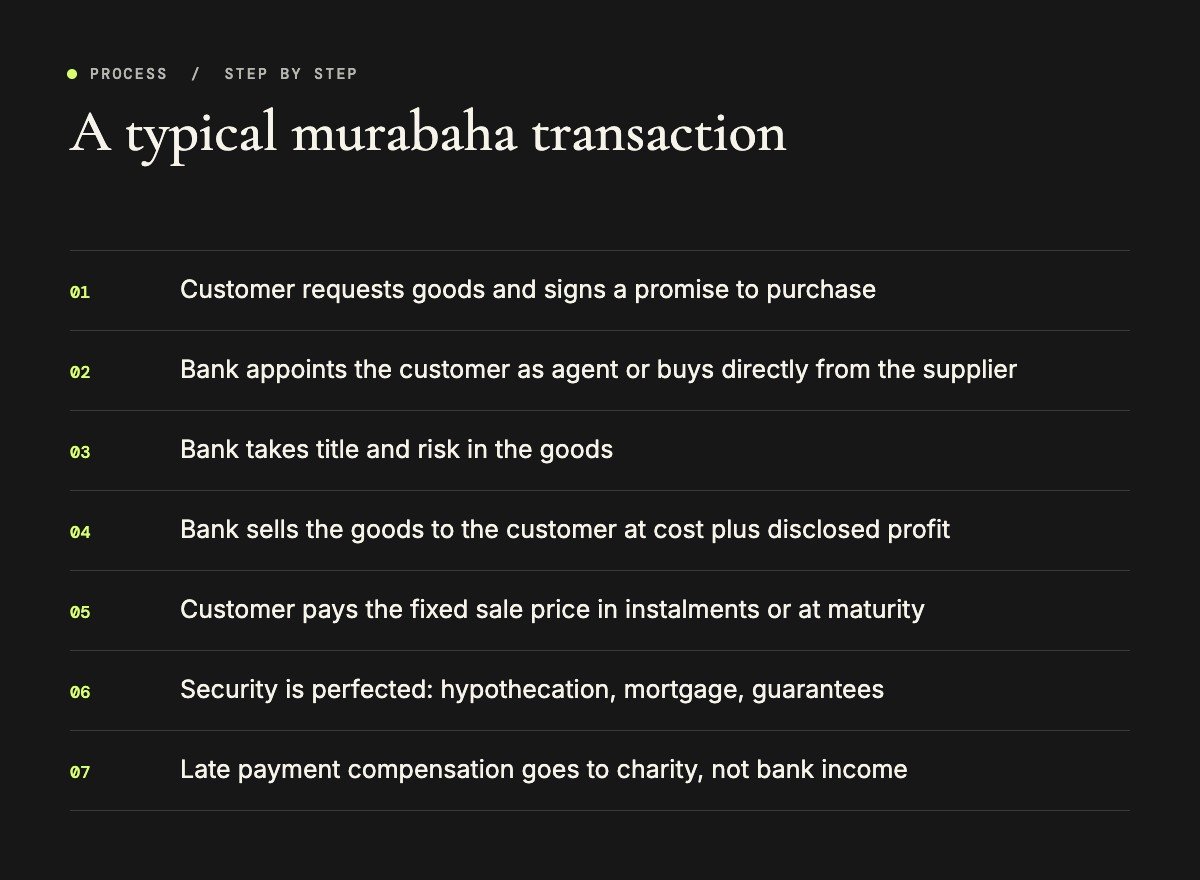
A standard murabaha has five stages, and each stage has its own document. The sequence below reflects common practice in Bangladeshi Islamic banks; individual products differ in detail.
- Request and promise. The customer applies for an investment facility and signs a unilateral promise (wa'd) to buy the goods from the bank once the bank acquires them.
- Agency or direct purchase. The bank either buys directly from the supplier or appoints the customer as its agent to buy on the bank's behalf, under a separate agency agreement.
- Bank takes title and risk. The supplier's invoice is in the bank's name, the bank pays the supplier, and the goods are the bank's property and at its risk until resale.
- Sale to the customer. The bank offers and the customer accepts a sale at cost plus disclosed profit. The sale price, payment dates and any instalments are fixed in the murabaha agreement.
- Payment and closure. The customer pays the sale price on the agreed schedule. Early settlement rebates, if any, are at the bank's discretion under its policy.
Getting the structure right is the single most important point in murabaha financing in Bangladesh. Common shortcuts, such as backdated invoices, payment straight to the customer's account or a sale signed before the bank owns anything, undermine both the Shariah basis and the bank's evidence.
Documents in murabaha financing in Bangladesh
A well-run file contains the following documents. Templates vary, but each serves a distinct legal purpose.
| Document | Purpose | Key points |
|---|---|---|
| Sanction letter | Approves the facility limit and terms | States the mode (murabaha or bai-muajjal), limit, profit rate basis, tenor and security |
| Master murabaha agreement | Framework for repeated purchases under a limit | Sets general terms; each sale is a separate transaction |
| Promise to purchase | Customer's undertaking to buy | Unilateral promise, not itself the sale |
| Agency agreement | Appoints customer to buy for the bank | Customer acts as agent, not owner, until the sale |
| Supplier invoice and payment proof | Shows the bank bought the goods | Invoice in the bank's name; payment direct to supplier |
| Offer and acceptance | Concludes the sale to the customer | Signed after the bank owns the goods |
| Security documents | Protect the bank if the customer defaults | Hypothecation, mortgage, guarantees, cheques |
Stamping and registration
Agreements, guarantees and security documents attract stamp duty under the Stamp Act 1899 as amended by each Finance Act. A mortgage of land must be made by registered instrument under the Transfer of Property Act 1882, and a charge created by a company must be registered with RJSC within 21 days under section 159 of the Companies Act 1994. Check the current stamp schedule when signing rather than relying on an old precedent.
Pricing, profit and late payment
The profit in murabaha financing in Bangladesh is usually expressed as a rate, often benchmarked internally, but it is fixed into the sale price at the time of the sale. Once the sale is concluded, the price is a debt and cannot be increased. That is the key difference from a conventional loan, where interest keeps running.
Lending rates in Bangladesh became market-based after Bangladesh Bank abolished the SMART reference rate on 8 May 2024. Islamic banks set their investment rates within the same broad market, and the profit rate is negotiated at sanction.
Late payment and compensation
Because the price cannot rise, Islamic banks deal with late payment through a customer undertaking to pay a sum to charity if payment is late. Bangladesh Bank's September 2026 credit card guidelines express the same principle: a late payment amount is a charitable undertaking and is not bank income. Some banks also claim actual costs of recovery. Check that your documents keep these amounts separate from profit.
Rebate on early settlement
A customer who pays early has no automatic right to a discount, because the sale price is fixed. Many banks give a rebate as a matter of policy. If a rebate is important to the customer, negotiate it into the facility letter.
Security and guarantees
Islamic banks take the same types of security as conventional lenders, and murabaha financing in Bangladesh is no exception. For murabaha financing in Bangladesh, a typical package for a working capital limit includes hypothecation of stock and receivables, a mortgage of land or a flat, personal guarantees of directors, a corporate guarantee from a group company and post-dated or undated cheques.
- Hypothecation. The customer keeps the goods but charges them to the bank. For companies, register the charge at RJSC within 21 days.
- Mortgage. Land mortgages must be registered. Check title, mutation and land development tax before accepting land; our guide to the land registration process explains the records.
- Guarantees. Personal and corporate guarantees are contracts under the Contract Act 1872. A variation of the facility without the guarantor's consent can discharge the guarantee, so take fresh consent on restructuring.
- Cheques. Security cheques can support proceedings under section 138 of the Negotiable Instruments Act 1881 if dishonoured. See our guide to cheque dishonour remedies.
Before the sale, the goods belong to the bank; after the sale, they belong to the customer and are then hypothecated back. The documents should make this change of ownership clear. A hypothecation that predates the sale, over goods the customer does not yet own, is a frequent defect in murabaha files.
Murabaha financing in Bangladesh for imports and trade
Importers are among the heaviest users of Islamic trade finance, and much murabaha financing in Bangladesh is trade-related. A typical structure starts with a letter of credit opened by the bank. When documents arrive, the bank pays the foreign supplier and holds the goods, then sells them to the importer under murabaha post-import or a trust receipt arrangement, often with a short tenor.
All the usual import rules still apply: Bangladesh Bank foreign exchange regulations, LC margin instructions issued from time to time, customs and VAT on import, and documentary credit rules under UCP 600. The Islamic overlay adds the requirement that the bank actually owns the goods before reselling them. Our trade finance practice advises on these structures.
Commodity murabaha and liquidity
Internationally, Islamic banks use commodity murabaha for liquidity and interbank placements. Bangladeshi Islamic banks have relied more on Bangladesh Bank's Islamic liquidity instruments and government Islamic securities. Commodity murabaha with foreign counterparties raises foreign exchange approval questions and should be cleared with Bangladesh Bank first.
Tax and VAT considerations
Tax treatment is an area where murabaha financing in Bangladesh is not always neatly accommodated. For income tax, profit earned by the bank on murabaha is treated as business income of the bank, and the customer generally deducts the profit element as a financing cost, subject to the Income Tax Act 2023. Withholding rules on profit paid to depositors follow the rules for interest-equivalent income.
VAT is more complex, because a murabaha involves two sales: supplier to bank and bank to customer. Banks have relied on administrative treatment to avoid double VAT on the same goods. Rates, exemptions and administrative orders change with each budget, so confirm the current position with the NBR or a tax adviser before structuring a large transaction. Our tax practice can review the flow.
Default and recovery
When a customer defaults on murabaha financing in Bangladesh, the bank's claim is for the unpaid sale price, which is a debt. Banks file recovery suits in the Artha Rin Adalat under the Artha Rin Adalat Ain 2003, which applies to Islamic banks as financial institutions. The Act also lets banks sell mortgaged or hypothecated property after notice in defined circumstances, before or instead of a suit.
In court, the bank must prove the debt. That means producing the sanction letter, the purchase from the supplier, the sale to the customer, the payment schedule and the account statement. Courts focus on the documents, not the Shariah label. A file with a missing supplier invoice or an unsigned offer and acceptance weakens the claim.
Classification and rescheduling
Overdue murabaha investments are classified under Bangladesh Bank's loan classification and provisioning rules, which apply to Islamic investments in the same way. Rescheduling is possible, but the original sale price cannot be increased to compensate the bank. Rescheduled facilities often use a new sale for fresh working capital rather than adding profit to the old debt.
Bank resolution and merged banks
Several Shariah-based banks have been under resolution since 2024. In 2025 the government approved the merger of five Shariah-based banks into Sammilito Islami Bank, as reported in the press. Customers of merged banks should check which entity now holds their facility, and confirm that security documents and guarantees transferred properly.
Common pitfalls in murabaha financing in Bangladesh
From our experience reviewing Islamic finance files for banks and customers, the same problems recur:
- Sale before purchase. The offer and acceptance is signed before the bank buys the goods, so there is nothing to sell.
- Funds to the customer. The bank credits the customer's account instead of paying the supplier, making the transaction look like a cash loan.
- Price increases. Additional profit is charged on overdue amounts, which Shariah does not permit.
- Weak agency records. The customer acts as agent but no agency agreement or purchase report exists.
- Unregistered security. Mortgages not registered or company charges not filed with RJSC within 21 days.
- Stale guarantees. Guarantees not refreshed when the facility is renewed or restructured.
Each of these problems in murabaha financing in Bangladesh is easy to avoid at the start and expensive to fix in litigation. A short pre-disbursement checklist, reviewed by the bank's legal and Shariah teams together, prevents most of them.
Advice for customers
Customers often see murabaha financing in Bangladesh as interchangeable with a conventional loan. Practically, it often is, but a few points deserve attention before signing:
- Ask for the sale price, not only the profit rate, and check that the payment schedule adds up to it.
- Understand what happens on early settlement and whether a rebate is written into the documents.
- Check the late payment clause: who receives the amount, and whether actual costs are also charged.
- Read the security documents and guarantees, which are usually the same as in conventional finance and just as onerous.
- Keep copies of supplier invoices and delivery documents, which you may need if a dispute arises.
Our banking and finance team reviews facility documents for borrowers as well as banks.
Frequently asked questions about murabaha financing in Bangladesh
Is murabaha just a loan with a different name?
Economically it is similar, but legally it is a sale. The bank must own the goods and bear their risk before selling them at a disclosed profit. If those steps are skipped, the deal may fail Shariah review and weaken the bank's position.
Which law governs Islamic banks in Bangladesh?
The Bank Company Act 1991, with Bangladesh Bank guidelines for Islamic banking and circulars from its Islamic Banking Regulation and Policy Department. As of October 2026 there is no separate Islamic banking Act.
Can the bank charge more if I pay late?
The sale price cannot be increased. Contracts usually require a late payment amount to be paid to charity, and some banks also recover actual recovery costs.
Where does a bank sue on a defaulted murabaha?
In the Artha Rin Adalat under the Artha Rin Adalat Ain 2003, which applies to Islamic banks. The bank must prove the debt with the sale documents and account statements.
Do I get a discount if I repay early?
Not automatically, because the price is fixed at the sale. Many banks give a rebate as policy; negotiate it into the documents if it matters to you.
Does a company need to register a hypothecation for murabaha?
Yes. A charge created by a company must be registered with RJSC within 21 days under section 159 of the Companies Act 1994, or it is void against the liquidator and other creditors.
How we can help
We advise Islamic banks, windows and customers on murabaha financing in Bangladesh: product structuring, Shariah-aligned documentation, security, restructuring and recovery in the Artha Rin Adalat. Learn more about our Islamic finance practice.
Structuring or reviewing an Islamic facility?
We check that the sale sequence, documents and security will stand up to Shariah review and in court.
Book a consultationIslamic finance practicePrimary sources: the Bank Company Act 1991, Companies Act 1994 and Artha Rin Adalat Ain 2003 on the Laws of Bangladesh portal; Islamic banking guidelines and IBRPD circulars (including Circular No. 01 of 27 September 2026) from Bangladesh Bank; charge registration with the RJSC; reporting in the Daily Observer (17 October 2025) on the Shariah Advisory Board.
This article is general information about Bangladeshi law as of October 2026 and is not legal or Shariah advice. Bangladesh Bank rules, tax treatment and bank resolution arrangements change; confirm the current position with Bangladesh Bank, your bank's Shariah committee or a qualified lawyer before acting.


0 Comments