
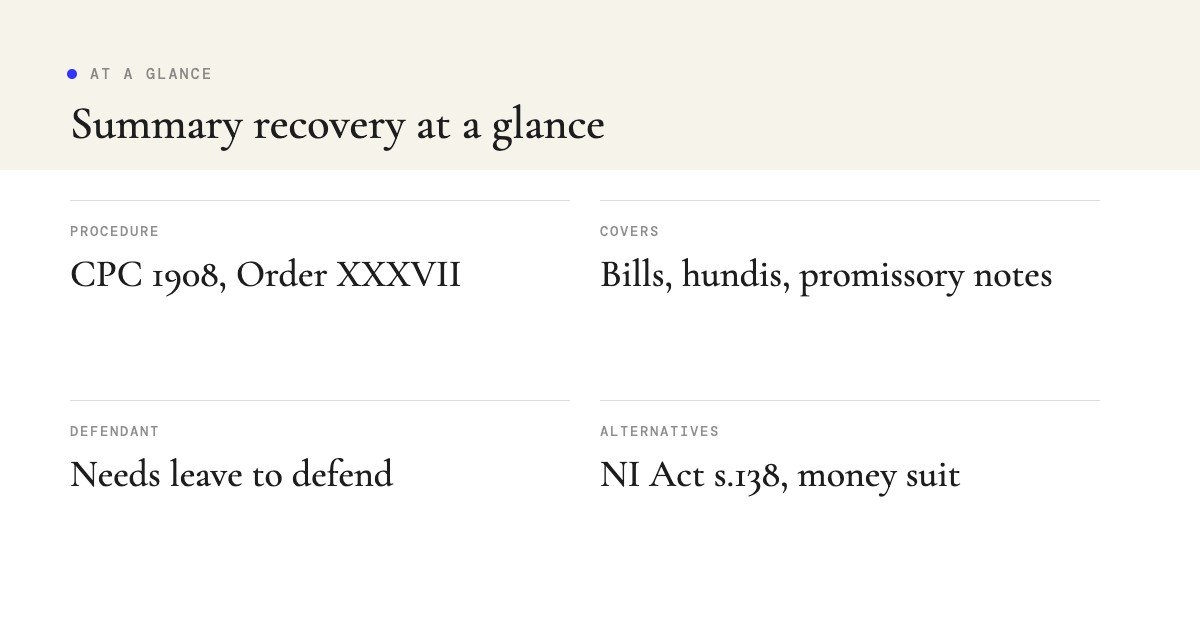
A summary suit in Bangladesh is a fast-track civil procedure for recovering money due on negotiable instruments such as bills of exchange, hundis and promissory notes. The defendant cannot simply file a defence; it must first obtain the court's leave. For creditors with clean documents, it can be quicker than an ordinary money suit, but it is not the only option.

- Order XXXVII of the Code of Civil Procedure 1908 provides summary procedure for suits on bills of exchange, hundis and promissory notes in the courts to which it applies.
- The defendant must apply for leave to defend within the time allowed; if leave is refused or not sought, the plaintiff can obtain a decree quickly.
- Leave is granted where the defendant shows a triable issue, sometimes on condition of depositing money or giving security.
- For dishonoured cheques, the criminal route under section 138 of the Negotiable Instruments Act 1881 is often more effective, while banks use the Artha Rin Adalat.
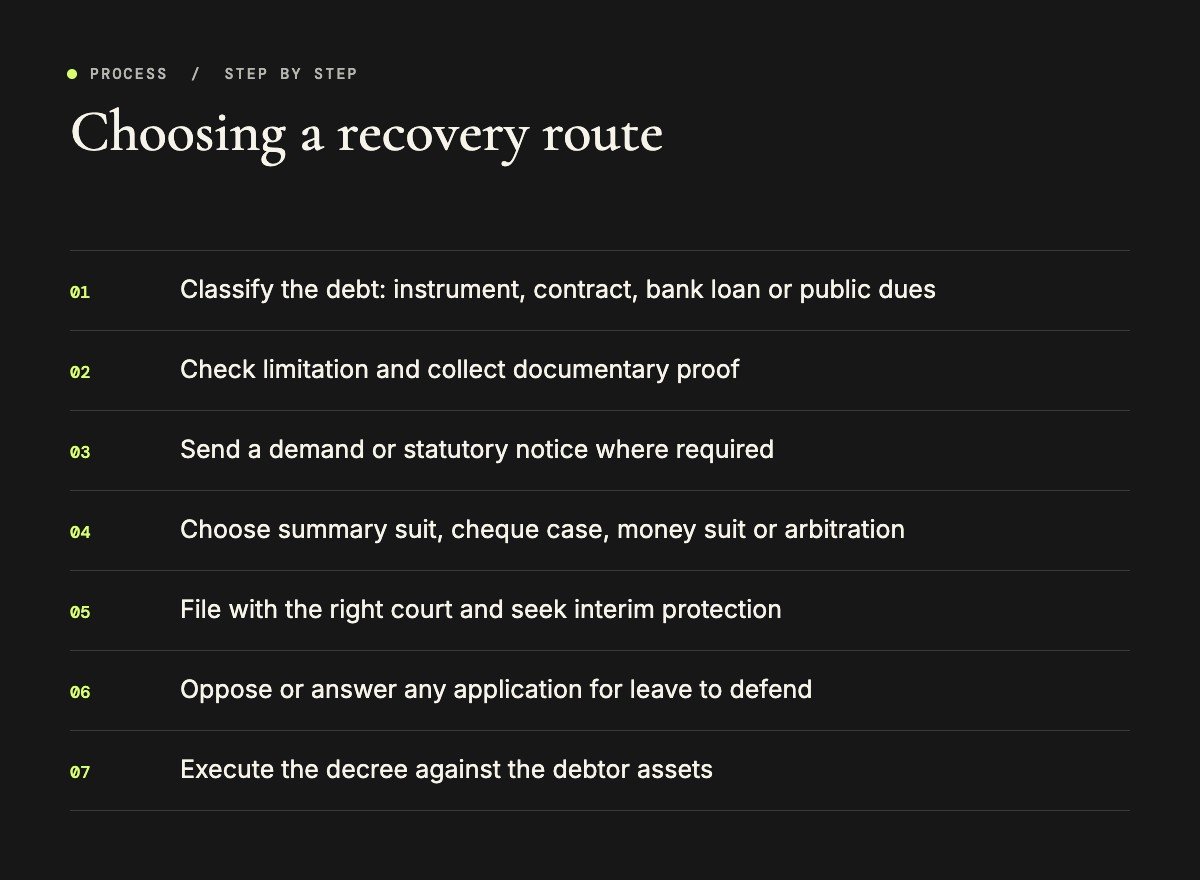
- Choosing the right route depends on the type of debt, the documents, limitation and where the debtor's assets are.
What a summary suit in Bangladesh is
Unlike a summary suit in Bangladesh, ordinary civil suits follow a full procedure: plaint, written statement, framing of issues, evidence and judgment. Even a straightforward debt claim can take years if the defendant contests every step. Summary procedure is designed to cut this short where the claim is based on a negotiable instrument whose signature and terms are not genuinely disputed.
Under Order XXXVII of the Code of Civil Procedure 1908, the plaintiff files a plaint in the prescribed form stating that it is a summary suit. The defendant is served with a summons that requires it to obtain leave to appear and defend. If the defendant does not obtain leave, the plaintiff is entitled to a decree for the amount claimed, with interest and costs as allowed. A summary suit in Bangladesh is therefore a powerful tool against debtors who sign instruments and then delay payment.
Where it applies
Order XXXVII applies to the courts specified under the Code and any notifications extending it. In practice, its use in Bangladesh has been more limited than in some neighbouring jurisdictions, and many creditors instead rely on cheque dishonour proceedings or ordinary money suits. Before filing, confirm that the court where you intend to sue can try summary suits and that your claim falls within the categories the Order covers.
Claims suited to a summary suit in Bangladesh
The Order covers suits upon negotiable instruments. The table below shows how common types of debt fit.
| Type of debt | Summary suit? | Usual alternative |
|---|---|---|
| Promissory note signed by the debtor | Yes, if the court applies Order XXXVII | Money suit |
| Bill of exchange or hundi | Yes | Money suit |
| Dishonoured cheque | Possible as a negotiable instrument claim | Criminal complaint under NI Act s.138 |
| Unpaid invoices under a contract | Generally no | Money suit or arbitration |
| Bank or financial institution loan | No | Artha Rin Adalat under the 2003 Act |
| Government dues and certain bank dues | No | Certificate case under the Public Demands Recovery Act 1913 |
The categories matter because a summary suit filed outside them may be converted into an ordinary suit or rejected, wasting time. Our guide to types of civil cases explains where each claim belongs.
How the procedure works
A summary suit in Bangladesh follows a compact sequence. Details such as forms and time periods are set by Order XXXVII and should be checked against the current text and court practice.
- Prepare the plaint. Draft the plaint in the summary form, stating that the suit is filed under Order XXXVII, attaching the instrument and stating that no relief outside the Order is claimed.
- Pay court fees and file. File with the competent court and pay the court fee based on the amount claimed.
- Serve the summons. The court issues a summons in the summary form, requiring the defendant to seek leave to defend within the period stated.
- Leave application. The defendant applies for leave, supported by an affidavit showing a defence that raises a triable issue.
- Decision on leave. The court grants unconditional leave, conditional leave on deposit or security, or refuses leave.
- Decree or trial. If leave is refused or not sought, the court passes a decree; if leave is granted, the suit proceeds to trial on the issues raised.
- Execution. The plaintiff executes the decree against the defendant's assets in the usual way.
The strength of a summary suit lies in the instrument itself. Make sure the original promissory note or bill is complete, signed, stamped as the Stamp Act 1899 requires and within the limitation period. An unstamped or defective instrument gives the defendant an easy reason to obtain leave.
Leave to defend
The leave stage is the heart of a summary suit in Bangladesh, and often decides the outcome. Courts generally grant unconditional leave where the defendant shows a substantial defence, such as a genuine dispute about the signature, a plausible claim that the instrument was given without consideration, or evidence of payment. Where the defence is weak but not hopeless, courts may grant leave on condition that the defendant deposits all or part of the amount claimed, or provides security.
Courts refuse leave where the defence is sham or merely intended to delay. In that event, the plaintiff obtains a decree without a full trial. Because the decision turns on affidavits, both sides should prepare their documents carefully: the plaintiff to show that the instrument is unconditional and genuine, and the defendant to show specific facts supporting its defence.
Setting aside a decree
Order XXXVII allows a decree to be set aside in special circumstances, for example where the defendant was not properly served or was prevented by sufficient cause from applying for leave. Courts apply this power cautiously, and the defendant usually needs to show both a good reason and a credible defence.
Drafting the promissory note for a future summary suit in Bangladesh
Creditors who lend money or extend credit can prepare for recovery at the outset by taking a properly drafted promissory note. The note should contain an unconditional promise to pay a fixed sum, on demand or on a fixed date, to the creditor or order, signed by the debtor. Conditions, references to performance of another contract or uncertain amounts can take the document outside the definition of a promissory note in the Negotiable Instruments Act 1881 and weaken any later summary suit in Bangladesh.
The note must also be stamped correctly under the Stamp Act 1899, because an unstamped instrument may be inadmissible in evidence. Where the debtor is a company, check that the signatory has authority under the articles or a board resolution. Keep the original safe: the plaintiff must produce it in court.
Interest and costs
If the note provides for interest, state the rate clearly. Courts may award interest at the agreed rate up to the date of suit and at a rate they consider reasonable afterwards. Legal costs are in the court's discretion, but a clear contractual costs provision can help.
Defendants facing a summary suit in Bangladesh
A defendant served with a summary summons must act quickly. Missing the time for applying for leave can lead to a decree without any hearing on the merits. The defendant should immediately collect evidence: proof of payment, correspondence showing the instrument was security only, evidence of forgery or material alteration, or proof that the plaintiff is not the holder in due course.
Affidavits in support of leave should be specific. General denials rarely succeed. Where the defence is partial, the defendant may offer to deposit the undisputed amount, which can improve the chances of obtaining leave for the disputed balance. Settlement remains possible at every stage, and many summary suits in Bangladesh end with a negotiated payment schedule.
Cheque dishonour: the criminal alternative
For dishonoured cheques, most creditors in Bangladesh use section 138 of the Negotiable Instruments Act 1881 rather than a summary suit. The holder sends written notice within thirty days of learning of the dishonour; if the drawer does not pay within thirty days of receiving notice, the holder files a complaint within one month. The drawer faces imprisonment of up to one year, or a fine up to three times the cheque amount, or both, and the fine can be paid to the complainant.
The criminal route puts more pressure on the debtor, and appeals require deposit of at least half the cheque amount. It is not available to banks seeking to recover loans, according to a 2022 High Court Division observation that banks must proceed under the Artha Rin Adalat Ain 2003. Our guide to cheque dishonour remedies explains the steps.
Ordinary money suits and small claims
Where the debt arises from a contract, invoice or loan without a negotiable instrument, the usual route is an ordinary money suit in the civil court with pecuniary jurisdiction. Under the Civil Courts Act 1887 as amended in 2021, jurisdiction depends on the value of the suit. Small claims may be tried by Small Cause Courts under the Small Cause Courts Act 1887, which use a simpler procedure.
Money suits can be slow, but tools exist to protect the plaintiff: attachment before judgment where the defendant is disposing of assets, temporary injunctions and the court's power to send the case to mediation under section 89A of the Code. A well-prepared money suit, with documents organised and witnesses ready, often settles once the defendant sees the strength of the claim.
Commercial courts and pre-suit mediation
The Commercial Court Ordinance 2026, reported as Ordinance No. 1 of 2026, provides for commercial courts at district level, commercial appellate benches in the High Court Division and pre-suit mediation for commercial disputes. If it is in force for your dispute, a commercial claim may need to go through mediation before suit and then be tried under the ordinance's procedure. Whether Parliament has re-enacted the ordinance as an Act should be checked before filing.
For creditors, the commercial court framework may offer a faster alternative to a summary suit in Bangladesh for contract-based debts that do not involve negotiable instruments. Our commercial litigation practice monitors how these courts are being set up and used.
Arbitration and contractual routes
Many commercial contracts contain arbitration clauses. Where they do, the court will usually refer the parties to arbitration if the defendant applies in time, so filing a summary suit may only delay matters. Arbitration under the Arbitration Act 2001 can be quick if the clause is well drafted and the institution manages timelines.
Creditors should also consider contractual security: guarantees, post-dated cheques, retention of title and security deposits. A creditor holding a guarantee from a solvent parent or a bank can often recover faster by calling the guarantee than by suing the debtor.
Limitation still runs while parties negotiate. The Limitation Act 1908 sets periods for suits on promissory notes, bills and contracts, usually three years from the relevant date. An acknowledgment of debt in writing signed by the debtor can extend time, so obtain one if settlement talks drag on.
Executing the decree
A decree from a summary suit in Bangladesh is only valuable if it can be enforced. Execution under Order XXI of the Code allows attachment and sale of the debtor's property, attachment of bank accounts and debts owed to the debtor, and, in some cases, arrest and detention in civil prison. Before suing, find out what assets the debtor has and where. A summary suit in Bangladesh that ends in a decree against a debtor with no reachable assets achieves little.
Where the debtor is a company, the creditor may also consider a winding up petition under the Companies Act 1994 if the company cannot pay its debts, which often prompts payment. Our guide to winding up cases explains that route.
Practical checklist for creditors
- Identify the nature of the debt and the documents that prove it.
- Check limitation dates and obtain acknowledgments where possible.
- Confirm stamping and execution of instruments before relying on them.
- Check for arbitration or exclusive jurisdiction clauses.
- Investigate the debtor's assets before choosing a route.
- Send a clear demand letter or statutory notice where required.
- Choose between summary suit, cheque case, money suit, commercial court or arbitration with advice.
Frequently asked questions about summary suit in bangladesh
What is a summary suit?
A suit under Order XXXVII of the Code of Civil Procedure 1908 on a bill of exchange, hundi or promissory note, in which the defendant must obtain leave of the court before defending.
Can I file a summary suit for unpaid invoices?
Generally not, unless the debt is supported by a negotiable instrument. Invoice debts usually require an ordinary money suit, commercial court proceedings or arbitration.
How does a defendant get leave to defend?
By applying within the time allowed with an affidavit showing a triable issue. The court may grant leave unconditionally, on conditions such as a deposit, or refuse it.
Is a cheque case better than a summary suit?
For dishonoured cheques, the criminal route under section 138 of the Negotiable Instruments Act 1881 is often more effective because of the pressure it creates and the deposit required on appeal.
Can banks use summary suits?
Banks and financial institutions recover loans through the Artha Rin Adalat under the Artha Rin Adalat Ain 2003, not summary suits.
How long does a summary suit take?
If leave is refused, a decree can follow relatively quickly. If leave is granted, the suit proceeds to trial and timelines resemble ordinary suits.
How we can help
We advise creditors and debtors on every route to debt recovery: summary suit in Bangladesh, cheque dishonour proceedings, money suits, commercial court claims, arbitration, execution and winding up petitions. Learn more about our commercial litigation practice.
Owed money and unsure which route to take?
We review your documents and the debtor's position and recommend the fastest realistic path to recovery.
Book a consultationLitigation practicePrimary sources: the Code of Civil Procedure 1908, Negotiable Instruments Act 1881, Limitation Act 1908, Small Cause Courts Act 1887 and Artha Rin Adalat Ain 2003 on the Laws of Bangladesh portal; court information from the Supreme Court of Bangladesh.
This article is general information about Bangladeshi civil procedure as of October 2026 and is not legal advice. The application of Order XXXVII and the status of the Commercial Court Ordinance 2026 should be confirmed with a qualified lawyer before filing.

0 Comments