
Withholding tax in Bangladesh turns every company into a tax collector. When you pay salaries, contractors, consultants, landlords, lenders or foreign suppliers, the Income Tax Act 2023 usually requires you to deduct tax, deposit it with the government and report it. Getting it wrong costs more than the tax itself: penalties, interest and disallowed expenses.
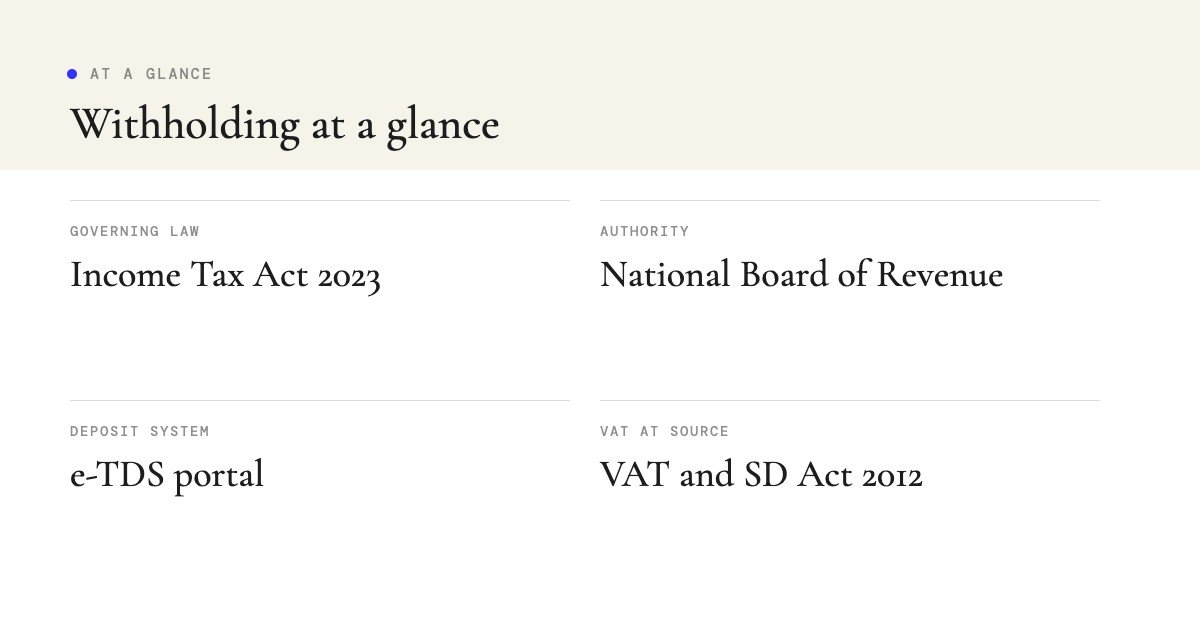
- The Income Tax Act 2023, which replaced the Income Tax Ordinance 1984, sets out tax deduction at source (TDS) and collection at source; rates are changed by each Finance Act.
- Companies, firms and many other specified entities must deduct tax from a wide range of payments, including salaries, contract payments, professional fees, rent, interest and payments to non-residents.
- Deposits are made through the NBR's e-TDS system, and a monthly withholding return is required; deadlines are short and strictly enforced.
- A payment made without required deduction can be disallowed as a business expense, and the payer can be treated as the defaulting taxpayer for the shortfall.
- VAT deduction at source is a separate obligation under the VAT and Supplementary Duty Act 2012 and must be managed alongside income tax withholding.
How withholding tax in Bangladesh works
Bangladesh collects a large share of its income tax at source. Instead of waiting for the recipient to pay tax at year end, the law requires the payer to deduct a portion of the payment and remit it to the government. The recipient later claims credit for the tax deducted in its own return, and in many cases the deduction is treated as a minimum or final tax.
For a company finance team, withholding tax in Bangladesh is therefore a monthly operational process, not a once-a-year exercise. Each payment must be classified, the correct rate applied, the deduction deposited, a certificate issued and the transaction reported. Errors compound quickly, because the same supplier or landlord may be paid every month.
The legal basis
The Income Tax Act 2023 took effect from tax year 2023-24 and replaced the Income Tax Ordinance 1984. It brought the withholding provisions into a new structure with new section numbers, and the NBR issued withholding rules and an e-TDS framework to support it. Rates and thresholds are revised by the Finance Ordinance 2025 and the Finance Act 2026, so always use the schedule in force on the payment date.
Who must deduct withholding tax in Bangladesh
The Act places the obligation on "specified persons". The list is broad and includes, among others:
- Companies, including foreign companies and their branches.
- Firms, associations of persons, trusts and funds.
- Government bodies, autonomous bodies and public-private partnership entities.
- Non-government organisations and microfinance institutions.
- Certain hospitals, clinics, diagnostic centres, hotels and other businesses above turnover thresholds set by the Act.
If your business is a specified person, the duty applies regardless of whether the payee is registered for tax. In most cases, the obligation arises at the time of payment or credit to the payee's account, whichever is earlier.
Foreign-owned subsidiaries often assume their parent's global vendor system handles local withholding. It does not. Payments recharged from the parent, intra-group service fees and payments to foreign vendors made from Bangladesh all need their own local withholding analysis.
Common payments and their treatment
The table below lists the payment types that most often trigger withholding tax in Bangladesh for companies. It deliberately does not state rates, which change with each Finance Act; use the current schedule.
| Payment | Who deducts | Practical point |
|---|---|---|
| Salaries and allowances | Employer | Deduct based on projected annual income; reconcile at year end |
| Contractors and suppliers | Specified person paying | Rates depend on the type of supply and payment amount |
| Professional and technical services | Specified person paying | Includes consultants, lawyers, auditors and IT services |
| House and office rent | Specified person paying | Deduct from rent paid to landlords |
| Commission and brokerage | Specified person paying | Includes agency and distribution commissions |
| Interest and profit | Bank, finance company or payer | Rates differ for deposits, savings instruments and loans |
| Dividends | Company declaring dividend | Rate depends on the shareholder's status and residence |
| Payments to non-residents | Any payer | Royalties, fees, interest and services; treaty relief may apply |
| Imports | Customs at import stage | Advance income tax collected with import duties |
| Export proceeds | Bank realising proceeds | Tax collected at source on export receipts |
The payee's documents matter
Withholding often depends on the payee's documents. Payees without a taxpayer identification number or proof of submission of return may face higher deductions under the current rules, and some payments require the payer to verify the payee's return status. Build these checks into vendor onboarding rather than discovering gaps at the time of payment.
Withholding tax in Bangladesh on salaries
Salary withholding is the most familiar form of deduction, but it is often handled loosely. The employer must estimate each employee's annual taxable income, including allowances and benefits in kind, apply the current slab rates and investment rebate rules, and deduct an appropriate amount every month. Under-deduction early in the year should be corrected in later months, not left until June.
Employers should collect employees' tax identification numbers and, where relevant, evidence of eligible investments for rebate purposes. Foreign employees are taxed on income for work in Bangladesh whether paid locally or abroad, so salary paid by an overseas parent must be brought into the local payroll calculation. Bonus, gratuity and provident fund contributions each have their own treatment.
Year-end salary reconciliation
At year end, the employer should reconcile total salary paid with total tax deducted and the certificates issued. Mismatches surface when employees file their own returns, and the NBR increasingly cross-checks employer data against individual returns. A clean reconciliation is the simplest defence against queries about withholding tax in Bangladesh on payroll.
Contracts, procurement and withholding
For companies that buy goods and services from many suppliers, contract withholding is the largest operational burden. Rates often depend on the nature of the supply and the size of the payment, so the purchasing and finance teams must agree how each contract is classified. Mixed contracts, such as supply with installation, cause frequent disputes and should be split in the purchase order where possible.
Government and public procurement contracts add another layer, because the procuring entity deducts income tax and VAT at source from each running bill. Contractors working on public projects should price these deductions into their cash flow and collect certificates for every bill, so that withholding tax in Bangladesh deducted by the employer is credited correctly in their own returns.
Payments to non-residents
Payments abroad are the highest-risk area of withholding tax in Bangladesh, and the area banks scrutinise most. Royalties, technical fees, management fees, software licences, interest on foreign loans and service fees paid to non-residents generally require deduction at the rate in the Act, unless a double tax treaty gives a lower rate.
Bangladesh has double tax treaties with many trading partners, including Japan, China, India, Singapore, the United Kingdom and the United States, among others. To apply a treaty rate, the payer should obtain a certificate of tax residence from the payee and keep evidence that the payee is the beneficial owner and has no permanent establishment in Bangladesh. The authorised dealer bank will also ask for tax documents before remitting the payment under Bangladesh Bank foreign exchange rules.
Gross-up clauses
Many foreign contracts say the price is net of all taxes. If you agree to that, your company bears the withholding and must gross up the payment so the vendor receives the full amount. The tax is then calculated on the grossed-up figure. Check contract terms before signing; it is a commercial cost as much as a tax issue.
Depositing tax through e-TDS
The NBR's electronic tax deduction at source system, known as e-TDS, is used to record deductions, generate challans and deposit tax. Its use was made mandatory for withholding entities by NBR notification in 2022. The system links deductions to payees' tax records, which makes mismatches easier for the NBR to spot.
Deposit deadlines are short. Practitioner summaries of the current withholding rules indicate that tax deducted in July to May must be deposited within fourteen days after the end of the month, with tighter deadlines for deductions made in June, the last month of the fiscal year. Confirm the exact deadlines in the current rules, because missing them triggers additional tax and penalties.
Step-by-step: the monthly compliance cycle
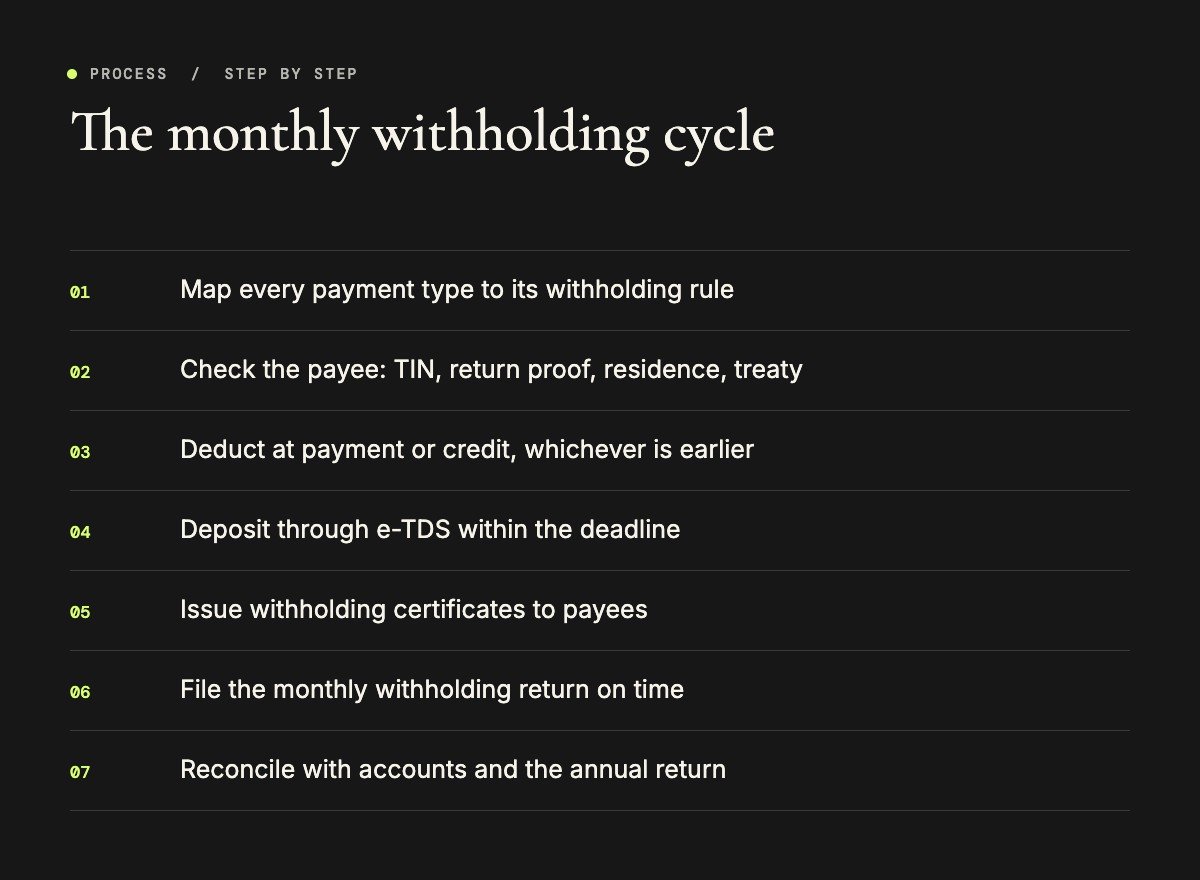
- Classify every payment. Maintain a payment matrix mapping each vendor and payment type to the withholding rule, rate and any VAT deduction.
- Check payee documents. Confirm TIN, proof of return, residence and treaty eligibility before the first payment.
- Deduct at source. Deduct at the time of payment or credit, whichever is earlier, and record the deduction in the ledger.
- Deposit through e-TDS. Generate challans and deposit within the deadline, keeping proof of payment.
- Issue certificates. Provide withholding certificates to payees so they can claim credit.
- File the monthly return. Submit the withholding return with details of all deductions for the month.
- Reconcile. Reconcile deductions with the general ledger, bank statements and the annual return, and fix differences promptly.
Monthly withholding returns
The Income Tax Act 2023 requires withholding entities to file returns of tax deducted. Practitioner guides describe a monthly withholding return due by the 15th of the following month, with limited extension available. Late filing attracts penalties separate from those for late deposit. Diarise both deadlines: deposit and return.
Consequences of getting withholding tax in Bangladesh wrong
The Act gives the NBR several tools against companies that mishandle withholding tax in Bangladesh. The main consequences are:
- Defaulting taxpayer. A person who fails to deduct or deposit can be treated as an assessee in default for the tax not deducted or not paid.
- Additional tax. Additional tax accrues on the unpaid amount for the period of default, at a monthly rate set by the Act.
- Disallowance. Expenses paid without required deduction can be disallowed in computing the payer's own taxable income, increasing corporate tax.
- Penalties. Penalties apply for failure to deduct, failure to deposit and late returns, and serious or deliberate failures can lead to prosecution.
- Audit exposure. Withholding is one of the first areas the NBR examines in a tax audit.
Because disallowance increases corporate tax, a single missed deduction can cost the company the withholding amount plus tax on the disallowed expense. For large recurring payments, the exposure grows month by month.
Withholding failures often surface only during audit, years after the payments. By then, the vendor may be gone and recovery from them impossible. The company bears the tax, additional tax and disallowance. Annual internal reviews catch these early.
VAT deduction at source
Alongside income tax, the VAT and Supplementary Duty Act 2012 requires certain entities to deduct VAT at source (VDS) from payments for specified supplies and services. Withholding entities for VAT include government bodies, banks, insurance companies, finance companies, NGOs, educational institutions, limited companies and others listed by the NBR.
VDS has its own rates, certificates and return, the monthly VAT return. A company that handles income tax withholding well but neglects VDS still faces exposure. Our tax practice often reviews both together, because they share the same vendor data.
Imports and exports
At import, customs collect advance income tax and advance VAT together with duties. At export, banks deduct tax from export proceeds. These are collections at source rather than deductions by the company, but they affect cash flow and must be recorded correctly to claim credit.
Withholding and the company's own tax return
Tax deducted from the company's own income, such as on its export receipts, interest or contract revenue, is credited against its corporate tax liability. In some cases, the deduction is treated as the minimum tax payable regardless of profit, which matters for loss-making companies. The company should reconcile all withholding certificates received with the NBR's records before filing.
Withholding paid on behalf of others also appears in the corporate return through the reconciliation of expenses. Disallowances arising from missed withholding feed directly into taxable income. Our guide to company income tax return filing explains how these pieces fit together at year end.
Building a robust process
From our experience advising companies on withholding tax in Bangladesh, the companies that stay compliant share a few habits:
- A single payment matrix, owned by finance and updated after every Finance Act.
- Vendor onboarding that collects TIN, return proof and treaty documents before the first payment.
- ERP controls that block payment without a withholding code.
- A monthly checklist covering deposit, certificates and both income tax and VAT returns.
- An annual review by an external adviser, focused on payments to non-residents and large recurring vendors.
Foreign investors setting up a new entity should build these controls from day one. See our guide to legal requirements for a new business for the registrations that come first.
Disputes and assessments
When the NBR assesses a company for failures in withholding tax in Bangladesh, the company can respond in writing, seek a hearing, and if necessary appeal to the Commissioner of Taxes (Appeals) and then the Taxes Appellate Tribunal, with further reference to the High Court Division on questions of law. Alternative dispute resolution is also available in tax matters. Strict time limits apply at each step.
In any dispute over withholding tax in Bangladesh, the best defence is documentation. Withholding challans, certificates, payee documents, treaty certificates and the reasoning for any classification decision should be kept for each payment. A company that can show a reasoned position, even if the NBR disagrees, is in a stronger position on penalties.
Frequently asked questions about withholding tax in bangladesh
Which law governs withholding tax in Bangladesh?
The Income Tax Act 2023, which replaced the Income Tax Ordinance 1984 from tax year 2023-24, with rates set by the annual Finance Act. VAT deduction at source is governed by the VAT and Supplementary Duty Act 2012.
Does a small private company have to deduct tax?
Yes. Companies are specified persons under the Act and must deduct tax from relevant payments, whatever their size.
What happens if we forget to deduct tax from a vendor?
The company can be treated as a defaulting taxpayer for the shortfall, pay additional tax, and have the expense disallowed in its own tax computation. Correct the position as soon as it is found.
Can we apply a treaty rate on payments abroad?
Yes, if a double tax treaty applies and you hold a certificate of tax residence and supporting evidence from the payee. Without them, deduct at the domestic rate.
How do we deposit withheld tax?
Through the NBR's e-TDS system, which generates challans and links deductions to payees' records. Deposit within the deadline in the current rules.
Is VAT deduction at source the same as income tax withholding?
No. VDS is a separate obligation under the VAT law, with its own rates, certificates and monthly VAT return.
How we can help
We advise companies on withholding tax in Bangladesh: payment matrices, cross-border payments and treaty claims, e-TDS processes, health checks before audit, and representation in assessments and appeals. Learn more about our tax law practice.
Worried about your withholding position?
We review your payments, fix gaps before audit and set up a monthly process your finance team can run.
Book a consultationTax practicePrimary sources: the Income Tax Act 2023 and VAT and Supplementary Duty Act 2012 on the Laws of Bangladesh portal; withholding rules, notifications and the e-TDS framework from the National Board of Revenue; online return services at eTaxNBR.
This article is general information about Bangladeshi tax law as of October 2026 and is not tax advice. Rates, thresholds and deadlines change with each Finance Act and NBR notification; confirm the current position with the NBR or a qualified adviser before acting.



0 Comments