
BIDA registration is the formal step that puts an investment project on the record of the Bangladesh Investment Development Authority. For foreign investors in particular, it is the gateway to the services that make a business workable: work permits for expatriate staff, approvals for remittances and loans, and access to the One Stop Service portal.

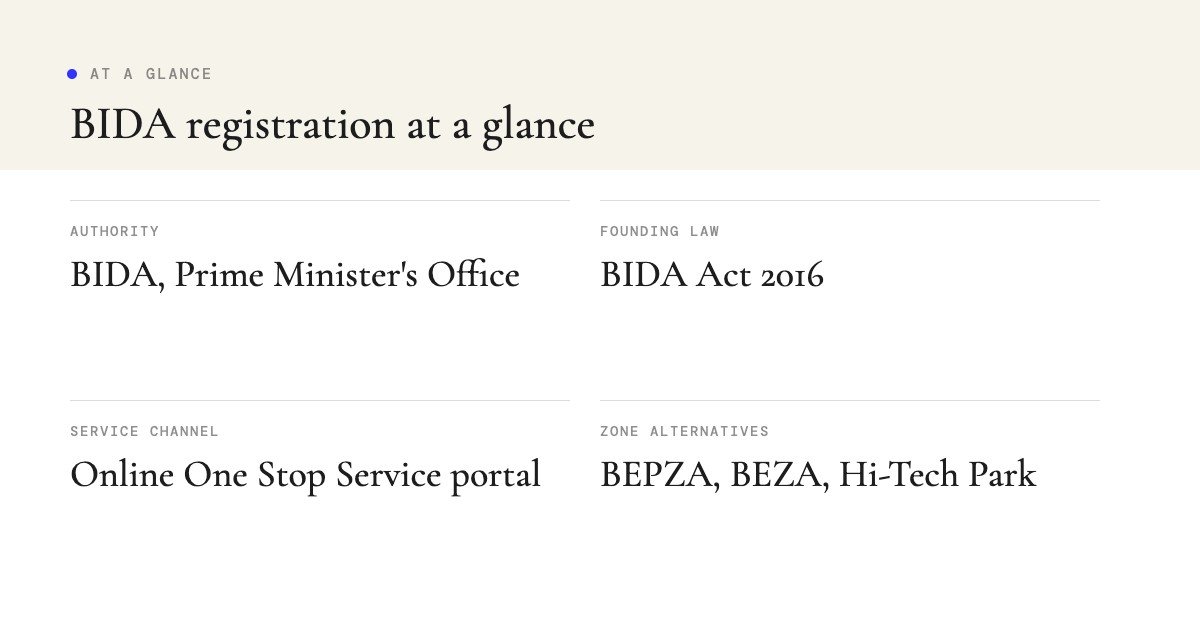
- BIDA was established under the Bangladesh Investment Development Authority Act 2016 and is the main investment promotion and facilitation agency outside the special zones.
- Projects in export processing zones, economic zones and hi-tech parks deal with BEPZA, BEZA or the Hi-Tech Park Authority instead of BIDA.
- Applications are made online through BIDA's One Stop Service platform, which operates under the One Stop Service Act 2018.
- For foreign-invested companies, proof that capital arrived through banking channels is central to the application and to later repatriation.
- Registration is not a one-time event: changes in capital, ownership, products or location usually need an amendment.
Under the Invest Bangladesh Act 2026, effective 23 August 2026, the Bangladesh Investment Development Authority (BIDA), the Bangladesh Economic Zones Authority (BEZA) and the PPP Authority were merged into a single body, Invest Bangladesh. References below to BIDA, BEZA or the PPP Authority should be read as references to Invest Bangladesh. BEPZA continues as a separate authority.
What BIDA registration is
The Bangladesh Investment Development Authority (BIDA) replaced the former Board of Investment and the Privatisation Commission under the Bangladesh Investment Development Authority Act 2016. It sits under the Prime Minister's Office and is responsible for promoting, facilitating and registering private investment across most of the country.
BIDA registration records an investment project with the Authority: who owns it, what it will produce or do, how much capital it involves, where it will operate and how many people it will employ. The registration letter is then used as a reference document by banks, other regulators and BIDA itself when processing later requests.
Industrial and commercial registration
In practice, BIDA distinguishes between industrial projects (local, foreign or joint venture) and the separate permission regime for branch, liaison and representative offices of foreign companies. This guide focuses on registration of investment projects carried on through a Bangladeshi company. Branch and liaison office permissions follow a related but distinct process, with their own conditions on activities and remittances.
Who needs BIDA registration
Whether registration is strictly required depends on the nature of the business and the investor. As a working rule, any company with foreign shareholding that intends to carry on industrial or service activity in Bangladesh outside the special zones should plan to register, because many downstream approvals assume it.
Purely local businesses often register too, particularly where they want access to BIDA facilitation services, plan to employ foreign nationals, or need recommendations for imports of capital machinery. Smaller local trading businesses frequently operate without it, relying on a trade licence, TIN and VAT registration instead.
The question to ask is not only "must we register?" but "what will we need later?" If the company will hire expatriates, remit royalties or technical fees, borrow from abroad or repatriate dividends, registration usually sits somewhere in that chain. Registering early avoids delays when those needs arise.
When another authority is the right regulator
Location decides the regulator. A factory inside an export processing zone registers with the Bangladesh Export Processing Zones Authority (BEPZA). A project in an economic zone deals with the Bangladesh Economic Zones Authority (BEZA). Hi-tech park enterprises deal with the Bangladesh Hi-Tech Park Authority. Each authority has its own one-stop service and its own incentives, and a project in a zone does not normally need a separate BIDA filing.
What you need before BIDA registration
BIDA registers an existing business, so the corporate groundwork comes first. For most investors that means incorporating a private limited company with the Registrar of Joint Stock Companies and Firms under the Companies Act 1994. Our guide to setting up a private limited company in Bangladesh walks through that stage.
Foreign shareholders must then bring in their share capital through a bank in Bangladesh. The receiving bank issues an encashment certificate or equivalent proof of inward remittance. This document matters more than almost any other: it proves that the investment is genuine foreign capital and supports later repatriation of dividends and sale proceeds under foreign exchange rules administered by Bangladesh Bank.
Typical documents for BIDA registration
The exact checklist is set by BIDA and changes from time to time, so always confirm it on the portal. Applications generally include the following.
| Document | Purpose |
|---|---|
| Certificate of incorporation, memorandum and articles | Proves the company exists and shows its objects |
| Form XII and list of shareholders and directors | Shows ownership and management |
| Trade licence and TIN certificate | Shows local business and tax registration |
| Bank encashment certificate (foreign investment) | Proves capital arrived through banking channels |
| Project profile | Describes products or services, capacity, cost and jobs |
| Office or factory lease or title documents | Confirms the project location |
| Board resolution and authorisation | Authorises the application and the signatory |
| Passport or national ID copies of directors | Identifies the people behind the company |
The BIDA registration process step by step
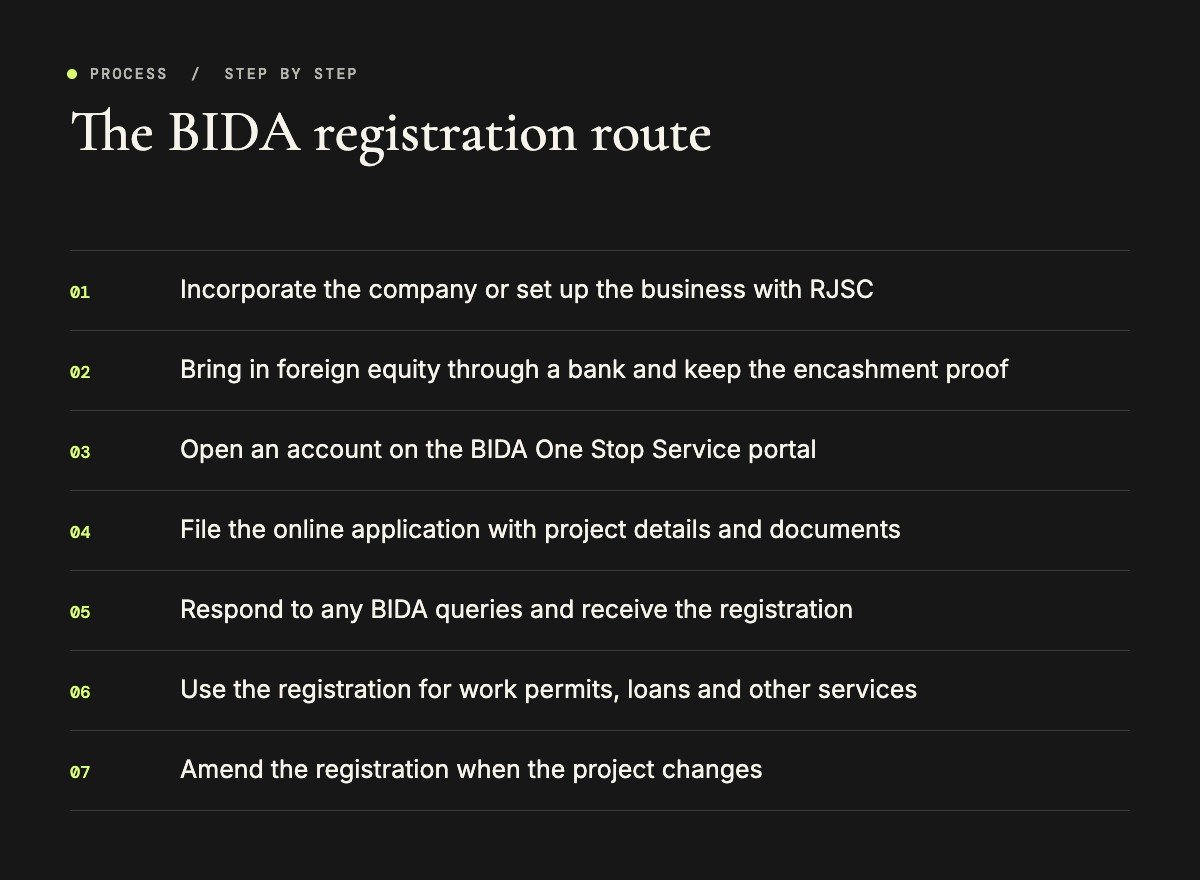
The process is online and, when the file is complete, relatively quick. Most delays we see come from mismatched information across documents rather than from BIDA itself. Here is how the process usually runs for a foreign-invested company.
- Prepare the company. Incorporate with RJSC, obtain a trade licence and TIN, and open a bank account in the company's name.
- Bring in the capital. Remit foreign equity through the bank and collect the encashment certificate showing the amount and source.
- Create a portal account. Register the company and an authorised user on the BIDA One Stop Service portal.
- Complete the application. Enter the project details: type of industry, products, annual capacity, project cost, sources of finance, machinery and manpower.
- Upload documents and pay. Attach scanned copies of the required documents and pay the government fee shown on the portal.
- Answer queries. BIDA officers may ask for clarifications or corrected documents through the portal. Respond promptly and consistently.
- Receive the registration. Download the registration letter and keep it with the company's statutory records.
BIDA publishes service timelines for many of its services. Treat them as targets rather than guarantees, and build buffer into any investment schedule that depends on them.
Getting the project profile right
The project profile is where applicants make the most avoidable mistakes. The products and activities described must fall within the objects in the memorandum. The capital figures should match the encashment certificate and the RJSC filings. The machinery list and manpower plan should be realistic, because later requests such as work permits are assessed against them.
The One Stop Service behind BIDA registration
The One Stop Service Act 2018 was passed to let investors obtain many government services through a single point of contact. BIDA, BEPZA, BEZA and the Hi-Tech Park Authority each act as one-stop service providers for the investors they regulate.
BIDA's online platform brings together its own services, such as project registration, work permits, branch office permissions and remittance recommendations, with links to services from other agencies. Depending on current integration, these can include company name clearance and incorporation with RJSC, trade licences from city corporations, TIN and VAT registration, environmental clearance and utility connections.
The range of integrated services has grown over time and continues to change. Check the portal at the time you apply to see which services can be requested online and which still require a separate application to the relevant agency.
Services that depend on BIDA registration
For most investors, registration is a means to an end. These are the services it most often unlocks.
Work permits for foreign nationals
Foreign nationals employed by a BIDA-registered company need a work permit from BIDA before starting work, alongside the appropriate employment visa. BIDA considers the company's registration, capital and local workforce when assessing applications, and there are policy expectations on the ratio of local to foreign staff. Our immigration law team handles these applications regularly.
Remittances, royalties and technical fees
Payments abroad for royalties, technical know-how, technical assistance and franchise fees are subject to foreign exchange rules and, depending on amount and type, may require BIDA recommendation or approval. A registered project with a clear record of its foreign investment is better placed to obtain these approvals.
Foreign loans and capital machinery
Medium and long-term foreign borrowing by private companies has historically required approval through a process involving BIDA and Bangladesh Bank. Import of capital machinery at concessionary duty, where available, also tends to rely on the project's registration. Check current procedures, as both areas have been revised in recent years.
Keeping BIDA registration up to date
A registration describes the project as it stood on the day of application. When the project changes, the record should change too. Common triggers for an amendment include an increase in capital, a change in shareholding (especially between local and foreign ownership), new products or services, a change of factory location, and a change of company name.
Failing to amend can cause practical problems later. A bank may question a dividend remittance where the shareholding on BIDA's file differs from RJSC records. A work permit application may stall where the registered activity no longer matches the role. Treat the BIDA record as part of the company's compliance calendar, alongside annual RJSC returns and tax filings.
Share transfers are the most frequently missed amendment. When a foreign investor buys or sells shares, update RJSC, the bank and BIDA together, and keep the evidence of payment through banking channels. Our guide to company share transfer in Bangladesh explains the RJSC side.
BIDA registration for joint ventures and regulated sectors
Joint ventures between Bangladeshi and foreign partners register as joint venture projects. The application should reflect the agreed shareholding, the capital contributions of each side and how they will be paid. If the foreign partner contributes machinery or technology instead of cash, the valuation and the route by which that contribution is recognised need careful handling under foreign exchange rules.
The joint venture agreement and the articles of association should be consistent with what is filed with BIDA. Differences in capital or shareholding between the three records are a common source of queries.
Incentives and sector restrictions
Bangladesh offers a range of incentives to investors, including tax exemptions for certain sectors and regions, concessionary duty on capital machinery and protection for foreign investment under the Foreign Private Investment (Promotion and Protection) Act 1980. Many incentives are delivered through tax and customs law rather than through the registration itself, so eligibility should be checked under the Income Tax Act 2023, customs rules and the latest Finance Act.
A small number of sectors are reserved or restricted, and some regulated sectors need a sector licence in addition to registration: for example, telecommunications (BTRC), banking and finance (Bangladesh Bank), insurance, pharmaceuticals (DGDA) and power (BERC). BIDA registration does not replace those licences.
Branch, liaison and representative offices
Not every foreign business wants a subsidiary. Some prefer to test the market or support local customers through an office of the parent company. BIDA grants permission for three types of office, each with a different scope.
A liaison or representative office may promote the parent's products, explore business opportunities and coordinate with local partners, but it may not earn income in Bangladesh. Its running costs must be met entirely by inward remittances from the parent. A branch office may carry on business within the activities approved by BIDA, such as executing contracts or providing services, and it is taxed in Bangladesh on its local income.
Practical conditions for foreign offices
Permissions are usually granted for a fixed period and must be renewed. The office must open a bank account, bring in its establishment and operating costs through banking channels, register for tax, and file returns. Expatriates working in the office still need work permits.
The choice between a branch and a subsidiary has tax, liability and exit consequences. A subsidiary is a separate legal person with limited liability; a branch exposes the parent directly. A subsidiary can also take on local investors and borrow in its own name, which a branch cannot do as easily. We usually recommend a subsidiary for any business that expects to generate significant local revenue or hold assets in Bangladesh.
Repatriation of profits and capital
Investors register their projects largely so that money can later leave the country lawfully. The Foreign Private Investment (Promotion and Protection) Act 1980 provides protection for foreign investment, including the right to repatriate capital and returns, subject to foreign exchange law.
In practice, dividends are remitted through the company's bank after the company has audited accounts, has paid or provided for tax, and has passed a proper dividend resolution. The bank will check that the shareholder is a recorded foreign investor and that the original capital came through banking channels. Dividend withholding tax applies under the Income Tax Act 2023, subject to any treaty relief.
Selling shares and exiting
When a foreign investor sells its shares, the sale price, the valuation basis and the payment route all matter. Transfers between a non-resident and a resident may need regulatory clearance and the price may be tested against a fair valuation. Proceeds are remitted abroad through the bank once tax on any capital gain has been dealt with. A clean paper trail from the original investment onwards, with the encashment certificate at its centre, is what makes this process predictable. Keep certified copies of every inward remittance record for the life of the investment.
Common mistakes with BIDA registration
- Capital that bypasses the banking channel. Investment brought in informally cannot be properly evidenced and creates repatriation problems later.
- Mismatched documents. Different capital figures or shareholders in RJSC records, the encashment certificate and the application.
- Objects that do not fit. Applying for an activity that the memorandum does not authorise.
- Wrong regulator. Applying to BIDA for a project located inside an economic zone or EPZ.
- Forgotten amendments. Not updating the registration after a share transfer or capital increase.
- Expatriates working early. Allowing foreign staff to start work before the work permit is issued.
Frequently asked questions about BIDA registration
Is BIDA registration mandatory for foreign companies?
For a foreign-invested company operating outside the special zones, registration is the normal route and many later approvals depend on it. Whether it is strictly required depends on the business, so take advice on your specific project.
Can BIDA registration be done fully online?
Yes. Applications are filed through BIDA's One Stop Service portal, and documents and fees are submitted online. BIDA may still ask for originals or clarifications.
How long does BIDA registration take?
BIDA publishes target timelines for its services. A complete, consistent file is usually processed far faster than one that attracts queries, so preparation matters most.
Does a company in an economic zone need BIDA registration?
Normally no. Projects in economic zones, export processing zones and hi-tech parks are registered with BEZA, BEPZA or the Hi-Tech Park Authority respectively.
What is the fee for BIDA registration?
The fee is set by BIDA's current schedule and has been revised from time to time. Check the amount displayed on the portal when you apply.
Do we need to update BIDA after a share transfer?
Usually yes. Changes in ownership, capital, products or location should be reflected by amending the registration so that BIDA, RJSC and bank records match.
How we can help
We prepare and file BIDA registration for foreign and joint venture companies, align the RJSC, bank and BIDA records, and handle the work permits and remittance approvals that follow. Learn more about our foreign direct investment practice.
Investing in Bangladesh?
We take foreign investors from incorporation through BIDA registration, work permits and ongoing compliance, with one team coordinating every filing.
Book a consultationForeign investment practicePrimary sources: the Bangladesh Investment Development Authority Act 2016 and the One Stop Service Act 2018 on the Laws of Bangladesh portal; services and checklists from BIDA; incorporation through RJSC; foreign exchange rules from Bangladesh Bank.
This article is general information about Bangladeshi law as of 2026 and is not legal advice. Fees, forms and procedures change; confirm current requirements with BIDA or a qualified lawyer before acting.



0 Comments