
Islamic banking in Bangladesh now holds a large share of the country's deposits, yet it still runs on a conventional banking statute, a 2009 set of central bank guidelines and a fast-growing body of circulars. Here is how the framework fits together, who supervises Shariah compliance and what changed in 2025 and 2026.
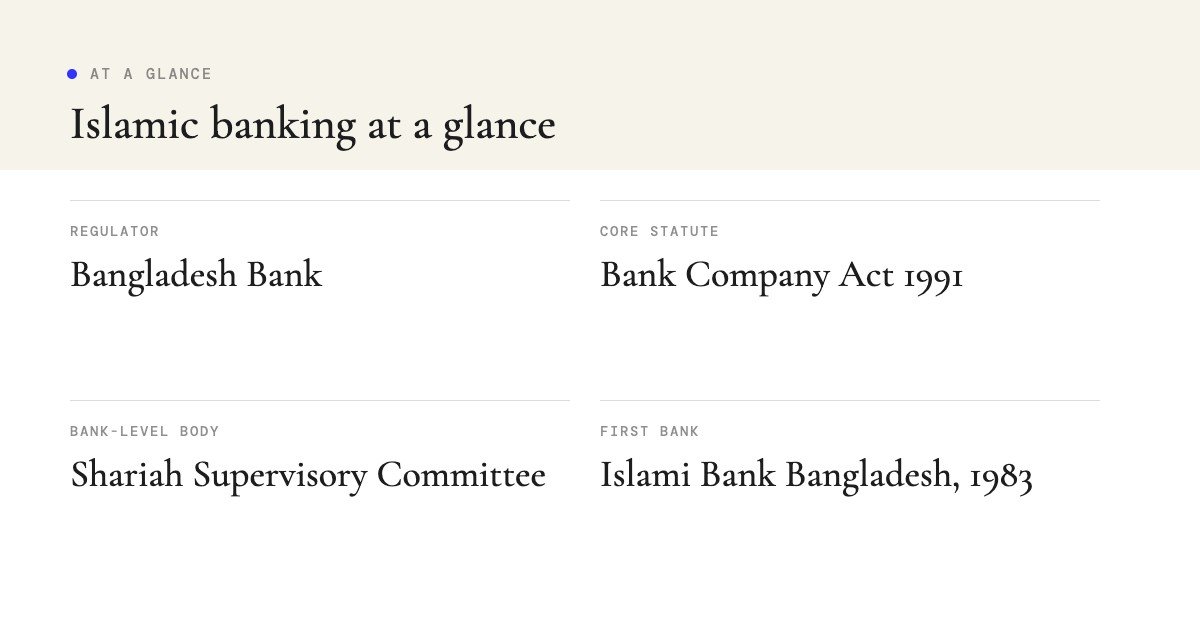
- There is no standalone Islamic banking statute yet. Islamic banks are licensed and supervised under the Bank Company Act 1991 and Bangladesh Bank's guidelines and circulars; a dedicated Islamic Banking Act has been in drafting.
- Since January 2026, every Islamic bank must run an independent Shariah Supervisory Committee under a detailed Bangladesh Bank framework issued in September 2025.
- Bangladesh Bank has approved a policy to create its own Shariah Advisory Board to set standards at national level.
- The Bank Resolution Ordinance 2025 gave the central bank power to resolve failing banks; five Islamic banks were merged into the state-owned Sammilito Islami Bank under it.
- Corporate clients should check both the commercial terms and the Shariah ruling behind any facility before signing.
Non-bank financial institutions are now governed by the Finance Company Act 2023, which replaced the Financial Institutions Act 1993; such institutions are now called finance companies. References below to the 1993 Act should be read accordingly.
What Islamic banking in Bangladesh looks like today
Islamic banking began in Bangladesh in 1983 with the establishment of Islami Bank Bangladesh. Over four decades the sector grew from a single institution into one of the most significant parts of the banking system, with full-fledged Islamic banks, Islamic branches of conventional banks and Islamic windows all competing for deposits.
Reports published in late 2025 described ten full-fledged Islamic banks and more than thirty conventional banks offering Islamic products through branches or windows. Those figures move as banks convert, merge or open windows, so treat them as a snapshot and check Bangladesh Bank's latest data before relying on them.
For businesses and individuals, the practical point is simple. Islamic banking in Bangladesh is mainstream, not niche. Many companies already hold Mudaraba deposit accounts, import under Murabaha or Bai-Muajjal lines, or finance equipment through Ijarah, sometimes without fully understanding how those contracts differ from an ordinary loan.
Why the regulatory picture is changing
The years 2024 to 2026 brought the biggest shake-up the sector has seen. Governance failures at several Shariah-based banks, heavy concentration of financing to connected groups and liquidity stress led the authorities to intervene. The response has been threefold: tighter Shariah governance at bank level, a planned national Shariah authority at Bangladesh Bank, and new resolution powers for failing banks.
The legal framework for Islamic banking in Bangladesh
Understanding the legal framework for Islamic banking in Bangladesh starts with an uncomfortable fact: the main statute was written for conventional banks. Islamic banks are bank companies like any other, and Shariah requirements sit on top of that general law through regulation and contract.
The Bank Company Act 1991
Every Islamic bank is incorporated under the Companies Act 1994 and licensed as a bank company under the Bank Company Act 1991. The Act governs licensing, minimum capital, board composition, lending limits, related-party exposure, audits and Bangladesh Bank's powers to inspect, direct and remove directors. Amendments over the years have recognised Shariah-based bank companies within the Act, but the core prudential rules apply to them as they apply to everyone.
That means the directors of a bank engaged in Islamic banking in Bangladesh face the same duties, single-borrower limits and fit-and-proper tests as their conventional counterparts. Shariah compliance is an additional obligation, not a substitute for prudential compliance.
Bangladesh Bank guidelines and circulars
The cornerstone regulatory document for Islamic banking in Bangladesh has been Bangladesh Bank's Guidelines for Conducting Islamic Banking, issued in 2009. The guidelines cover the basic principles, permitted modes of investment, deposit products, the role of Shariah committees and the conditions for conventional banks opening Islamic branches or windows.
Since then, a dedicated department within Bangladesh Bank responsible for Islamic banking regulation and policy has issued circulars on Shariah governance, liquidity, profit distribution, accounting presentation and specific refinance schemes. In practice, these circulars matter as much as the 2009 guidelines, and a compliance review must cover both.
The proposed Islamic Banking Act
Industry bodies and Bangladesh Bank have long argued that Islamic banking in Bangladesh needs its own statute. In July 2026, a Bangladesh Bank executive director publicly said the drafting of an Islamic Banking Act had reached its final stage. At the time of writing we have not seen an enacted text, so check the current position before advising on any point the new law may change.
Several banking laws were amended or replaced by ordinance in 2024 and 2025. If you are relying on an older memo or a bank's standard terms drafted before 2025, re-check every statutory reference against the current text on the official laws portal.
Other laws that apply
Islamic banks are also bound by the Money Laundering Prevention Act 2012 and BFIU instructions, the Negotiable Instruments Act 1881 for cheques, the Transfer of Property Act 1882 and Registration Act 1908 for mortgages, and the Artha Rin Adalat Ain 2003 for recovery of dues. Islamic non-bank financial institutions are regulated under the Financial Institutions Act 2023, and Takaful operators sit under insurance law and the insurance regulator.
How Islamic banks are licensed and structured
There are three ways to offer Islamic banking in Bangladesh. Each carries different regulatory obligations, and the choice affects everything from capital planning to the way profits are calculated and distributed.
| Model | What it means | Key regulatory points |
|---|---|---|
| Full-fledged Islamic bank | The entire bank operates on Shariah principles | Licensed under the Bank Company Act 1991; must maintain a Shariah Supervisory Committee and Shariah Secretariat |
| Conversion of a conventional bank | An existing bank converts its whole business | Needs Bangladesh Bank approval, a conversion plan and a strategy for legacy interest-based assets and liabilities |
| Islamic branch | A dedicated branch of a conventional bank | Separate books and funds; Islamic deposits must not be mixed with conventional funds |
| Islamic window | An Islamic counter or product line within a conventional branch | Requires prior approval and clear segregation of funds, accounts and reporting |
Segregation of funds
For conventional banks entering Islamic banking in Bangladesh, the key obligation is segregation. Money collected under Islamic deposit products must be invested only in Shariah-compliant assets, and the profit distributed to depositors must come from those assets. Commingling Islamic and conventional funds is one of the most common findings in Shariah audits and attracts regulatory attention.
Conversion is harder than it looks
A conventional bank converting to full Islamic operation must deal with existing interest-bearing loans, bonds and deposits. A realistic conversion plan sets a timetable for restructuring each portfolio, explains how impure income during the transition will be purified, and shows Bangladesh Bank how capital and liquidity will hold up.
Shariah supervision in Islamic banking in Bangladesh
The most important recent development in Islamic banking in Bangladesh is the Shariah Supervisory Committee framework. Bangladesh Bank first gave directions on Shariah committees in 2009, but those directions left membership, tenure and duties loosely defined. A circular issued on 28 September 2025, effective from January 2026, replaced that with a detailed regime.
Composition and appointment
According to published reports of the circular, every Islamic bank must form an independent Shariah Supervisory Committee of three to five members, appointed by the board. Members elect a chair, and the head of the bank's Shariah Secretariat acts as secretary without a vote. An individual may serve on no more than three such committees at once.
Members serve three-year terms, renewable up to a total of six years, after which a two-year break is required. They must hold a recognised degree in a relevant Islamic discipline and have teaching, Mufti or prior Shariah committee experience. They must also declare that they are not loan defaulters, have no relevant convictions and hold no executive post in a bank or financial institution.
Powers and duties
The committee's decisions on Shariah matters are final, and the board and management must implement them. The committee oversees policies, contracts and products, profit and loss allocation, Zakat and the use of Qard funds. Where it finds non-compliance, the board must take corrective and preventive action on its recommendations.
Importantly, the committee must notify Bangladesh Bank of any disagreement with management or the board, and must report negligence. That reporting line turns the committee from an advisory body into a genuine supervisory one.
The Shariah Secretariat
Each bank must also maintain a Shariah Secretariat to support the committee, with functions for internal Shariah audit and review, compliance and research. The Secretariat prepares an annual Shariah audit plan for the committee's approval and follows up on findings.
Members must attend at least three-quarters of meetings, and repeated absence leads to automatic removal. Banks should build attendance tracking, conflict declarations and confidentiality undertakings into appointment letters from day one, because these are now inspection items.
A national Shariah authority at Bangladesh Bank
For most of its history, Islamic banking in Bangladesh had no state-level Shariah body. Each bank's committee interpreted Shariah for that bank, which produced inconsistent product structures. An industry body, the Central Shariah Board for Islamic Banks of Bangladesh, has offered common guidance, but its views are not binding regulation.
In October 2025, Bangladesh Bank's board approved a policy to establish a Shariah Advisory Board at the central bank. Reports describe a seven-member board of Shariah scholars and Islamic finance academics, appointed by the governor, with a majority of recognised Shariah scholars. Its expected role is to set national standards, verify new product structures, resolve Shariah concerns and draw on AAOIFI and IFSB standards.
The Bank Resolution Ordinance 2025 was cited as giving the central bank power to create its own Shariah board in connection with resolving Islamic banks. How far the Advisory Board's rulings will override bank-level committees is a question the proposed Islamic Banking Act is expected to answer. Until then, treat national rulings as highly persuasive and check whether a specific circular makes them binding.
Products and contracts used in Islamic banking in Bangladesh
Islamic banking in Bangladesh does not involve lending money at interest. They enter into trade, lease and partnership contracts that produce a return linked to an asset or a venture. Knowing which contract sits behind a facility matters, because it determines ownership, risk, tax treatment and what happens on default.
| Contract | How it works | Typical use |
|---|---|---|
| Mudaraba | One party provides capital, the other manages; profit shared by agreed ratio, loss borne by the capital provider | Savings and term deposits |
| Musharaka | Both parties contribute capital and share profit and loss | Project and working-capital partnerships |
| Murabaha / Bai-Muajjal | Bank buys an asset and sells it at cost plus disclosed margin, paid later | Raw materials, imports, inventory |
| Ijarah | Bank owns and leases an asset for rent | Machinery, vehicles, equipment |
| Hire Purchase under Shirkatul Melk (HPSM) | Co-ownership with gradual transfer of the bank's share to the client | Home and long-term asset finance |
| Salam and Istisna | Advance purchase of goods, or manufacture to order | Agriculture and construction |
Approving a new product
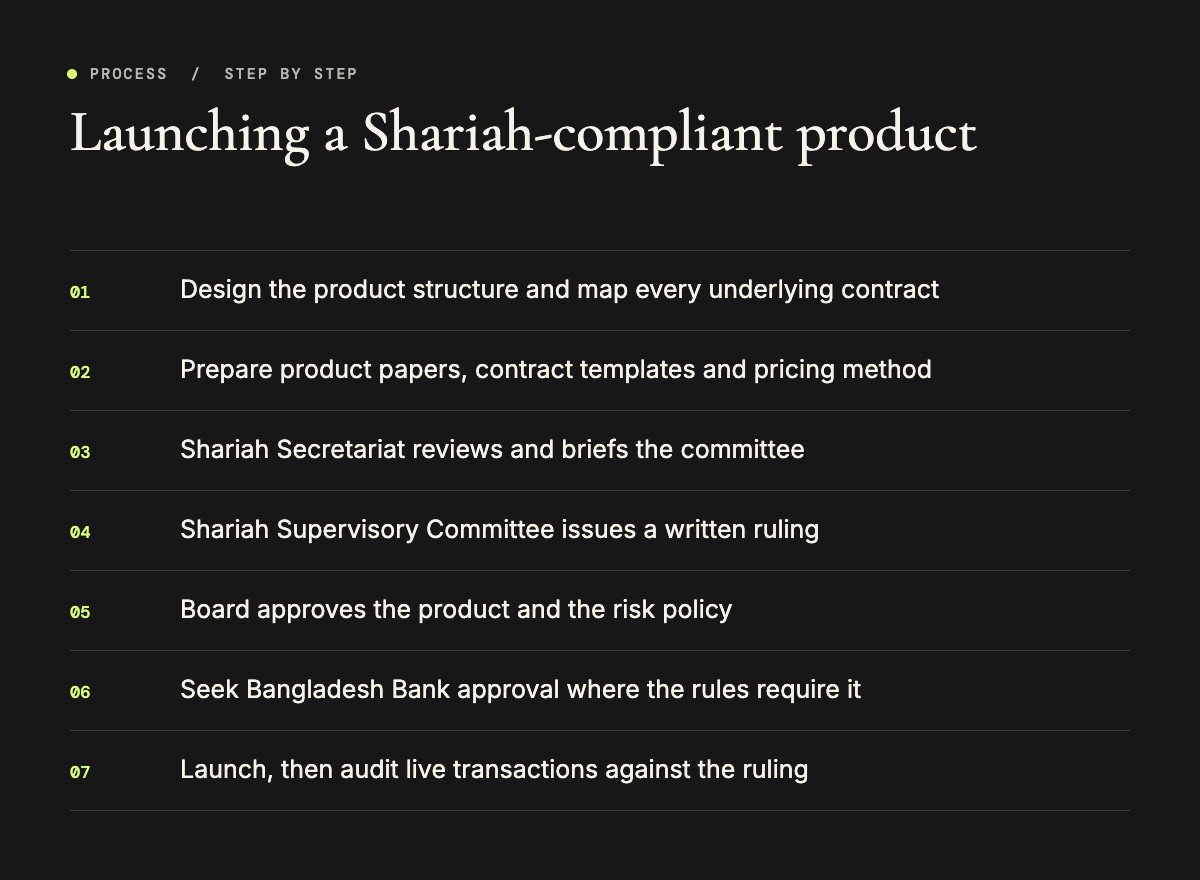
Under the current Shariah governance framework, no product may be launched without a prior Shariah ruling. Banks that follow a disciplined process avoid both regulatory findings and later customer disputes about whether a product was genuinely Shariah-compliant.
- Design the structure. Identify the underlying contracts, who owns the asset at each stage and how the return is generated.
- Prepare the product paper. Draft templates, pricing method, risk analysis and accounting treatment.
- Secretariat review. The Shariah Secretariat checks the paper against existing rulings and prepares a brief.
- Committee ruling. The Shariah Supervisory Committee issues a written ruling, with any conditions.
- Board approval. The board approves the product and its risk policy, recording the Shariah ruling in the minutes.
- Regulatory approval. Where a product departs from established structures or the circulars require it, obtain Bangladesh Bank approval before launch.
- Post-launch audit. Test live transactions against the ruling, because a sound template can still be misapplied by branches.
Where structures go wrong
The commonest Shariah audit findings are practical rather than theological. In Murabaha, the bank never actually acquires the goods, or the sale is executed after the client has already received them. In Ijarah, the bank passes all ownership risk to the client. In Mudaraba deposits, profit rates are smoothed so heavily that depositors receive a fixed return in substance. Each of these can undermine the contract.
Liquidity, sukuk and capital markets
Liquidity is a structural challenge for Islamic banking in Bangladesh. Islamic banks cannot use interest-bearing treasury bills or the conventional repo window, so they need Shariah-compliant liquidity tools. Bangladesh Bank introduced an Islamic Bank Liquidity Facility, and the government has issued Bangladesh Government Investment Sukuk, first launched in 2020, which Islamic banks can hold and use for liquidity management.
On the capital markets side, the BSEC (Investment Sukuk) Rules 2019 provide the framework for corporate sukuk issued to investors. Islamic banks have also raised regulatory capital through Mudaraba subordinated and perpetual bonds approved by Bangladesh Bank and BSEC. Any issuer must satisfy both the securities rules and the Shariah approval requirements.
Cash reserve and liquidity ratios
Islamic banks must maintain cash reserve and statutory liquidity requirements set by Bangladesh Bank. The required ratios have historically differed for Shariah-based banks and change by circular, so always confirm the current figures with Bangladesh Bank rather than relying on an older percentage.
Resolution of failing Islamic banks
The Bank Resolution Ordinance 2025 gave Bangladesh Bank formal tools to deal with failing banks: appointing administrators, transferring assets and liabilities, creating bridge banks and merging institutions. Islamic banking in Bangladesh was the first major test of those powers.
In November 2025, five Shariah-based banks, EXIM Bank, First Security Islami Bank, Global Islami Bank, Social Islami Bank and Union Bank, were placed under resolution and administrators were appointed. They were merged into Sammilito Islami Bank PLC, a state-owned Shariah-based bank that received its licence and was registered with RJSC. A writ petition challenging the merger was reported, so its outcome should be checked.
What this means for depositors and borrowers
The merger is the largest restructuring Islamic banking in Bangladesh has seen. Deposits and financing contracts with the merged banks were transferred to the new bank. Borrowers remain liable on their facilities, and the new bank can enforce security under the existing documents. Shareholders of the failed banks were reportedly asked to write their shares down to zero, a sharp reminder that resolution protects depositors before investors.
Islamic banking in Bangladesh for corporate clients
For a company using Islamic banking in Bangladesh, the documentation looks different from a conventional facility, but the legal risks are familiar. Our review of Islamic facility documents usually focuses on four areas.
- The asset trail. Make sure purchase, sale and lease documents reflect real transactions in the right order, so the facility is enforceable and Shariah-compliant.
- Pricing and late payment. Islamic banks cannot charge default interest. Late payment amounts are usually paid to charity, and compensation clauses need careful drafting.
- Security. Mortgages, hypothecation and guarantees follow general law. Registration under the Registration Act 1908 and charge filing with RJSC are still required.
- Disputes. Recovery normally goes to the Artha Rin Adalat. Where parties choose arbitration under the Arbitration Act 2001, the clause should say how Shariah questions will be decided.
For larger transactions, such as syndicated Musharaka for infrastructure or Islamic tranches in a project financing, our project finance practice works alongside the Shariah adviser to align the intercreditor terms.
Compliance checklist for Islamic banking in Bangladesh
Boards and compliance teams can use the following checklist to test their readiness for Bangladesh Bank inspection under the current regime for Islamic banking in Bangladesh:
- Shariah Supervisory Committee constituted with three to five qualified, independent members and signed declarations.
- Shariah Secretariat staffed, with audit, compliance and research functions and an approved annual audit plan.
- Every live product backed by a written Shariah ruling and board minutes.
- Islamic funds fully segregated, with separate books for branches and windows.
- Profit distribution policy disclosed to depositors and applied consistently.
- Escalation route to Bangladesh Bank documented for disagreements between the committee and management.
- Credit, related-party and large-exposure limits under the Bank Company Act 1991 met in full.
For broader banking regulatory advice, see our banking and finance practice.
Frequently asked questions about Islamic banking in Bangladesh
Is there a separate law for Islamic banking in Bangladesh?
Not yet. Islamic banks operate under the Bank Company Act 1991 and Bangladesh Bank's 2009 guidelines and later circulars. A dedicated Islamic Banking Act was reported to be in final drafting in 2026; check whether it has been enacted.
Who decides whether a product is Shariah-compliant?
At bank level, the Shariah Supervisory Committee issues a binding ruling before any product is launched. Bangladesh Bank is creating a national Shariah Advisory Board to set common standards.
Can a conventional bank offer Islamic products?
Yes, through approved Islamic branches or windows, provided Islamic funds and accounts are kept fully separate from conventional business.
Are Mudaraba deposits guaranteed?
In principle, Mudaraba depositors share in profits and losses, so returns are not fixed. Deposit protection rules and resolution law also apply, so check the current deposit protection scheme for the limit and coverage.
How are Islamic banking disputes resolved?
Most recovery claims go to the Artha Rin Adalat under the Artha Rin Adalat Ain 2003. Commercial disputes can go to arbitration if the contract provides for it, ideally with a clause on resolving Shariah questions.
How we can help
We advise banks, financial institutions and corporate clients on Islamic banking in Bangladesh, including Shariah governance frameworks, product documentation, Islamic facilities, sukuk issues and disputes. We work with your Shariah advisers to make sure contracts are both enforceable and compliant. Learn more about our Islamic finance practice.
Need advice on an Islamic facility or framework?
We review Shariah governance, product structures and financing documents against the Bank Company Act 1991 and current Bangladesh Bank rules.
Book a consultationIslamic finance practicePrimary sources: the Bank Company Act 1991 and related laws on the Laws of Bangladesh portal; circulars and guidelines from Bangladesh Bank; sukuk rules from the Bangladesh Securities and Exchange Commission.
This article is general information about Bangladeshi law as of 2026 and is not legal advice. Laws, circulars and procedures change; confirm current requirements with Bangladesh Bank or a qualified lawyer before acting.




0 Comments