
A property dispute in Sylhet often begins thousands of miles away: a family in London, Birmingham or Bradford discovers that inherited land has been occupied, mutated into someone else's name or sold on a forged deed. The law gives real remedies, but distance, missing records and old powers of attorney make speed and planning essential.
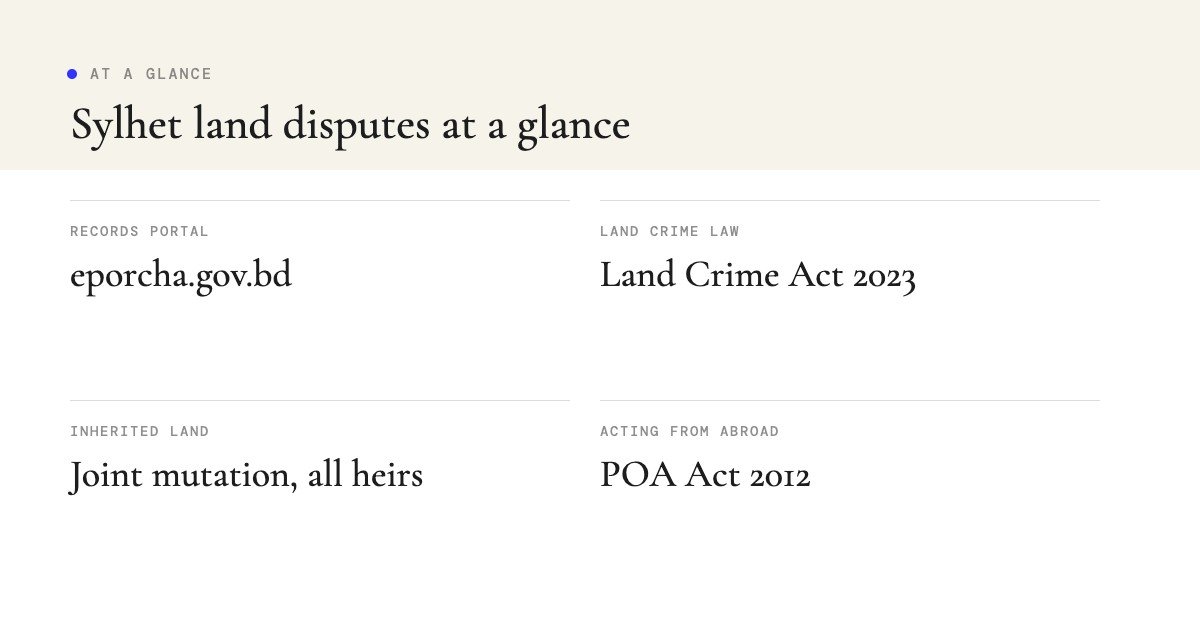
- Since February 2025, inherited land must be mutated jointly in the names of all heirs in one khatian; separate holdings need a registered partition deed or compromise deed.
- Section 52A of the Registration Act 1908 requires the seller's name to appear in the latest khatian before a sale deed can be registered, which helps stop some fraudulent sales.
- Under the Land Crime Prevention and Remedy Act 2023 and its 2024 Rules, an Executive Magistrate can protect or restore possession, with protection applications meant to finish within 45 working days.
- Since September 2025, partition and pre-emption disputes in Sylhet district must go to pre-case mediation at the District Legal Aid Office before a court case.
- Owners in the UK act through a power of attorney signed at the High Commission and authenticated in Bangladesh under the Power of Attorney Act 2012.
Why a property dispute in Sylhet so often involves UK families
Most British Bangladeshis trace their roots to Sylhet division. Many families still own ancestral homesteads, agricultural land and town plots there, often bought with remittances over several decades. Ownership is frequently spread across siblings and cousins in the UK, relatives in Bangladesh and, increasingly, a third generation that has never lived there.
That pattern creates the classic conditions for conflict. Land is managed by a caretaker or a relative, documents are kept by whoever lives nearest, and nobody updates the records after a death. When the family finally looks at the land, a property dispute in Sylhet is already under way: someone else is farming it, a building has gone up, or the record of rights shows a new name.
None of this is unique to Sylhet, but the scale of overseas ownership makes it far more common. The good news is that Bangladeshi law, especially reforms since 2023, offers better tools than many families realise.
Common types of property dispute in Sylhet
Almost every property dispute in Sylhet we see falls into a handful of patterns. Identifying which one you face decides the remedy and the forum.
| Type of dispute | Typical facts | Main remedy |
|---|---|---|
| Inheritance and partition | Heirs disagree on shares or on who gets which plot | Mediation, registered partition deed, or partition suit |
| Unlawful occupation | Relative, caretaker or neighbour takes possession | Executive Magistrate under the 2023 Act; suit for possession |
| Forged deed or fake POA | Land "sold" using forged signatures or a revoked power | Cancellation suit, criminal case, record correction |
| Wrong mutation | Khatian updated in another person's name | Objection, appeal or review before land authorities |
| Sale by a co-sharer | One heir sells part of joint land to an outsider | Pre-emption application by the other co-sharers |
| Boundary encroachment | Neighbour moves the boundary or builds over it | Survey, mediation, declaration and injunction suit |
The laws that apply in 2026
Succession to a Muslim owner's land follows Muslim personal law, applied through the Muslim Family Laws Ordinance 1961 where relevant. Title and transfer are governed by the State Acquisition and Tenancy Act 1950, the Transfer of Property Act 1882 and the Registration Act 1908. Civil remedies such as declaration, injunction and recovery of possession come from the Specific Relief Act 1877 and the Code of Civil Procedure 1908.
Three newer laws matter in almost every property dispute in Sylhet today: the Land Crime Prevention and Remedy Act 2023, which criminalises forgery and unlawful occupation and gives Executive Magistrates power to protect and restore possession; the Land Development Tax Act 2023; and the Legal Aid (Amendment) Act 2026, which made pre-case mediation mandatory for some disputes in listed districts, including Sylhet.
Sylhet's different land history
Sylhet was part of Assam until 1947, and its survey and tenancy history differs from much of the rest of Bangladesh. As a result, the chain of records for a Sylhet plot can look unfamiliar to lawyers used to other districts, and older documents may refer to Assam-era rules. Make sure whoever reviews your title knows local records.
First step: secure the records
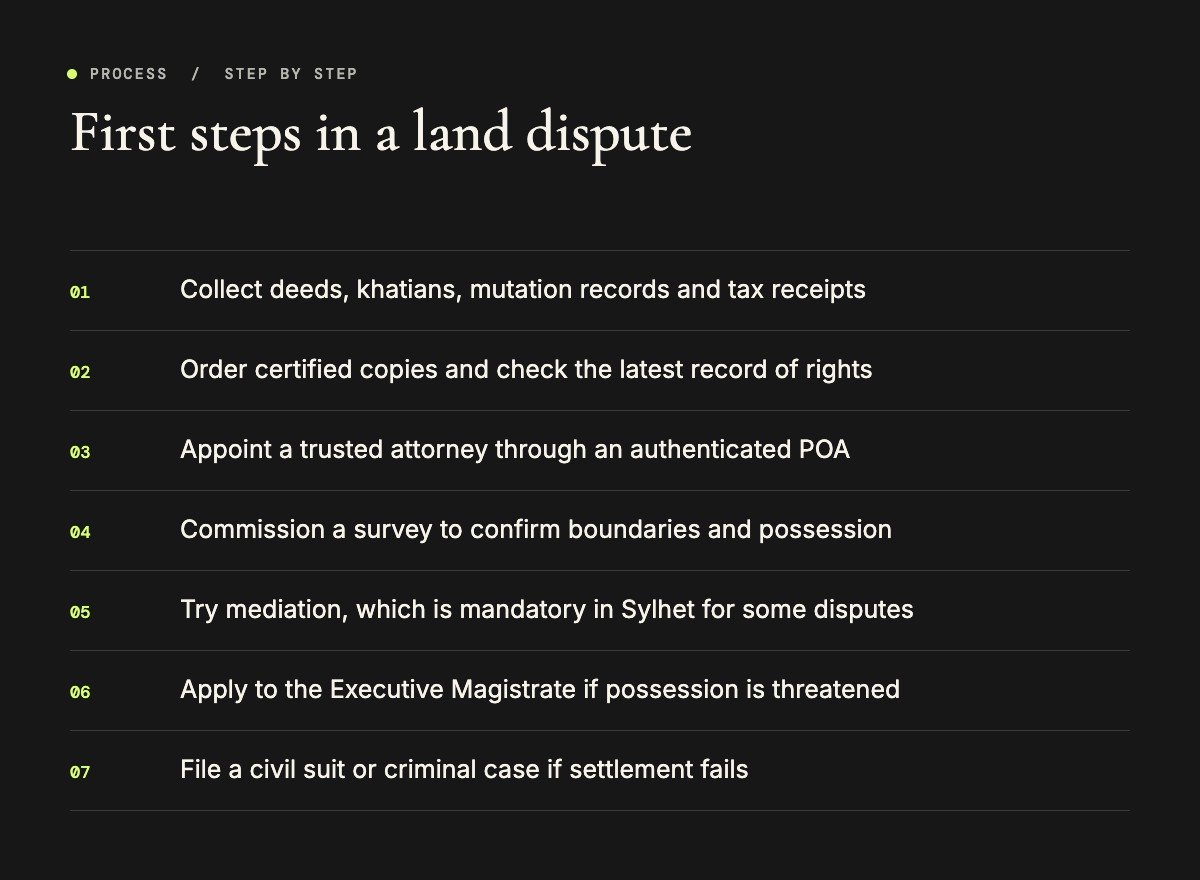
Every successful property dispute in Sylhet starts with documents. Before arguing about who is right, find out what the official records actually say. Certified copies of khatians and mouza maps can be ordered online through the Ministry of Land's e-porcha service, and land development tax records through the LD tax portal.
- Gather family papers. Collect title deeds, inheritance documents, old khatians, mutation orders, tax receipts and any previous powers of attorney.
- Order certified copies. Obtain the latest khatian, the mouza map and copies of registered deeds from the sub-registry.
- Trace the chain. Link each owner from the earliest record to the present, noting every death, sale and partition.
- Check mutation status. Confirm whose names are in the current khatian and whether any recent mutation was made without the family's knowledge.
- Survey the land. Commission a licensed surveyor to measure the plot against the map and record who is in possession.
- Check tax payments. See who has been paying land development tax, because payment records are often used as evidence of possession.
Order records before you alert the other side. Once a dispute is open, documents can go missing and new mutation applications can appear. Quiet preparation is the strongest start to any property dispute in Sylhet.
Inherited land, mutation and partition
When an owner dies, the heirs inherit by operation of law, but the record of rights does not update itself. Under a Ministry of Land notification of 11 February 2025, inherited land must now be mutated jointly in the names of all heirs in a single khatian. A separate khatian for one heir requires a registered partition deed (bantonnama) or a registered compromise deed.
This rule matters for UK families. An heir abroad who ignores mutation can find that relatives have obtained a joint khatian with incorrect shares, or have registered a partition without proper consent. Heirs should check the mutation file and object promptly if their names or shares are wrong. For proof of heirship, see our guide to obtaining a succession certificate.
Partition: deed or suit
If all heirs agree, a registered partition deed is quicker and cheaper than litigation. If they do not, any co-sharer can file a partition suit in the civil court, usually before an Assistant Judge, asking the court to declare shares and divide the land. Partition suits can take years, especially with many heirs abroad.
Mandatory mediation in Sylhet
Sylhet was in the first group of 12 districts where mandatory pre-case mediation began on 18 September 2025. Under the Legal Aid (Amendment) Act 2026, partition disputes, pre-emption cases and several family matters must first go to mediation at the District Legal Aid Office before a court case. For a property dispute in Sylhet involving family members, this is now the first formal step, and it often works well because it is free and less adversarial.
Recovering land from occupiers
Unlawful occupation by a relative, caretaker or neighbour is the most urgent kind of property dispute in Sylhet. The longer an occupier stays, the more evidence of possession builds up and the harder it becomes to remove them.
The Land Crime Prevention and Remedy Act 2023 and the Land Offences Prevention and Remedy Rules 2024, in force from 24 October 2024, give a faster administrative route. A person facing threatened dispossession can apply to an Executive Magistrate for protection, and those proceedings should conclude within 45 working days. A person already dispossessed can apply for restoration; after notice, a site inquiry and a hearing, the Magistrate can order the land restored, with police assistance if the order is not obeyed within 15 days.
Civil remedies
Civil courts remain essential in any property dispute in Sylhet where title is genuinely disputed. Under section 9 of the Specific Relief Act 1877, a person dispossessed without their consent and otherwise than by due course of law can sue to recover possession within six months of dispossession, without having to prove title. After that, a suit for declaration of title and recovery of possession is needed, usually with an application for a temporary injunction to stop further building or sale.
Forged deeds and fake powers of attorney
Forgery is a serious risk for absent owners, and it is behind many a property dispute in Sylhet. Fraudsters may use forged signatures, impersonate an owner at the sub-registry, or rely on an old power of attorney that the owner believed had lapsed. When this happens, act on three fronts at once.
- Civil: file a suit to cancel the forged deed and for declaration of title, with an injunction against further transfer.
- Criminal: lodge a complaint for forgery and cheating under the Penal Code 1860 and the Land Crime Prevention and Remedy Act 2023.
- Administrative: object to any mutation based on the forged deed and ask the land office to stay it.
Section 52A of the Registration Act 1908 helps prevention: a sale deed cannot be registered unless the seller's name is in the latest khatian, or the mutation khatian for inherited land. Keeping your own name correctly recorded is therefore one of the best protections against fraud.
Revoke any power of attorney you no longer want a relative or caretaker to use, and register or notify the revocation formally. Many disputes we handle involve a broad power signed years ago and never cancelled.
Acting from the UK through a power of attorney
Most families cannot travel for every hearing in a property dispute in Sylhet, so a reliable attorney in Bangladesh is essential. A power of attorney made abroad must follow the Power of Attorney Act 2012 and the Power of Attorney Rules 2015. It is signed in the prescribed form before a consular officer at the Bangladesh High Commission in London or a consulate, with a Bangladeshi passport or a foreign passport carrying No Visa Required (NVR) status.
Once in Bangladesh, the document is attested by the Ministry of Foreign Affairs (High Commission guidance has asked for this within two months of signing) and then authenticated at the Deputy Commissioner's office within the period set by the rules. It is not registered at a sub-registry. Our guide to the power of attorney in Bangladesh explains the formalities in detail.
Choosing the right attorney
Give a specific, limited power for the particular dispute rather than a general power over all your property. Name a person you trust who has no competing interest in the land, and ask for regular written updates with copies of every filing and order.
Evidence that persuades courts and magistrates
Whatever the forum, the side with better evidence usually wins. In a property dispute in Sylhet that means certified copies rather than photocopies, a consistent chain of title, survey reports prepared with notice to neighbours, land development tax receipts, utility bills or caretaker agreements showing possession, and dated photographs. Statements from neutral local witnesses, such as long-standing neighbours, carry more weight than statements from family members.
Keep the originals of key deeds in a safe place, ideally outside the house on the disputed land. Give your lawyer scanned copies and produce originals only when the court calls for them.
Buying, selling and dual nationality
A property dispute in Sylhet often surfaces when a family tries to sell. Buyers now insist on a clean, updated khatian because of section 52A, so mutation must be completed first. Joint land also raises pre-emption: under section 96 of the State Acquisition and Tenancy Act 1950, a co-sharer can apply to pre-empt a sale of a share to an outsider, which can unwind a sale that ignored other heirs.
British Bangladeshis who hold dual citizenship are Bangladeshi citizens and can own and transfer land in the usual way. Heirs who are foreign nationals only should take advice before buying land, although inheritance itself is not defeated by foreign nationality. Sale proceeds sent to the UK must move through banking channels under Bangladesh Bank's foreign exchange rules.
Costs and timelines
Families often ask how long a property dispute in Sylhet will take. Mediation at the Legal Aid Office can resolve a family disagreement in weeks if the parties engage. An Executive Magistrate's protection order under the 2023 Act is designed to take around 45 working days. Contested civil suits for partition, declaration or cancellation commonly take several years through trial and appeal.
Court fees depend on the valuation of the suit and the type of relief, and survey, certified copy and lawyer's fees add to the cost. Because litigation is slow, a realistic plan usually combines urgent steps to protect possession with negotiation towards a registered settlement.
Practical tips for UK-based owners
- Keep the khatian current. Complete mutation after every death, sale or partition.
- Pay land development tax. Pay it yourself, online if possible, and keep the receipts.
- Visit or inspect regularly. Photograph the land and boundaries, or ask your lawyer to arrange periodic inspections.
- Use written caretaker agreements. Make clear that a caretaker holds possession on your behalf, not as owner or tenant.
- Act quickly. Some remedies have six-month or similar deadlines; delay weakens every property dispute in Sylhet.
Families in England and Wales may also face cross-border issues, such as UK wills dealing with Bangladeshi land or UK court orders on divorce. Our England and Wales desk helps coordinate these with advisers in both countries.
Frequently asked questions about property dispute in Sylhet
Can I handle a property dispute in Sylhet without travelling?
Largely yes. With a properly executed and authenticated power of attorney, your attorney and lawyer can file cases, attend hearings and handle records. You may need to attend in person to give evidence on contested facts.
A relative has occupied our land. What is the fastest remedy?
An application to the Executive Magistrate under the Land Crime Prevention and Remedy Act 2023 for protection or restoration of possession is often the quickest route. A suit under section 9 of the Specific Relief Act 1877 must be filed within six months of dispossession.
Do I have to try mediation first?
For partition, pre-emption and certain family disputes in Sylhet district, yes. Pre-case mediation at the District Legal Aid Office has been mandatory there since September 2025.
Someone mutated our inherited land in their own name. What can we do?
Object to the mutation or appeal it before the land authorities, citing the February 2025 rule that inherited land must be mutated jointly in all heirs' names. If a forged document was used, add civil and criminal proceedings.
Can a foreign-national heir inherit land in Bangladesh?
Inheritance is governed by personal law and is not defeated by foreign nationality, but buying land is different. Dual citizens have full rights; foreign-only nationals should take advice on acquisition and sale.
How we can help
We act for UK-based families in Sylhet land matters: tracing title and records, correcting mutation, negotiating and mediating family settlements, protecting possession before Executive Magistrates, and litigating partition, possession and forgery cases. We work through authenticated powers of attorney and keep clients abroad informed at every step. Learn more about our Sylhet practice.
Facing a land dispute back home?
We review your documents, check the official records and set out a clear plan to protect your family's property, wherever you live.
Book a consultationSylhet practicePrimary sources: the Land Crime Prevention and Remedy Act 2023, the Registration Act 1908, the Specific Relief Act 1877, the State Acquisition and Tenancy Act 1950 and the Power of Attorney Act 2012 on the Laws of Bangladesh portal; land records from e-porcha and the Ministry of Land; land development tax via LD Tax.
This article is general information about Bangladeshi law as of 2026 and is not legal advice. Rules, fees and procedures change; confirm current requirements with the relevant land office, court or a qualified lawyer before acting.

0 Comments