
A trademark opposition in Bangladesh is the formal challenge a brand owner files against someone else's application after it is published in the Trademarks Journal. It is usually cheaper and faster than cancelling a registered mark later, but the window is short: two months from advertisement, with limited extensions.
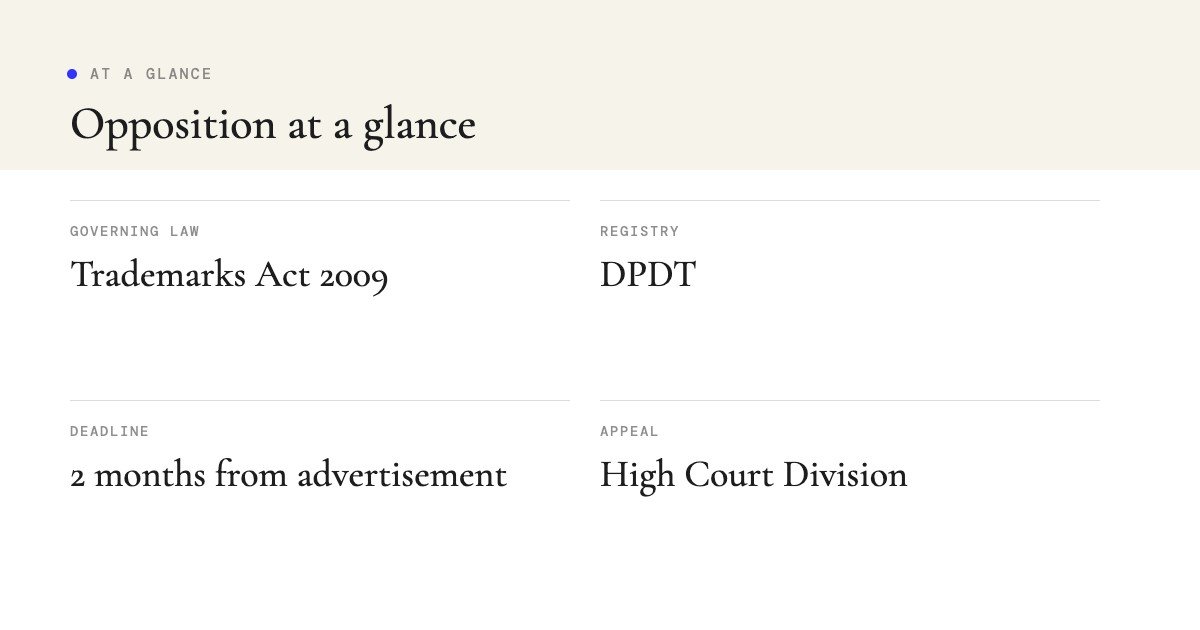
- Section 18 of the Trademarks Act 2009 allows any person to oppose a published application by filing a notice within two months of the advertisement in the Trademarks Journal.
- Practitioner summaries report that the period can be extended by up to three further months, by monthly requests with fees; do not rely on an extension being granted.
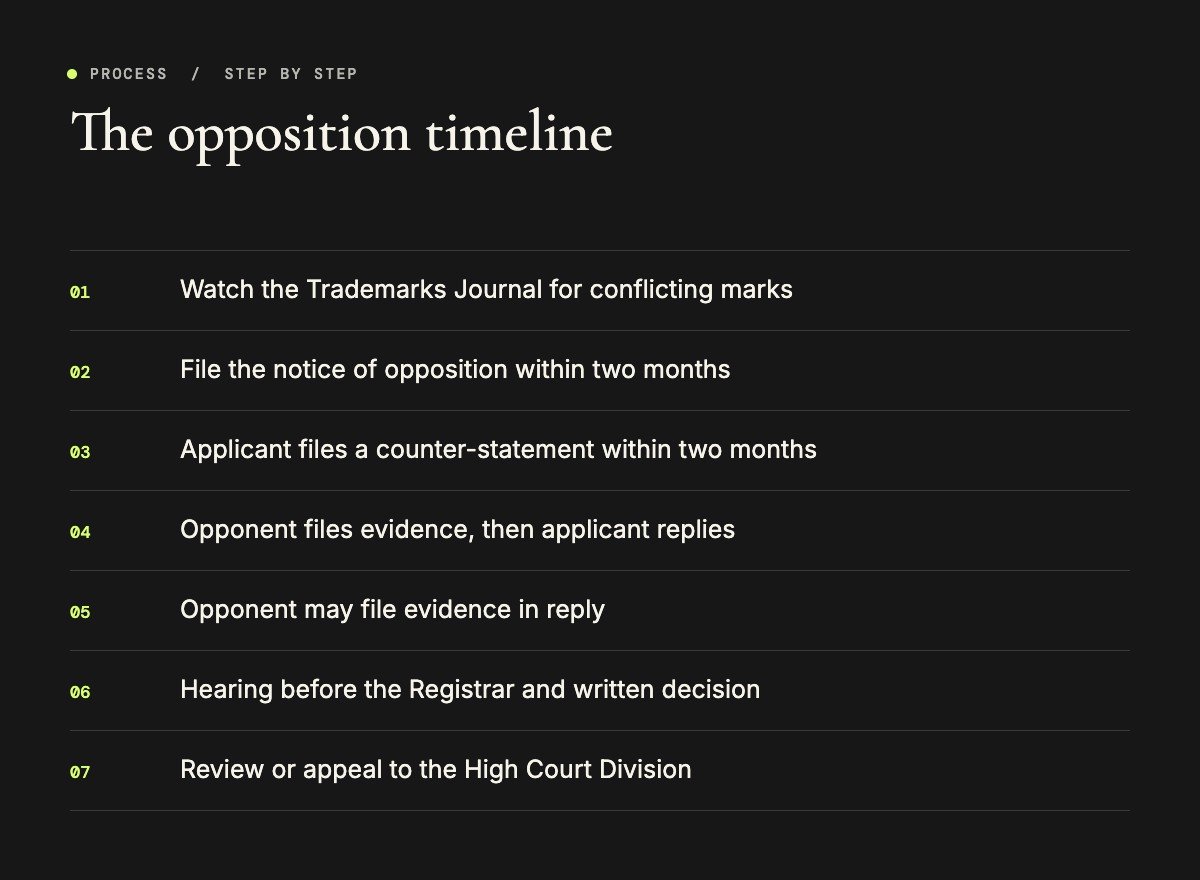
- The process runs in stages: notice, counter-statement, evidence from each side, a hearing before the Registrar and a written decision.
- Missing a deadline has severe consequences: an applicant who fails to file a counter-statement is treated as having abandoned the application, and an opponent who fails to file evidence is treated as having abandoned the opposition.
- Decisions can be reviewed by the Registrar or appealed to the High Court Division within the time allowed.
What a trademark opposition in Bangladesh is
Trademarks in Bangladesh are registered by the Department of Patents, Designs and Trademarks (DPDT) under the Trademarks Act 2009 and the Trademarks Rules made under it. After examination, an accepted application is advertised in the Trademarks Journal so that the public can object before registration. That objection is a trademark opposition in Bangladesh.
Opposition gives prior rights holders a chance to stop conflicting marks at the threshold. Once a mark is registered, removing it requires rectification proceedings, which are more complex and place a heavier burden on the challenger. For brand owners, watching the Journal and opposing promptly is one of the most cost-effective forms of brand protection available. Our guide to the trademark registration process explains the steps before publication.
Who can oppose
Section 18 allows "any person" to oppose, so an opponent does not need to hold a Bangladeshi registration. In practice, opponents are usually owners of earlier registered or pending marks, owners of unregistered marks used in Bangladesh, and owners of well-known foreign marks whose reputation extends to Bangladesh.
Grounds for trademark opposition in Bangladesh
The grounds of opposition generally mirror the grounds on which the Registrar may refuse registration under the Trademarks Act 2009, principally sections 8 to 10. Common grounds include the following.
| Ground | What the opponent must show |
|---|---|
| Identical or similar earlier mark | An earlier mark for identical or similar goods or services, creating a likelihood of confusion |
| Well-known mark | The opponent's mark is well known and the applicant's mark would take unfair advantage or cause confusion |
| Prior use and passing off | The opponent used the mark in Bangladesh first and has goodwill that the applicant's use would damage |
| Lack of distinctiveness | The mark is descriptive, generic or customary in trade |
| Deceptive or contrary to law | The mark is likely to deceive or cause confusion, or contains prohibited matter |
| Bad faith | The applicant copied a mark it knew belonged to another, for example a former distributor |
The strength of an opposition depends on evidence. A ground is only as good as the documents that support it, so the choice of grounds should follow a careful review of what the opponent can prove.
Former distributors and agents filing the brand owner's mark in their own names is a recurring problem in Bangladesh. Distribution agreements, correspondence and invoices showing the relationship are powerful evidence of bad faith. Keep them organised before a dispute arises.
The deadline: two months from advertisement
The notice of opposition must be filed within two months of the date of advertisement of the application in the Trademarks Journal. Practitioner guidance notes that, in practice, the period is often counted from when the Journal is made available to the public, and that extensions of up to three months can be requested in monthly increments with fees.
Because the Journal's publication and availability dates can differ, and because extensions are discretionary, the safest approach is to treat the earliest possible date as the start of the period. A trademark opposition in Bangladesh filed late may simply be refused, leaving only the slower route of rectification after registration.
Watching the Journal
Brand owners should run a watching service covering the classes and marks that matter to them. The DPDT publishes journals periodically, and an experienced agent can review them for identical and confusingly similar marks. Early detection gives time to collect evidence and, sometimes, to negotiate with the applicant before filing.
Step-by-step: the opposition procedure
The procedure for a trademark opposition in Bangladesh is set by the Act and Rules and is largely written. The stages below summarise practice as reported by practitioners; check current forms and fees with the DPDT.
- Notice of opposition. The opponent files a notice stating the grounds, with the prescribed fee and a power of attorney if filed through an agent. The Registry serves a copy on the applicant.
- Counter-statement. The applicant must file a counter-statement within two months of receiving the notice, setting out the grounds on which it relies. If it does not, the application is treated as abandoned.
- Opponent's evidence. The opponent files evidence in support, usually by statutory declaration with exhibits, within two months of receiving the counter-statement. Failure means the opposition is treated as abandoned.
- Applicant's evidence. The applicant files evidence in support of its application within two months of receiving the opponent's evidence.
- Evidence in reply. The opponent may file evidence strictly in reply, within one month.
- Hearing. The Registrar issues a hearing notice; parties confirm attendance and pay the hearing fee within the time stated, then present arguments.
- Decision. The Registrar decides whether to allow registration, refuse it or allow it with conditions or limitations, and notifies the parties.
Evidence that works
Good evidence in a trademark opposition in Bangladesh includes registration certificates, sales invoices and turnover figures in Bangladesh, advertising and marketing materials, import and customs records, market surveys, media coverage and evidence of international reputation. Evidence should be dated, relevant to Bangladesh where possible and exhibited properly in a statutory declaration.
Assessing similarity: how the Registrar compares marks
Most oppositions turn on whether the marks are confusingly similar. The Registrar compares the marks as a whole, looking at visual, phonetic and conceptual similarity, while giving weight to the dominant and distinctive elements. In Bangladesh, phonetic similarity deserves particular attention, because many consumers order products by name, in Bengali or English, rather than by reading labels closely.
The goods and services matter as much as the marks. Identical marks may coexist for unrelated goods, while similar marks for the same goods sold through the same channels to the same customers are likely to conflict. For pharmaceuticals, food and other products where confusion could harm health, Bangladeshi tribunals have traditionally applied a stricter standard. A trademark opposition in Bangladesh should therefore analyse the specification of goods carefully, not just the marks.
Transliteration and Bengali marks
Brands often appear in both English and Bengali script. An applicant may file the Bengali transliteration of a well-known English mark, or a mark that sounds the same when spoken. Opponents should present evidence of how the mark is pronounced and used in the market, including Bengali-language advertising, packaging and online listings. This is an area where a trademark opposition in Bangladesh differs from oppositions in single-script markets.
Opposition strategy for brand portfolios
Companies with many brands should decide in advance which oppositions are worth filing. Priorities usually include marks identical or very close to core brands, marks filed by former distributors or business partners, marks in the company's main product classes and filings that look like part of a pattern of copying. Lower-risk conflicts can sometimes be handled by a warning letter or simply monitored.
A written policy helps local teams act within the deadline without waiting for head office approval for every case. Each trademark opposition in Bangladesh then follows a consistent standard of evidence and argument, which strengthens the brand owner's position over time.
Hearing and decision
At the hearing of a trademark opposition in Bangladesh, each side presents its case, usually through an advocate or registered agent. The Registrar considers the similarity of the marks, the similarity of the goods or services, the nature of the market and consumers, evidence of actual confusion and the parties' conduct. If a party does not attend after notice, the Registrar may decide in its absence.
The decision should be in writing with reasons. Parties should obtain the grounds of decision promptly, because they are needed for any review or appeal. A successful opponent may also seek costs, although cost awards are generally modest.
Settlement
Many oppositions settle. The applicant may agree to withdraw, limit its specification of goods, change the mark or enter into a coexistence agreement. Settlement terms should be written and, where they affect the register, filed with the DPDT. A coexistence agreement should define the markets, get-up and territories carefully to avoid future disputes.
Review and appeal
A party dissatisfied with the Registrar's decision may apply to the Registrar for review within the period set by the Rules, reported by practitioners as three months from notification. Alternatively, an appeal lies to the High Court Division, within the period set by the Act, reported as ninety days from receipt of the decision.
Appeals are decided on the record and the law, so the quality of evidence filed before the Registrar matters greatly. New evidence on appeal is not freely admitted. Our Supreme Court practice handles appeals from the DPDT.
The timetable in a trademark opposition in Bangladesh is unforgiving. An applicant who forgets the counter-statement loses the application; an opponent who forgets its evidence loses the opposition. Diarise every deadline from the date of receipt of each document and keep proof of receipt.
Opposition versus rectification and infringement
If the opposition period has passed and the mark is registered, an aggrieved person can apply for rectification or cancellation of the register on grounds such as non-use, bad faith or wrongful entry. Rectification can be filed before the Registrar or the High Court Division depending on the circumstances.
Where the other party is already using a conflicting mark, the brand owner may also bring infringement or passing off proceedings in the District Court, seeking an injunction and damages. A trademark opposition in Bangladesh, a rectification action and an infringement suit can run in parallel, but they should be coordinated so that evidence and positions are consistent.
| Route | When | Forum |
|---|---|---|
| Opposition | After advertisement, before registration | Registrar of Trademarks (DPDT) |
| Rectification or cancellation | After registration | Registrar or High Court Division |
| Infringement or passing off | When the conflicting mark is used | District Court |
| Customs action | When infringing goods are imported | Customs authorities |
Foreign brand owners
In trademark opposition in Bangladesh, foreign companies are frequent opponents, especially where local traders register well-known international marks. Foreign opponents need a power of attorney in favour of a Bangladeshi agent or advocate, usually notarised and, depending on DPDT practice, legalised. Prepare it early, because document formalities often take longer than drafting the opposition itself.
Evidence of reputation in Bangladesh can be harder for foreign owners to assemble if they have not yet entered the market. Evidence of spill-over reputation, such as international advertising reaching Bangladeshi consumers, online sales, travel retail and media coverage, can help establish that a mark is well known. Registration in Bangladesh before market entry remains the best protection.
Applicants facing an opposition
If your application is opposed, do not ignore the notice. Review the grounds with your adviser, assess the opponent's likely evidence and consider whether a limitation of goods or a coexistence agreement could resolve the matter. If you defend, file the counter-statement within two months and plan your evidence.
Applicants with genuine prior use, a clear commercial rationale for their mark and no knowledge of the opponent are often in a strong position. Applicants who adopted a mark close to a famous brand should consider early settlement, because a finding of bad faith can affect their other applications and their reputation.
Costs and timing
Official fees for filing, extensions and hearings are set by the Rules and change from time to time; check the current schedule on the DPDT website. Contested oppositions often take a year or more to reach a decision, depending on the evidence and the Registry's workload. Settlement can shorten this dramatically.
Practical checklist
- Register core marks early in all relevant classes, including Bengali versions where used.
- Run a Journal watch and review results promptly.
- Keep dated evidence of use, sales and advertising in Bangladesh.
- Prepare powers of attorney in advance if you are a foreign owner.
- Diarise every deadline in the opposition from the date of receipt.
- Consider settlement and coexistence options at each stage.
These habits make any trademark opposition in Bangladesh faster, cheaper and more likely to succeed.
Frequently asked questions about trademark opposition in bangladesh
How long do I have to oppose a trademark in Bangladesh?
Two months from the advertisement of the application in the Trademarks Journal under section 18 of the Trademarks Act 2009. Extensions may be available on request, but should not be relied on.
Do I need a registered mark in Bangladesh to oppose?
No. Any person may oppose. Owners of unregistered marks with goodwill in Bangladesh, and owners of well-known marks, can oppose on appropriate grounds.
What happens if the applicant does not reply?
If the applicant fails to file a counter-statement within the time allowed, the application is treated as abandoned.
Can the Registrar's decision be appealed?
Yes. A party may seek review by the Registrar or appeal to the High Court Division within the periods set by the Act and Rules.
Is opposition better than cancellation after registration?
Usually yes. Opposition is generally faster and cheaper, and the applicant has not yet acquired a registered right.
Can we settle an opposition?
Yes. Parties often settle by withdrawal, limitation of goods, a change of mark or a coexistence agreement, recorded in writing and filed where needed.
How we can help
We act for brand owners and applicants in every trademark opposition in Bangladesh: Journal watching, notices and counter-statements, evidence, hearings, settlement and appeals, together with rectification and infringement actions. Learn more about our intellectual property practice.
Spotted a conflicting mark?
We assess your grounds and evidence quickly and file within the deadline, or defend your application if it is opposed.
Book a consultationIP practicePrimary sources: the Trademarks Act 2009 on the Laws of Bangladesh portal; procedures, journals and fees of the Department of Patents, Designs and Trademarks; appeals to the High Court Division; practitioner summaries of opposition procedure (S.S. Rana & Co.).
This article is general information about Bangladeshi trademark law as of October 2026 and is not legal advice. Deadlines, forms and fees are set by the Act, Rules and DPDT practice and may change; confirm current requirements with the DPDT or a qualified lawyer before acting.




0 Comments