
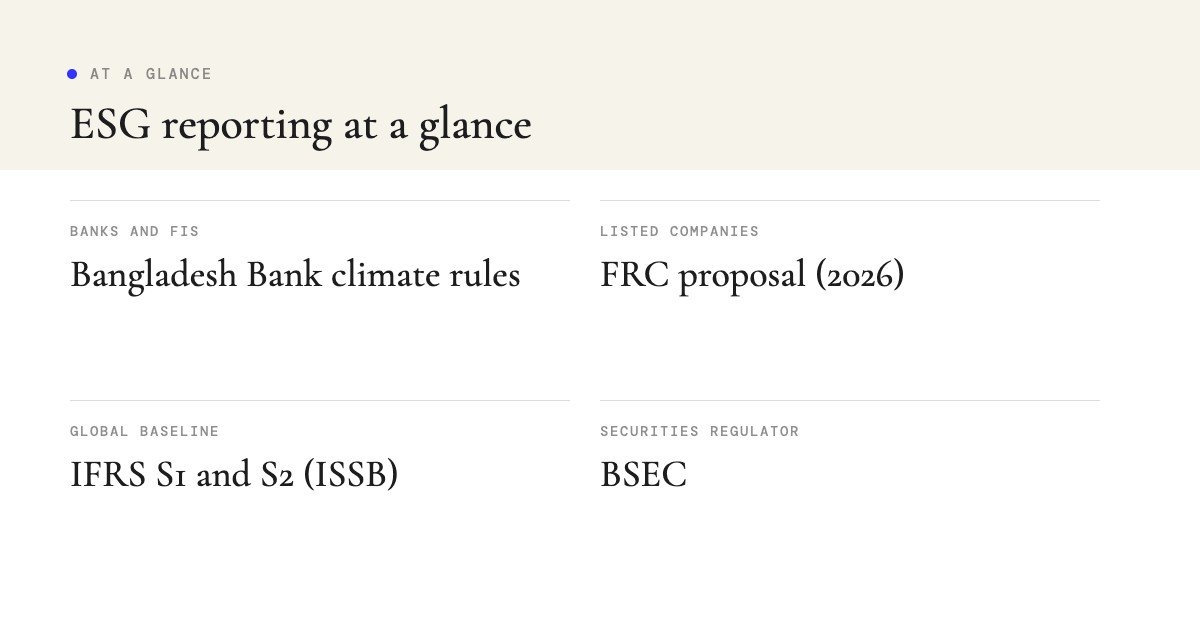
ESG reporting in Bangladesh is moving from glossy voluntary reports to regulated disclosure. Banks and financial institutions already follow Bangladesh Bank rules modelled on the ISSB standards, the Financial Reporting Council has proposed extending IFRS S1 and S2 to listed companies, and export buyers increasingly demand verified data from their suppliers.

- Bangladesh Bank issued guidelines in December 2023 requiring banks and financial institutions to make sustainability and climate-related financial disclosures, drawing on IFRS S1 and S2.
- In April 2026 the Financial Reporting Council (FRC) opened consultation on extending IFRS S1 and S2, alongside IFRS 18 and IFRS 19, to all listed companies; check the final decision and timetable.
- BSEC's Corporate Governance Code and listing rules already require governance disclosures, and BSEC supports green and sustainable bond issuance.
- Export-oriented industries face indirect requirements through buyer codes and foreign laws such as EU due diligence and reporting rules.
- Good reporting depends on data, governance and controls built well before the first report is due.
Why ESG reporting in Bangladesh matters now
ESG reporting in Bangladesh, as elsewhere, describes how a company manages risks and impacts beyond its financial statements: climate, energy, water, pollution, labour conditions, health and safety, community relations, board oversight and ethics. For years, Bangladeshi companies treated sustainability reports as public relations. That is changing because regulators, lenders and buyers now use the information to make decisions.
Bangladesh is among the countries most exposed to climate change, and its economy depends heavily on export manufacturing, particularly garments. Climate risk affects banks' loan books, and labour and environmental performance affects factories' access to global markets. ESG reporting in Bangladesh has therefore become a question of finance and trade, not just reputation.
Who is pushing for disclosure
- Bangladesh Bank, through sustainable finance policies and disclosure guidelines for banks and financial institutions.
- The Financial Reporting Council, which sets financial reporting standards and has proposed adopting the ISSB standards for listed companies.
- BSEC, through corporate governance rules, listing requirements and green bond frameworks.
- International buyers and lenders, through supplier codes, audits and lending conditions.
- Foreign laws, such as the EU's sustainability reporting and due diligence rules, which reach Bangladeshi suppliers through value chains.
The regulatory framework
There is no single statute governing ESG reporting in Bangladesh. Requirements come from several regulators and instruments, summarised below.
| Instrument | Who it covers | What it requires |
|---|---|---|
| Bangladesh Bank sustainability and climate disclosure guidelines (December 2023) | Banks and financial institutions | Sustainability and climate-related disclosures aligned with IFRS S1 and S2, phased in |
| Bangladesh Bank Sustainable Finance Policy and environmental and social risk management guidelines | Banks and financial institutions | Environmental and social due diligence of borrowers, sustainable finance targets and reporting |
| FRC consultation on IFRS S1, S2, 18 and 19 (April 2026) | Proposed: all listed companies | Adoption of ISSB standards; final scope and dates to be confirmed |
| BSEC Corporate Governance Code 2018 | Listed companies | Governance disclosures, board committees and compliance reporting |
| Environment Conservation Act 1995 and Rules 2023 | Industrial units and projects | Environmental clearance, discharge standards and monitoring data |
| Bangladesh Labour Act 2006 (amended 2026) | Employers | Labour standards that feed social disclosures |
Because the FRC's proposal was still at consultation stage in April 2026, listed companies should monitor the official texts and FRC announcements for the final timetable rather than assume a date.
Banks and financial institutions
Banks lead ESG reporting in Bangladesh because Bangladesh Bank has regulated sustainable finance for more than a decade. Its December 2023 guidelines on sustainability and climate-related financial disclosure, reported by IAS Plus at the time, require banks and financial institutions to disclose governance, strategy, risk management and metrics relating to sustainability and climate risks, following the structure of the ISSB standards, with phased implementation.
For banks, disclosure is closely linked to lending practice. Environmental and social risk management guidelines require banks to assess borrowers' environmental and social risks, and sustainable finance policies set targets for green and sustainable lending. A bank's report is only credible if its credit processes actually collect and use this data.
What this means for borrowers
Companies borrowing from Bangladeshi banks should expect more questions about emissions, energy use, environmental clearance, effluent treatment, labour practices and climate exposure. Borrowers who can provide reliable data may find financing easier, and some green finance products offer preferential terms for qualifying projects. Our banking and finance practice advises on green loan documentation.
Listed companies and the FRC proposal
The Financial Reporting Council is the statutory body responsible for financial reporting standards. In April 2026 it launched consultation on adopting IFRS S1 (general sustainability-related disclosures) and IFRS S2 (climate-related disclosures), together with IFRS 18 on presentation of financial statements and IFRS 19 on subsidiaries without public accountability, and on extending sustainability requirements from banks to all listed companies.
If adopted as proposed, ESG reporting in Bangladesh for listed companies will move from voluntary narrative to standardised disclosure connected to financial statements. Companies should expect requirements to disclose sustainability governance, strategy, risk management and metrics, including greenhouse gas emissions, with transitional relief in early years as is common internationally.
Do not wait for the final FRC timetable to start. Collecting reliable emissions and energy data, and building board oversight, typically takes at least one full reporting cycle. Companies that start now can publish a voluntary, aligned report first and refine it before disclosure becomes mandatory.
The IFRS S1 and S2 framework
The ISSB standards organise disclosures around four pillars, which also offer a sensible structure for any company starting ESG reporting in Bangladesh.
- Governance. How the board and management oversee sustainability-related risks and opportunities, including skills, committees and incentives.
- Strategy. The risks and opportunities that could affect the company's prospects, their effect on the business model and financial position, and resilience under climate scenarios.
- Risk management. How the company identifies, assesses and manages these risks, and how this fits with overall risk management.
- Metrics and targets. Performance measures, including scope 1, scope 2 and, subject to relief, scope 3 greenhouse gas emissions, and progress against targets.
IFRS S2 focuses on climate, including physical risks such as floods, cyclones and heat, which are highly relevant in Bangladesh, and transition risks such as carbon pricing in export markets and shifts in buyer requirements.
Export industries and buyer requirements
In ESG reporting in Bangladesh for garment, textile, leather and other export manufacturers, the strongest ESG pressure comes from buyers. Global brands require supplier data on energy, water, chemicals, wastewater, wages, working hours, health and safety and grievance mechanisms. They use certification schemes, audits and data platforms, and many have set science-based emissions targets that require supplier emissions data.
Foreign laws add weight. The European Union's corporate sustainability reporting and due diligence rules, even after simplification in 2025 and 2026, require large EU companies to understand and address risks in their supply chains. Bangladeshi suppliers are not directly regulated by those laws, but they are asked to provide the evidence. ESG reporting in Bangladesh for exporters is therefore as much about responding to buyer questionnaires accurately as about publishing a report.
Accuracy and legal risk
Overstated claims about sustainability, sometimes called greenwashing, carry legal risk. Buyers may terminate contracts for false certifications, lenders may call defaults for misrepresentation, and regulators may act on misleading disclosures in listed company reports. Every public claim should be supported by documented data.
Social and labour data in ESG reporting in Bangladesh
The "S" in ESG is particularly important for Bangladeshi companies because of the size of the industrial workforce. Social disclosures typically cover headcount and turnover, gender balance, wages relative to legal minimums, working hours and overtime, occupational health and safety incidents, freedom of association, grievance mechanisms and supply chain labour risks.
Much of this data already exists because of obligations under the Bangladesh Labour Act 2006, as amended in 2026, and the Bangladesh Labour Rules 2015, such as wage registers, leave records and accident reports. The challenge is to consolidate it reliably across factories and to present it consistently. Since the Rana Plaza collapse in 2013, building and fire safety data have become a standard part of social reporting for garment suppliers, and buyers check it closely.
Human rights due diligence
International buyers increasingly expect suppliers to identify and address human rights risks, including forced labour, child labour, discrimination and harassment, and to show how grievances are resolved. A clear policy, a working grievance channel and records of corrective action make ESG reporting in Bangladesh on human rights credible rather than aspirational.
Climate risk: what Bangladeshi companies should disclose
Climate disclosure is often the most technical part of the work. Under IFRS S2, companies explain how climate-related risks could affect their business. In Bangladesh, physical risks are immediate: riverine and flash floods, cyclones and storm surges in coastal areas, heat stress affecting workers and machinery, and salinity affecting agriculture and water supply. Transition risks include carbon border measures in export markets, buyer decarbonisation demands and changes in energy prices and supply.
Companies should start by mapping the location of their facilities and key suppliers against flood and cyclone exposure, measuring energy use and scope 1 and 2 emissions, and understanding what their largest customers will require over the next five years. ESG reporting in Bangladesh that links these risks to concrete actions, such as rooftop solar, energy efficiency, water recycling and flood defences, is far more persuasive than general statements of commitment.
Step-by-step: building an ESG reporting process
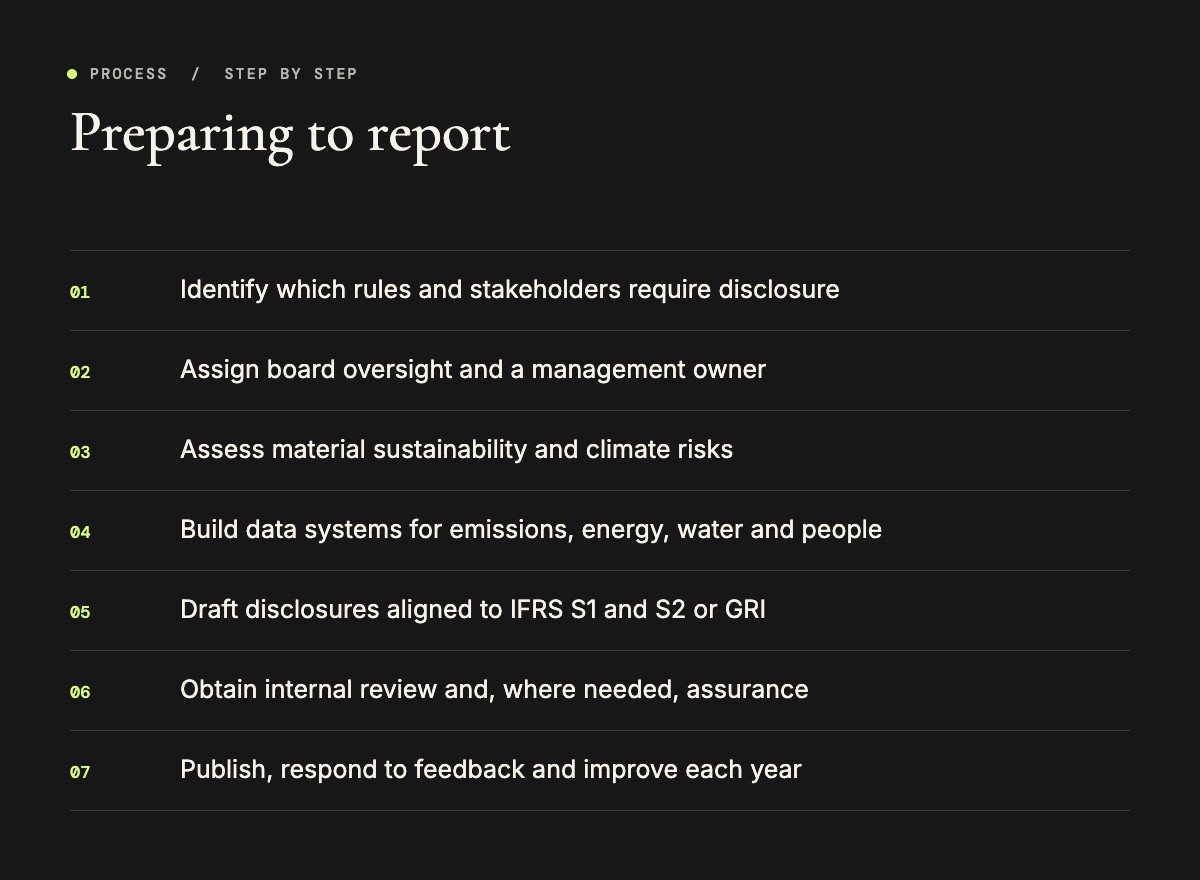
- Map requirements. List the regulations, lender conditions, buyer codes and investor expectations that apply to your company.
- Set governance. Give the board, or a board committee, oversight of sustainability, and appoint a senior manager responsible for reporting.
- Assess materiality. Identify the sustainability and climate matters most significant for your business, using stakeholder input and financial impact.
- Build data systems. Collect energy, fuel, electricity, water, waste, emissions, workforce and safety data with clear definitions and controls.
- Draft disclosures. Prepare disclosures aligned to IFRS S1 and S2 or, for voluntary reports, recognised frameworks such as GRI, explaining methods and limitations.
- Review and assure. Run internal review by finance, legal and operations; consider external assurance for key metrics.
- Publish and improve. Publish the report, respond to stakeholder questions and set improvement actions for the next cycle.
Governance and legal considerations
For ESG reporting in Bangladesh, directors are responsible for the accuracy of what the company publishes. For listed companies, sustainability information placed in the annual report sits alongside audited financial statements and corporate governance disclosures required by BSEC. Misleading statements can expose the company and its directors to regulatory action and claims.
Boards should approve ESG disclosures through a defined process, with sign-off from the people who own the underlying data. Legal review should check claims, forward-looking statements and consistency with other public documents. Our corporate governance practice helps boards set up these processes.
Environmental data reported to buyers, to the Department of Environment and in public reports should be consistent. Differences between the effluent data in a sustainability report and the results submitted to the DOE invite questions from all three audiences.
Green bonds, sustainable finance and investors
ESG reporting in Bangladesh also supports access to capital. BSEC has established frameworks for green bonds and sukuk, and several banks and companies have issued green or sustainability-linked instruments. These require use-of-proceeds reporting and, often, external review. International investors and development finance institutions also apply their own environmental and social standards and reporting conditions.
Companies planning to raise sustainable finance should build reporting into the transaction from the start, including allocation and impact reporting, so that post-issuance obligations are met reliably. Our environment and ESG practice advises issuers and borrowers on these frameworks.
Small and medium enterprises
Smaller companies often assume ESG reporting is only for banks and listed groups. In practice, SMEs that supply exporters, borrow from banks or seek investment are asked the same questions in simpler form. A short annual statement covering energy and water use, waste handling, workforce data, safety incidents and governance basics, backed by records, meets most requests and prepares the business for growth. Starting small and accurate is better than copying a large company's template.
Industry associations and chambers in Bangladesh increasingly offer templates, training and shared data tools for members. Using a recognised framework and common definitions makes it easier to compare performance, answer buyer questionnaires and move to full IFRS S1 and S2 alignment when it becomes required. Whatever the starting point, document your methods so that next year's report can be compared fairly with this year's.
Common mistakes
- Publishing narrative reports without data or targets.
- Using inconsistent definitions year to year, making trends meaningless.
- Reporting only on the head office and ignoring factories and subsidiaries.
- Ignoring climate physical risks such as floods and heat in strategy disclosures.
- Making unsupported claims about certifications or "carbon neutral" status.
- Treating ESG as a communications task without board ownership.
Frequently asked questions about esg reporting in bangladesh
Is ESG reporting mandatory in Bangladesh?
For banks and financial institutions, yes, under Bangladesh Bank's sustainability and climate disclosure guidelines. For listed companies, the FRC proposed in April 2026 to extend IFRS S1 and S2; confirm the final decision and timetable.
Which standards should we use?
IFRS S1 and S2 are the emerging baseline in Bangladesh. Companies also use GRI for broader impact reporting, and buyers may require specific frameworks or platforms.
Do private exporters need to report?
There is no general statutory duty, but buyers, lenders and foreign laws increasingly require suppliers to provide ESG data, often verified by audits.
Do we need external assurance?
Not always yet, but assurance of key metrics adds credibility and is common for banks, listed companies and green bond issuers. Requirements may increase as standards are adopted.
What are the legal risks of ESG reports?
Misleading claims can lead to buyer and lender action, regulatory scrutiny of listed company disclosures and reputational damage. Every claim should be supported by documented data.
How we can help
We advise boards, banks and exporters on ESG reporting in Bangladesh: mapping requirements, governance and disclosure processes, legal review of reports and claims, green finance documentation and responding to buyer and investor demands. Learn more about our environment and ESG practice.
Preparing your first aligned report?
We help you build governance and processes that meet Bangladesh Bank, FRC and buyer expectations without overstating your position.
Book a consultationESG practicePrimary sources: sustainable finance and disclosure guidelines of Bangladesh Bank; corporate governance rules of BSEC; environmental regulation by the Department of Environment; reporting by IAS Plus (December 2023) and XBRL International (April 2026) on Bangladesh's adoption of ISSB standards.
This article is general information about Bangladeshi law and practice as of October 2026 and is not legal advice. Reporting requirements are evolving; confirm the current position with the FRC, Bangladesh Bank, BSEC or a qualified adviser before acting.




0 Comments