
Offshore lenders often offer longer tenors and lower rates than local banks, which makes a foreign currency loan in Bangladesh attractive for industrial expansion, power projects and foreign-owned subsidiaries. But borrowing abroad is tightly regulated. Depending on the loan, prior authorisation from Invest Bangladesh, Bangladesh Bank rules on cost and tenor, and strict reporting requirements may all apply.

- Bangladesh Bank consolidated its foreign exchange rules on loans and guarantees in a circular issued on 2 September 2026, building on FE Circular No. 34 of 2025.
- Long-term foreign loans for private-sector industrial projects need prior authorisation from Invest Bangladesh, the agency that replaced BIDA in 2026.
- Short-term trade credit of up to one year from foreign suppliers or buyers follows Bangladesh Bank's guidelines on current transactions.
- Since July 2026, fully foreign-owned industrial enterprises have general permission to take short-term loans from parents, associates or shareholders abroad, subject to conditions.
- Authorised dealer banks remit repayments of approved loans and report foreign loans to Bangladesh Bank every quarter.
Why foreign borrowing is regulated
Bangladesh operates a managed capital account. Foreign borrowing creates future demand for foreign currency to repay principal and interest, so the authorities monitor external debt closely to protect reserves and financial stability. The Foreign Exchange Regulation Act 1947 gives Bangladesh Bank the power to regulate these transactions, and the government sets policy for longer-term borrowing.
For borrowers, the result is a layered approval process for any foreign currency loan in Bangladesh. Understanding which layer applies to a particular loan is the first step. Our banking and finance practice advises borrowers, lenders and sponsors on these approvals.
The current rulebook
On 2 September 2026, Bangladesh Bank's Foreign Exchange Policy Department issued a consolidated circular on lending, loans, overdrafts, trade and commercial loans, foreign-owned companies, guarantees and foreign borrowing. It brings together FE Circular No. 34 of 2 September 2025 and later amendments, and is stated to remain valid for one year, so borrowers should check for any successor circular.
The consolidated circular is the starting point for any foreign currency loan in Bangladesh. It must be read with the Guidelines for Foreign Exchange Transactions and with Invest Bangladesh procedures for long-term loans.
Approval routes for a foreign currency loan in Bangladesh
| Type of borrowing | Approval route |
|---|---|
| Long-term loans for private industrial projects | Prior authorisation from Invest Bangladesh |
| Public-sector borrowing | Government approval; non-concessional loans need the Standing Committee on Non-Concessional Loans |
| Short-term trade credit up to one year (supplier's or buyer's credit) | Bangladesh Bank guidelines on current transactions, through AD banks |
| Short-term loans to fully foreign-owned industrial enterprises from parents or affiliates | General permission under the July 2026 circular, with reporting |
| Enterprises in economic zones and EPZs | Specific rules depending on Type A, B or C classification |
Long-term loans and Invest Bangladesh
For private-sector industrial projects, long-term foreign loans need prior authorisation. This function was previously performed by a scrutiny committee at the Bangladesh Investment Development Authority. Since August 2026, BIDA, BEZA and the PPP Authority have been merged into Invest Bangladesh, which now handles these authorisations.
An application for a long-term foreign currency loan in Bangladesh typically includes the loan agreement or term sheet, details of the lender, the purpose and project, the cost of borrowing, the repayment schedule, the borrower's financial statements and evidence of the project's viability. The authority considers whether the cost and terms are reasonable and whether the project can generate the foreign exchange or earnings needed to service the debt.
Short-term trade credit
Supplier's credit and buyer's credit for imports, with tenors of up to one year, are common forms of short-term foreign borrowing. These are handled by authorised dealer banks under Bangladesh Bank's guidelines on current commercial transactions, subject to limits on cost and tenor set by circular.
Trade credit is often the most practical foreign currency loan in Bangladesh for importers of raw materials and capital machinery, because it is linked directly to an import transaction and does not require separate long-term approval.
Intra-group loans for foreign-owned companies
A circular of 15 July 2026 granted general permission for fully foreign-owned industrial enterprises, inside and outside specialised zones, to borrow short-term from their parent companies, associates or shareholders abroad for genuine business purposes, without prior Bangladesh Bank approval. Authorised dealers must report each transaction to the Foreign Exchange Investment Department within a week.
Under that circular, interest-free loans may be used for general working capital, while cost-bearing loans may be used for input procurement subject to a cap on all-in cost. Loans are repaid in a single payment at maturity and may be rolled over, but the total tenor including rollovers cannot exceed three years, and short-term facilities cannot be converted into longer-term loans.
The July 2026 general permission applies to fully foreign-owned industrial enterprises. Joint ventures with local shareholders and trading companies should not assume it applies to them. Check the classification carefully and confirm the route with the authorised dealer bank before drawing funds.
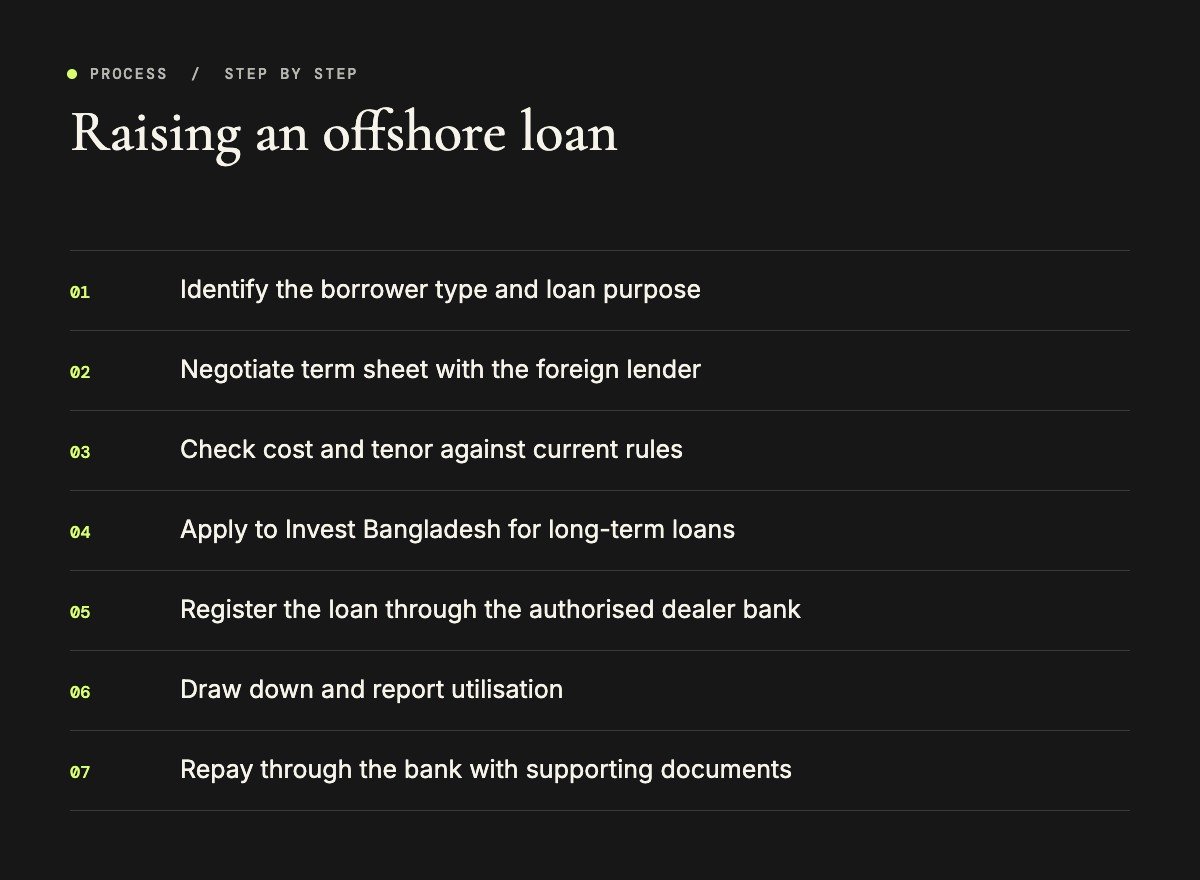
The borrowing process step by step
- Classify the borrower. Identify whether the borrower is local, joint venture or fully foreign-owned, and whether it is in a zone.
- Define the purpose. Capital machinery, working capital, project finance or refinancing.
- Negotiate terms. Agree interest, fees, tenor and security with the lender.
- Check the rules. Confirm cost, tenor and approval requirements under the current circulars.
- Obtain approvals. Apply to Invest Bangladesh for long-term loans, or proceed through the AD bank where general permission applies.
- Register and draw down. The AD bank records the loan and receives the inward remittance.
- Report and repay. The AD bank reports quarterly and remits repayments against supporting documents.
Repaying a foreign currency loan in Bangladesh
Under the consolidated circular, authorised dealer banks may remit repayments of approved foreign loans without prior reference to Bangladesh Bank, subject to conditions, including availability of the loan agreement and repayment schedule and, for supplier's credit, bills of entry confirming arrival of capital goods. Banks must submit consolidated quarterly statements of approved foreign loans, including utilisation, within fifteen days after each quarter.
Borrowers should keep complete records for every foreign currency loan in Bangladesh, because missing documents are the most common reason for delayed repayments.
Security for a foreign currency loan in Bangladesh
Foreign lenders usually require security over the borrower's assets, sponsor guarantees or bank guarantees. Mortgages over land must be registered, and charges must be filed with the RJSC within 21 days of creation under section 159 of the Companies Act 1994. Guarantees by local banks in favour of foreign lenders, and taka financing against foreign standby letters of credit, are subject to the guarantee provisions in the consolidated circular.
Tax on a foreign currency loan in Bangladesh
Interest paid to foreign lenders may be subject to withholding tax under the Income Tax Act 2023, reduced in some cases by double taxation treaties. Loan agreements should allocate withholding tax clearly through gross-up clauses. Stamp duty may also apply to loan and security documents. Our tax practice can review the position.
Common pitfalls
The most frequent problems with a foreign currency loan in Bangladesh arise from drawing funds before approval, using loan proceeds for a purpose not approved, missing reporting deadlines, or failing to register security. Each of these can delay repayment remittances, attract regulatory action or undermine the lender's security.
Exchange rate risk is another major issue. When the taka depreciates, the taka cost of servicing a foreign currency loan in Bangladesh rises sharply for borrowers without foreign currency income. Exporters have a natural hedge, but domestic-market businesses should consider hedging where available or limit foreign borrowing to what their cash flows can support.

Refinancing existing loans
Borrowers sometimes seek to refinance expensive local loans with cheaper foreign funds, or to refinance existing foreign loans on better terms. Refinancing usually requires the same approvals as a new loan, and the authorities consider whether the new terms are more favourable. Prepayment of an existing foreign currency loan in Bangladesh may also need approval or documentation through the authorised dealer bank.
Project finance and power sector loans
Large infrastructure and power projects often rely on a foreign currency loan in Bangladesh from development finance institutions, export credit agencies and commercial banks. These financings combine Invest Bangladesh authorisation, government support agreements, security over project assets and offshore accounts. The documentation is complex, and approvals must be sequenced carefully with financial close. See our infrastructure and energy practice.
Offshore banking units
Offshore banking units of Bangladeshi banks can provide foreign currency finance to eligible borrowers, including enterprises in export processing zones and economic zones, under separate rules. For some borrowers, an offshore banking unit is a faster source of a foreign currency loan in Bangladesh than an overseas lender, though eligibility and pricing should be compared.
Lender perspective
Foreign lenders should confirm that the borrower has obtained every required approval before disbursing, because an unapproved foreign currency loan in Bangladesh may face problems with repayment remittances. Lenders typically make approvals a condition precedent, require legal opinions from Bangladeshi counsel and take security over offshore accounts where permitted. Clear drafting on currency, withholding tax and enforcement protects the lender if the borrower defaults.
Economic zones and export processing zones
Enterprises in specialised zones are classified as Type A, fully foreign-owned, Type B, joint ventures, or Type C, fully Bangladeshi-owned. The consolidated circular allows Type A enterprises to obtain short-term foreign currency loans from overseas lenders for specified purposes such as imports, interest payments and loan repayment. Type B and Type C enterprises face different conditions. Zone authorities may also have their own procedures for registering loans, so enterprises should coordinate with both the zone authority and their bank before signing. Planning early avoids delays at drawdown, when suppliers or contractors are often waiting for payment.
Documents to prepare
Borrowers can speed up approvals by preparing a complete file early: board resolutions authorising the borrowing, the facility agreement, lender details, a project or business plan, recent audited accounts, tax certificates, the investment registration, and a cash flow forecast showing how the loan will be repaid. Having these ready shortens review times considerably.
Frequently asked questions about foreign currency loan in bangladesh
Who approves long-term foreign loans for private companies?
Invest Bangladesh, which replaced BIDA's role in 2026, gives prior authorisation for private industrial long-term loans.
Do short-term import credits need approval?
They follow Bangladesh Bank guidelines through AD banks, subject to cost and tenor limits.
Can a foreign subsidiary borrow from its parent?
Fully foreign-owned industrial enterprises have general permission for short-term loans under the July 2026 circular, subject to conditions.
How are repayments made?
Through the authorised dealer bank against the loan agreement and repayment schedule.
Is there a cap on borrowing costs?
Bangladesh Bank sets cost limits for different categories; check the current circular.
Is withholding tax payable on interest?
Generally yes, subject to any applicable tax treaty.
How we can help
We advise borrowers and lenders on every foreign currency loan in Bangladesh, from structuring and approvals to security, documentation and repayment. Learn more about our banking and finance practice, our project finance team and our foreign investment practice.
Considering offshore finance?
We map the approvals and draft documents that satisfy regulators and lenders.
Book a consultationBanking and financePrimary sources: foreign exchange circulars from Bangladesh Bank; investment approvals through Invest Bangladesh; the Foreign Exchange Regulation Act 1947 on the Laws of Bangladesh portal.
This article is general information about Bangladeshi foreign exchange rules as of October 2026 and is not legal advice. Circulars change frequently; confirm the current rules before borrowing.

0 Comments