
Trust in the stock market depends on a level playing field. Insider trading in Bangladesh, meaning dealing in listed securities while holding undisclosed price sensitive information, is prohibited and can lead to fines, imprisonment and regulatory sanctions. For listed companies, directors and sponsors, a robust compliance programme is the best defence.

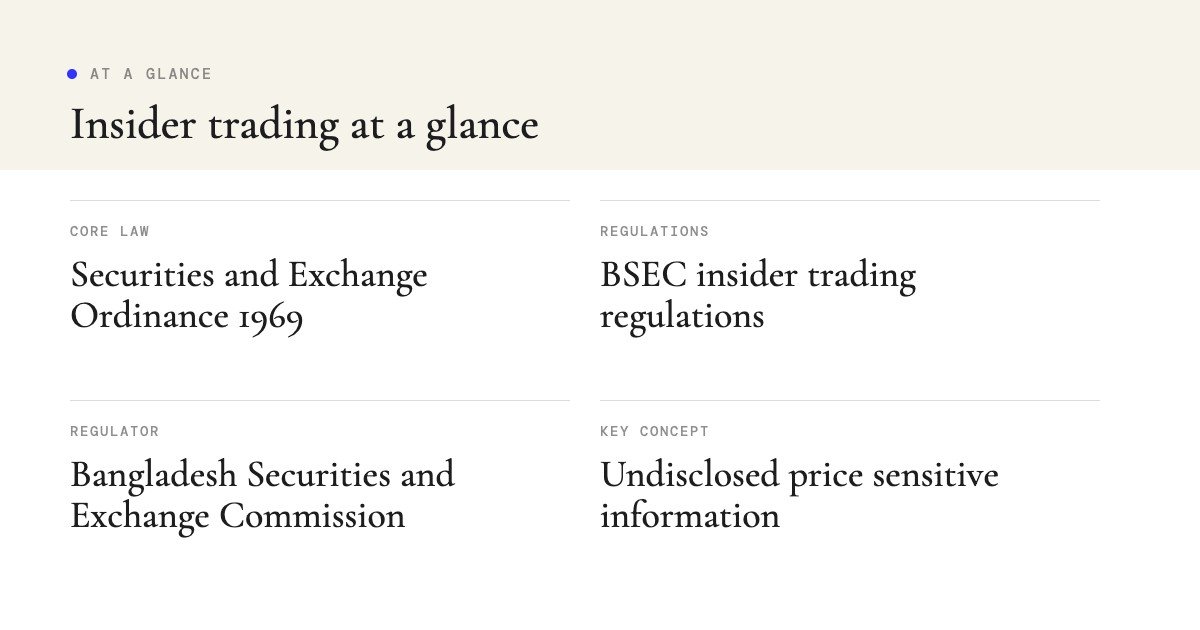
- Insider trading in Bangladesh is prohibited under the Securities and Exchange Ordinance 1969 and BSEC's insider trading regulations.
- Insiders include sponsors, directors, substantial shareholders, officers, employees, auditors, advisers and others with access to undisclosed price sensitive information.
- Listed companies must disclose price sensitive information promptly through prescribed channels.
- Companies commonly impose restricted trading periods around financial results and other major announcements.
- BSEC regularly fines sponsors and directors for trading during prohibited periods or without required disclosures.
What insider trading means
Insider trading occurs when a person who has undisclosed price sensitive information about a listed company buys or sells that company's securities, or passes the information to someone else who trades. The harm lies in the unfair advantage: ordinary investors trade without information that the insider knows will move the price.
Not every trade by an insider is unlawful. Directors and employees may hold and trade shares, but only when they do not possess undisclosed price sensitive information and when they comply with disclosure and restricted period rules. Our capital markets practice advises issuers, sponsors and investors on compliance.
The legal framework for insider trading in Bangladesh
The Securities and Exchange Ordinance 1969 is the primary statute. It prohibits fraudulent and manipulative practices in securities dealings and contains provisions targeting misuse of inside information, together with restrictions on short-swing trading by directors, officers and holders of ten percent or more of a listed company's securities. The Bangladesh Securities and Exchange Commission Act 1993 gives BSEC wide powers to investigate and impose penalties.
BSEC's insider trading regulations, originally issued in 1995, set out the detailed prohibition, definitions of insiders and price sensitive information, and obligations of listed companies. Listed companies also follow BSEC notifications on disclosure of price sensitive information and stock exchange listing regulations. Market participants should check whether BSEC has issued updated rules, as the framework is periodically revised.
Who is an insider
| Category | Examples |
|---|---|
| Corporate insiders | Sponsors, directors, officers and employees |
| Substantial shareholders | Holders of ten percent or more of the shares |
| Professional advisers | Auditors, lawyers, consultants, bankers and merchant bankers |
| Connected persons | Close family members and entities controlled by insiders |
| Tippees | Anyone who receives inside information from an insider |
Because the definition is broad, companies should maintain an up-to-date list of insiders and make sure every person on it understands their obligations. Insider trading in Bangladesh can be committed by outsiders who receive information, not only by directors.
Price sensitive information and insider trading in Bangladesh
Price sensitive information is information about a company that is not generally available and that would be likely to have a material effect on the price of its securities if it became public. Typical examples include financial results, dividend declarations, bonus or rights issues, changes in capital structure, major acquisitions or disposals, mergers, significant contracts, expansion plans, changes in key management and material litigation.
Listed companies must disclose such information promptly to BSEC and the stock exchanges and publish it through prescribed channels. Information is treated as public only after it has been properly disseminated and investors have had a reasonable opportunity to absorb it. Selective disclosure to analysts or favoured investors before public release increases the risk of insider trading in Bangladesh.
Restricted trading periods
Many listed companies impose a restricted or closed period during which sponsors, directors, employees and advisers may not trade. A common approach is to restrict trading from the end of the financial year, or from a specified date, until the board approves and the company publishes its annual results, with similar periods around quarterly results and other major announcements.
BSEC has fined directors and sponsors for trading during such prohibited periods. Companies should communicate restricted periods clearly in writing and require pre-clearance for any trade by insiders.
Disclosure of trades by sponsors and directors
Sponsors and directors of listed companies must give advance notice and disclose their intention to buy, sell or transfer shares through the stock exchanges, in accordance with BSEC requirements, and must complete the transaction within the period allowed. Failing to make the required declaration, or trading outside the declared terms, is a frequent ground for BSEC penalties.
These disclosure rules complement the prohibition on insider trading in Bangladesh by making insider transactions transparent to the market.
Penalties for insider trading in Bangladesh
Breaches can lead to criminal prosecution under the Securities and Exchange Ordinance 1969, with imprisonment of up to five years, fines or both, depending on the provision. BSEC can also impose administrative fines, suspend or cancel registrations of market intermediaries, require disgorgement of profits, and take action against directors, including disqualification in serious cases.
Beyond formal penalties, the reputational damage to individuals and companies can be severe, affecting access to capital and relationships with regulators and investors.
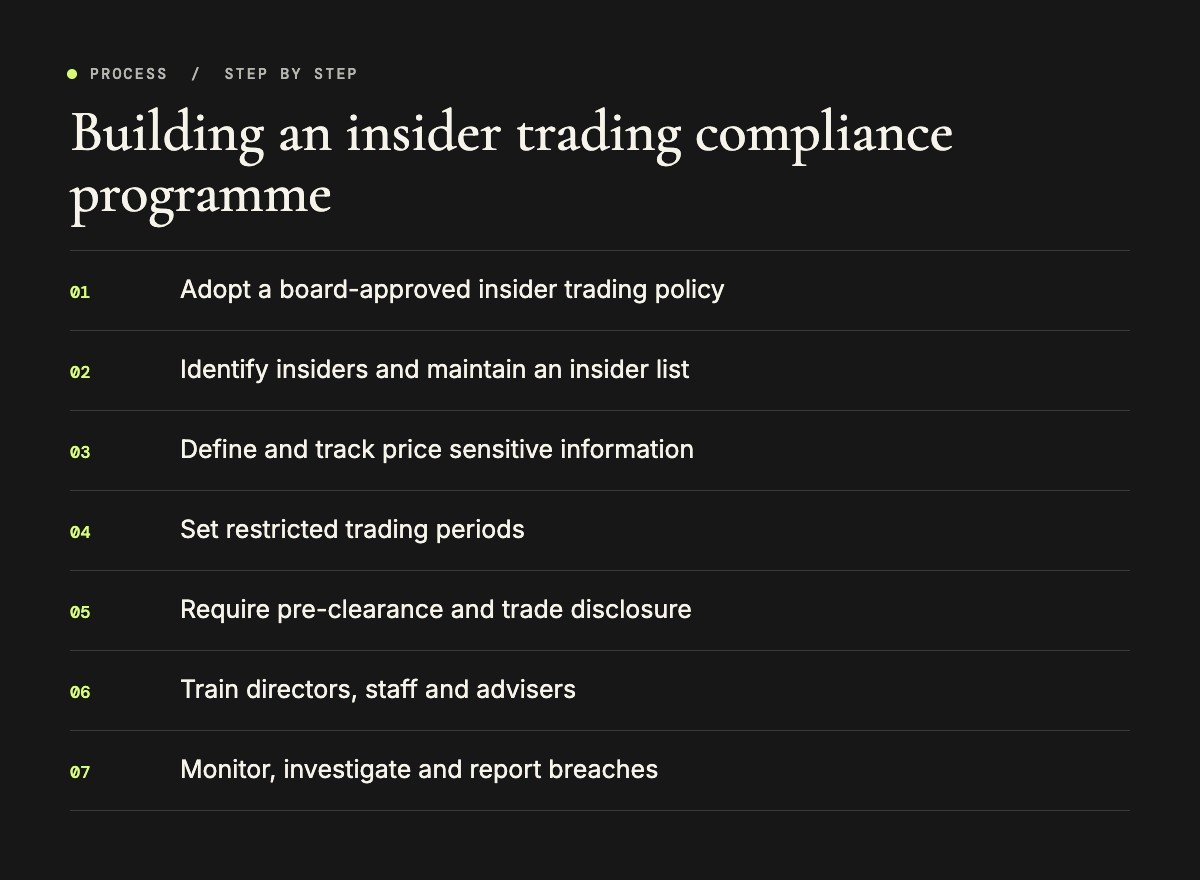
Building a compliance programme
- Adopt a policy. A board-approved insider trading policy setting out prohibitions, restricted periods and procedures.
- Maintain an insider list. Record everyone with access to price sensitive information, with dates.
- Control information. Limit access on a need-to-know basis and use confidentiality agreements with advisers.
- Set restricted periods. Announce closed periods around results and major transactions.
- Pre-clear trades. Require insiders to seek approval before trading and report completed trades.
- Train regularly. Brief directors, staff and advisers on their obligations.
- Monitor and enforce. Review trading patterns, investigate suspicions and report to regulators where required.
During merger negotiations, fundraising or major contracts, create a specific project insider list and remind everyone on it in writing that they hold price sensitive information. This simple step is strong evidence of good faith if BSEC later investigates trading around the announcement.
Insider trading in Bangladesh and market manipulation
Insider dealing is closely related to market manipulation, such as circular trading, spreading false rumours or creating artificial prices. BSEC investigations frequently examine both together, because a group that manipulates a share price often benefits from advance knowledge of company announcements. The Securities and Exchange Ordinance 1969 prohibits manipulative and deceptive practices alongside insider trading in Bangladesh.
Social media and messaging groups have made rumours spread faster. Companies should monitor unusual price movements and, where false information circulates, consider issuing clarifications through the stock exchanges.
Investigations and enforcement
BSEC's surveillance systems flag unusual trading before announcements. When suspicious patterns appear, BSEC can form enquiry committees, call for trading records from brokers and depository participants, examine bank records and interview witnesses. Findings can lead to administrative penalties or referral for prosecution.
Individuals and companies facing an enquiry into insider trading in Bangladesh should respond carefully, preserve documents and take legal advice before giving statements. Cooperation and evidence of a strong compliance programme can significantly influence the outcome.
Responsibilities of the board
The board of a listed company sets the tone. Directors should approve and periodically review the insider trading policy, appoint a compliance officer, ensure price sensitive information is disclosed promptly and lead by example in their own trading. The company secretary usually maintains insider lists and handles pre-clearance requests.
Audit committees can oversee compliance and receive reports on breaches. Strong governance reduces the risk of insider trading in Bangladesh and supports investor confidence.
Mergers, IPOs and fundraising
Corporate transactions create the highest risk of insider trading in Bangladesh. During an initial public offering, rights issue, merger, acquisition or major financing, many people outside the company, including merchant bankers, valuers, lawyers and potential investors, gain access to confidential information. Each of them can become an insider.
Transaction teams should use code names, limit document circulation, sign non-disclosure agreements and record who receives information and when. When a deal leaks and the share price moves before announcement, BSEC will want to know who knew. A disciplined information barrier is the most effective protection against allegations of insider trading in Bangladesh during transactions.
Institutional investors and fund managers
Asset managers, mutual funds and other institutional investors meet company management regularly. These meetings are legitimate, but they must not become channels for selective disclosure. Fund managers should have policies to identify when they have received inside information, wall off the relevant team and restrict trading until the information becomes public.
Brokers and merchant bankers face similar issues, especially where research, corporate finance and trading functions sit in the same group. Chinese walls, restricted lists and compliance monitoring are standard tools to manage insider trading in Bangladesh within financial institutions.
Practical guidance for directors
Directors should assume they hold price sensitive information most of the time. Before any trade, check whether a restricted period applies, seek written pre-clearance, make the required declarations to the exchanges and keep records. Avoid trading immediately before or after major announcements, and never encourage family members or friends to trade on the basis of what you know.
Following these simple habits protects directors personally and reduces the risk that ordinary personal investment is mistaken for insider trading in Bangladesh.
Employees and whistleblowing
Employees in finance, legal, investor relations and senior management often see results and transaction information before the market does. Employment contracts and codes of conduct should state clearly that misuse of inside information is a disciplinary offence. Companies should also provide a confidential channel for staff to raise concerns about suspicious trading by colleagues or executives, and protect those who report in good faith.
A culture where employees feel able to ask questions, such as whether they may sell shares received under a bonus issue, prevents many breaches before they happen. Simple guidance notes, regular reminders before results and a named compliance contact make the rules practical rather than theoretical, and help the company show regulators that it takes its obligations seriously.
Record-keeping
Good records are a company's best evidence. Keep insider lists with dates of access, copies of restricted period notices, pre-clearance requests and approvals, trade disclosures and training attendance. Retain these records for several years, because investigations may begin long after the trades in question.
Frequently asked questions about insider trading in bangladesh
Is insider trading illegal in Bangladesh?
Yes. It is prohibited under the Securities and Exchange Ordinance 1969 and BSEC regulations.
Who regulates insider trading?
The Bangladesh Securities and Exchange Commission, with the stock exchanges.
Can directors trade their company's shares?
Yes, but only without inside information, outside restricted periods and with required disclosures.
What is price sensitive information?
Non-public information likely to materially affect the share price, such as results or major transactions.
What are the penalties?
Imprisonment of up to five years, fines, or both, plus BSEC administrative sanctions.
Do the rules apply to advisers?
Yes. Auditors, lawyers, bankers and consultants can be insiders.
How we can help
We help listed companies, sponsors and investors manage insider trading in Bangladesh risks, from policies and training to investigations and BSEC proceedings. Learn more about our capital markets practice, our BSEC regulatory team and our compliance practice.
Need an insider trading policy?
We design practical compliance programmes for listed companies.
Book a consultationCapital marketsPrimary sources: the Securities and Exchange Ordinance 1969 and Bangladesh Securities and Exchange Commission Act 1993 on the Laws of Bangladesh portal; regulations and notifications from the Bangladesh Securities and Exchange Commission; disclosures on the Dhaka Stock Exchange.
This article is general information about Bangladeshi securities law as of October 2026 and is not legal advice. BSEC rules change; check the current regulations.

0 Comments