
With one of the world’s largest Muslim populations and a fast-growing Islamic banking sector, Bangladesh has strong demand for Shariah-compliant investments. Sukuk issuance in Bangladesh lets companies and the government raise funds from Islamic banks, takaful operators and investors, using asset-based structures approved by a Shariah board and regulated by the Bangladesh Securities and Exchange Commission.
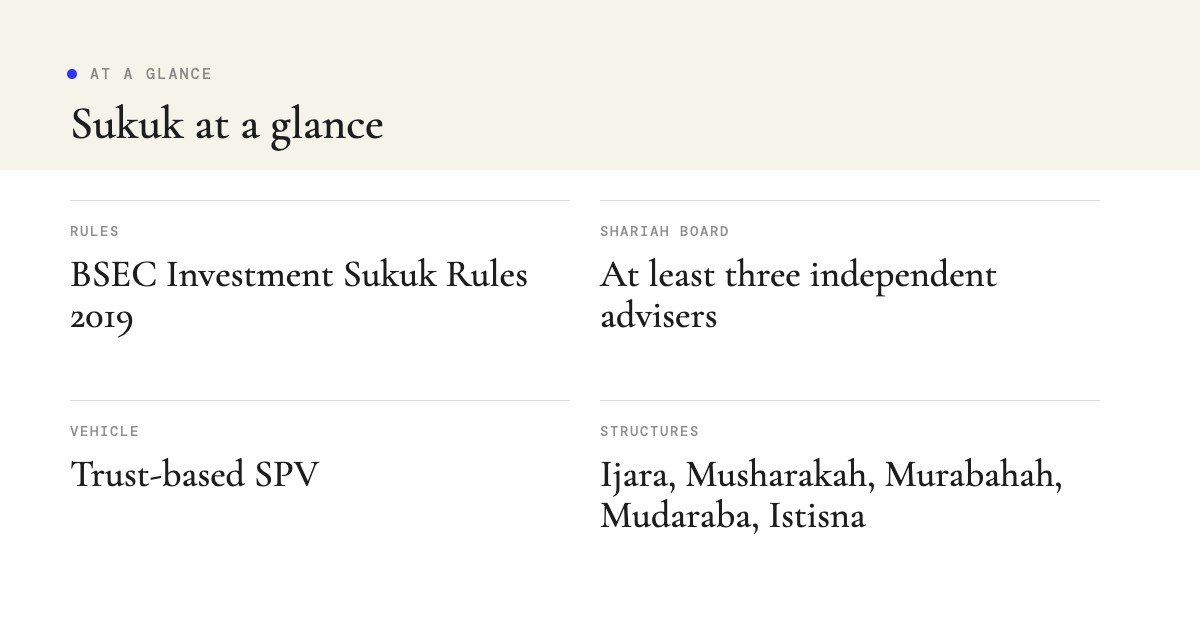
- Corporate sukuk issuance in Bangladesh is governed by the BSEC (Investment Sukuk) Rules 2019, read with other BSEC rules on debt and asset-backed securities.
- Each issue requires a Shariah supervisory board of at least three independent Shariah advisers, whose pronouncements bind the issuer.
- Sukuk are issued through a trust-based special purpose vehicle, with assets transferred to the SPV and a registered trustee protecting holders.
- Permitted structures include ijarah, musharakah, murabahah, mudarabah and istisna, following AAOIFI standards.
- Bangladesh Bank issues government investment sukuk, starting with a Tk 8,000 crore ijarah sukuk in December 2020.
What is a sukuk?
A sukuk is an Islamic financial certificate representing an undivided ownership interest in underlying assets, a project or a business venture. Unlike a conventional bond, which is a debt obligation paying interest, a sukuk generates returns from the income or profit of the underlying assets, in line with the Shariah prohibition on riba.
Sukuk issuance in Bangladesh therefore requires a real asset or business activity at its core, with contracts structured so that investors share in returns and, depending on the structure, risks. Our Islamic finance practice advises issuers, arrangers and investors on structuring and documentation.
The regulatory framework for sukuk issuance in Bangladesh
The BSEC (Investment Sukuk) Rules 2019, made under section 33 of the Securities and Exchange Ordinance 1969, govern sukuk issued by companies and other issuers in the capital market, whether by private placement or public offer. They must be read together with other BSEC rules, including the Asset Backed Securities Rules 2004, the Private Placement of Debt Securities Rules 2012 and the rules on public offers, which were updated in 2025.
Which additional rules apply depends on the structure. Asset-backed sukuk generally follow the asset-backed securities regime, while sukuk with debt-like characteristics follow the private placement or public offer rules. BSEC has published draft revisions to its sukuk framework, so issuers should check the current text before structuring.
The Shariah supervisory board
Every sukuk issuance in Bangladesh must have a Shariah supervisory board of at least three independent Shariah advisers who meet qualification and experience requirements. The board issues a provisional Shariah pronouncement on the structure and documents, and a final pronouncement before issuance, each signed by every adviser.
The pronouncements are binding on the originator and issuer. The board also oversees ongoing Shariah compliance during the life of the sukuk, and a Bangla version of the pronouncement must accompany the prospectus for public offers.
The SPV and trustee in sukuk issuance in Bangladesh
Sukuk are issued through a special purpose vehicle constituted as a trust under the Trust Act 1882 and registered as required. BSEC must approve the draft trust deed. The trustee must be registered under BSEC's trustee rules, and the originator must carry out due diligence before appointing it.
Sukuk assets must be transferred to the SPV absolutely, and the originator may not control or hold equity in the SPV. On default, the trustee's board can take control of the assets with BSEC approval. This structure protects holders by separating the assets from the originator's other creditors.
Common structures for sukuk issuance in Bangladesh
| Structure | How it works | Typical use |
|---|---|---|
| Ijarah | SPV buys assets and leases them back; holders receive rental income | Government sukuk, real estate, equipment |
| Istisna | Manufacturing or construction contract with deferred delivery | Project finance, solar and infrastructure |
| Musharakah | Joint ownership and profit sharing | Business expansion |
| Mudarabah | Investors provide capital; manager provides expertise; profits shared | Investment funds |
| Murabahah | Cost-plus sale of assets | Trade and working capital |
The rules refer to AAOIFI Shariah Standard 17 on investment sukuk and allow other permitted concepts. Hybrid structures combining concepts are named after the main concept.
Step by step
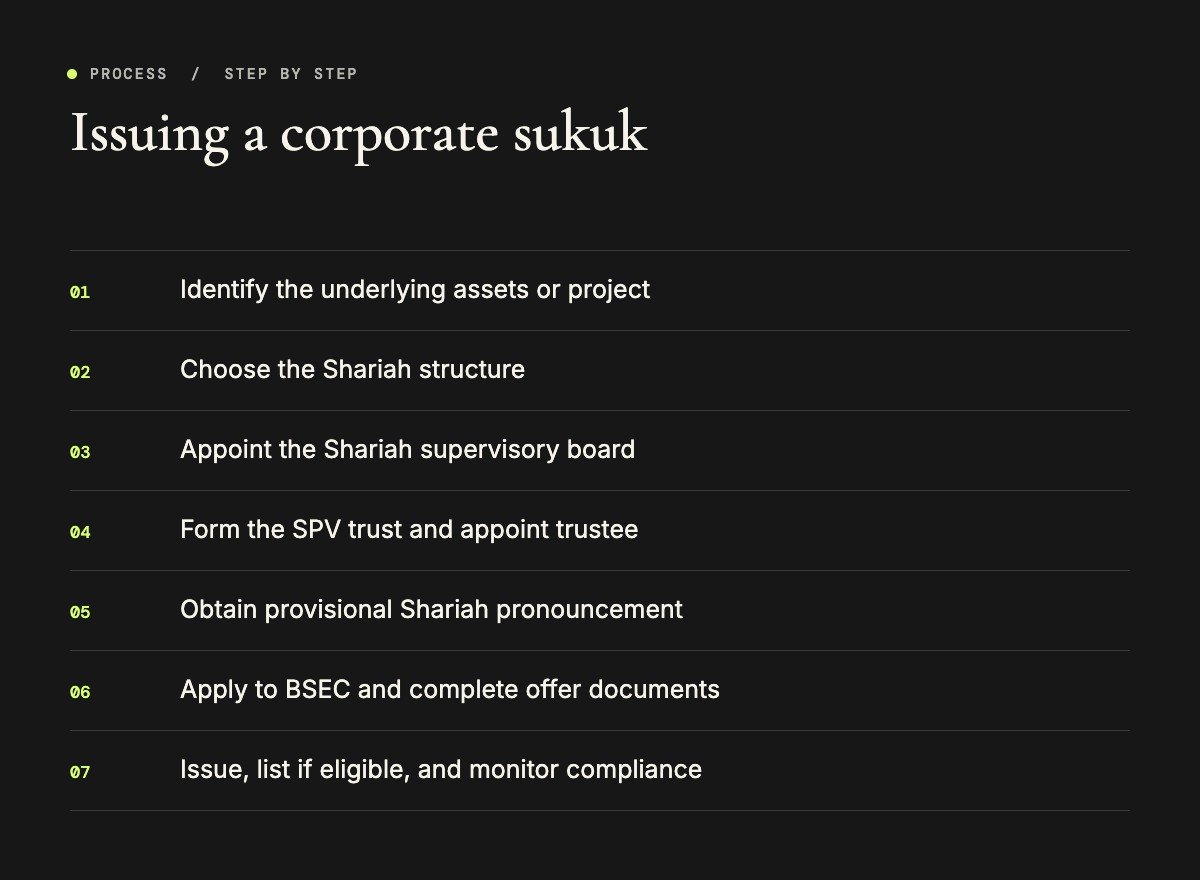
- Identify assets. Choose suitable assets or a project that will generate returns.
- Select the structure. Match the Shariah concept to the assets and the issuer's needs.
- Appoint the Shariah board. Engage at least three qualified independent advisers.
- Form the SPV. Draft the trust deed, obtain BSEC approval and appoint the trustee.
- Obtain Shariah approval. Secure the provisional pronouncement on the structure and documents.
- Prepare offer documents. Information memorandum for private placement or prospectus for public offer, with credit rating where required.
- Issue and monitor. Complete the offer, list if eligible, and maintain Shariah and regulatory compliance.
Transferring land or buildings into the SPV can trigger registration costs and title issues. Check the title, mutation and encumbrances on the underlying assets early, and consider structures that minimise transfer costs while satisfying the Shariah board.
Government investment sukuk
Bangladesh Bank issues Bangladesh Government Investment Sukuk on behalf of the government. The first issue, in December 2020, raised Tk 8,000 crore through an ijarah structure to fund a safe water supply project, and was heavily oversubscribed. Further government sukuk have followed, giving Islamic banks a Shariah-compliant instrument for liquidity management.
Government sukuk have helped build the market infrastructure and investor familiarity that corporate sukuk issuance in Bangladesh relies on.
Corporate sukuk experience
In 2021, Beximco issued a Tk 3,000 crore green sukuk al-istisna, with proceeds used for solar projects and textile machinery. It was one of the first large corporate sukuk in the market and attracted attention for combining Islamic finance with green investment. Its experience also highlighted the importance of issuer credit quality and ongoing disclosure for investors.
Other issuers, including banks and infrastructure companies, have explored sukuk as an alternative to conventional bonds and bank loans.
Investors in sukuk
Islamic banks are natural investors because they need Shariah-compliant assets for liquidity and returns. Takaful operators, Islamic windows of conventional banks, mutual funds and individuals seeking ethical investments also participate. Demand for sukuk issuance in Bangladesh is supported by the large deposit base of Islamic banks, which hold a significant share of the banking sector's deposits.
Foreign investors, including Gulf-based institutions, may invest subject to foreign exchange rules, although most corporate sukuk to date have been placed with local investors.
Credit rating and disclosure
Credit ratings from registered rating agencies are generally required for publicly offered sukuk and often requested by investors in private placements. The offer document must describe the assets, structure, Shariah pronouncements, risks, the originator's financial position and the rights of sukuk holders. Ongoing disclosure obligations continue after issuance.
Transparent reporting on the use of proceeds is especially important for green or sustainable sukuk issuance in Bangladesh, where investors expect evidence that funds were applied to qualifying projects.
Tax and costs
Tax treatment of sukuk returns, asset transfers and SPV income depends on the Income Tax Act 2023, VAT rules and stamp duty and registration costs on asset transfers. Some sukuk have benefited from specific tax concessions. Issuers should obtain current tax advice early, because transfer costs on underlying assets can significantly affect the economics of sukuk issuance in Bangladesh.
Shariah compliance risk
A sukuk that fails to comply with Shariah principles can damage the issuer's reputation and may trigger investor claims or restructuring. Ongoing oversight by the Shariah board, regular Shariah audits and clear documentation of each transaction step help manage this risk throughout the life of the instrument.
Why companies choose sukuk
For many issuers, sukuk issuance in Bangladesh opens access to a pool of Shariah-sensitive capital that would not invest in conventional bonds. Islamic banks with surplus liquidity are often keen to invest in high-quality sukuk. Sukuk can also offer longer tenors than typical bank loans, which suits infrastructure, power and real estate projects with long payback periods.
Sukuk issuance in Bangladesh also carries reputational benefits for companies seeking to demonstrate alignment with ethical or Islamic values, and green sukuk can attract investors focused on climate and sustainability.
Challenges in the market
Despite strong potential, sukuk issuance in Bangladesh faces practical challenges. Asset transfers can be expensive and slow, the pool of qualified Shariah scholars with capital markets experience is limited, and secondary market liquidity for listed sukuk remains thin. Investors also need more education about how sukuk differ from conventional bonds, particularly regarding risk sharing and default.
Regulators and market participants have discussed reforms such as standardised documentation, tax neutrality for asset transfers and clearer insolvency treatment. Each improvement makes sukuk issuance in Bangladesh more efficient for future issuers.
Green and sustainable sukuk
Green sukuk combine Islamic finance with environmental objectives, funding renewable energy, energy efficiency and climate adaptation. Bangladesh's vulnerability to climate change and its renewable energy targets create a natural pipeline of eligible projects. Issuers should adopt a green framework, obtain external review where possible and report on use of proceeds and impact.
Green sukuk issuance in Bangladesh can attract both Islamic and ESG-focused investors, broadening the investor base and potentially lowering funding costs.
Default and enforcement
When an issuer fails to make periodic distributions or redeem the sukuk, the trustee acts for holders. Depending on the structure, holders may have recourse to the underlying assets, a purchase undertaking from the originator, or both. Clear drafting of dissolution events and purchase undertakings is critical, because Shariah rules restrict guaranteed returns and the enforcement mechanism must remain compliant while giving investors real protection.
Banks issuing sukuk for capital
Islamic banks and conventional banks with Islamic windows have used mudarabah-based instruments to raise subordinated or perpetual capital that can count towards regulatory capital, subject to Bangladesh Bank approval and Basel III criteria. These instruments must satisfy both the Shariah board and the banking regulator, which requires careful structuring of loss absorption, call options and profit distribution. Banks considering such issues should engage early with Bangladesh Bank as well as BSEC, because regulatory capital recognition depends on meeting the central bank's specific conditions, and documents may need revision to satisfy both regulators before launch.
Timeline
A first-time corporate sukuk typically takes several months from mandate to issuance. Time is needed to select assets, appoint the Shariah board and trustee, obtain the provisional pronouncement, prepare documents, secure a credit rating and obtain BSEC approval. Repeat issuers with established frameworks can move faster.
Frequently asked questions about sukuk issuance in bangladesh
Which rules govern corporate sukuk?
The BSEC (Investment Sukuk) Rules 2019, together with other BSEC debt and asset-backed securities rules.
Is a Shariah board mandatory?
Yes, at least three independent Shariah advisers, whose pronouncements bind the issuer.
Must sukuk use an SPV?
Yes, a trust-based SPV with a registered trustee.
Which structures are allowed?
Ijarah, musharakah, murabahah, mudarabah, istisna and other permitted concepts.
Does the government issue sukuk?
Yes, Bangladesh Bank has issued government investment sukuk since December 2020.
Can sukuk be listed?
Tradable sukuk can be listed subject to Shariah and exchange rules; non-tradable sukuk cannot.
How we can help
We advise on sukuk issuance in Bangladesh for issuers, arrangers, trustees and investors, from structure and Shariah process to BSEC approval and listing. Learn more about our Islamic finance practice, our debt capital markets team and our BSEC regulatory practice.
Considering a sukuk?
We structure Shariah-compliant issues that satisfy regulators and investors.
Book a consultationIslamic financePrimary sources: sukuk rules and approvals from the Bangladesh Securities and Exchange Commission; government sukuk auctions by Bangladesh Bank; the Trust Act 1882 on the Laws of Bangladesh portal.
This article is general information about Bangladeshi capital markets law as of October 2026 and is not legal advice. BSEC rules may be revised; confirm the current position.




0 Comments