
Digital wallets, payment gateways and merchant payment platforms are reshaping how Bangladeshis pay. Anyone wanting to offer these services needs the right authorisation from Bangladesh Bank. A PSP licence in Bangladesh allows a company to provide payment services such as e-wallets, while a PSO licence covers operating payment systems such as gateways and switches. Both are now issued under the Payment and Settlement Systems Act 2024.
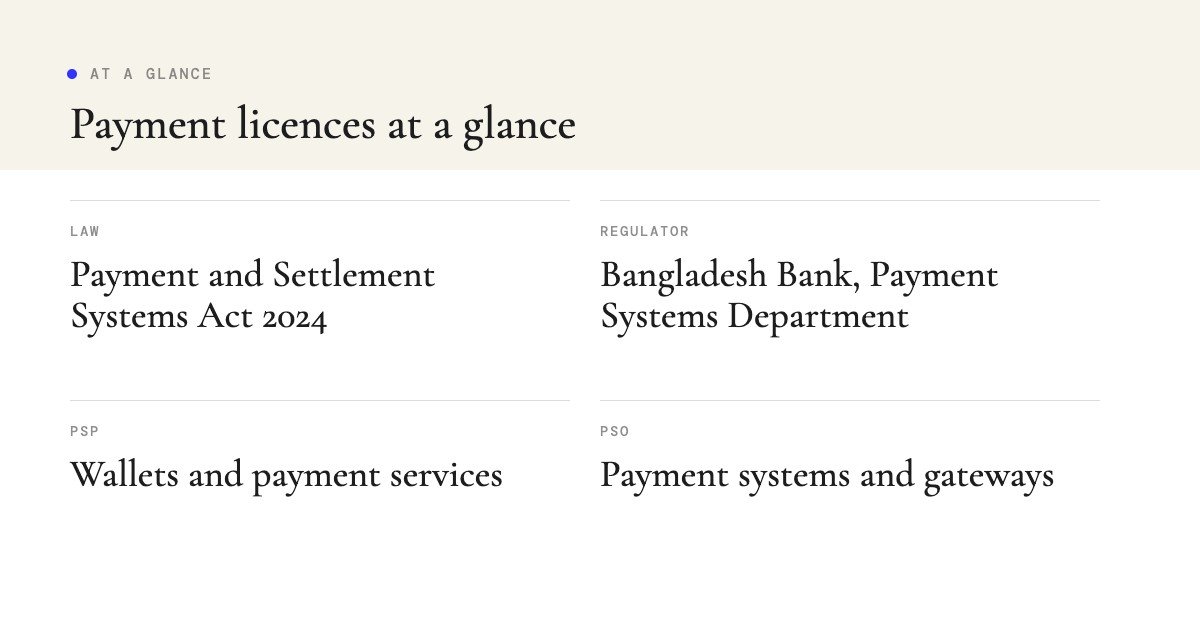
- The Payment and Settlement Systems Act 2024 provides the statutory basis for licensing payment service providers (PSPs) and payment system operators (PSOs).
- Bangladesh Bank's Payment Systems Department licenses and supervises PSPs and PSOs.
- A PSP licence in Bangladesh generally covers wallets and payment services without the cash-out agent networks that characterise MFS.
- Applicants must meet requirements on capital, ownership, fit and proper management, technology, security, AML compliance and protection of customer funds.
- In August 2026, Bangladesh Bank granted a PSP licence under the 2024 Act to a subsidiary of a mobile network operator.
Parliament passed the Personal Data Protection Act 2026 in April 2026, repealing the Personal Data Protection Ordinance 2025. References below to the Ordinance should be read in light of the 2026 Act.
PSP, PSO and MFS compared
| Licence | Typical activities | Key features |
|---|---|---|
| Payment service provider (PSP) | E-wallets, merchant payments, bill payments, P2P transfers within limits | Customer funds held in trust; no agent cash-out network |
| Payment system operator (PSO) | Payment gateways, switches, aggregators, clearing infrastructure | Operates systems used by banks, PSPs and merchants |
| Mobile financial services (MFS) | E-money with cash-in and cash-out through agents | Bank-led subsidiary under MFS Regulations 2022 |
Choosing the right licence depends on the business model. A wallet without agent cash-out may fit a PSP licence in Bangladesh, while a company providing gateway services to merchants usually needs a PSO licence. Our banking and financial services practice helps fintechs select and obtain the right authorisation.
The legal framework for a PSP licence in Bangladesh
For many years, payment businesses were regulated under the Bangladesh Payment and Settlement Systems Regulations 2014 and related guidelines issued by Bangladesh Bank. The Payment and Settlement Systems Act 2024 placed the regime on a statutory footing, giving Bangladesh Bank clear powers to license, supervise, inspect and sanction payment service providers and system operators.
Applicants must also comply with the Money Laundering Prevention Act 2012, BFIU directives, Bangladesh Bank ICT security guidelines, foreign exchange regulations for cross-border elements, and data protection and cyber security requirements.
Eligibility for a PSP licence in Bangladesh
Applicants are generally required to be companies incorporated in Bangladesh with a business plan focused on payment services. Bangladesh Bank assesses the fitness and propriety of sponsors, directors and senior management, the source of capital and the group structure. Unlike MFS, where mobile network operators cannot hold equity, Bangladesh Bank granted a PSP licence in August 2026 to NEO PSP Limited, a subsidiary of Banglalink, showing that telecom groups can participate through the PSP route subject to conditions.
Foreign investment in PSPs and PSOs is possible, subject to foreign exchange rules on capital inflows and Bangladesh Bank's assessment of the investors.
Capital and financial requirements
Bangladesh Bank sets minimum paid-up capital requirements for PSPs and PSOs, and may require higher capital depending on the scale and risk of the business. Capital must be maintained at all times, and the regulator may require additional capital if losses erode it. Because capital thresholds can change through regulations and circulars, applicants should confirm the current requirement before structuring their investment in a PSP licence in Bangladesh.
Protecting customer funds
PSPs that hold customer money must keep it in trust or settlement accounts with scheduled banks, separate from the company's own funds, and must not use customer funds for operating expenses or lending. Daily reconciliation between e-money liabilities and trust account balances is a core requirement. These rules protect customers if the PSP fails.
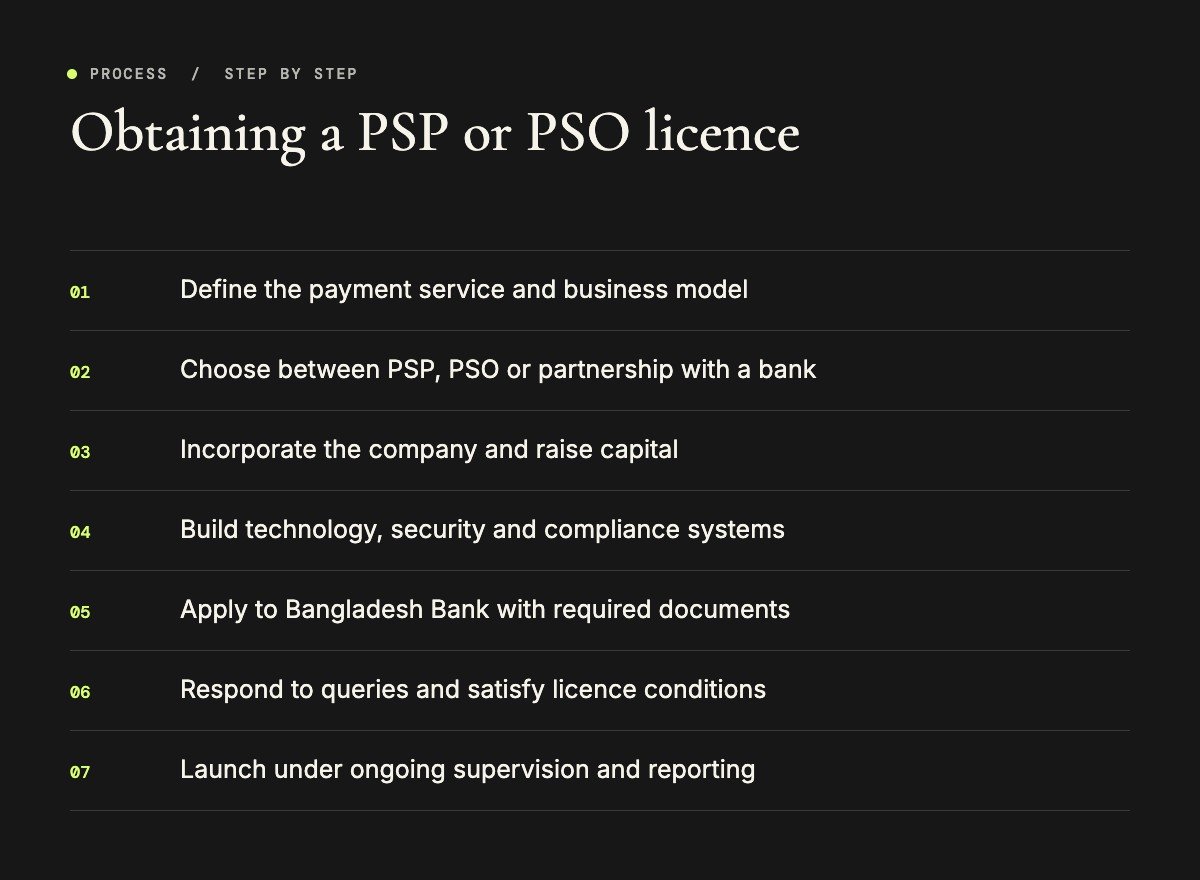
Applying step by step
- Define services. Describe exactly what the company will do and for whom.
- Select the licence. Decide between PSP, PSO or a partnership model with a bank.
- Incorporate and capitalise. Form the company and raise the required capital.
- Build systems. Develop technology, security, risk and compliance frameworks.
- Prepare documents. Business plan, financial projections, policies, technology architecture and fit and proper declarations.
- Apply. Submit the application to Bangladesh Bank's Payment Systems Department.
- Meet conditions. Address queries, pass any system audit and satisfy licence conditions before launch.
Bangladesh Bank pays close attention to information security and AML controls. Prepare a detailed technology risk assessment and independent security audit before applying. Weak security documentation is a common reason for delays.
Ongoing compliance after a PSP licence in Bangladesh
After licensing, PSPs and PSOs must submit regular reports, maintain transaction limits set by Bangladesh Bank, handle customer complaints within prescribed times, conduct KYC and transaction monitoring, report suspicious transactions to BFIU and undergo inspections and audits. Changes in ownership, directors, services or systems generally require prior approval. Breaches can lead to fines, restrictions or licence cancellation.
Why a PSP licence in Bangladesh is attractive
Bangladesh has a large, young and increasingly digital population, with growing e-commerce, ride-hailing, food delivery, utility payments and government digital services. A PSP licence in Bangladesh allows a business to capture payment flows directly rather than relying on banks or MFS providers, opening opportunities for customer data, loyalty programmes and value-added services. Interoperability initiatives led by Bangladesh Bank also make it easier for new providers to connect with banks and other wallets.
At the same time, competition is intense and regulatory expectations are high, so a clear business case is essential before applying.
Partnership models
Some fintechs begin by partnering with licensed banks or PSOs instead of seeking their own licence, providing the customer interface while the partner holds funds and bears regulatory responsibility. This can speed up market entry and test demand, but it limits control and margins. As the business grows, the company may apply for its own PSP licence in Bangladesh. Partnership agreements should clearly allocate compliance responsibilities, data ownership and liability for fraud.
Cross-border payments
Cross-border elements, such as receiving payments from foreign platforms or paying foreign merchants, raise foreign exchange issues. PSPs need authorised dealer bank partners and must comply with Bangladesh Bank rules on inward and outward remittances. Freelancer and export payment services have attracted regulatory attention, and specific approvals may be needed. Any PSP licence in Bangladesh application involving cross-border flows should explain the foreign exchange model in detail.
Merchant onboarding and risk
PSPs and payment aggregators must conduct due diligence on merchants before allowing them to accept payments. This includes verifying trade licences, ownership, business activity and bank accounts, and monitoring for prohibited activities such as unlicensed gambling, illegal online trading or fraud. Bangladesh Bank and BFIU expect strong merchant risk controls, and failures can lead to enforcement against the licence holder. A robust merchant onboarding framework is therefore central to maintaining a PSP licence in Bangladesh.
Chargebacks, refunds and disputes between customers and merchants should be handled through clear procedures set out in merchant agreements and customer terms.
Technology and outsourcing
Many PSPs rely on third-party technology platforms, cloud providers or foreign group companies for core systems. Bangladesh Bank expects licence holders to retain control and accountability, ensure data security and continuity, and give the regulator access to data and systems. Outsourcing contracts should include audit rights, data localisation where required, incident notification and exit plans. Regulators review these arrangements carefully when assessing applications for a PSP licence in Bangladesh.
Customer protection
Clear terms and conditions, transparent fees, accessible complaint channels and prompt dispute resolution are expected of all payment providers. Bangladesh Bank's customer protection framework allows customers to escalate unresolved complaints to the central bank. Providers that treat customers fairly build trust and reduce regulatory risk.
Common reasons for delay
- Incomplete business plans or unrealistic financial projections.
- Unclear source of funds or complex ownership structures.
- Weak information security and business continuity documentation.
- Insufficient AML and KYC policies.
- Lack of experienced local management.
Addressing these issues before filing significantly improves the chances of a smooth PSP licence in Bangladesh process.
Timeline expectations
Licensing can take several months, depending on the completeness of the application, the novelty of the business model and Bangladesh Bank's workload. Applicants should plan for questions, presentations to the regulator and possibly an in-principle approval before final licence. Building the team and technology in parallel helps launch quickly once a PSP licence in Bangladesh is granted.
Governance and key personnel
Bangladesh Bank expects payment companies to have a competent board, independent oversight where appropriate, and qualified senior managers responsible for operations, technology, risk, compliance and finance. A chief anti-money laundering compliance officer is typically required. The regulator may interview key personnel and assess their experience. Frequent changes in senior management can raise concerns, so stable leadership supports both the application and later supervision.
Board minutes, policies and committee charters should show that risks are discussed and managed, not merely documented. Investors should budget for these governance costs from the start.
Data protection
Payment providers handle sensitive personal and financial data. They must comply with Bangladesh Bank data and security rules and with evolving data protection legislation, including the Personal Data Protection Act 2026, which replaced the 2025 Ordinance. Clear privacy policies, consent mechanisms and secure storage are essential, and breaches must be handled and reported promptly.
Interoperability and the national payment infrastructure
Bangladesh Bank operates national payment infrastructure including the National Payment Switch Bangladesh, the Bangladesh Automated Clearing House, BEFTN and RTGS, and has promoted interoperable digital transactions through platforms such as Binimoy and Bangla QR. Licensed PSPs and PSOs are expected to connect to and comply with these systems as required. Interoperability allows wallets to send money to bank accounts and other wallets, increasing usefulness for customers and creating opportunities for innovative services built on shared rails. Applicants should explain in their business plan how they will integrate with national infrastructure, the technical standards they will follow and the timeline for connection.
Exit and wind-down planning
Regulators increasingly expect payment providers to have a credible plan for winding down safely if the business fails, ensuring customer funds are returned and transactions completed. A wind-down plan reassures Bangladesh Bank and customers and is good practice for any regulated fintech.
Frequently asked questions about psp licence in bangladesh
Which law governs PSP licences?
The Payment and Settlement Systems Act 2024, with Bangladesh Bank regulations and guidelines.
What is the difference between PSP and MFS?
MFS uses agent cash-in and cash-out networks under bank-led rules; PSPs generally provide wallets and payments without such networks.
Do I need a PSO licence for a payment gateway?
Usually yes, as gateways are payment system operations.
Can foreign investors own a PSP?
Yes, subject to Bangladesh Bank approval and foreign exchange rules.
Can telecom companies get a PSP licence?
Bangladesh Bank granted one to a telecom subsidiary in August 2026, subject to conditions.
How are customer funds protected?
Through trust or settlement accounts separated from company funds and daily reconciliation.
How we can help
We advise fintechs and investors on every PSP licence in Bangladesh and PSO application, from structuring and documentation to Bangladesh Bank engagement and ongoing compliance. Learn more about our financial services practice, our technology team and our foreign investment practice.
Building a payments business?
We guide you through licensing and compliance with Bangladesh Bank.
Book a consultationFinancial servicesPrimary sources: payment systems regulations and circulars from Bangladesh Bank; AML directives from the BFIU; legislation on the Laws of Bangladesh portal.
This article is general information about Bangladeshi payment regulation as of October 2026 and is not legal advice. Capital requirements and limits change; confirm current requirements with Bangladesh Bank.




0 Comments