
A final judgment of the Appellate Division ends most cases, but the Constitution allows one narrow route back. A review petition in Bangladesh asks the court that decided the case to correct a clear error in its own judgment. Review is not a second appeal, and courts dismiss petitions that simply reargue the case, so understanding the limited grounds and strict deadlines is essential.
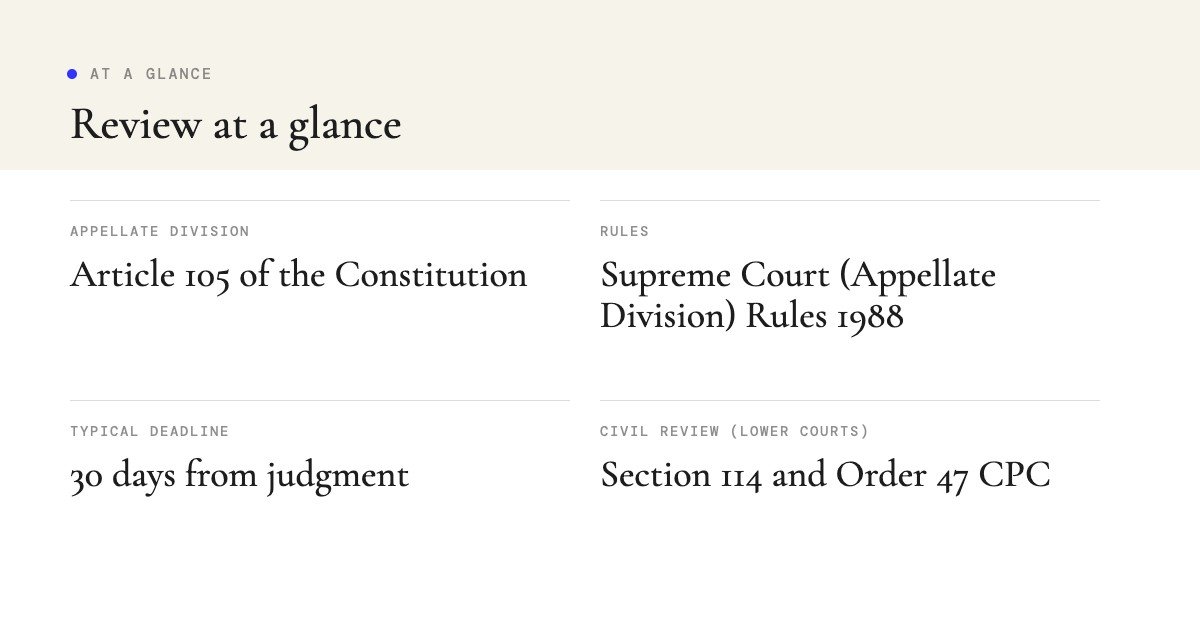
- Article 105 of the Constitution empowers the Appellate Division to review its own judgments or orders, subject to Acts of Parliament and its rules.
- Under the Appellate Division Rules, a review petition is generally filed within 30 days of the judgment or order.
- Review is limited to errors apparent on the face of the record and similar grounds; it is not a rehearing.
- In civil matters, other courts, including the High Court Division, may review under section 114 and Order 47 of the Code of Civil Procedure.
- The High Court Division generally cannot review its own judgments in criminal matters beyond correcting clerical errors.
The constitutional basis for a review petition in Bangladesh
Article 105 of the Constitution provides that the Appellate Division shall have power, subject to the provisions of any Act of Parliament and of any rules made by that Division, to review any judgment pronounced or order made by it. The Supreme Court of Bangladesh (Appellate Division) Rules 1988 set out the procedure, including time limits, form and grounds.
A review petition in Bangladesh before the Appellate Division is therefore an exceptional remedy available after the final appellate decision. Our Supreme Court practice prepares and argues review petitions in civil and criminal matters.
Grounds for a review petition in Bangladesh
| Ground | Explanation |
|---|---|
| Error apparent on the face of the record | An obvious mistake of fact or law that needs no lengthy argument to establish |
| Discovery of new and important evidence | Evidence that could not be produced earlier despite due diligence (civil review) |
| Other sufficient reason | Reasons analogous to the above, interpreted narrowly |
Courts repeatedly emphasise that a review petition in Bangladesh cannot be used to rehear the appeal or to argue that the court reached the wrong conclusion on the evidence. An error that can only be shown through elaborate reasoning is not "apparent on the face of the record."
Time limits for a review petition in Bangladesh
Under the Appellate Division Rules, a review petition is ordinarily filed within thirty days from the date of the judgment or order sought to be reviewed. Delay may be condoned only where sufficient cause is shown. Because certified copies take time to obtain, petitioners should apply immediately after judgment and begin drafting promptly.
For review in the High Court Division and subordinate courts in civil matters, the Limitation Act prescribes the relevant periods, which should be checked for each case.
Procedure in the Appellate Division
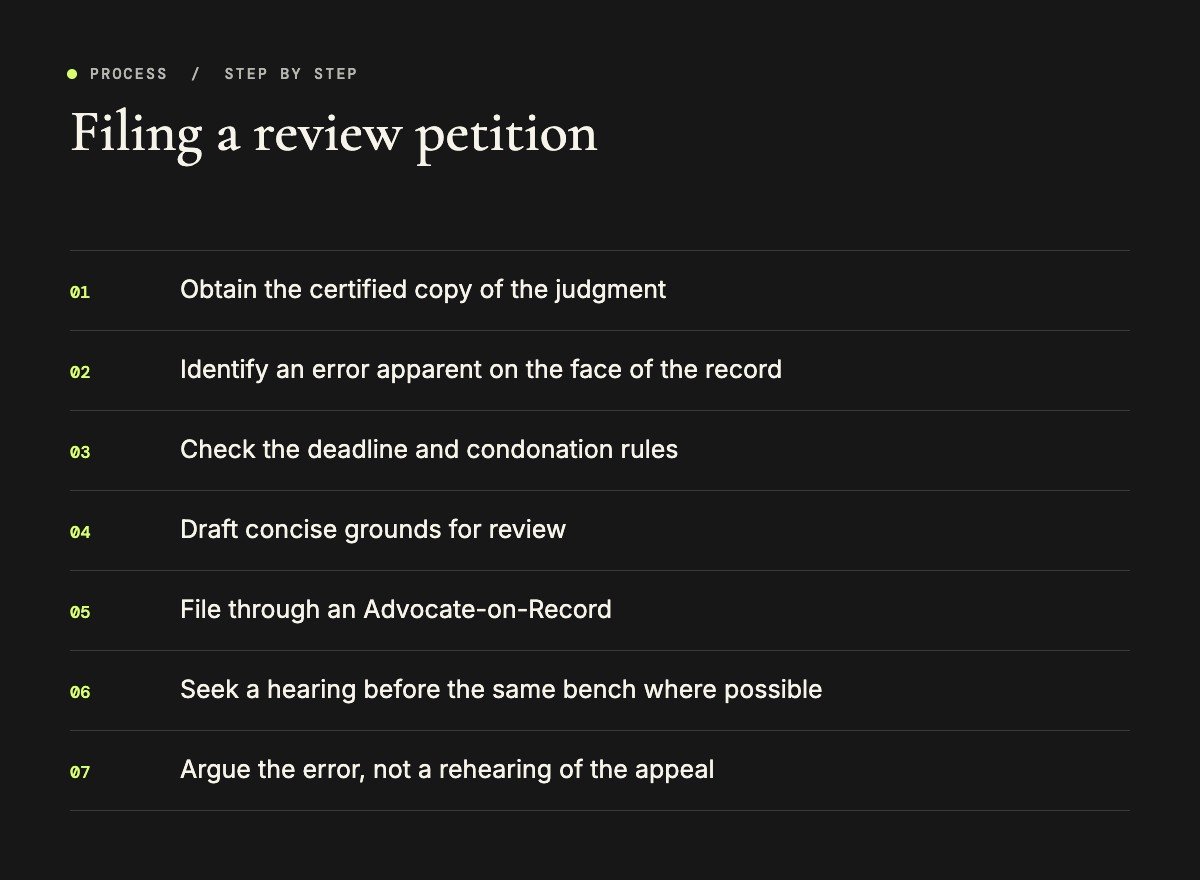
- Obtain the judgment. Apply for a certified copy of the judgment or order.
- Identify the error. Pinpoint the specific error apparent on the record.
- Check the deadline. Calculate the thirty-day period and any condonation needed.
- Draft the petition. State concise grounds, with references to the record.
- File through counsel. Petitions are filed through an Advocate-on-Record with the required certificates.
- Listing. Review is generally heard by the same bench or judges where practicable.
- Hearing. The court may dismiss in limine or hear the parties before deciding.
Keep the review petition short and focused. Judges quickly lose patience with petitions that repeat the appeal arguments. Identify one or two clear errors, show precisely where they appear in the record, and explain why they affect the outcome.
Review in the High Court Division and lower courts
In civil matters, section 114 and Order 47 of the Code of Civil Procedure allow a person aggrieved by a decree or order to apply for review to the court that passed it, on grounds of discovery of new and important evidence, a mistake or error apparent on the face of the record, or any other sufficient reason. An appeal and review cannot generally be pursued simultaneously on the same issues.
In writ jurisdiction, the High Court Division has accepted limited inherent power to review its own orders to correct obvious errors, but the scope is narrow. Litigants should consider carefully whether a review petition in Bangladesh or an appeal to the Appellate Division is the better route.
Review petition in Bangladesh in criminal matters
Section 369 of the Code of Criminal Procedure provides that, except as otherwise provided, no court shall alter or review its judgment once signed, except to correct a clerical error. This means the High Court Division generally cannot review its criminal judgments on the merits. The Appellate Division, however, has power under Article 105 to review its judgments in criminal cases, including death penalty appeals, and such review petitions are an important safeguard.
In capital cases, review petitions often receive close attention because of the irreversible nature of the sentence.
When a review petition in Bangladesh succeeds
Successful reviews are rare but do occur. Examples include cases where the court overlooked a binding statutory provision, misread a document that was central to the decision, decided a point not argued without hearing the parties, or proceeded on a factual premise plainly contradicted by the record. In such cases, the court may recall its judgment, rehear the matter or modify the order.
A review petition in Bangladesh is more likely to succeed where the error is narrow, obvious and decisive, rather than where the petitioner disagrees with the court's reasoning or weighing of evidence.
Stay pending review
Filing a review petition does not automatically stay the judgment. Where execution or implementation would cause irreparable harm, the petitioner can apply for a stay pending disposal of the review. The court considers the strength of the review grounds and the balance of convenience. In criminal cases involving custody or sentences, urgent applications may be necessary.
Professional responsibility
Lawyers must certify that review petitions are filed on genuine grounds, and courts may impose costs for frivolous petitions that waste judicial time. Advocates-on-Record carry particular responsibility for the accuracy of statements in petitions. Clients should be advised candidly about the low success rate so they can make informed decisions about filing a review petition in Bangladesh.
Review versus appeal
An appeal asks a higher court to examine whether the lower court was right. A review asks the same court to correct its own clear mistake. Where an appeal lies, it is usually the better route because the appellate court can reconsider the merits. A review petition in Bangladesh is mainly important where no further appeal is available, such as against judgments of the Appellate Division, or where the error is so obvious that the same court can correct it quickly.
In civil matters, a party who has filed an appeal generally cannot pursue a review on the same grounds at the same time, and vice versa, so the choice must be made carefully.
Drafting an effective petition
A persuasive review petition in Bangladesh is concise, precise and respectful. It identifies the paragraph of the judgment containing the error, explains the correct position with reference to the record or statute, and shows why the error affected the outcome. It avoids repeating arguments already considered and rejected. Attaching the relevant pages of the paper book or statutory text helps the court see the error immediately.
Tone matters. Review petitions that criticise the court or allege bias are unlikely to succeed and may attract adverse comment.
Practical checklist
- Apply for certified copies on the day of judgment.
- Diarise the thirty-day deadline immediately.
- Identify a specific, obvious error rather than general disagreement.
- Consider whether a stay is needed pending review.
- Instruct an experienced Advocate-on-Record early.
Following this checklist gives a review petition in Bangladesh the best possible chance within the narrow limits the law allows.
Review in writ and constitutional cases
Many significant public law cases reach the Appellate Division on appeal from writ decisions of the High Court Division. Once the Appellate Division decides, review under Article 105 is the only remaining route. In constitutional cases, review petitions sometimes raise questions about the interpretation of fundamental rights or the separation of powers, and the court has occasionally modified its observations or directions on review while leaving the core decision intact. Government bodies also file review petitions where judgments have wide administrative implications, for example in service matters affecting large numbers of public employees. In such cases the court weighs the need for finality against the importance of correcting errors with broad consequences.
Costs and timing
Review petitions are relatively quick to prepare compared with appeals, but costs include obtaining certified copies, preparing paper books and counsel's fees. Hearings may be listed within weeks or months depending on the court's schedule and any urgency shown. Where a stay is sought, early listing can be requested.
After the review is decided
If the review is dismissed, the original judgment stands and becomes final. Repeated review petitions on the same judgment are generally not entertained, as courts protect finality. If the review is allowed, the court may correct the error directly, recall the judgment and rehear the matter, or remit it for fresh consideration. Parties should be prepared for either outcome and, where the judgment requires action such as payment, reinstatement or release, plan for compliance or enforcement promptly. Ignoring a final judgment after an unsuccessful review can lead to contempt proceedings, so implementation should not be delayed in the hope of further remedies.
Clerical and arithmetical errors
Not every mistake requires a formal review. Clerical or arithmetical errors in judgments, decrees or orders, or errors arising from accidental slips, can usually be corrected under section 152 of the Code of Civil Procedure by a simple application. This is quicker and avoids the high threshold for review.
Frequently asked questions about review petition in bangladesh
What is the legal basis for review by the Appellate Division?
Article 105 of the Constitution and the Appellate Division Rules 1988.
What is the deadline?
Ordinarily thirty days from the judgment or order, with condonation only for sufficient cause.
Can I reargue my appeal in review?
No. Review is limited to errors apparent on the face of the record and similar grounds.
Can the High Court Division review a criminal judgment?
Generally not on the merits; section 369 CrPC limits review to clerical errors.
Who hears the review?
Usually the same bench or judges that decided the case, where practicable.
Is there a further remedy after review?
Generally no; review is the final opportunity before the Appellate Division.
How we can help
We assess whether a review petition in Bangladesh is viable, prepare focused grounds and argue before the Appellate Division and High Court Division. Learn more about our Supreme Court practice, our guide to the structure of the Supreme Court and our litigation team.
Disappointed by a judgment?
We advise quickly on review and other remaining options.
Book a consultationSupreme Court practicePrimary sources: the Constitution of Bangladesh, Code of Civil Procedure 1908 and Code of Criminal Procedure 1898 on the Laws of Bangladesh portal; rules and cause lists of the Supreme Court of Bangladesh.
This article is general information about Bangladeshi procedural law as of October 2026 and is not legal advice. Deadlines are strict; seek advice immediately after judgment.




0 Comments