
Performance bonds, advance payment guarantees and bid bonds underpin construction, supply and government contracts across Bangladesh. A bank guarantee in Bangladesh gives the beneficiary a bank’s promise to pay on demand, independent of disputes under the underlying contract. Courts protect this independence strongly, restraining encashment only in narrow cases of fraud or special equities, so both sides need to understand the rules before a dispute arises.
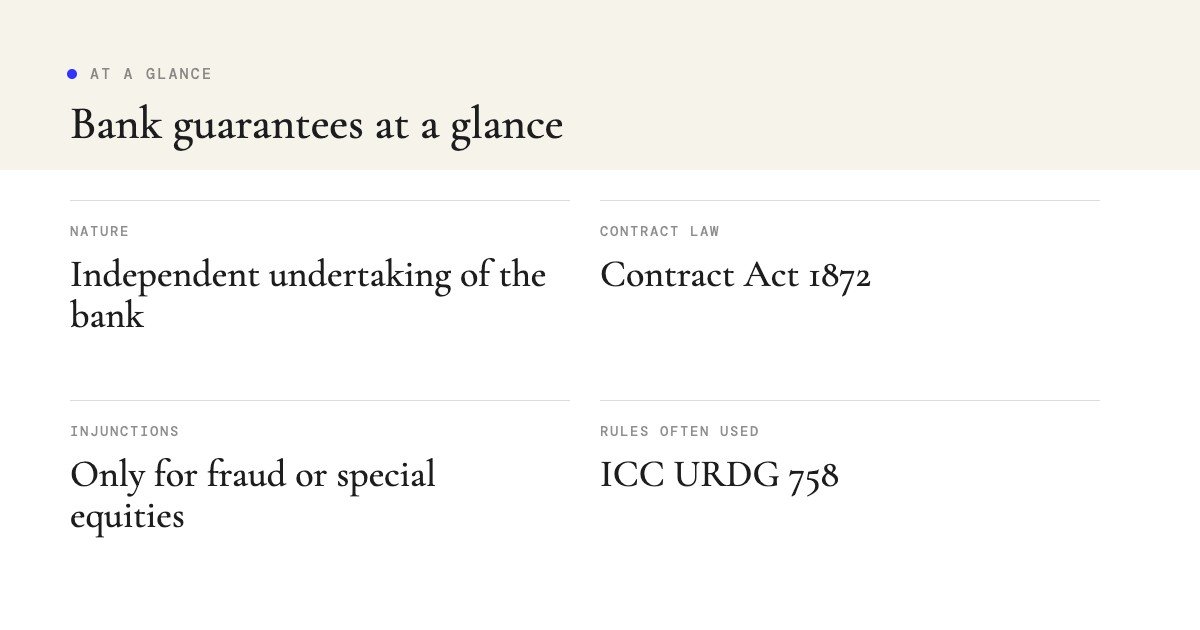
- An on-demand bank guarantee is an independent undertaking: the bank must pay a compliant demand regardless of disputes under the underlying contract.
- Courts in Bangladesh generally refuse to restrain encashment except in cases of established fraud known to the bank or special equities causing irretrievable injustice.
- The wording of the guarantee, including expiry, claim conditions and governing rules, determines the parties' rights.
- Many guarantees incorporate the ICC Uniform Rules for Demand Guarantees (URDG 758).
- Guarantees issued in favour of foreign beneficiaries must comply with Bangladesh Bank foreign exchange rules.
Types of bank guarantee in Bangladesh
| Type | Purpose |
|---|---|
| Bid or tender guarantee | Secures a bidder's commitment to sign the contract if awarded |
| Performance guarantee | Secures proper performance of the contract |
| Advance payment guarantee | Secures repayment of an advance if work is not performed |
| Retention money guarantee | Replaces cash retention during defects liability |
| Payment guarantee | Secures payment by a buyer or employer |
Public procurement in Bangladesh routinely requires bid and performance securities in the form of bank guarantees, and private construction and supply contracts often do the same. Our banking and finance practice advises banks, contractors and employers on these instruments.
The independence principle for a bank guarantee in Bangladesh
A bank guarantee in Bangladesh is treated as a separate contract between the bank and the beneficiary. The bank is concerned only with whether the demand complies with the terms of the guarantee, not with whether the beneficiary is actually entitled under the underlying contract. This principle gives guarantees their commercial value: beneficiaries can obtain payment quickly, and disputes about entitlement are resolved later between the contracting parties.
Bangladeshi courts, following established principles in the subcontinent and England, have repeatedly held that a bank must honour its guarantee according to its terms, and that disputes between the applicant and beneficiary do not justify refusing payment.
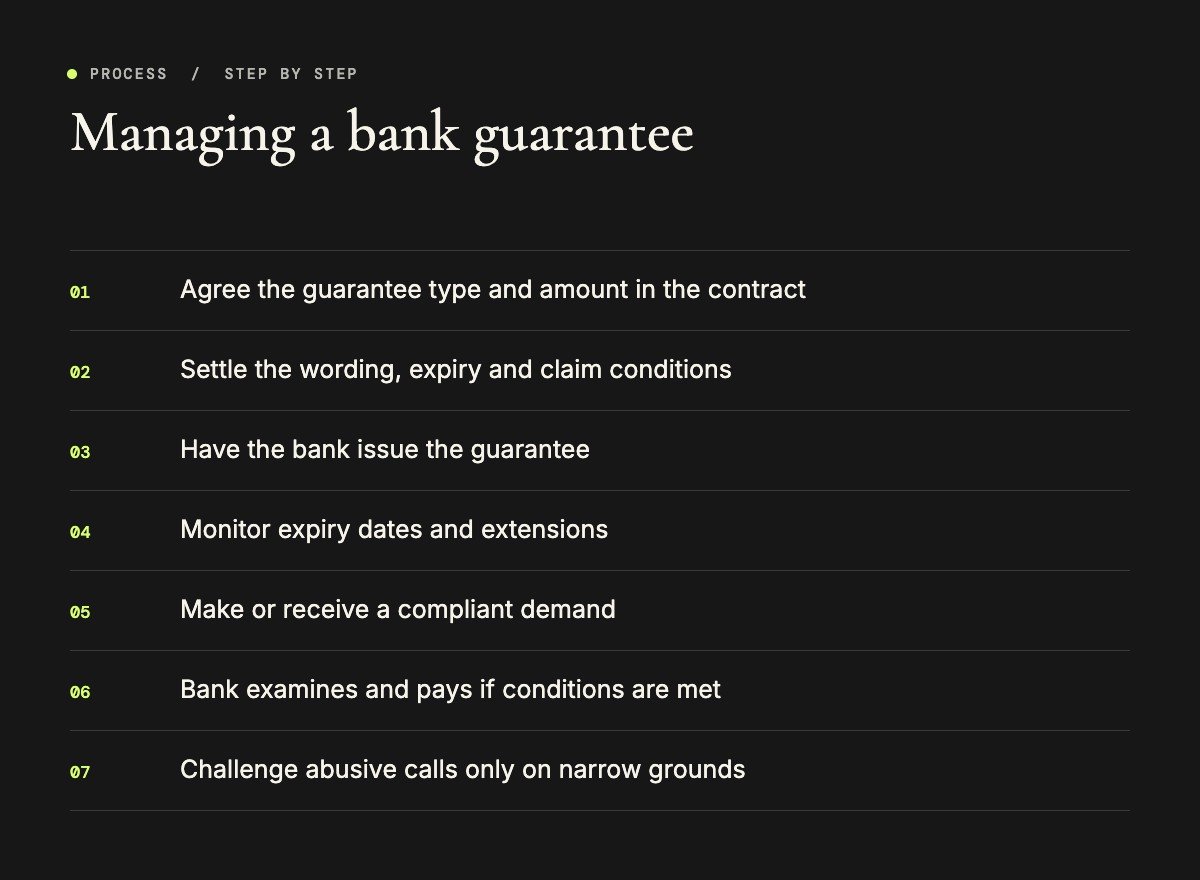
When courts restrain encashment
Courts will restrain a beneficiary from encashing, or a bank from paying, only in exceptional circumstances. The two recognised exceptions are established or egregious fraud of which the bank has notice, and special equities, such as irretrievable injustice that would make it impossible to recover the money later. Mere allegations of breach, or a genuine dispute about performance, are not enough.
An applicant seeking to stop payment of a bank guarantee in Bangladesh must produce strong prima facie evidence of fraud, not just argue that the beneficiary is wrong. Courts are cautious because routine injunctions would undermine trust in guarantees and harm Bangladesh's international trade.
Drafting a bank guarantee in Bangladesh
- Type and amount. Match the guarantee to the risk it secures.
- Demand conditions. Decide whether a simple demand suffices or supporting documents are required.
- Expiry. Set a clear expiry date and place for presentation.
- Reduction. Provide for reduction as work progresses or advances are recovered.
- Governing rules. Consider incorporating URDG 758.
- Governing law and forum. Specify which law and courts govern the guarantee.
- Extension. Address "extend or pay" demands and renewal procedures.
Applicants should negotiate demand conditions carefully. A guarantee requiring the beneficiary to state the specific breach, or to provide a certificate from an engineer, offers more protection against abusive calls than a pure "first demand" guarantee.
Making a demand under a bank guarantee in Bangladesh
Beneficiaries must present a demand that strictly complies with the guarantee: correct form, signed by authorised persons, within the expiry period, at the designated place and with any required documents. Banks examine demands for compliance and may reject non-compliant ones. Under URDG 758, the bank has a limited period to examine and must give notice of rejection specifying discrepancies.
Beneficiaries should diarise expiry dates and present demands early enough to cure any defects before expiry.
Foreign beneficiaries and counter-guarantees
International contracts often involve counter-guarantees, where a Bangladeshi bank issues a guarantee to a local beneficiary backed by a foreign bank's counter-guarantee, or vice versa. Guarantees issued by Bangladeshi banks in favour of foreign beneficiaries must comply with Bangladesh Bank foreign exchange rules, and payment abroad requires proper documentation. Bangladesh Bank's consolidated foreign exchange circular on loans and guarantees sets out when authorised dealer banks can issue such guarantees without prior approval.
Bank guarantee in Bangladesh in public procurement
Under the Public Procurement Act 2006 and Public Procurement Rules 2025, procuring entities require tender securities and performance securities, usually in the form of bank guarantees from scheduled banks in prescribed formats. A bidder who withdraws after the deadline or fails to sign the contract may forfeit the tender security, and a contractor who defaults may face encashment of the performance security. Contractors challenging forfeiture or encashment by a public body face the same high threshold as in private disputes, although public law remedies may be relevant where the procuring entity acts outside its powers.
Contractors should diarise expiry dates of every bank guarantee in Bangladesh issued for public contracts, as procuring entities often demand extension before expiry and may call the guarantee if extension is not provided.
Extend or pay demands
Beneficiaries sometimes send "extend or pay" demands shortly before expiry, asking the bank either to extend the guarantee or to pay. The applicant must decide quickly whether to agree to extension. Refusing may result in payment, while agreeing extends exposure. URDG 758 provides a procedure allowing the bank to suspend payment for a short period while the applicant considers extension.
Recovering money after an unjustified call
If a beneficiary encashes a bank guarantee in Bangladesh without entitlement under the underlying contract, the applicant's remedy usually lies in a claim against the beneficiary, through arbitration or litigation under the contract. The applicant must also reimburse the bank under its counter-indemnity. Strong contract terms requiring the beneficiary to account for sums received, and clear dispute resolution clauses, make recovery easier.
Fraud: what courts look for
To succeed on the fraud exception, an applicant usually needs clear evidence that the beneficiary knows it has no honest claim but is demanding payment anyway, and that the bank is aware of this. Examples include a demand after the beneficiary has acknowledged full performance in writing, or a demand based on forged documents. A dispute about the quality of work, delay or set-off is normally not fraud.
Evidence must be presented at the injunction hearing, often within days of the demand. Contractors who anticipate a call should prepare documentation in advance. Without strong evidence, an application to restrain a bank guarantee in Bangladesh is likely to fail and may lead to costs.
Special equities and irretrievable injustice
The special equities exception covers situations where payment would cause irretrievable harm that cannot be remedied later, for example where the beneficiary is insolvent or located in a jurisdiction where recovery would be practically impossible. Courts apply this exception sparingly, and applicants must show concrete evidence rather than speculation.
Banks' perspective
Banks issuing guarantees rely on counter-indemnities from applicants and often require cash margin or security. When a demand arrives, the bank examines it strictly against the guarantee terms. Banks are reluctant to become involved in underlying disputes and will usually pay compliant demands unless restrained by a court order. Clear internal procedures for examining demands and responding to injunctions protect banks from liability.
Banks must also consider sanctions screening and foreign exchange rules before paying foreign beneficiaries under a bank guarantee in Bangladesh.
Practical tips for applicants
- Negotiate demand conditions and reduction clauses before signing.
- Track expiry dates and extension requests carefully.
- Keep evidence of performance and acknowledgments from the beneficiary.
- Act immediately if a demand appears fraudulent.
- Plan for recovery under the contract if an unjustified call succeeds.
These steps help applicants manage the risks that come with every bank guarantee in Bangladesh.
Guarantees and arbitration
Where the underlying contract contains an arbitration clause, disputes about whether the beneficiary was entitled to call the guarantee belong to arbitration. However, the guarantee itself is a separate contract with the bank and may have its own governing law and forum. Applicants sometimes seek interim relief from the court under section 7A of the Arbitration Act 2001 to restrain a call pending arbitration, but the same strict fraud and special equities test applies. Tribunals may later order the beneficiary to repay sums wrongly received, and awards can be enforced like decrees. Planning the dispute strategy early, including where to seek urgent relief, is important because guarantee calls often happen without warning.
Standby letters of credit
Standby letters of credit perform a similar function to demand guarantees and are common in international transactions. They may be governed by the ICC International Standby Practices (ISP98) or UCP 600. The independence principle applies equally, and Bangladeshi banks issuing or confirming standbys must comply with foreign exchange rules.
Insolvency of the applicant or beneficiary
If the applicant becomes insolvent, the beneficiary can still call the guarantee and the bank must pay, then claim reimbursement from the applicant's estate or any security held. If the beneficiary becomes insolvent, the applicant may argue special equities to prevent a call, since recovering money from an insolvent beneficiary may be impossible. Banks and parties should monitor counterparties' financial health and consider stronger security or shorter guarantee terms where risks are high. Finance company and bank resolution laws may also affect guarantees issued by distressed institutions, so beneficiaries should consider the issuing bank's strength when accepting a guarantee.
Cost of guarantees
Banks charge commission based on the amount and tenor of the guarantee, and may require cash margin or collateral. Long-dated or large guarantees can tie up credit lines, so contractors should negotiate reductions as milestones are met and the prompt return of expired guarantees.
Frequently asked questions about bank guarantee in bangladesh
Can a bank refuse to pay because of a contract dispute?
No, if the demand complies with the guarantee, disputes under the contract do not justify refusal.
When will a court stop encashment?
Only for established fraud known to the bank or special equities causing irretrievable injustice.
What is URDG 758?
ICC rules for demand guarantees often incorporated into guarantee wording.
What happens after expiry?
The bank's liability ends for demands not presented in time, subject to the guarantee terms.
Can the applicant recover money after an unjustified call?
Yes, by claiming against the beneficiary under the underlying contract.
Do public procurement contracts use guarantees?
Yes, bid and performance securities are standard in government contracts.
How we can help
We advise on bank guarantee in Bangladesh drafting, demands, injunction applications, bank disputes and recovery after unjustified calls. Learn more about our banking and finance practice, our construction disputes team and our trade finance practice.
Guarantee about to be called?
We act fast to assess your options and protect your position.
Book a consultationBanking practicePrimary sources: the Contract Act 1872 and Specific Relief Act 1877 on the Laws of Bangladesh portal; ICC rules from the International Chamber of Commerce; foreign exchange rules from Bangladesh Bank.
This article is general information about Bangladeshi law as of October 2026 and is not legal advice. Outcomes depend on the guarantee wording and facts.




0 Comments