
Cloud hosting abroad, a regional shared service centre, a parent company’s HR system: almost every business in Bangladesh sends personal data overseas. Cross border data transfer in Bangladesh is now governed by a dedicated data protection statute, alongside long-standing sector rules for banks, telecoms operators and government data. Getting the rules right avoids fines, suspension orders and reputational damage.

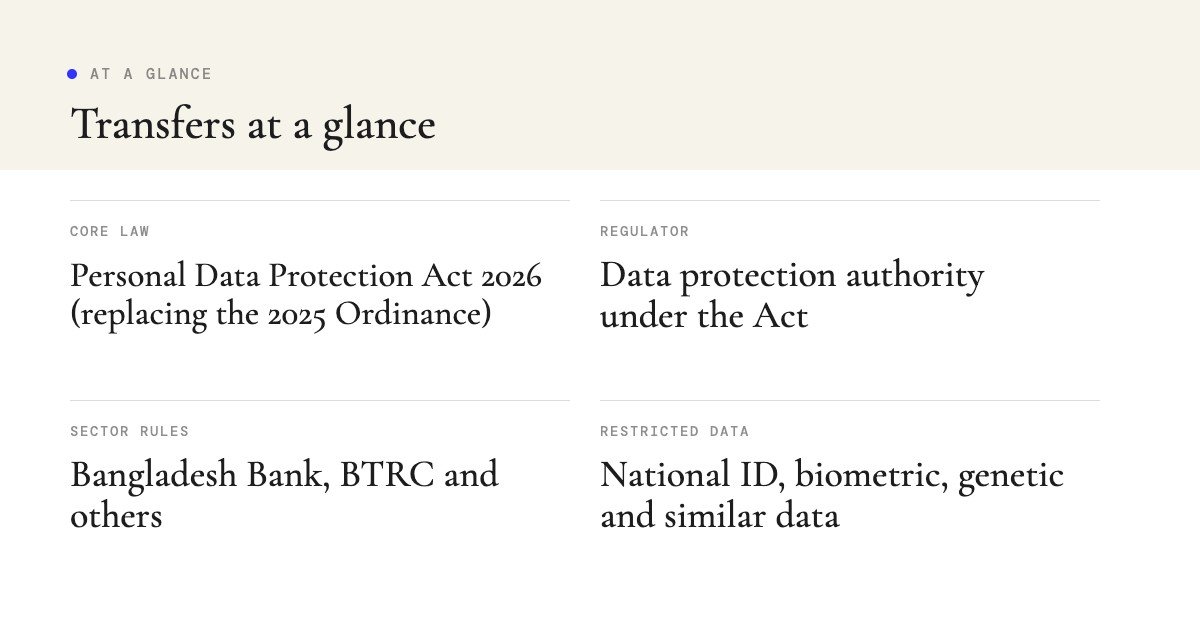
- Parliament passed the Personal Data Protection Act 2026 in April 2026, replacing the Personal Data Protection Ordinance 2025; businesses should confirm commencement dates and implementing rules.
- Transfers abroad must meet transparency and safety requirements, and certain large-scale transfers of sensitive data must be notified to the authority.
- Bulk transfers of identifiers such as national ID, passport and tax ID numbers, and biometric and genetic data, face particular restrictions.
- Sector regulators, including Bangladesh Bank and BTRC, impose their own localisation and approval requirements.
- Contracts, security measures and records of transfers are the practical core of compliance.
Why cross border data transfer in Bangladesh matters now
For years Bangladesh had no comprehensive data protection law, and transfers were governed mainly by sector rules and general provisions in information technology and cyber laws. That changed with the Personal Data Protection Ordinance 2025, issued in November 2025 and amended in early 2026, followed by the Personal Data Protection Act 2026 passed by Parliament in April 2026. The new regime introduces consent standards, data subject rights, a regulator and specific rules for cross border data transfer in Bangladesh.
Our data protection and privacy practice helps organisations map their data flows and adapt contracts and systems to the new law.
The legal framework for cross border data transfer in Bangladesh
| Source | Relevance to transfers |
|---|---|
| Personal Data Protection Act 2026 | General rules on processing, consent, rights and transfers abroad |
| Cyber security legislation (2026) | Critical information infrastructure and security obligations |
| Bangladesh Bank regulations | Outsourcing, cloud and data location rules for banks and financial institutions |
| BTRC licence conditions | Subscriber data, lawful interception and data location for telecoms operators |
| Sector laws | Health, insurance and government data rules |
Because commentary on the new Act is still developing and implementing rules may follow, organisations should read the official text on Laws of Bangladesh rather than rely on summaries.
Rules for cross border data transfer in Bangladesh
Reported features of the Act require that transfers outside Bangladesh be transparent and subject to appropriate safeguards. Data controllers must be able to explain the safeguards to data subjects on request and must notify the authority of cross-border transfers involving large volumes of sensitive personally identifiable data. Transfers may be assessed for risks to national sovereignty, security and financial stability, and the authority has powers to suspend transfers.
Earlier drafts and the original ordinance contained broad localisation requirements for technology companies, but amendments in early 2026 reportedly narrowed these. The practical effect is that cross border data transfer in Bangladesh is generally permitted with safeguards, while particular categories remain tightly controlled.
Restricted and sensitive data
The Act treats sensitive personal data, children’s data and certain identifiers with extra care. Bulk transfers of national ID, passport and tax identification numbers are restricted, biometric and genetic data are heavily protected against leaving the country without authorisation, and criminal records data is also restricted. Organisations handling these categories, such as banks, telecoms operators, fintechs, hospitals and HR outsourcing providers, should treat each transfer as requiring specific review.
Building a compliant transfer programme
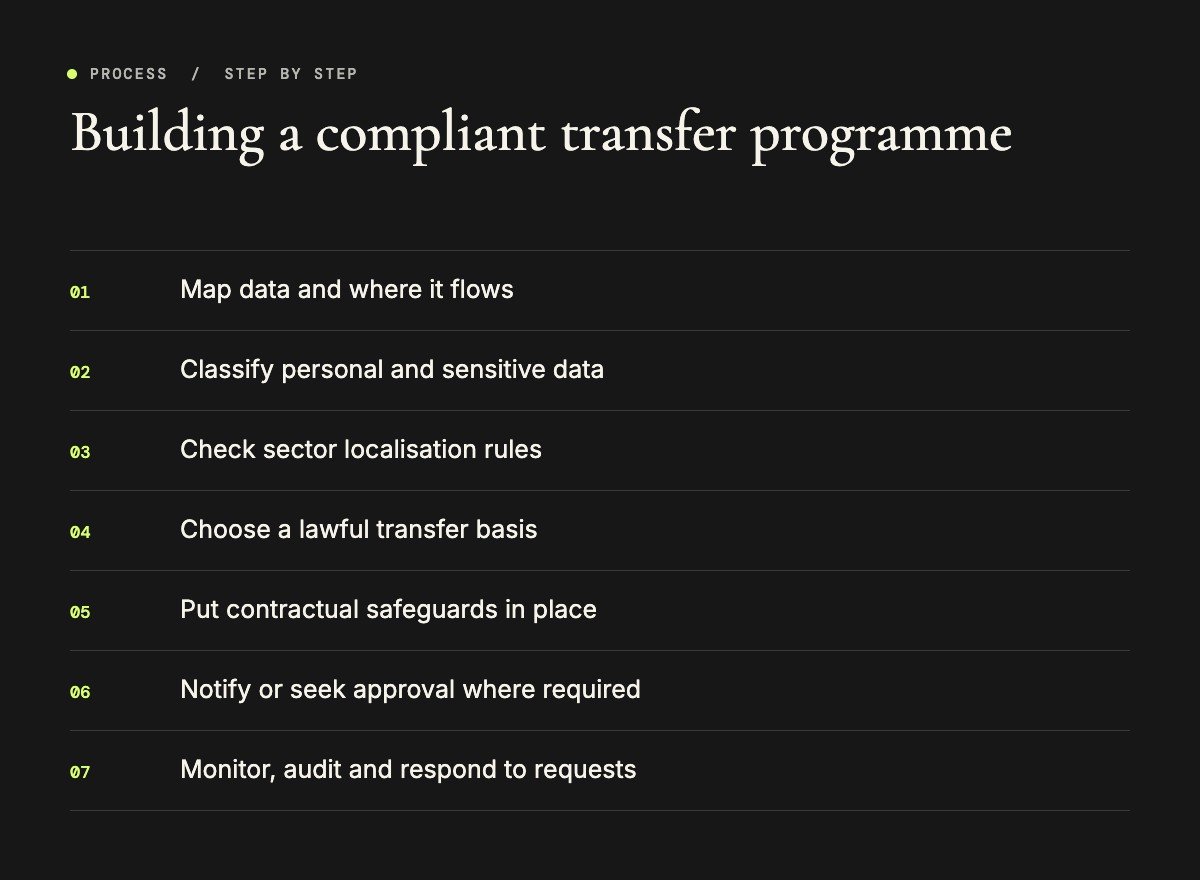
- Map data flows. Identify what personal data leaves Bangladesh, to whom and why.
- Classify data. Distinguish ordinary, sensitive and restricted categories.
- Check sector rules. Review Bangladesh Bank, BTRC or other regulator requirements.
- Choose a lawful basis. Consent, contract necessity or other basis recognised by the Act.
- Contract safeguards. Put data transfer and processing agreements in place.
- Notify where required. File notifications or seek approvals for large-scale sensitive transfers.
- Monitor. Keep records, audit recipients and respond to data subject requests.
Start with a simple data inventory. Many organisations discover transfers they did not know about, such as marketing tools, analytics scripts or overseas support teams with remote access, which also count as transfers.
Banking and financial services
Banks, financial institutions and payment service providers face the strictest regime. Bangladesh Bank rules on ICT security, outsourcing and cloud services require risk assessments, board approval and, for certain data and systems, hosting within Bangladesh or regulator consent before using overseas cloud. Customer data confidentiality obligations under banking law also apply. A bank planning cross border data transfer in Bangladesh, for example to a group data centre or a global core banking provider, should engage with Bangladesh Bank early and document how customer data will be protected and accessible to the regulator.
Telecoms and digital platforms
Mobile operators and internet service providers hold large volumes of subscriber data and must comply with BTRC licence conditions on subscriber registration, retention and lawful access. Some data must be kept in Bangladesh and available to authorities. Digital platforms and e-commerce businesses must also consider the new Act’s rules on consent, children’s data and transfers, especially where they rely on overseas cloud infrastructure and analytics.
Contracts and safeguards for cross border data transfer in Bangladesh
A written data transfer or processing agreement is the backbone of any compliant cross border data transfer in Bangladesh. It should define the data and purposes, require the recipient to process only on instructions, impose security measures, restrict onward transfers, require breach notification, support data subject rights, allow audits and provide for return or deletion. Multinational groups may use an intra-group data transfer agreement covering all entities, adapted to include Bangladesh-specific requirements.
Technical safeguards, such as encryption in transit and at rest, pseudonymisation and access controls, reduce risk and help demonstrate compliance to the regulator.
Consent and transparency
Privacy notices should tell individuals that their data may be transferred abroad, to which types of recipients and countries, and with what safeguards. Where consent is the basis, it must be clear, specific and freely given, and individuals must be able to withdraw it. Employers transferring employee data to overseas HR systems should update employment documents and notices accordingly.
Penalties for unlawful cross border data transfer in Bangladesh
The authority can issue binding instructions, inspect premises and systems, issue warnings, impose fines and suspend transfers. Reported administrative fines reach up to Tk 25 lakh for certain failures and up to Tk 50 lakh for significant data fiduciaries, with additional fines for repeat violations. Sector regulators may impose their own sanctions. Beyond fines, suspension of transfers can disrupt operations that depend on overseas systems.
Cloud hosting and outsourcing
Moving systems to public cloud providers with data centres outside Bangladesh is the most common form of transfer. Organisations should review where data will be stored and processed, who at the provider can access it, which sub-processors are involved, and how the provider responds to government access requests in other countries. Contract terms offered by large cloud providers are standard, so Bangladeshi businesses should check whether addenda are needed to meet local requirements. For regulated sectors, regulator approval may be required before cross border data transfer in Bangladesh to a cloud provider.
Outsourcing of customer service, payroll or IT support to overseas vendors raises similar issues, especially where vendors access live systems containing personal data.
Human resources and group data
Multinational employers routinely share employee data with parent companies for payroll, performance management, compliance and global HR systems. Such sharing is a cross border data transfer in Bangladesh and should be covered by notices to employees, a lawful basis and an intra-group agreement. Sensitive employee data, such as health information, national ID numbers and biometric attendance records, deserves particular attention because of the restrictions on these categories.
Data breaches involving overseas recipients
If a recipient abroad suffers a breach, the Bangladeshi controller remains responsible for responding under the Act. Contracts should require prompt notification by the recipient, cooperation with investigations and support for notifications to the authority and affected individuals. Incident response plans should include scenarios involving overseas vendors and group companies, with clear contacts and timelines.
Government and public sector data
Government bodies and contractors handling public sector data face additional controls, including policies favouring storage in national data centres and restrictions on sharing government data abroad. Vendors bidding for public projects should check tender requirements on data location and security, which may be stricter than the general rules for cross border data transfer in Bangladesh.
Chief data officer and governance
Significant data controllers are reportedly required to appoint a chief data officer responsible for compliance. Even where not strictly required, assigning ownership of data protection to a senior person, with a cross-functional team from legal, IT, HR and business units, helps maintain a transfer register, approve new transfers and keep policies current. Board oversight is increasingly expected, particularly in regulated sectors.
Transition planning for cross border data transfer in Bangladesh
Because the Act is new, organisations should plan a phased transition: complete a data inventory, prioritise high-risk transfers of sensitive and restricted data, update privacy notices and contracts, implement technical safeguards and train staff. Monitor the regulator for rules, guidance and templates, which may refine how notifications and assessments work. Acting early reduces disruption and positions the business well with customers, partners and regulators.
Practical checklist
Keep a register of every transfer, the data involved, recipients, countries, lawful basis and safeguards. Review vendor contracts annually. Test incident response with overseas partners. Train staff who approve new tools or vendors to spot transfers. Revisit the register whenever the business adopts a new cloud service or enters a new market.
Data subject requests
Individuals can ask for access, correction, erasure and portability of their data, and can withdraw consent. Where data sits with overseas recipients, the controller must be able to retrieve, correct or delete it within the required timeframes, which reportedly include 30 days for communicating corrections. Contracts should oblige recipients to help with these requests promptly.
Frequently asked questions about cross border data transfer in bangladesh
Is there a data protection law in Bangladesh?
Yes, the Personal Data Protection Act 2026 passed in April 2026, replacing the 2025 Ordinance.
Can personal data be stored abroad?
Generally yes with safeguards, but certain data categories and sectors have restrictions.
Do transfers need approval?
Large-scale transfers of sensitive data must be notified, and some categories need authorisation.
Do banks face extra rules?
Yes, Bangladesh Bank rules on outsourcing, cloud and data location apply.
What are the penalties?
Reported fines run up to Tk 25 lakh, and higher for significant data fiduciaries; confirm in the official text.
Does remote access count as a transfer?
Generally yes, access to data from abroad should be treated as a transfer.
How we can help
We advise on cross border data transfer in Bangladesh, data mapping, transfer agreements, regulator notifications and sector rules. See our data protection and privacy practice, our technology and digital team and our telecommunications practice.
Sending data abroad?
We build transfer programmes that satisfy the new law.
Book a consultationData protectionPrimary sources: legislation on Laws of Bangladesh; banking regulations from Bangladesh Bank; telecoms rules from BTRC.
This article is general information about Bangladeshi law as of October 2026 and is not legal advice. The data protection regime is new and evolving; confirm the official text, commencement and implementing rules.




0 Comments