
Unpaid wages, unfair dismissal, denial of benefits: when a workplace dispute cannot be resolved internally, a labour court case in Bangladesh is the main route to a remedy. The Bangladesh Labour Act 2006 sets out a grievance procedure that must usually be followed first, strict time limits, and the powers of labour courts to order reinstatement, back wages and compensation. Employers and workers both benefit from understanding the process.
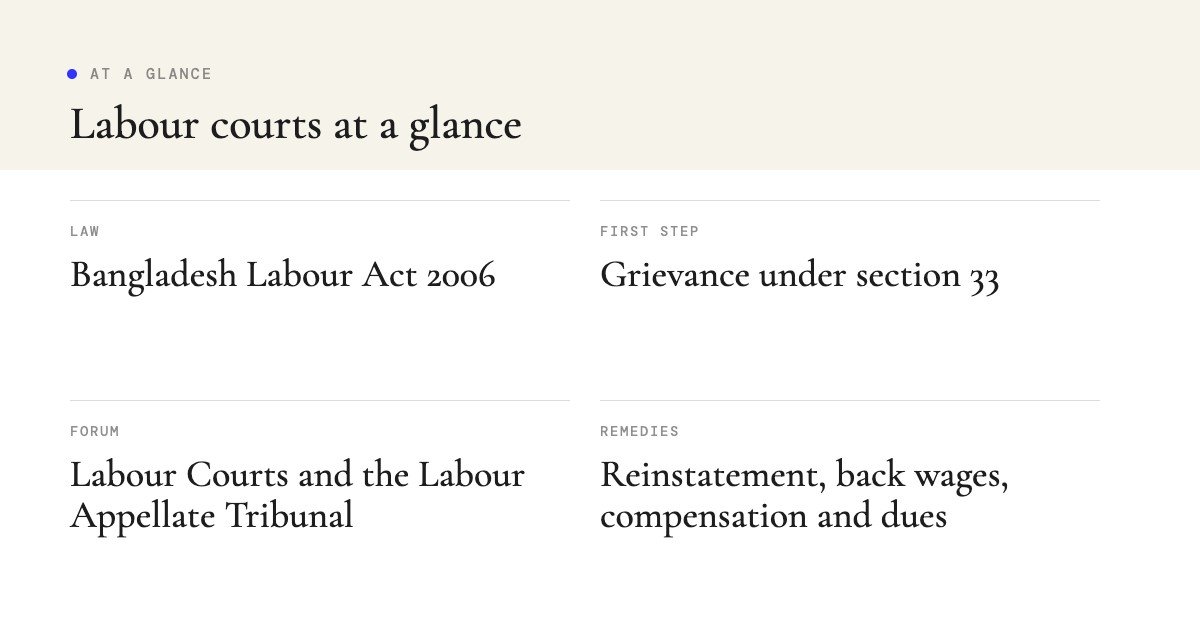
- Labour courts established under the Bangladesh Labour Act 2006 hear individual and collective employment disputes.
- For dismissal, discharge, retrenchment and similar grievances, a worker must generally first submit a written grievance to the employer under section 33.
- If the employer’s decision is unsatisfactory or no decision is given, the worker may complain to the Labour Court within the statutory time.
- Labour courts can order reinstatement with back wages, compensation and payment of dues.
- Appeals lie to the Labour Appellate Tribunal within the time allowed.
When a labour court case in Bangladesh arises
Labour courts hear disputes over termination, dismissal, retrenchment, unpaid wages and benefits, workers participation fund entitlements, provident fund, maternity benefits, unfair labour practices, trade union matters and industrial disputes. They also try certain offences under the Labour Act. Workers within the Act’s definition of worker can use the labour courts; managers and administrative staff outside that definition generally pursue contractual claims in civil courts.
Our employment and labour practice represents employers and employees in labour courts.
The grievance step before a labour court case in Bangladesh
Before going to court on matters such as termination, a worker must usually send a written grievance to the employer by registered post or other recognised means within the time set in section 33. The employer must investigate, give the worker a hearing and communicate a decision within the statutory period. If the worker is dissatisfied, or the employer does not respond, the worker may file a complaint with the Labour Court within the time allowed after the employer’s decision or deadline. Missing these deadlines can defeat a claim, so they must be checked against the current text of the Act, which has been amended several times, including in 2026.
The Labour Act text is available on Laws of Bangladesh.
Forums for a labour court case in Bangladesh
| Forum | Role |
|---|---|
| Labour Court | First instance court for individual and collective disputes and offences; chaired by a judge with members representing employers and workers |
| Labour Appellate Tribunal | Hears appeals from Labour Courts |
| High Court Division | Limited review, including writ jurisdiction in exceptional cases |
| EPZ Labour Tribunals | Separate forums for disputes in export processing zones |
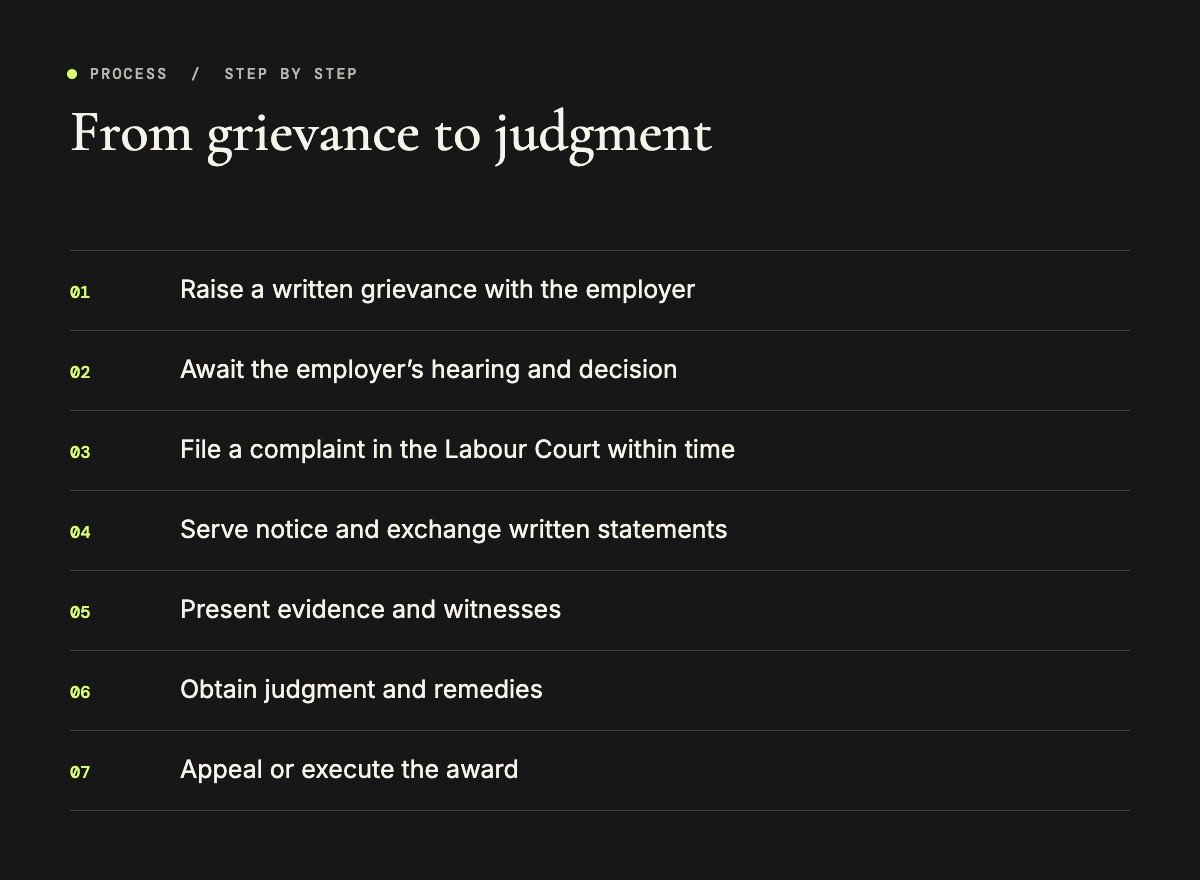
From grievance to judgment
- Grievance. Submit a written grievance to the employer within the statutory time.
- Employer decision. Attend the hearing and await the decision.
- Complaint. File a complaint in the Labour Court if unsatisfied, within the time limit.
- Pleadings. The employer is summoned and files a written statement.
- Evidence. Both sides present documents and witnesses.
- Judgment. The court decides and grants remedies.
- Appeal or execution. Appeal to the Labour Appellate Tribunal or enforce the judgment.
Keep proof of sending the grievance, such as registered post receipts. Disputes over whether the grievance was sent on time are common and can decide the case.
Remedies in a labour court case in Bangladesh
If the court finds that a termination or dismissal was unlawful, it may order reinstatement with or without back wages, or compensation in lieu, depending on the circumstances. It can also order payment of unpaid wages, overtime, leave encashment, gratuity, provident fund dues, workers participation fund entitlements and maternity benefits. In some cases, the court may convert a dismissal into discharge or termination simpliciter with appropriate compensation. Remedies in a labour court case in Bangladesh therefore depend heavily on the nature of the termination and the evidence.
Evidence that wins a labour court case in Bangladesh
Workers should keep their appointment letter, identity card, payslips, attendance records, any show-cause notices, inquiry documents, termination letters and the grievance letter with proof of sending. Employers should maintain personnel files, inquiry records, minutes of the inquiry committee, notices and payment records. In misconduct cases, courts examine whether the employer followed the procedure in section 24, including notice, a fair inquiry and an opportunity to be heard. Procedural defects often lead to findings of unlawful dismissal.
Collective disputes
Industrial disputes between employers and collective bargaining agents follow a separate process under the Labour Act, involving negotiation, conciliation by the Department of Labour, arbitration if agreed, and strikes or lockouts subject to legal conditions. Unresolved disputes may be referred to the Labour Court. Trade union registration, unfair labour practices and union elections can also give rise to labour court proceedings.
How long a labour court case in Bangladesh takes
The Labour Act contemplates prompt decisions, but in practice labour courts carry heavy caseloads, and cases can take considerably longer than the statutory targets. Adjournments, service problems and appeals add time. Parties should be prepared for a lengthy process and consider settlement at any stage. Courts encourage compromise, and settlements recorded by the court are enforceable.
Employer strategy
Employers facing a labour court case in Bangladesh should review the termination file immediately, assess procedural compliance and calculate potential exposure, including back wages if reinstatement is ordered. Where procedure was defective, early settlement is often cheaper than litigating. Where the employer has a strong case, a well-prepared written statement, organised documents and credible witnesses, such as inquiry officers and supervisors, are essential. Employers should also check whether other workers may bring similar claims, as outcomes can have wider implications.
Consistent policies, training for managers on disciplinary procedure and accurate record-keeping reduce future disputes.
Worker strategy
Workers should act quickly, send the grievance within time, keep copies of all documents and seek advice from a lawyer, trade union or legal aid organisation. Being clear about the remedy sought, whether reinstatement, compensation or payment of specific dues, helps focus the case. Workers should also consider whether settlement offers fairly reflect their entitlements and the risks and delays of litigation.
Execution of labour court decisions
If the employer does not comply with a judgment, the worker can apply for execution, and the court can enforce payment through the procedures available to it, including recovery as public demand in some cases. Non-compliance with labour court orders can also be an offence under the Labour Act. Workers should keep track of payment deadlines and act promptly if payment is not made.
Settlement and mediation
Many disputes settle before or during proceedings. Settlements should be written, list every payment and be signed voluntarily; where filed in court, they become enforceable. The Department of Labour and legal aid offices can facilitate conciliation, and participation committees and collective bargaining agents can help resolve workplace issues before they become court cases.
Disciplinary procedure and dismissal
Many labour cases challenge dismissals for misconduct. Under section 24 of the Labour Act, before dismissal the employer must give the worker a written allegation, allow time to respond, hold an inquiry by an impartial committee with an opportunity for the worker to be heard and to call witnesses, and record findings. Suspension during inquiry is permitted with subsistence allowance. Failure to follow these steps frequently results in the court setting aside the dismissal, even where misconduct may have occurred. Employers should therefore treat disciplinary procedure as a legal requirement, not a formality.
Wage claims in a labour court case in Bangladesh
Not every claim concerns dismissal. Workers may claim unpaid wages, overtime, festival bonuses, leave pay, maternity benefits or other dues while still employed or after leaving. The Labour Act provides mechanisms for wage claims, and labour inspectors can also investigate non-payment. Employers that keep accurate payroll records and pay through banking or mobile financial services are better placed to defend such claims.
Special considerations for women workers
Women workers have specific protections, including maternity benefit, protection from dismissal during pregnancy and maternity leave in prescribed circumstances, and protections against harassment under High Court guidelines and workplace policies. The Labour (Amendment) Act 2026 extended maternity leave. Claims involving these protections can be brought before the labour courts, and employers should handle such matters with particular care.
Appeals to the Labour Appellate Tribunal
A party dissatisfied with a Labour Court judgment may appeal to the Labour Appellate Tribunal within the period allowed by the Act. The tribunal can confirm, vary or set aside the judgment, or send the case back for retrial. Its decisions are generally final, though the High Court Division may intervene through writ jurisdiction in limited circumstances, such as lack of jurisdiction or violation of natural justice. Appeals should focus on clear errors of law or fact, as the tribunal gives weight to the trial court’s assessment of witnesses.
Filing an appeal does not automatically suspend the judgment, so the appellant may need to seek a stay, sometimes on condition of depositing part of the amount awarded.
Practical checklist
For workers: send the grievance on time, keep proof, collect documents, seek advice and file within the deadline. For employers: follow disciplinary procedure, respond to grievances properly, keep complete records, assess exposure early and consider settlement. Both sides benefit from treating a labour court case in Bangladesh as an evidence-driven process that rewards preparation.
Costs and representation
Workers may appear in person, through a lawyer, or through a trade union representative where permitted, and court fees in labour matters are modest. Employers usually appoint lawyers and may send human resources officers as witnesses. The main costs are legal fees and management time over a potentially long process. Budgeting realistically and considering early resolution can save both sides significant expense and stress.
Where several workers have similar claims against the same employer, coordinating them can reduce costs and lead to consistent outcomes, though each worker’s entitlements must still be proved individually.
Frequently asked questions about labour court case in bangladesh
Must I send a grievance before filing?
For dismissal and similar matters, generally yes, under section 33 of the Labour Act.
How long do I have to file?
Strict time limits apply under section 33; check the current Act and act quickly.
What can the court order?
Reinstatement with back wages, compensation, payment of dues and other relief.
Can managers use the labour court?
Generally only if they fall within the definition of worker; otherwise civil courts apply.
Where do appeals go?
To the Labour Appellate Tribunal.
Is legal aid available?
Yes, through government legal aid and labour rights organisations.
How we can help
We handle every stage of a labour court case in Bangladesh, from grievance letters and settlement negotiations to trials, appeals and execution. See our employment and labour practice, our guide on termination of employment and our litigation team.
Facing a labour dispute?
We protect your position from the first letter.
Book a consultationEmployment and labourPrimary sources: the Bangladesh Labour Act 2006 and the Bangladesh Labour Rules 2015 on Laws of Bangladesh; policy from the Ministry of Labour and Employment; legal aid from the National Legal Aid Services Organisation.
This article is general information about Bangladeshi labour law as of October 2026 and is not legal advice. Time limits are strict and the Act was amended in 2026; take advice promptly.




0 Comments