
Freedom of association is guaranteed by the Constitution and the Bangladesh Labour Act 2006, but forming a union has long been difficult in practice. Trade union registration in Bangladesh changed substantially with the Labour (Amendment) Act 2026, passed by Parliament on 9 April 2026, which replaced the old percentage-based membership requirement with tiered thresholds, capped the number of unions per establishment and strengthened protections against anti-union discrimination.

- The Labour (Amendment) Act 2026 turned the November 2025 ordinance into law with amendments.
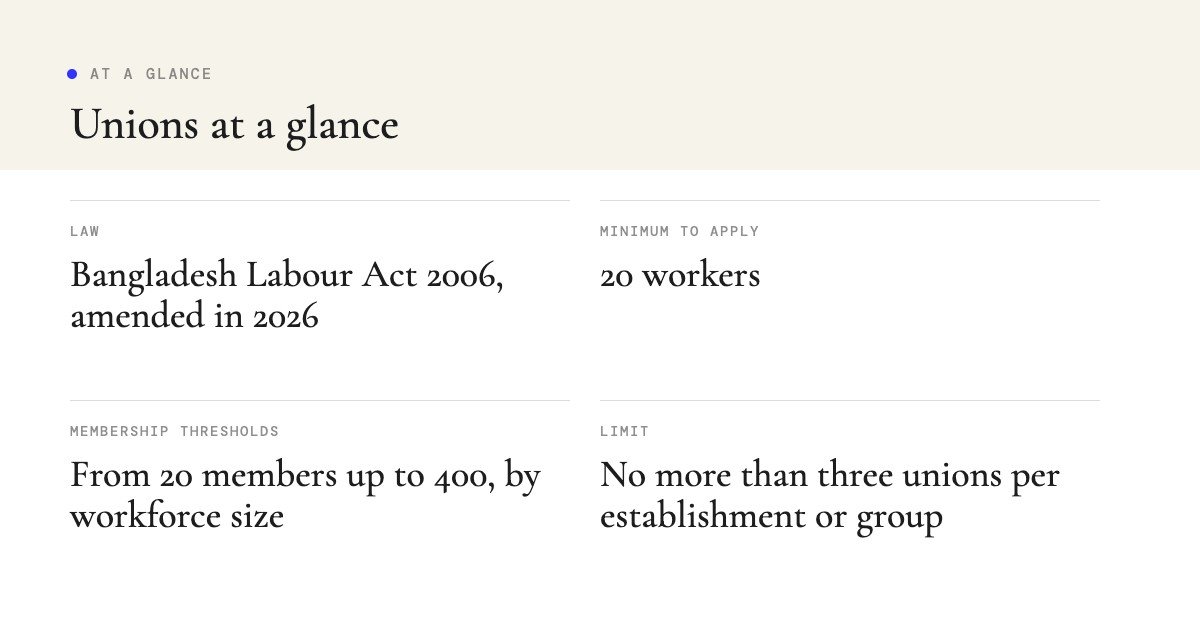
- A minimum of 20 workers can apply to register a union, with membership thresholds scaling by establishment size, from 20 members at establishments of up to 300 workers to 400 members at those with over 3,000.
- No more than three unions may be registered in an establishment or group of establishments at one time.
- Employers are prohibited from blacklisting workers, controlling or funding unions, and retaliating against union members.
- A registered union can seek to become the collective bargaining agent through an election.
Why trade union registration in Bangladesh matters
Registration gives a union legal recognition, allowing it to represent members, negotiate with employers, participate in dispute resolution and, if it becomes the collective bargaining agent (CBA), bargain collectively on wages and conditions. Unregistered groups lack these rights. For employers, engaging constructively with registered unions supports stable industrial relations and compliance with buyer and international labour standards, which matter greatly in export sectors.
Our employment and labour practice advises employers and worker organisations on union matters.
The 2026 reforms to trade union registration in Bangladesh
Before the reforms, a union needed membership of at least 20% of the total workers in an establishment, a requirement criticised as a major barrier in large factories. The Labour (Amendment) Act 2026 replaced this with tiered membership thresholds linked to workforce size and set a floor of 20 workers to apply. It limited the number of unions per establishment or group to three, required unions to hold at least one general meeting a year, allowed the registrar to verify applications using worker lists or digital systems, and added detailed prohibitions on anti-union practices. The amended Act is available on Laws of Bangladesh.
Membership thresholds for trade union registration in Bangladesh
| Establishment size | Membership requirement |
|---|---|
| Up to 300 workers | 20 members |
| Intermediate sizes | Higher thresholds set by the Act in tiers |
| Over 3,000 workers | 400 members |
The intermediate tiers should be checked in the gazetted text of the Act, as exact numbers for each band determine whether an application can proceed.
Registering a union
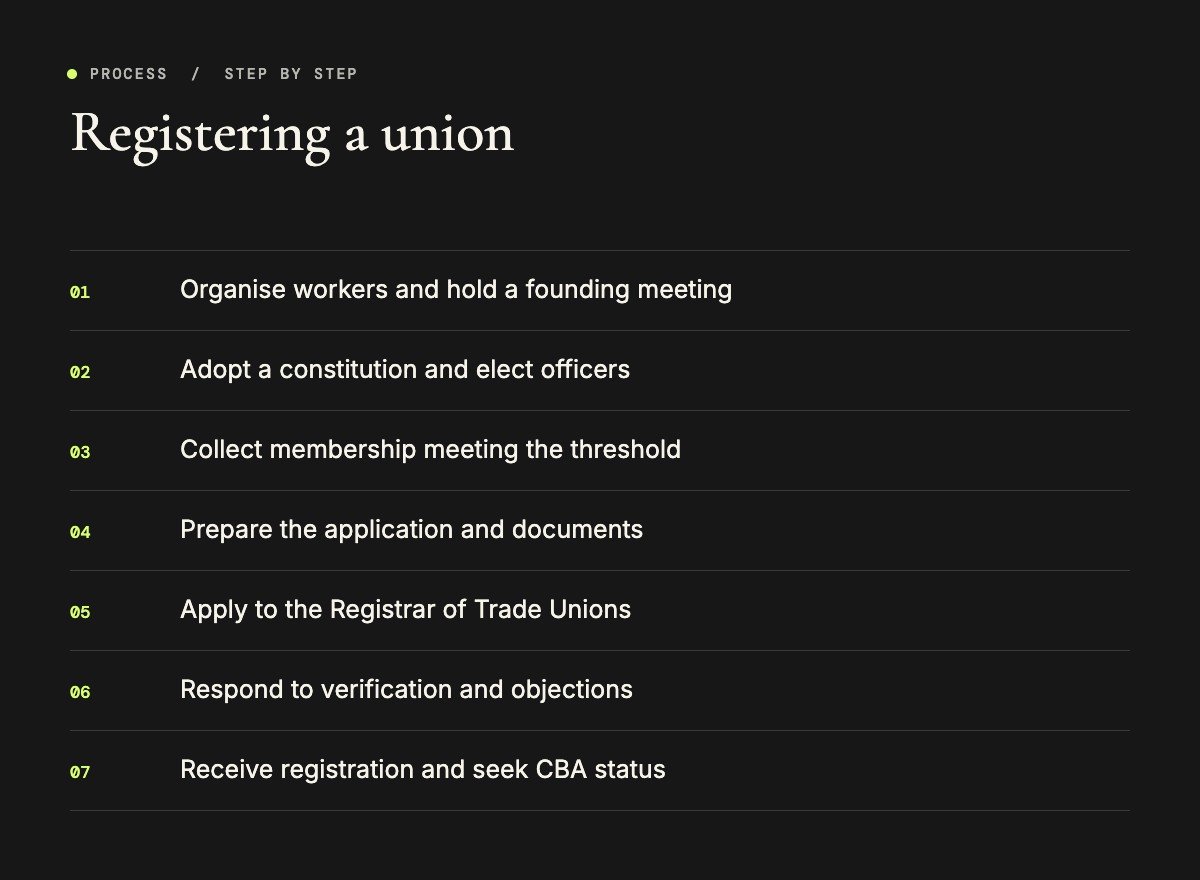
- Organise. Hold a founding meeting of workers and agree to form a union.
- Constitution and officers. Adopt a constitution and elect an executive committee.
- Membership. Collect signed membership forms meeting the applicable threshold.
- Prepare documents. Compile the application, constitution, member list and officer details.
- Apply. Submit to the Registrar of Trade Unions in the Department of Labour.
- Verification. Respond to queries and verification of membership.
- Registration and CBA. Receive registration and, if appropriate, seek CBA status through election.
Incomplete constitutions and inconsistent member lists are common reasons for rejection. Check that every member is a current worker of the establishment and that signatures match records.
Unfair labour practices and trade union registration in Bangladesh
The Labour Act prohibits unfair labour practices by employers, including dismissing or discriminating against workers for union activity, interfering with union formation, dominating or funding unions, and refusing to bargain with the CBA. The 2026 amendments expanded these protections, banning blacklisting and retaliation against workers who complain, and empowering the Director General of Labour to order employers to stop such practices and pay compensation. Unions and workers also have obligations, such as refraining from intimidation and illegal strikes. A balanced understanding of these rules supports lawful trade union registration in Bangladesh and constructive engagement.
From trade union registration in Bangladesh to CBA status
Where more than one union exists, an election determines which union becomes the CBA. The CBA negotiates collective agreements on wages, working hours, benefits and other conditions, represents workers in disputes and participates in welfare bodies. Collective agreements bind the employer and workers for their term. Where there is only one union, it may be recognised as the CBA subject to the Act’s requirements.
Participation committees
Establishments with a minimum number of workers must have a participation committee with worker and employer representatives to promote mutual trust, discuss productivity, welfare and safety, and resolve issues. Participation committees are not a substitute for unions, but they play an important role in workplaces without registered unions. The 2026 reforms and earlier amendments also strengthened safety committees in factories.
Industrial disputes and strikes
When collective bargaining fails, the Act provides for conciliation by the Department of Labour, voluntary arbitration and, as a last resort, lawful strikes or lockouts after notice and procedures. Certain essential services and new establishments face restrictions on strikes. Disputes can also be referred to the Labour Court. Following the procedures carefully protects both unions and employers from claims of illegality.
The registrar’s review of trade union registration in Bangladesh
The Registrar of Trade Unions examines whether the application meets legal requirements, including membership thresholds, a compliant constitution, proper election of officers and eligibility of members as workers of the establishment. The registrar may verify membership using worker lists or digital records, seek clarifications and, where requirements are met, register the union within the statutory time. Rejection must be reasoned, and applicants can appeal. Transparent, timely processing has been a key demand of workers and international partners, and the 2026 amendments aim to make trade union registration in Bangladesh more predictable.
Employers may be asked to provide worker lists for verification, and should respond accurately and promptly to avoid allegations of obstruction.
Employer obligations during registration
While a union is being formed and registered, employers must not interfere, intimidate workers, transfer or dismiss organisers for union activity, or encourage rival unions. Managers should be trained on what is permitted, such as communicating facts about terms and conditions, and what is prohibited. Violations can lead to orders from the Director General of Labour, compensation awards and complaints to buyers or international bodies.
Union governance and accountability
Registered unions must operate in accordance with their constitutions and the Act, hold regular general meetings, maintain accounts, conduct elections and submit returns to the registrar. Good governance strengthens unions’ credibility with members and employers. Failure to comply with statutory obligations can lead to cancellation of registration in serious cases.
International context for trade union registration in Bangladesh
Labour rights in Bangladesh have been under international scrutiny, particularly from the International Labour Organization, trading partners and global brands sourcing from the garment sector. Concerns about freedom of association, union registration barriers and anti-union discrimination have featured in trade preference reviews and buyer due diligence. The 2026 reforms respond in part to these concerns. For exporters, demonstrating respect for workers’ rights, including smooth trade union registration in Bangladesh, has become a commercial necessity as well as a legal obligation.
Buyer codes of conduct and new human rights due diligence laws in importing countries increasingly require suppliers to show that workers can organise freely.
Sector-specific considerations
The garment and textile sector has the most union activity and scrutiny, but unions also exist in jute, tea, transport, ports, pharmaceuticals and services. Group-level structures, where several factories belong to one owner, raise questions about whether thresholds apply per establishment or across the group, a point addressed in the amendments’ reference to establishments or groups of establishments. Tea gardens and other sectors with distinctive employment patterns may face particular practical issues.
Workers previously excluded
Reports indicate that the 2026 amendments extended freedom of association and collective bargaining to categories of workers previously excluded from the Labour Act’s union provisions. The exact scope should be confirmed in the gazetted text. Employers in sectors with newly covered workers should review their industrial relations policies accordingly.
Appeals against refusal
If the registrar refuses registration, the applicants can appeal to the Labour Court within the time allowed, and further to the Labour Appellate Tribunal. Applicants should keep complete records of their application, membership forms and correspondence. In some cases, addressing the registrar’s objections and reapplying may be faster than litigating. Legal support from labour rights organisations or lawyers improves the chances of success.
Practical guidance for employers
Employers should adopt a clear freedom of association policy, train managers, respond promptly and accurately to registrar verification requests, refrain from interference, and prepare to engage in good faith with registered unions and CBAs. Integrating union engagement into broader human resources and compliance systems reduces the risk of disputes and supports relationships with buyers, investors and regulators.
Practical guidance for workers
Workers forming a union should organise transparently, keep accurate membership records, adopt a clear constitution, elect officers democratically and seek advice from federations or labour lawyers. Documenting any interference by management, such as threats or transfers, is important for complaints. Once registered, unions should focus on member services and constructive bargaining to deliver results for workers.
Federations and national bodies
Registered enterprise unions may affiliate with industry federations and national trade union centres, which provide training, legal support and representation in national forums such as minimum wage boards and tripartite consultative councils. Federations themselves register under the Act. Affiliation can strengthen enterprise unions, particularly in negotiations with large employers, and connect workers with broader policy debates on labour law reform and social protection.
Employers’ associations play a parallel role for businesses, and tripartite dialogue among government, employers and workers shaped the 2026 amendments.
As implementing rules and registrar practices develop under the amended Act, both employers and worker organisations should monitor guidance from the Department of Labour and seek advice on how the new thresholds and protections apply to their specific establishments.
Early clarity helps avoid disputes over whether an application meets the thresholds that apply to a particular workforce.
Frequently asked questions about trade union registration in bangladesh
How many workers are needed to form a union?
At least 20 workers can apply, with membership thresholds rising with establishment size.
Who registers trade unions?
The Registrar of Trade Unions under the Department of Labour.
How many unions can exist in one factory?
No more than three per establishment or group under the 2026 amendments.
Can employers blacklist union members?
No, blacklisting and anti-union discrimination are prohibited.
What is a CBA?
The collective bargaining agent, the union elected to bargain with the employer.
Do EPZ workers form trade unions?
EPZ workers are governed by the EPZ Labour Act 2019, which provides for workers’ welfare associations.
How we can help
We advise on trade union registration in Bangladesh, collective bargaining, unfair labour practice complaints and industrial disputes. See our employment and labour practice, our manufacturing sector team and our compliance and risk practice.
Navigating union matters?
We help you comply with the new rules and build stable relations.
Book a consultationEmployment and labourPrimary sources: the Bangladesh Labour Act 2006 as amended on Laws of Bangladesh; policy from the Ministry of Labour and Employment; inspections from the Department of Inspection for Factories and Establishments.
This article is general information about Bangladeshi labour law as of October 2026 and is not legal advice. Confirm the gazetted text of the 2026 amendments before acting.




0 Comments