
Before a civil court will hear a claim, the plaintiff must value the suit and pay the correct court fee. Mistakes cause rejected plaints, delays and disputes over jurisdiction. Civil suit court fees in Bangladesh are governed by the Court-fees Act 1870, read with the Suits Valuation Act 1887 and the Code of Civil Procedure 1908. This guide explains how valuation works, when fees are ad valorem or fixed, and how fees can be recovered or refunded.
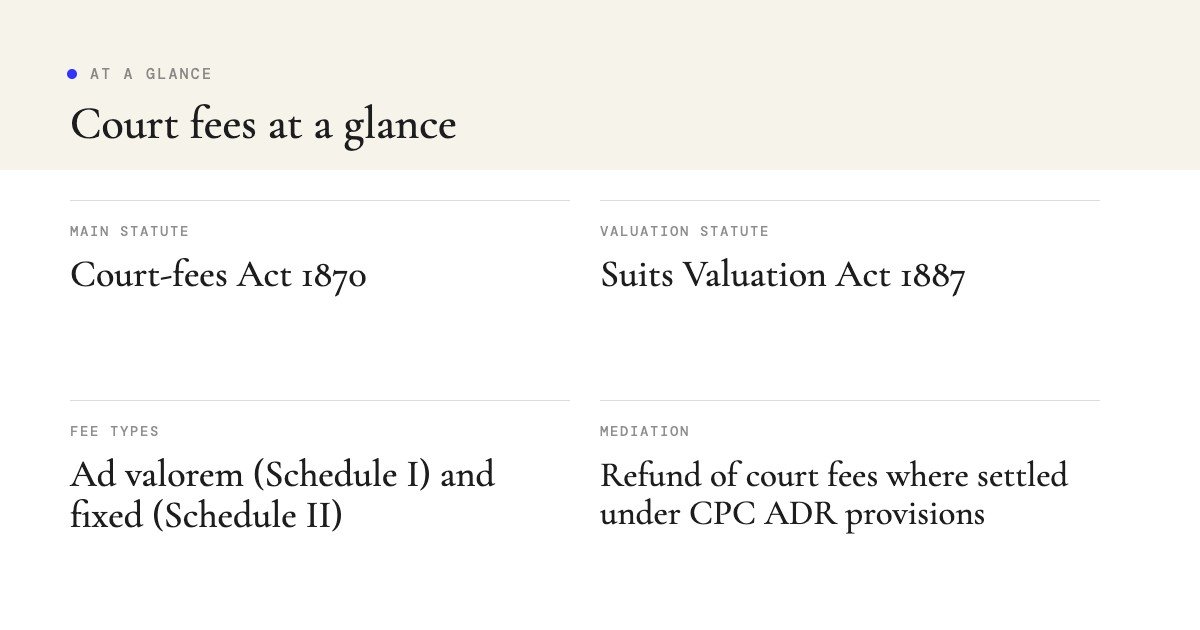
- Court fees are either ad valorem, calculated on the value of the subject matter under Schedule I, or fixed, under Schedule II of the Court-fees Act 1870.
- Section 7 of the Act sets the basis for computing fees for different types of suit, such as money claims, possession, declarations and injunctions.
- Valuation also determines which court has pecuniary jurisdiction and where appeals lie.
- A deficit in court fees can usually be made good within time allowed by the court, but a plaint can be rejected if it is not.
- Where a suit is settled through mediation under the Code of Civil Procedure, the plaintiff is entitled to a refund of court fees paid.
Why civil suit court fees in Bangladesh matter
Court fees are a tax on litigation, collected by the state through court-fee stamps. They serve two purposes in practice. First, they fund the system and discourage frivolous claims. Second, the valuation on which they are based fixes the forum: the value of the suit determines whether it is heard by an Assistant Judge, a Senior Assistant Judge or a Joint District Judge, and whether an appeal lies to the District Judge or the High Court Division.
Because the same valuation decides both fees and jurisdiction, getting it wrong can be costly. An undervalued suit may be filed in a court without jurisdiction, and any decree obtained there can be challenged. An overvalued suit wastes money and may send the case to a busier court.
Our civil litigation team, described on our about page, values and files suits across Bangladesh and regularly handles valuation disputes.
The legal framework for civil suit court fees in Bangladesh
| Statute | Role |
|---|---|
| Court-fees Act 1870 | Sets fees for plaints, appeals, applications and other documents; section 7 governs computation |
| Suits Valuation Act 1887 | Links valuation for court fees with valuation for jurisdiction |
| Civil Courts Act 1887 | Sets pecuniary limits of civil courts, revised in 2021 |
| Code of Civil Procedure 1908 | Order VII rule 11 on rejection, section 149 on deficit fees, and ADR provisions on refunds |
These statutes are available on Laws of Bangladesh.

Ad valorem and fixed civil suit court fees in Bangladesh
Ad valorem fees rise with the value of the claim, according to the graduated table in Schedule I. They apply to most suits where a definite value can be placed on the relief, such as money claims, suits for possession of land and suits for specific performance. The table has been amended over the years, including by capping the maximum fee, so practitioners always check the current schedule before filing.
Fixed fees under Schedule II apply to certain documents and suits where the relief cannot readily be valued, such as many applications, certain petitions and declaratory suits where no consequential relief is claimed. Combining a declaration with consequential relief, such as possession or an injunction, usually brings the suit back into ad valorem territory for the consequential part.
How civil suit court fees in Bangladesh are calculated for common suits
For money suits, the fee is calculated on the amount claimed, including any interest claimed up to the date of filing. For suits for possession of land, section 7 links valuation to the market value of the land or to statutory formulas based on revenue, depending on the type of land and the provision applied. Suits for specific performance of a contract for sale are valued on the amount of consideration. Suits for an injunction or declaration with consequential relief are valued by the plaintiff, subject to the court’s scrutiny of whether the valuation is reasonable.
Partition suits, pre-emption cases, suits for accounts and suits for cancellation of instruments each have particular rules or practices. Where a suit contains several distinct reliefs, fees are generally payable on each relief, and the aggregate value determines jurisdiction.
Paying civil suit court fees in Bangladesh step by step
- List reliefs. Identify every relief claimed in the plaint.
- Value each relief. Apply section 7 and the Suits Valuation Act to each one.
- Choose the court. Match the total value to the court’s pecuniary limits.
- Calculate fees. Use Schedule I or Schedule II as applicable.
- Stamps. Purchase court-fee stamps from licensed vendors or the treasury and affix them to the plaint.
- Objections. Respond if the defendant or court questions the valuation.
- Refund. Claim the refund if the case settles through mediation.
Put a short valuation paragraph in every plaint, explaining how each relief was valued and why. Courts and opponents challenge unexplained valuations far more often than clearly reasoned ones.
Pecuniary jurisdiction after the 2021 amendments
The Civil Courts (Amendment) Act 2021 raised the pecuniary limits of the civil courts. Following the amendment, Assistant Judges hear suits up to a set limit, Senior Assistant Judges hear suits above that up to a higher limit, and Joint District Judges hear suits of higher value without upper limit. Appeal routes were also revised, with District Judges hearing appeals up to a substantial value and the High Court Division hearing appeals above it. Because valuation decides the forum, check the current limits before filing.
Deficit civil suit court fees in Bangladesh and undervaluation
If the court finds that the suit is undervalued or the fee paid is insufficient, Order VII rule 11 of the Code of Civil Procedure requires the court to give the plaintiff time to correct the valuation or pay the deficit. Only if the plaintiff fails to do so within that time is the plaint rejected. Section 149 gives the court discretion to allow deficit fees to be paid at any stage, and once paid the document has the same effect as if the full fee had been paid originally. Defendants commonly raise undervaluation objections, sometimes tactically to delay the case.
Refund of civil suit court fees in Bangladesh after mediation
To encourage settlement, the ADR provisions of the Code of Civil Procedure provide that where a suit is settled through mediation, the plaintiff is entitled to a refund of the court fees paid. This can be a significant saving in high-value suits and is one reason courts and lawyers encourage mediation at an early stage. The refund is processed through a certificate issued by the court. Our mediation services page explains how court-annexed and private mediation work.
Fees on appeals and applications
Memoranda of appeal attract court fees calculated on the value of the subject matter in dispute in the appeal, which may be less than the value of the original suit if only part of the decree is challenged. Revision applications, applications for review and many interlocutory applications carry fixed fees. Writ petitions in the High Court Division have their own fee structure. Certified copies, process fees for service of summons and commission fees are additional costs.
Other costs in a civil suit
Beyond court fees, litigants should budget for lawyers’ fees, process and service fees, certified copies of land records and documents, commission and survey fees, expert fees and, in some cases, security for costs. At the end of the case the court may order costs in favour of the successful party, though awards in practice rarely cover full expenditure.
Civil suit court fees in Bangladesh for land disputes
Land suits generate most valuation disputes. In a suit for declaration of title with recovery of possession, the possession relief is usually valued on the market value of the land, which plaintiffs sometimes understate to save fees. Defendants then argue that the suit is undervalued and belongs in a higher court. Courts may call for evidence of market value, such as recent registered sale deeds in the same mouza, or appoint a commissioner. Where the plaintiff claims to be in possession and seeks only a declaration and injunction, the valuation and fee may be considerably lower.
In partition suits, the plaintiff typically pays fees on the value of their own share, and each defendant seeking a separate saham pays on theirs. In pre-emption cases, fees follow the consideration in the challenged deed. Because land values in urban areas have risen sharply, these differences can amount to large sums.
Money suits and commercial claims
For claims to recover money, such as unpaid invoices, loans or damages, the fee is calculated on the full amount claimed. Claimants should consider carefully whether to include speculative heads of damages, because each adds to the fee. Interest claimed up to the date of filing forms part of the value, while future interest does not. For banks and financial institutions, suits under the Artha Rin Adalat Ain 2003 follow their own fee rules and are heard by specialised money loan courts rather than ordinary civil courts.
Civil suit court fees in Bangladesh for injunctions and declarations
For a declaration without consequential relief, a fixed fee usually applies. For an injunction, or a declaration with an injunction, the plaintiff states a value for the relief, which the court can examine. Plaintiffs should resist the temptation to put a nominal value on a valuable relief, because courts increasingly scrutinise artificial valuations, particularly where they appear designed to keep the suit in a lower court.
Exemptions and legal aid
Some government litigants and certain categories of cases are exempt from court fees. People who cannot afford fees may sue as pauper (indigent) plaintiffs under Order XXXIII of the Code of Civil Procedure, and the state recovers the fees later if they succeed. Eligible people can also obtain free legal representation through the National Legal Aid Services Organisation, which covers fees and costs.
Frequently asked questions about civil suit court fees in bangladesh
Which law governs court fees?
The Court-fees Act 1870, together with the Suits Valuation Act 1887.
What is an ad valorem fee?
A fee calculated on the value of the claim under Schedule I of the Act.
What if I paid too little?
The court will usually allow time to pay the deficit before rejecting the plaint.
Does valuation affect which court hears my case?
Yes, valuation determines pecuniary jurisdiction and the appeal route.
Can I get court fees back?
Yes, if the suit is settled through mediation under the CPC provisions.
How are fees paid?
By court-fee stamps affixed to the plaint or other document.
How we can help
We advise on civil suit court fees in Bangladesh, value plaints, answer valuation objections and help clients recover fees through mediation. Learn more about our practice and our guides to types of civil cases and the structure of the Supreme Court.
Primary sources: the Court-fees Act 1870, the Suits Valuation Act 1887, the Civil Courts Act 1887 and the Code of Civil Procedure 1908 on Laws of Bangladesh; court information from the Supreme Court of Bangladesh.
This article is general information about Bangladeshi civil procedure as of October 2026 and is not legal advice. Take advice on your circumstances.




0 Comments