
Winning a civil suit is only half the battle. If the losing party does not pay or hand over property voluntarily, the decree holder must start a separate process. Execution of decree in Bangladesh is governed by sections 36 to 74 and Order XXI of the Code of Civil Procedure 1908. The executing court can order delivery of property, attach and sell assets, appoint a receiver or, in limited cases, detain the judgment debtor in civil prison.
- Execution begins with an execution petition filed by the decree holder in the court that passed the decree or a court to which it is transferred.
- Money decrees are usually enforced by attachment and sale of the judgment debtor’s property; decrees for land by delivery of possession.
- All questions between the parties about execution, discharge or satisfaction are decided by the executing court under section 47, not by a separate suit.
- Third parties claiming attached property can file claims under Order XXI, which the court investigates.
- Time limits apply under the Limitation Act and the Code, so decree holders should not delay.
What execution of decree in Bangladesh involves
A decree is the formal expression of the court’s decision. Execution is the process of enforcing it. The decree holder applies to the court; the judgment debtor is given notice; and, if they do not comply, the court uses its coercive powers through its officers, the nazir and bailiffs, sometimes with police assistance. The process applies to money decrees, decrees for possession of immovable or movable property, decrees for specific performance, injunctions and declarations with consequential relief.
Our civil litigation team, described on our about page, acts for decree holders and judgment debtors in execution proceedings.
Modes of execution of decree in Bangladesh
| Decree type | Usual mode | Key provisions |
|---|---|---|
| Money decree | Attachment and sale of property; arrest in limited cases | Section 51; Order XXI rules 30, 37 to 40, 41 to 64 |
| Possession of land | Delivery of possession by court officers | Order XXI rules 35 and 36 |
| Movable property | Seizure and delivery | Order XXI rule 31 |
| Specific performance or injunction | Detention, attachment or execution of documents by the court | Order XXI rules 32 and 34 |
| Complex assets | Appointment of receiver | Section 51 and Order XL |
The Code of Civil Procedure is available on Laws of Bangladesh.
Filing for execution of decree in Bangladesh step by step
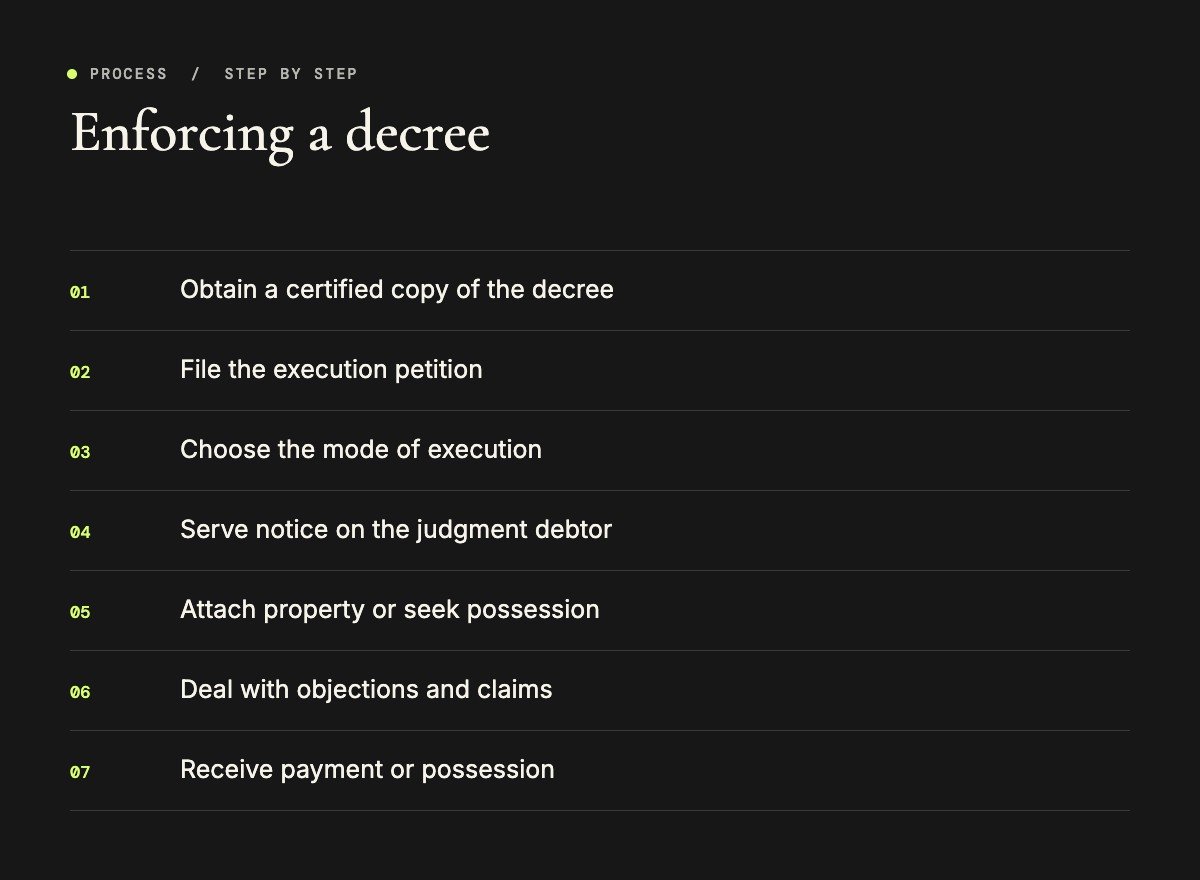
- Certified copy. Obtain a certified copy of the decree once it is drawn up.
- Execution petition. File the petition in tabular form under Order XXI rule 11, giving the decree details and the relief sought.
- Mode. Specify the mode of execution and, for attachment, list the property with particulars.
- Notice. The court issues notice to the judgment debtor where required, such as under rule 22 for older decrees.
- Attachment or possession. The court attaches property or directs delivery of possession.
- Objections. The court decides objections by the judgment debtor or claims by third parties.
- Satisfaction. Money is paid out or possession delivered, and satisfaction is recorded.
Investigate the judgment debtor’s assets before filing. A petition that identifies specific land, bank accounts or shares, with supporting particulars, moves far faster than one that simply asks the court to recover money.
Attachment and sale in execution of decree in Bangladesh
For money decrees, the decree holder can seek attachment of the judgment debtor’s movable or immovable property, debts owed to them, shares, salary within statutory limits and bank deposits. Immovable property is attached by an order prohibiting transfer, proclaimed at the property and in the court, and private transfers after attachment are void against the decree holder under section 64. The court then orders sale by public auction after a proclamation of sale setting out the details of the property and encumbrances.
Certain property is exempt from attachment under the proviso to section 60, including necessary wearing apparel, cooking vessels, tools of artisans, and a portion of salaries. The judgment debtor can apply to set aside a sale for material irregularity or fraud causing substantial injury under Order XXI rule 90, or by depositing the amount due plus compensation under rule 89.
Delivery of possession in execution of decree in Bangladesh
Where the decree is for possession of land or a building, the court directs its officers to deliver possession to the decree holder, removing anyone bound by the decree who refuses to vacate. If the property is in the occupation of a tenant or other person entitled to remain, symbolic possession may be given instead. Resistance or obstruction is dealt with under Order XXI rules 97 to 103, where the court investigates whether the resisting person is bound by the decree or has an independent claim.
Arrest and detention in civil prison
Arrest and detention in civil prison is a last resort for money decrees. Before ordering detention, the court must give the judgment debtor an opportunity to show cause, and it must be satisfied that the debtor has the means to pay and has refused or neglected to do so, or has transferred or concealed property with intent to defeat the decree. Detention is limited in time by the Code and does not extinguish the debt.
Section 47 objections in execution of decree in Bangladesh
Section 47 provides that all questions arising between the parties to the suit, or their representatives, relating to the execution, discharge or satisfaction of the decree must be decided by the executing court and not by a separate suit. Judgment debtors commonly object that the decree has been satisfied, that it is not executable, that it is time-barred or that the property is not liable to attachment. The executing court cannot go behind the decree, but it can decide whether the decree is a nullity, for example for lack of inherent jurisdiction.
Third-party claims
A person who is not a party to the suit but claims that attached property belongs to them can file a claim under Order XXI rule 58. The court investigates the claim and decides whether the property was in the judgment debtor’s possession or held on their behalf. The unsuccessful party may then file a regular suit to establish their right. Third-party claims are common where property is held in the names of relatives.
Time limits for execution of decree in Bangladesh
Execution applications are subject to limitation under the Limitation Act 1908, with the period running from the date of the decree or from later events such as the final order on appeal or a previous execution application. The Code also contains an outer limit on fresh applications to execute the same decree. Because missing these periods can make an otherwise valid decree unenforceable, decree holders should file promptly and keep records of every application and order.
Transfer and execution of decree in Bangladesh across districts
If the judgment debtor’s property is located in another district, the decree can be transferred under section 39 to the court within whose jurisdiction the property lies. The transferee court then has the same powers of execution as the court that passed the decree. A certificate of non-satisfaction and a copy of the decree are sent with the transfer order.

Foreign decrees
Section 44A of the Code allows decrees of superior courts of reciprocating territories, notified by the government, to be executed in Bangladesh as if passed by a Bangladeshi District Court. Decrees from other countries cannot be executed directly; the holder must sue on the foreign judgment in a Bangladeshi court, subject to the conditions in section 13. Arbitral awards follow a separate route under the Arbitration Act 2001, explained in our enforcement of awards page.
Tracing the judgment debtor’s assets
Effective execution depends on finding assets. Useful sources include land records and registry searches in districts where the debtor is known to own property, company records at the Registrar of Joint Stock Companies for shareholdings and directorships, vehicle registration records, and information about bank accounts obtained during the suit. The court can also examine the judgment debtor orally under Order XXI rule 41 about their property and means, which often reveals assets that were not previously known.
Practical tips for decree holders
Apply for execution soon after the decree, before assets are moved. Where there is a real risk of dissipation, consider seeking attachment before judgment during the suit under Order XXXVIII. Keep the judgment debtor’s addresses current, monitor any appeal and seek a stay condition such as security if the debtor appeals. Settlement during execution is common, but record any agreement with the court so that satisfaction is properly certified.
Execution of decree in Bangladesh against companies
Where the judgment debtor is a company, execution can proceed against its bank accounts, receivables, vehicles, machinery and real property. Directors and shareholders are not personally liable for the company’s debts merely because of their position, so the decree holder must look to the company’s own assets unless there is a personal guarantee or a separate basis for liability. If the company cannot pay a substantial undisputed debt, a winding-up petition in the High Court Division under the Companies Act 1994 may create stronger pressure than ordinary execution, as explained in our guide to winding up cases.
Stay of execution
Filing an appeal does not automatically stay execution. The appellate court may stay execution, often on condition that the judgment debtor deposits the decretal amount or furnishes security. The executing court itself can also grant a limited stay to allow the judgment debtor to approach the appellate court. Decree holders should insist on conditions that protect their position if the appeal fails.
Common delays and how to avoid them
Execution cases are often delayed by incomplete property descriptions, repeated objections, third-party claims by relatives, failed auctions with no bidders and difficulties in service. Accurate schedules of property, prompt responses to objections, realistic reserve prices and close cooperation with the court’s nazir help keep the case moving.
Frequently asked questions about execution of decree in bangladesh
Where do I file for execution?
In the court that passed the decree or a court to which it has been transferred.
How is a money decree enforced?
Usually by attaching and selling the judgment debtor’s property, and in limited cases by arrest.
Can the judgment debtor object?
Yes, under section 47, but the executing court cannot go behind the decree.
What if someone else claims the property?
They can file a claim under Order XXI rule 58 for investigation.
Is there a time limit?
Yes, under the Limitation Act and the Code; file promptly.
Can foreign judgments be executed?
Only those from notified reciprocating territories directly; others require a suit.
How we can help
We handle execution of decree in Bangladesh for decree holders and judgment debtors, including asset tracing, attachment, auction, delivery of possession and objections. Learn more about our practice and our guides to types of civil cases and the Public Demands Recovery Act.
Primary sources: the Code of Civil Procedure 1908, the Limitation Act 1908 and the Arbitration Act 2001 on Laws of Bangladesh; court information from the Supreme Court of Bangladesh.
This article is general information about Bangladeshi civil procedure as of October 2026 and is not legal advice. Take advice on your circumstances.




0 Comments