
A first information report is usually the first step in a criminal case. Filing an FIR in Bangladesh under section 154 of the Code of Criminal Procedure 1898 puts the police on notice of a cognisable offence and obliges them to record it and start an investigation. Knowing what to include, what to do if the police refuse, and which alternatives exist can make the difference between a case that moves forward and one that stalls.
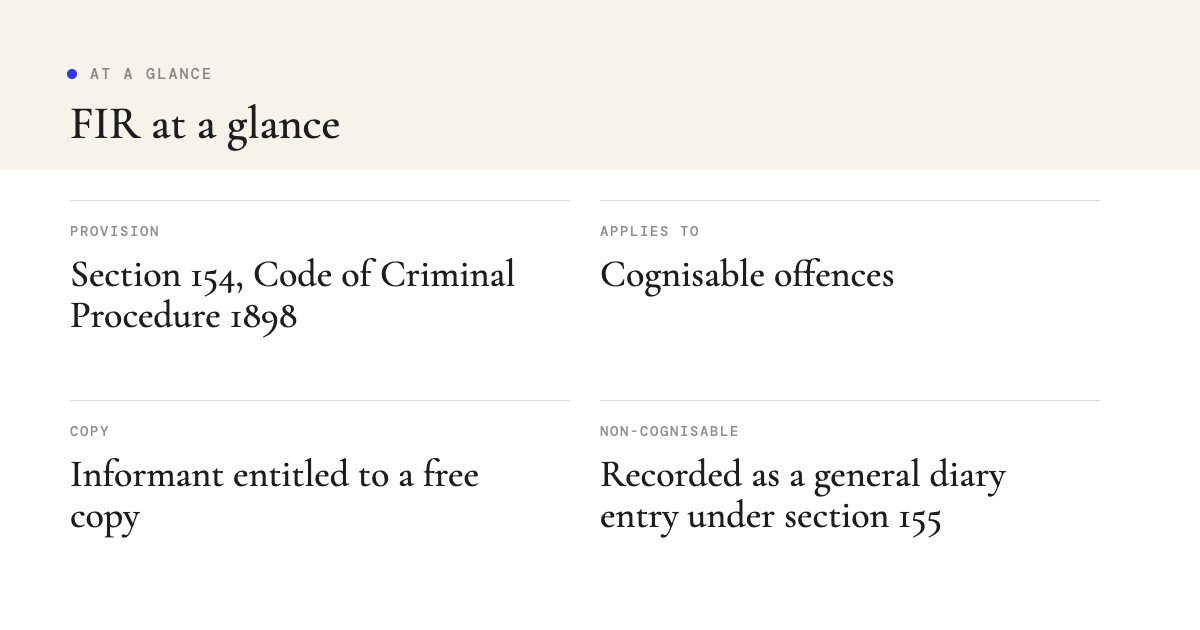
- An FIR is information about a cognisable offence given to the officer in charge of a police station, recorded in writing and signed by the informant.
- The informant is entitled to a copy of the FIR free of cost.
- For non-cognisable offences, the police record a general diary entry and the informant is referred to a Magistrate.
- If police refuse to record an FIR, the victim can approach senior police officers or file a complaint directly before a Magistrate.
- Lodging a false FIR is itself an offence, so information should be accurate.
What an FIR in Bangladesh is
Section 154 of the Code of Criminal Procedure requires every piece of information relating to the commission of a cognisable offence, given orally or in writing to the officer in charge of a police station, to be reduced to writing, read over to the informant and signed, and its substance entered in a book kept for the purpose. A cognisable offence is one for which police may arrest without a warrant, such as murder, rape, robbery, theft, grievous hurt, kidnapping and many offences under special laws. The Second Schedule to the Code indicates whether an offence is cognisable.
The FIR sets the criminal law in motion. It gives the police authority to investigate under section 156 without a Magistrate’s order, and it becomes an important document at trial, used to check the consistency of the informant’s account. The Code is available on Laws of Bangladesh.
Our criminal law team, described on our about page, assists victims and accused persons from the FIR stage through trial and appeal.
Cognisable offences and the FIR in Bangladesh
| Category | Police action | Route for victim |
|---|---|---|
| Cognisable offence | FIR recorded under section 154; investigation without Magistrate’s order | Police station FIR |
| Non-cognisable offence | General diary entry under section 155; investigation only with Magistrate’s order | GD, then complaint before Magistrate |
| Offences under special laws | Depends on the statute; some have special tribunals | FIR or complaint to tribunal |
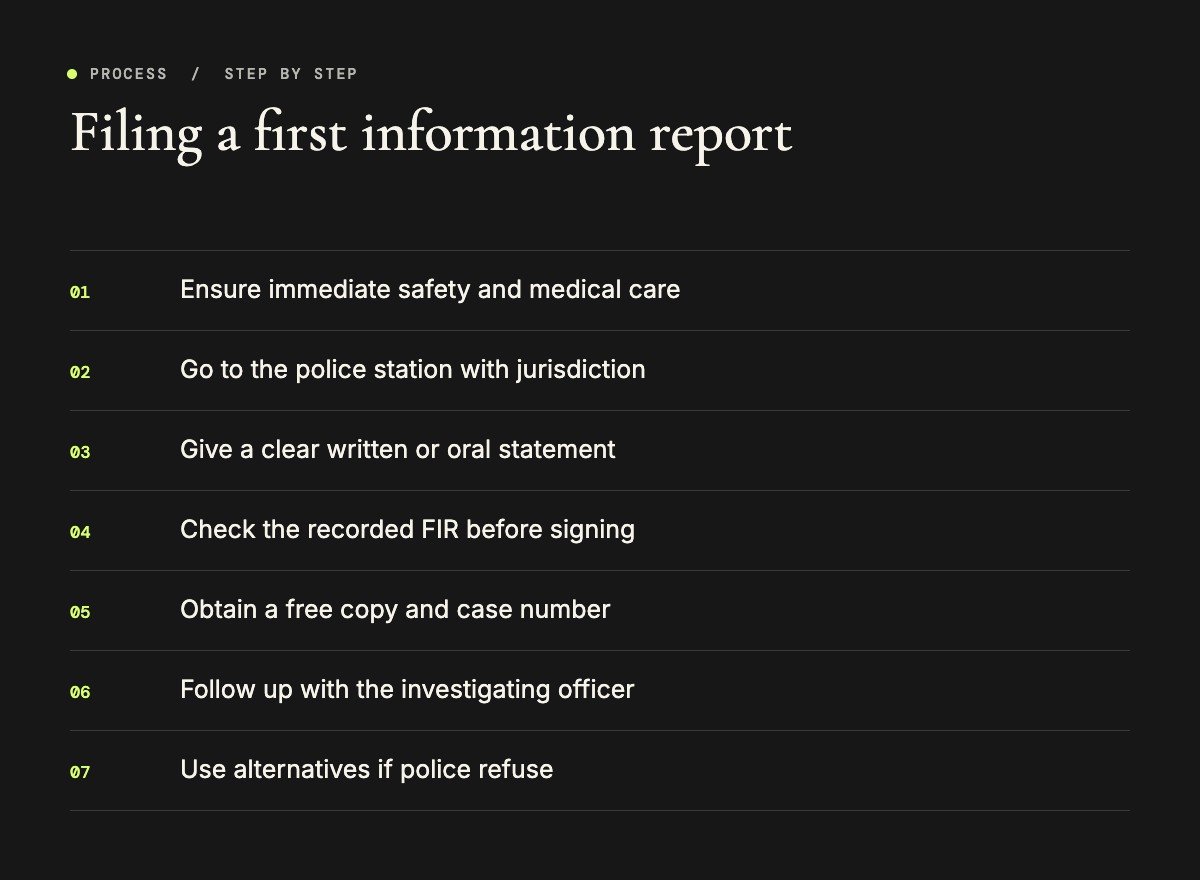
Filing an FIR in Bangladesh step by step
- Safety first. Call 999 in an emergency and obtain medical treatment for any injuries.
- Right police station. Go to the police station with jurisdiction over the place of the offence.
- Statement. Give a clear account, ideally in writing, with date, time, place, persons involved and witnesses.
- Check and sign. Read the recorded FIR carefully before signing; ask for corrections if needed.
- Copy and number. Obtain a free copy with the case number and section of law noted.
- Follow up. Note the investigating officer’s name and contact details and provide further evidence.
- Alternatives. If police refuse, approach senior officers or file a complaint before a Magistrate.
Prepare a typed written complaint before going to the police station. A written ejahar ensures that important details are not missed or altered, and the police record it as the FIR. Keep a signed copy for yourself.
What to include in an FIR in Bangladesh
A good FIR states who the informant is, the date, time and place of the offence, what happened in chronological order, the names and descriptions of the accused if known, the names of witnesses, any injuries or loss suffered, the property involved and any motive or background. It should be factual and avoid exaggeration. Omissions are not always fatal, but significant inconsistencies between the FIR and later evidence can be used by the defence to undermine credibility.
Delay in lodging the FIR should be explained in the report itself, for example because the victim needed medical treatment, was threatened, or was a child who disclosed later. Unexplained delay is commonly argued by the defence as a sign of fabrication.
General diary entries versus an FIR in Bangladesh
For non-cognisable offences, and for matters such as lost documents, threats, or missing persons, the police record a general diary (GD) entry. A GD creates an official record that can support later action. For a non-cognisable offence, the police cannot investigate without a Magistrate’s order, so the informant is usually advised to file a complaint before the Magistrate. Police have introduced online GD services for certain matters, which allow some entries to be made without visiting the station.
If police refuse to record an FIR in Bangladesh
Police sometimes refuse to record an FIR, delay it, or record a weaker version. If this happens, the victim can send the written information to the Superintendent of Police or the relevant senior officer, who may investigate or direct investigation under section 154 read with the Police Regulations. The victim can also file a complaint directly before the Magistrate having jurisdiction under section 200 of the Code. The Magistrate may examine the complainant, take cognisance, direct police investigation under section 156(3), or hold an inquiry under section 202.
For offences under the Nari O Shishu Nirjatan Daman Ain 2000, the tribunal can receive a complaint directly where the police have not recorded the case, subject to the conditions in the Act.
Investigation after an FIR in Bangladesh
After the FIR is recorded, an investigating officer is assigned. They visit the scene, collect evidence, record witness statements under section 161, arrange medical examinations and may arrest accused persons. At the end, the officer submits a police report under section 173: a charge sheet if there is sufficient evidence, or a final report if not. The informant has the right to be informed of the outcome and can file a naraji (objection) petition before the Magistrate if they disagree with a final report.
Rights after an FIR in Bangladesh
The informant is entitled to a free copy of the FIR, to be informed of progress, and to object to a final report. Victims of certain offences, such as sexual offences, are entitled to have statements recorded with sensitivity, often by female officers, and to medical examination at designated facilities. The accused has the right to be informed of the grounds of arrest, to consult a lawyer, and to be produced before a Magistrate within twenty-four hours of arrest, as guaranteed by Article 33 of the Constitution.
Filing a false FIR in Bangladesh
Giving false information to the police is an offence under section 182 of the Penal Code 1860, and instituting a false criminal case with intent to injure is an offence under section 211. Several special laws, including the Nari O Shishu Nirjatan Daman Ain, separately penalise false cases filed under them. Accurate reporting protects both the victim’s case and the integrity of the system.
Medical evidence and forensic steps
In cases of assault, sexual violence or injury, medical evidence is often decisive. Victims should go to a government hospital, where a medical officer can examine them and prepare a medico-legal report. One-Stop Crisis Centres in major hospitals provide medical, police and legal support for women and children in one place. Clothing and other physical evidence should be preserved without washing and handed to the police. In sexual offence cases, examination should take place as early as possible, because delay can affect forensic findings.
For property crimes, keep receipts, photographs and serial numbers of stolen items. For online offences, preserve screenshots, links, messages and transaction records before reporting.
Cases involving women and children
Special procedures apply to offences against women and children. Statements of child victims should be recorded in a child-friendly manner, often in the presence of a guardian or social worker, and female officers are generally assigned to record statements of female victims of sexual offences. The Nari O Shishu Nirjatan Daman Ain 2000, as amended, provides for special tribunals and time limits for investigation and trial. Victims can obtain support through the national helpline 109 and through government and NGO services.
Cyber crime reports
Online fraud, harassment, hacking and defamation can be reported to the police station, to the cyber units of the police, or through the relevant online reporting channels. Specialised units have the technical capacity to trace accounts and request data from platforms. Reporting quickly increases the chance of freezing funds in fraud cases and preserving evidence before it is deleted.
Withdrawing or compromising a case
Some offences are compoundable, meaning the victim can settle with the accused with or without court permission under section 345 of the Code. Serious offences are not compoundable and cannot be withdrawn by the informant alone; only the court can discharge or acquit the accused, and the state controls prosecution. Informants should be wary of pressure to settle serious cases informally.
Practical checklist
Before going to the police station, prepare a written statement, gather identity documents, medical reports, photographs and witness details, and take a trusted person with you. After filing, keep the FIR copy safe and note all follow-up dates.
Language and literacy
An FIR can be given in Bangla or English, orally or in writing. If the informant cannot read, the officer must read the recorded FIR aloud before the informant signs or puts a thumb impression. Ask a literate relative or lawyer to check the text, because errors at this stage can follow the case all the way to trial.
When the accused is influential
Where the accused is powerful or connected, victims sometimes face pressure or delay. In such cases, filing a complaint directly before a Magistrate, involving a lawyer from the start, and keeping written records of every visit to the police station provide important safeguards. The High Court Division can, in appropriate cases, issue directions to ensure proper investigation.
Frequently asked questions about fir in bangladesh
Where do I file an FIR?
At the police station with jurisdiction over the place where the offence occurred.
Is there a fee?
No, and the informant is entitled to a free copy.
What if the offence is non-cognisable?
Police record a general diary entry, and you can file a complaint before a Magistrate.
What if police refuse?
Approach senior police officers or file a complaint directly before a Magistrate.
Can someone else file on my behalf?
Yes, any person with knowledge of a cognisable offence can give information.
What happens after the FIR?
An investigating officer investigates and submits a charge sheet or final report.
How we can help
We help victims prepare and lodge an FIR in Bangladesh, follow up with investigators, file complaints before Magistrates and tribunals, and challenge final reports. We also represent accused persons from arrest through trial. Learn more about our practice and our guides to defamation remedies and cheque dishonour.
Need to report a crime?
We help you file a clear, effective FIR.
Book a consultationAbout usPrimary sources: the Code of Criminal Procedure 1898, the Penal Code 1860, the Constitution and the Nari O Shishu Nirjatan Daman Ain 2000 on Laws of Bangladesh; free legal aid via NLASO.
This article is general information about Bangladeshi criminal procedure as of October 2026 and is not legal advice. In an emergency, call 999.


0 Comments