
Online fraud, account hacking, sextortion and harassment have become some of the most common crimes in Bangladesh. Making an effective cyber crime complaint in Bangladesh means acting fast: securing accounts, preserving evidence before it disappears, alerting banks or mobile financial service providers to freeze funds, and reporting to the police and specialised cyber units. This guide explains each step and the legal framework that applies.
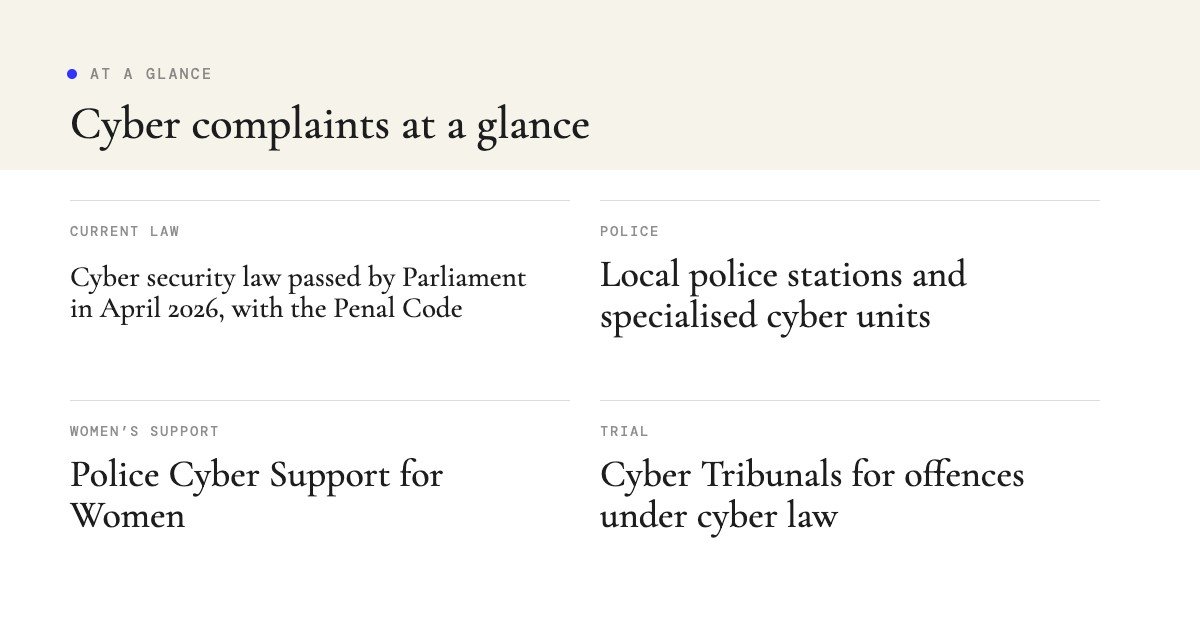
- Cyber offences are covered by Bangladesh’s cyber security legislation, most recently the law passed by Parliament in April 2026, together with the Penal Code and other statutes.
- Speed matters: evidence can be deleted and stolen money moved within hours.
- Victims can report to the local police station, specialised police cyber units and, for women, Police Cyber Support for Women.
- Banks and mobile financial service providers should be contacted immediately in fraud cases to request blocking of funds.
- Serious cases are tried by Cyber Tribunals, while related offences such as cheating may be tried in ordinary criminal courts.
Offences behind a cyber crime complaint in Bangladesh
The most frequently reported cyber offences include fraud through mobile financial services and fake online shops, phishing and account takeover, hacking of social media and email accounts, identity theft, sextortion and the non-consensual sharing of intimate images, online harassment and stalking, and defamatory or threatening posts. Businesses face email compromise scams, ransomware and data breaches. Each of these can form the basis of a cyber crime complaint in Bangladesh.
Our criminal and technology law teams, described on our about page and our technology and digital practice, help victims report offences and pursue civil and criminal remedies.
The legal framework for a cyber crime complaint in Bangladesh
| Law | Relevance |
|---|---|
| Cyber security law passed by Parliament in April 2026 | Current core statute on hacking, unauthorised access, digital fraud and related offences, replacing the Cyber Security Ordinance 2025 |
| Penal Code 1860 | Cheating, criminal intimidation, extortion, defamation and other general offences |
| Pornography Control Act 2012 | Production and distribution of obscene material, including non-consensual images |
| Code of Criminal Procedure 1898 | FIRs, complaints, investigation and trial procedure |
| Personal Data Protection Act 2026 | Obligations of organisations handling personal data |
Statutes are available on Laws of Bangladesh. Because cyber legislation has changed several times since 2018, check which law applied when the offence occurred, since that law usually governs the case.

Filing a cyber crime complaint in Bangladesh step by step
- Secure accounts. Change passwords, enable two-factor authentication, log out of unknown sessions and scan devices.
- Preserve evidence. Take screenshots showing URLs, dates, usernames and messages; save transaction IDs and emails.
- Contact your provider. In money fraud, call your bank or MFS provider at once to block the transaction and recipient account.
- Report to the platform. Use the platform’s reporting tools to remove content or recover accounts.
- Police report. Lodge a GD or FIR at the police station with your written statement and evidence.
- Specialised units. Contact police cyber units for technical investigation and tracing.
- Follow through. Cooperate with investigators and attend the Cyber Tribunal or criminal court.
Do not delete chats or block the offender before capturing evidence. Blocking can hide the offender’s profile and messages from you, making it harder to identify them later. Capture everything first, then block and report.
Evidence for a cyber crime complaint in Bangladesh
Digital evidence is fragile. Screenshots should show the full screen including the URL, date and time, and the profile or phone number of the offender. Save original files rather than edited versions, export chat histories where the app allows, and keep the device itself if it contains key evidence. For transactions, keep the transaction ID, the recipient number or account, the amount and the time. Write a short timeline of events while memory is fresh.
Courts in Bangladesh accept electronic records as evidence, but authenticity may be challenged. Evidence collected and preserved promptly, and later extracted by police forensic experts, carries the most weight.
Where to report a cyber crime complaint in Bangladesh
The local police station with jurisdiction is the starting point for a GD or FIR. Police have specialised cyber units, including the cyber crime divisions of metropolitan police and the CID’s cyber police centre, which have tools for tracing accounts and requesting data from platforms and telecom operators. Police Cyber Support for Women offers a dedicated channel for women facing online harassment, accessible through its official social media page and hotline. In an emergency, call 999.
Victims can also file a complaint directly with the Cyber Tribunal or a Magistrate where the police do not act, subject to the procedure in the applicable law.
Online fraud and the cyber crime complaint in Bangladesh
For fraud through bKash, Nagad, Rocket or bank transfers, contact the provider’s helpline immediately with the transaction details and ask them to hold the funds and the recipient account. Providers act on police requests to freeze accounts, so lodging a GD quickly and giving the reference to the provider strengthens the request. Bangladesh Bank’s customer complaint channels are available where a bank fails to respond. Information about financial consumer protection is available from Bangladesh Bank.
Harassment and sextortion: a cyber crime complaint in Bangladesh
Victims of sextortion or threats to share intimate images should not pay or send further material. Preserve evidence, report the account to the platform, and contact police or Police Cyber Support for Women. Platforms have dedicated processes for removing non-consensual intimate images. Offenders can be prosecuted under cyber law, the Pornography Control Act 2012 and the Penal Code. Victims are entitled to have their identity protected in proceedings.
Business data breaches and the cyber crime complaint in Bangladesh
Companies facing ransomware, business email compromise or data breaches should activate their incident response plan, preserve logs, notify their bank where payments are involved, report to police and consider notification obligations under the Personal Data Protection Act 2026. Early legal advice helps manage regulatory exposure and communications with customers.
What to write in the complaint
A written complaint should identify the complainant, describe what happened in date order, list the accounts, phone numbers, URLs and usernames involved, set out any money lost with transaction details, and attach printed screenshots and a copy of the evidence on a storage device. State clearly what you want: investigation, identification of the offender, freezing of funds, removal of content or prosecution. A clear, organised complaint helps investigators act quickly and reduces the chance of key details being missed.
If the offender is known, such as a former partner, colleague or business associate, include their identity and the background to the dispute. If the offender is unknown, describe everything that might help trace them, including writing style, the time of messages and any linked accounts.
Timelines and investigation
Investigation of cyber offences often requires data from platforms and telecom operators, some of which are located abroad. Requests to foreign platforms can take time, so victims should expect weeks or months for complex cases. Simple cases involving local phone numbers and mobile financial accounts can move faster, especially where the funds were frozen early. Stay in contact with the investigating officer and provide any new evidence promptly.
Civil remedies
Alongside criminal action, victims may pursue civil remedies, such as a suit for damages for defamation or breach of privacy, or an injunction to restrain publication. Businesses may have contractual claims against vendors or employees responsible for a breach. A lawyer can advise on combining civil and criminal routes.
Protecting yourself in future
Use strong unique passwords and two-factor authentication, never share one-time passwords or PINs, verify sellers before paying online, be wary of links in messages, keep software updated, and limit the personal information you share publicly. Businesses should train staff to recognise phishing and verify payment instructions by phone before transferring funds.
Common mistakes
Victims often delay reporting out of embarrassment, delete evidence, pay blackmailers, or rely only on platform reports without involving police. Each of these reduces the chance of a successful outcome. Report early and keep everything.
Fake news, impersonation and defamation online
Fake profiles impersonating individuals or businesses are used to defraud contacts or damage reputations. Report impersonation to the platform with proof of identity, warn your contacts, and lodge a GD so there is an official record. Defamatory posts can give rise to civil claims and, depending on the content and the law in force, criminal proceedings. Courts are cautious about speech-related prosecutions, and recent legal reforms have narrowed some speech offences, so take advice on the most appropriate route.
Children and online safety
Where a child is targeted online, through grooming, bullying or exploitation, parents should preserve evidence without engaging the offender, report to the platform and police immediately, and seek support from child protection services. Police and specialised units treat cases involving children as a priority, and the child’s identity is protected in proceedings.
Lost phones, SIM fraud and the cyber crime complaint in Bangladesh
If your phone or SIM is lost or stolen, lodge a GD immediately, ask your operator to block the SIM, and contact your bank and MFS providers to secure accounts linked to that number. Criminals use stolen SIMs to receive one-time passwords, so prompt action prevents further loss. Keep a copy of the GD, which operators and banks commonly ask for.
Cross-border offenders
Many online offenders operate from outside Bangladesh. Investigation then depends on cooperation from foreign platforms and authorities through formal requests. Even where prosecution is difficult, platform action, account freezing and recovery of funds held in Bangladeshi accounts may still be possible.
Getting legal help
A lawyer can prepare the complaint, liaise with investigators, banks and platforms, and protect your privacy throughout the process, especially in sensitive harassment cases.
Keeping records
Keep copies of every GD, FIR, bank letter and platform response, with dates, in one folder.
Frequently asked questions about cyber crime complaint in bangladesh
Where do I report a cyber crime?
At your local police station, with specialised police cyber units, or through Police Cyber Support for Women.
What evidence should I keep?
Screenshots with URLs and dates, chat exports, transaction IDs and the device itself.
Can stolen money be recovered?
Sometimes, if you report quickly and the provider freezes the recipient account.
Which law applies?
Usually the cyber law in force when the offence was committed, with the Penal Code.
Can I report anonymously?
Initial reports may be possible, but a formal case requires an identified complainant.
Where are cyber cases tried?
Cyber Tribunals hear offences under cyber law; related offences may go to ordinary courts.
How we can help
We help victims prepare a cyber crime complaint in Bangladesh, preserve evidence, deal with banks and platforms, and pursue prosecutions and civil claims. We also advise businesses on incident response and data protection. Learn more about our practice, our data protection practice and our guide to defamation remedies.
Victim of online fraud or harassment?
Act fast with expert help.
Book a consultationAbout usPrimary sources: Bangladesh’s cyber security legislation, the Penal Code 1860, the Pornography Control Act 2012 and the Code of Criminal Procedure 1898 on Laws of Bangladesh; telecom regulation via BTRC.
This article is general information about Bangladeshi law as of October 2026 and is not legal advice. In an emergency, call 999.

0 Comments