
Business partners who vanish with investment money, sellers who take payment and never deliver, employees who misappropriate funds, and land deals built on forged papers all lead to the same question: can I bring a criminal case? A fraud case in Bangladesh is usually brought for cheating under section 420 or criminal breach of trust under section 406 of the Penal Code 1860, often alongside forgery. Success depends on proving dishonest intention, not merely a broken promise.
- Cheating requires deception that dishonestly induces the victim to deliver property; the dishonest intention must exist at the time of the inducement.
- Criminal breach of trust requires property entrusted to the accused and dishonestly misappropriated or converted.
- A mere breach of contract is not a crime; courts regularly quash cases that are purely civil disputes.
- Cases can be started by an FIR at a police station or a complaint before a Magistrate.
- Criminal prosecution does not itself return your money, so civil recovery should be considered in parallel.
What counts as a fraud case in Bangladesh
Bangladeshi criminal law does not have a single offence called fraud. Instead, fraudulent conduct is prosecuted through several Penal Code offences. Cheating, defined in section 415 and punished under sections 417 and 420, covers deceiving a person to induce them to deliver property or to do something they would not otherwise do. Criminal breach of trust, defined in section 405 and punished under sections 406 to 409, covers dishonest misappropriation of property entrusted to the accused. Forgery and using forged documents are covered by sections 463 to 471, and cheating by personation by section 419.
Specialised laws also apply in particular contexts, such as the Negotiable Instruments Act 1881 for dishonoured cheques, the Anti-Corruption Commission Act 2004 for offences involving public servants, and the Money Laundering Prevention Act 2012, under which fraud is a predicate offence. The Penal Code is available on Laws of Bangladesh.
Our criminal and commercial litigation teams, described on our about page, act for complainants and accused persons in fraud matters.
Cheating versus breach of trust in a fraud case in Bangladesh
| Element | Cheating (s.415/420) | Criminal breach of trust (s.405/406) |
|---|---|---|
| How property is obtained | Through deception at the outset | Lawfully entrusted to the accused |
| Key wrongful act | Dishonest inducement | Dishonest misappropriation or conversion |
| Timing of intent | Dishonest intention when inducing | Dishonest intention when misappropriating |
| Typical examples | Fake investment schemes, sales with no intention to deliver | Agents, employees or partners misusing funds or goods |
The same facts sometimes support both offences, but they are legally distinct, and courts have held that a person cannot ordinarily be guilty of both in respect of the same property at the same moment. Framing the case correctly from the start matters.
Civil dispute or fraud case in Bangladesh
The most important practical question is whether the facts amount to a crime or only a breach of contract. If a buyer pays for goods and the seller fails to deliver because of genuine business problems, that is usually a civil dispute. If the seller never intended to deliver, used false documents or fake identities, or immediately diverted the money, that points to cheating. The High Court Division frequently quashes criminal proceedings under section 561A of the Code of Criminal Procedure where the complaint discloses only a civil dispute, so complainants must show dishonest intention clearly.
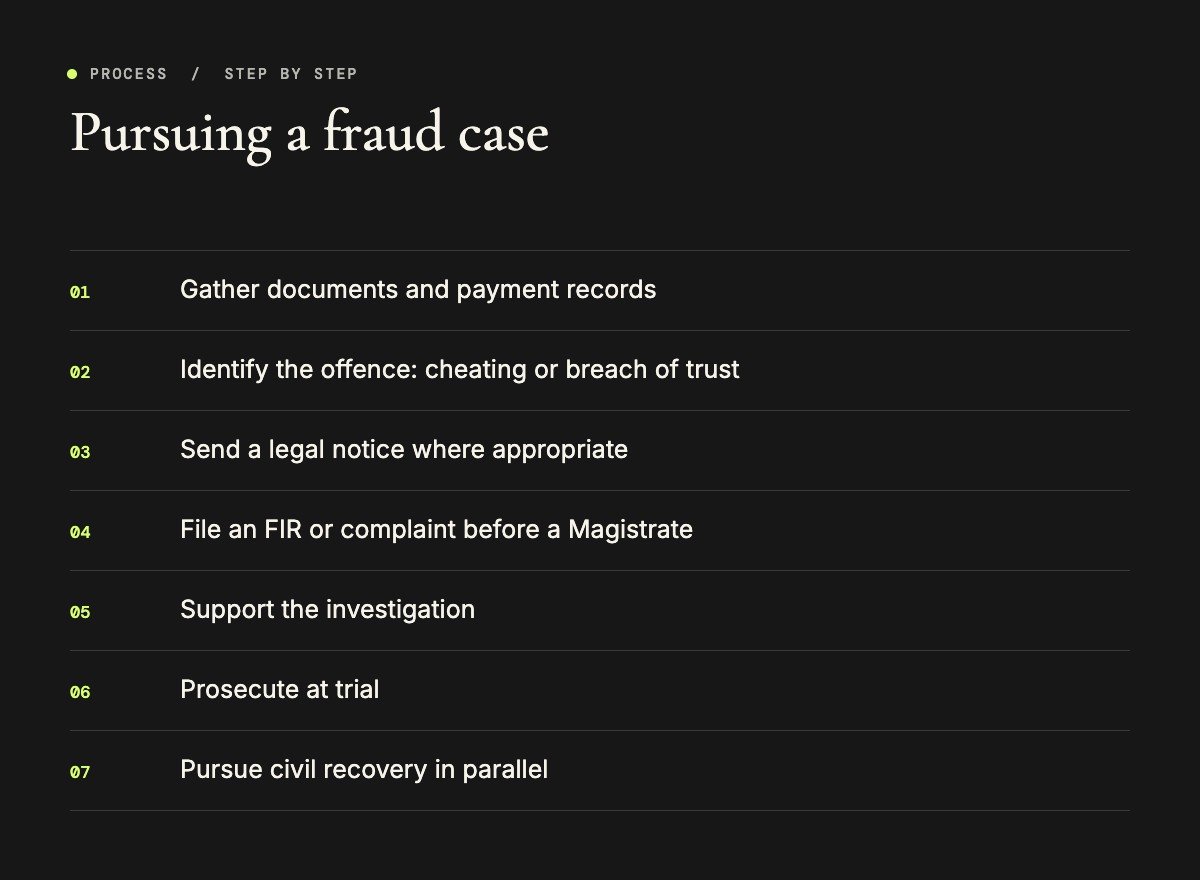
Bringing a fraud case in Bangladesh step by step
- Documents. Collect contracts, receipts, bank and MFS records, messages and witness details.
- Identify the offence. Decide whether the facts show cheating, breach of trust, forgery or a combination.
- Legal notice. Where appropriate, demand return of the money; the response may reveal intention.
- FIR or complaint. Lodge an FIR at the police station or file a complaint before the Magistrate under section 200.
- Investigation. Provide documents and witnesses to the investigating officer.
- Trial. Give evidence and support the prosecution through trial.
- Civil recovery. File a money suit or other civil claim to recover the loss.
Write the complaint around facts that show dishonest intention: false representations made before payment, fake documents, disappearance after receiving money, or similar conduct with other victims. A complaint that only says the accused failed to pay is vulnerable to quashing.
Evidence in a fraud case in Bangladesh
Documentary evidence carries the case. Bank statements, MFS transaction records, cheques, receipts, agreements, emails and chat messages showing what was promised and when are essential. Evidence that the accused used a false name, fake company or forged papers is powerful proof of dishonest intention from the outset. Statements from other victims of the same scheme show a pattern. In breach of trust cases, documents proving entrustment, such as appointment letters, agency agreements or delivery challans, are crucial.
Punishments in a fraud case in Bangladesh
Section 420 provides for imprisonment of up to seven years and fine. Section 406 provides for imprisonment of up to three years, fine or both. Aggravated forms of breach of trust carry heavier penalties, including section 408 for clerks and servants and section 409 for public servants, bankers, merchants and agents, which can attract imprisonment for life. Forgery of valuable securities and using forged documents also attract severe punishment.
Bail and compromise in a fraud case in Bangladesh
Cheating and criminal breach of trust are generally non-bailable, so bail is at the court’s discretion. Courts often grant bail where the dispute has a commercial background and the accused has roots in the community. Some fraud offences are compoundable with the court’s permission under section 345 of the Code, which allows the parties to settle and end the case, typically after repayment. Serious aggravated offences cannot be compounded.
Recovering money after a fraud case in Bangladesh
A criminal court may order compensation from a fine under section 545 of the Code, but this is limited and discretionary. To recover losses in full, victims usually file a civil suit for recovery of money, and can apply for attachment before judgment where the defendant is likely to dispose of assets. For dishonoured cheques, a separate case under section 138 of the Negotiable Instruments Act may be faster; see our guide to cheque dishonour.
Investment and real estate scams
Common schemes include promises of unrealistic returns from trading, foreign employment or business ventures, multi-level marketing structures, and sales of flats or plots that the seller does not own or has already sold to others. Victims should check whether the company is registered with the Registrar of Joint Stock Companies and whether the activity requires a licence, for example from the securities regulator or Bangladesh Bank. In land and flat fraud, verify title through the land records and sub-registry before paying.
Employee and partner fraud
Businesses often face misappropriation by employees, agents or partners. Internal investigation, preservation of accounting records, and suspension of access should come first. Before filing criminal proceedings, consider whether the relationship involved entrustment, what documents prove it, and whether civil claims, insurance or partnership remedies should be pursued as well. Careful sequencing avoids weakening either case.
Defending a fraud case
Accused persons should take advice immediately. Common defences include absence of dishonest intention, a genuine commercial dispute, payment or partial performance, lack of entrustment, limitation, and malicious prosecution. Where the case is plainly civil, an application to quash under section 561A may be appropriate. Our guide to defamation remedies is relevant where false accusations damage reputation.

Time limits and delay in a fraud case in Bangladesh
There is generally no limitation period for prosecuting serious offences such as cheating and criminal breach of trust, but delay can still harm the case. Unexplained delay in complaining is often argued by the defence as evidence that the matter was a civil dispute or that the complaint was fabricated. Evidence also becomes harder to obtain: bank records may be archived, witnesses move and digital messages are lost. Civil claims for recovery of money, by contrast, are subject to limitation periods under the Limitation Act 1908, usually three years for money claims, so delay can extinguish the civil remedy entirely.
Freezing assets in a fraud case in Bangladesh
Victims are often most concerned with getting their money back. In a civil suit, the court can order attachment before judgment where the defendant is about to dispose of or remove property to defeat a decree. In money laundering investigations, authorities have powers to freeze and confiscate property. Moving quickly, and identifying the accused’s bank accounts, land and vehicles early, improves the prospects of recovery.
Cross-border fraud case in Bangladesh issues
Where the fraudster is abroad or funds have been sent overseas, recovery is more complex. Criminal investigation may require mutual legal assistance, and civil claims may need to be brought in the foreign jurisdiction. Banks may be able to recall international transfers if notified promptly. Expatriate Bangladeshis targeted by fraud at home can pursue cases through a registered power of attorney, explained in our guide to powers of attorney.
Common mistakes by complainants
Complainants often exaggerate allegations, mix unrelated grievances into one complaint, omit key documents, accept partial payments without written terms, or rely only on a criminal case without protecting their civil claim. A focused, well-documented complaint and a coordinated civil strategy produce the best results.
Working with investigators
Investigating officers handle heavy caseloads. Provide an indexed bundle of documents, a short chronology and contact details of witnesses, and follow up regularly in writing. Where investigation stalls, the complainant can ask the court for directions or, after a final report, file a naraji petition.
Online and mobile payment scams
For scams carried out through mobile financial services or online shops, report immediately to the provider to block the recipient account, lodge a GD, and preserve screenshots and transaction IDs. Quick action greatly improves the chance of freezing funds before they are withdrawn.
Frequently asked questions about fraud case in bangladesh
Is breach of contract a crime?
No, unless there was dishonest intention amounting to cheating or breach of trust.
What is the punishment for cheating?
Up to seven years’ imprisonment and fine under section 420.
Where do I file?
At the police station with jurisdiction or before the Magistrate by complaint.
Can the case be settled?
Some fraud offences can be compounded with the court’s permission.
Will the criminal case return my money?
Not necessarily; a civil suit is usually needed for full recovery.
Can the accused get the case quashed?
Yes, if the High Court Division finds it is purely a civil dispute.
How we can help
We assess whether facts support a fraud case in Bangladesh, prepare complaints, support prosecutions, defend accused persons, and pursue civil recovery and asset preservation. Learn more about our practice, our commercial litigation services and our guide to civil cases.
Been cheated?
We help you choose the right route to justice and recovery.
Book a consultationAbout usPrimary sources: the Penal Code 1860, the Code of Criminal Procedure 1898, the Negotiable Instruments Act 1881 and the Money Laundering Prevention Act 2012 on Laws of Bangladesh; anti-corruption information from the Anti-Corruption Commission.
This article is general information about Bangladeshi criminal law as of October 2026 and is not legal advice. Take advice on your circumstances.

0 Comments