
Bangladesh’s legal system operates in two languages. Subordinate courts and most government offices work in Bangla, while the Supreme Court, international business, foreign embassies and overseas institutions often require English. Legal translation in Bangladesh bridges the gap: deeds, kabinnamas, court orders, certificates and contracts must be translated accurately, certified, and often notarised and attested before they will be accepted.
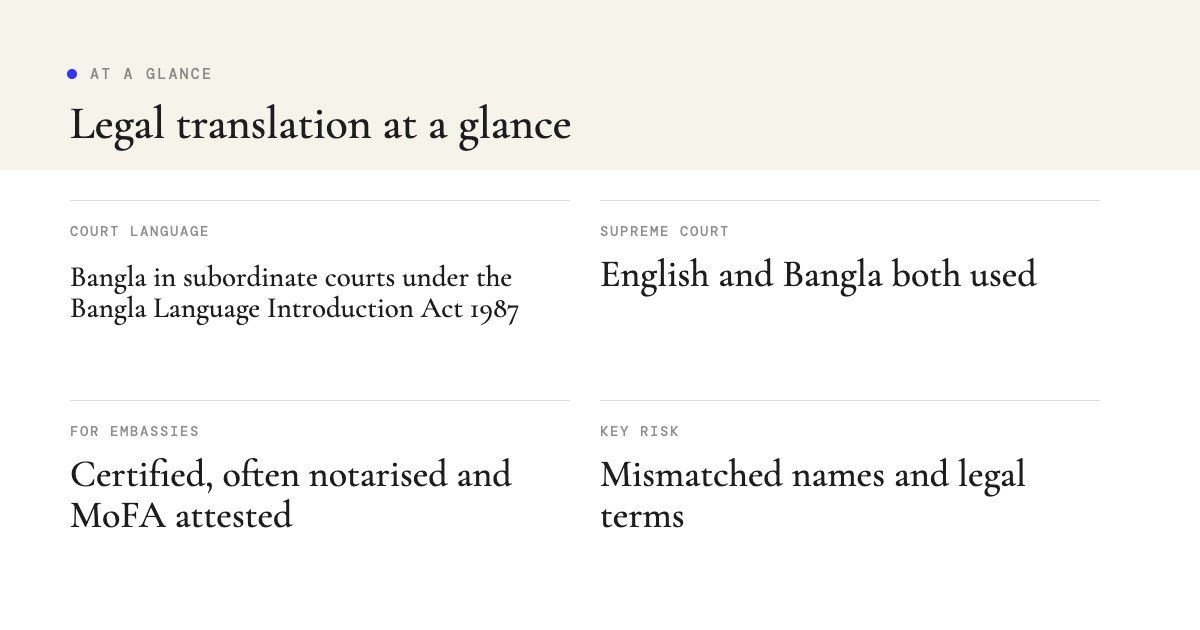
- The Bangla Language Introduction Act 1987 requires Bangla in government offices and courts, apart from specified exceptions, which drives demand for translations of foreign and English documents.
- Embassies, foreign universities and overseas courts usually require certified English translations of Bangla documents.
- A certified translation includes a translator’s statement of accuracy, signature and contact details, and is often notarised.
- For use abroad, translations are commonly attested by the Ministry of Foreign Affairs together with the original.
- Errors in names, dates, land descriptions and legal terms are the main reasons translations are rejected.
Why legal translation in Bangladesh matters
A translation of a legal document is only useful if the receiving authority can rely on it. A mistranslated term in a land deed can change the description of property; a wrongly rendered name in a marriage certificate can cause a visa refusal; and an imprecise translation of a contract clause can create a dispute about obligations. Legal translators must understand both languages and the legal concepts behind the words, including terms that have no exact equivalent, such as khatian, dag, mouza, mohrana or heba.
Our team, described on our about page, prepares and reviews translations of legal documents for courts, regulators, embassies and international transactions.
Where legal translation in Bangladesh is needed
| Setting | Typical documents | Usual requirement |
|---|---|---|
| Embassies and immigration | Birth, marriage and divorce certificates; police clearance; bank statements | Certified English translation, often notarised and attested |
| Foreign universities | Certificates and transcripts in Bangla | Certified translation; sometimes issuing institution translation |
| Bangladeshi courts | Foreign judgments, contracts, correspondence in English or other languages | Translation into Bangla or English per court practice |
| Foreign courts and arbitration | Deeds, court orders, statutes, witness statements | Certified translation, sometimes sworn translator |
| Business and regulators | Contracts, corporate documents, licences | Bilingual versions or certified translations |
Courts and legal translation in Bangladesh
The Bangla Language Introduction Act 1987 requires that records, correspondence, laws, court proceedings and other legal actions be in Bangla, except in dealings with foreign countries and organisations. In practice, subordinate courts work mainly in Bangla, while the Supreme Court uses both English and Bangla, and many High Court Division judgments are delivered in English. Documents in foreign languages filed in court should be accompanied by translations, and courts may require certification of their accuracy. The Act is available on Laws of Bangladesh.
Getting a legal translation in Bangladesh step by step
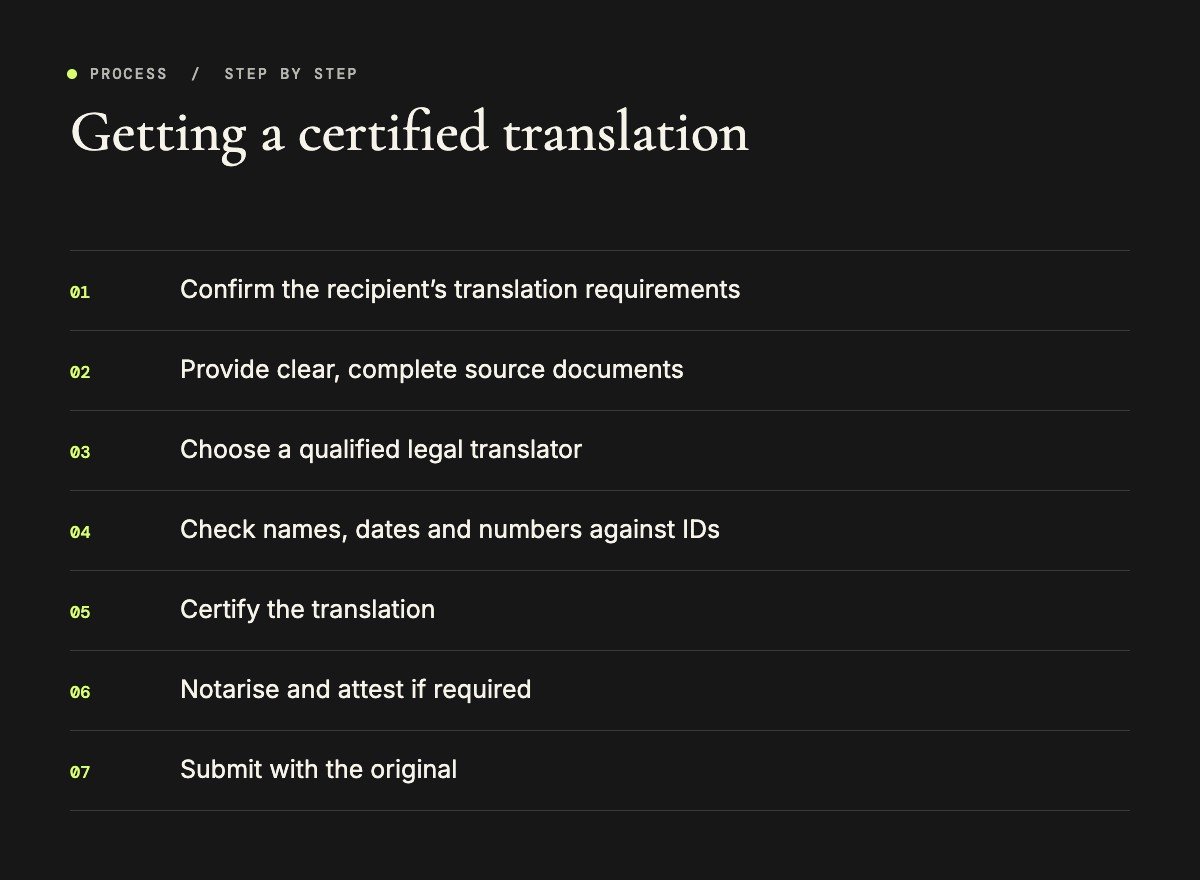
- Requirements. Ask the recipient what form of translation it accepts and whether notarisation or attestation is required.
- Source documents. Provide clear, complete copies, including stamps, seals, handwritten notes and reverse sides.
- Translator. Use a translator experienced in legal documents and familiar with the subject.
- Check details. Verify every name, date, number and address against passports and IDs.
- Certification. The translator signs a statement that the translation is true and accurate.
- Notarisation and attestation. Notarise and attest at the Ministry of Foreign Affairs if the recipient requires it.
- Submission. Submit the translation with the original or a certified copy of the source document.
Give the translator your passport spelling of every name. Bangla names can be transliterated in several ways, and a translation that uses a different spelling from the passport will often be rejected, even if it is technically correct.
What a certified translation contains
A certified translation reproduces the full content of the source document, including headings, seals, stamps, signatures and marginal notes, with descriptions such as “[seal]” or “[signature]” where these cannot be translated. It ends with a certificate in which the translator states their qualifications, confirms that the translation is complete and accurate to the best of their knowledge, and signs and dates it, with contact details. Where notarised, the notary certifies the translator’s signature, not the accuracy of the translation itself.
Land documents and legal translation in Bangladesh
Land documents are among the hardest to translate. Deeds, khatians, porchas and mutation records contain technical terms, measurements in local units such as decimals, kathas and bighas, and references to survey records such as CS, SA, RS and BS. A good translation keeps these terms in transliteration with an explanation, rather than forcing an inexact English equivalent. Foreign buyers, banks and courts dealing with Bangladeshi land should insist on translations that preserve dag and khatian numbers exactly. Land records can be checked through Ministry of Land services.
Family documents and legal translation in Bangladesh
Kabinnamas (marriage registration forms) contain specific clauses, such as the amount of dower and delegated divorce rights, that must be translated carefully because foreign authorities may rely on them for spousal and family visas. Divorce documents, including talaq notices and arbitration council certificates, require precise terminology. Birth and death registration certificates issued in Bangla should be translated with the registration number and issuing office details intact.
Contracts and legal translation in Bangladesh
Commercial contracts with foreign parties are commonly drafted in English, sometimes with Bangla versions for registration or regulatory filing. Where two language versions exist, the contract should state which prevails in case of conflict. Documents that must be registered, such as leases and sale deeds, are generally prepared in Bangla, and an English translation is provided for the foreign party. Inconsistent versions are a frequent source of disputes, so both should be reviewed by lawyers.
Statutes and judgments
Foreign courts and arbitral tribunals often need English versions of Bangladeshi statutes and judgments. Many older statutes exist in English, while newer laws are enacted in Bangla, and official English translations may not be available. Where an unofficial translation is used, it should be prepared by a legal translator and, in contentious matters, supported by an expert opinion on Bangladeshi law explaining how courts interpret the provisions.
Translations for regulators
Foreign investors dealing with Bangladeshi regulators, such as the investment authority, the securities regulator or Bangladesh Bank, may need to submit translations of parent company documents, financial statements and board resolutions. Regulators can reject submissions where translations are incomplete or inconsistent with the originals, delaying approvals.
Quality checks for legal translation in Bangladesh
For important documents, use a second reviewer, ideally a lawyer, to compare the translation with the source line by line. Check that nothing has been omitted, that numbers and dates match exactly, that legal terms are used consistently, and that the layout makes it easy to match sections of the translation with the original.
Choosing a legal translator
Look for translators with demonstrated experience in legal documents, not just general translation. Ask for samples, check whether embassies and courts have accepted their work, and confirm that they will provide a signed certificate with contact details. For specialised fields, such as patents, banking or construction contracts, choose someone familiar with the technical vocabulary. Lawyers who are fluent in both languages often review translations prepared by translators for high-stakes matters.
Confidentiality matters too. Legal documents contain personal and commercial information, so use translators who agree to keep documents confidential and to delete files after completion where appropriate.
Translations in arbitration
International arbitrations seated in Singapore, London or elsewhere frequently involve Bangladeshi documents. Tribunals usually require translations of all documents relied on into the language of the arbitration, and parties may challenge each other’s translations. Agreeing a protocol for translations early, including who prepares them and how disputes over accuracy are resolved, saves time and cost later.
Interpreters in court
Where a witness or party does not speak the language of the proceedings, the court can appoint an interpreter. Foreign parties in Bangladeshi courts, and Bangladeshi witnesses in foreign proceedings, should ask early about interpretation arrangements. The interpreter’s accuracy can determine how a witness’s evidence is understood, so experienced legal interpreters are essential in contested cases.
Common mistakes in legal translation in Bangladesh
Frequent errors include using different spellings for the same name across documents, omitting stamps or handwritten notes, converting land measurements incorrectly, translating dates from the Bangla calendar inaccurately, and using informal language in formal documents. A careful review against the original and against identity documents catches most of these errors before submission.
Bangla calendar dates
Older documents, especially land deeds, sometimes use Bangla calendar dates. Translators should give the original date and the corresponding Gregorian date, noting the conversion, so that courts and authorities can follow the chronology accurately.
Educational documents
Most Bangladeshi university degrees and transcripts are issued in English, but SSC and HSC certificates from some boards, madrasa certificates and older documents may be in Bangla. Universities abroad often require translations certified by the issuing institution or by a recognised translator, together with attestation where needed. Grade scales and course titles should be translated faithfully rather than converted, leaving evaluation to the receiving institution or credential agency.
Police clearance and court records
Police clearance certificates are generally issued in English for overseas use, but court records, case documents and judgments from subordinate courts are typically in Bangla. Immigration authorities may ask for translations of any criminal case records, including documents showing acquittal or discharge. These translations must be complete, because selective translation can be treated as misrepresentation.
Costs and timelines for legal translation in Bangladesh
Translation fees depend on length, complexity and urgency. Short certificates can be translated within a day, while lengthy deeds, judgments or contracts take longer, especially if a legal review is required. Add time for notarisation and attestation where needed.
Keeping records
Keep the signed translation, the translator’s certificate, notarised copies and attested versions together with the source documents. If the recipient later questions the translation, the translator’s details allow quick verification, and reusing an accepted translation for later applications saves time and cost.
Urgent translations
When deadlines are tight, such as visa appointments or court hearings, tell the translator the deadline at the outset and allow time for a review. Rushed translations without checks are the most likely to contain errors that cause rejection.
Frequently asked questions about legal translation in bangladesh
Who can certify a translation?
Usually a qualified translator signs a certificate of accuracy, often notarised for official use.
Do embassies accept any translation?
No; most require certified, and often notarised and attested, translations.
Which language do courts use?
Bangla in subordinate courts; English and Bangla in the Supreme Court.
Should land terms be translated into English?
Technical terms are best transliterated with explanations.
Does a notary verify accuracy?
No, the notary verifies the translator’s signature.
What causes rejections?
Name spelling mismatches, omissions and inaccurate legal terms.
How we can help
We provide and review legal translation in Bangladesh for deeds, court records, family documents and contracts, and coordinate notarisation and attestation. Learn more about our practice and our guides to land registration and divorce under Muslim law.
Primary sources: the Bangla Language Introduction Act 1987 and the Notaries Ordinance 1961 on Laws of Bangladesh; attestation information from the Ministry of Foreign Affairs.
This article is general information about Bangladeshi practice as of October 2026 and is not legal advice. Confirm requirements with the receiving authority.

0 Comments