
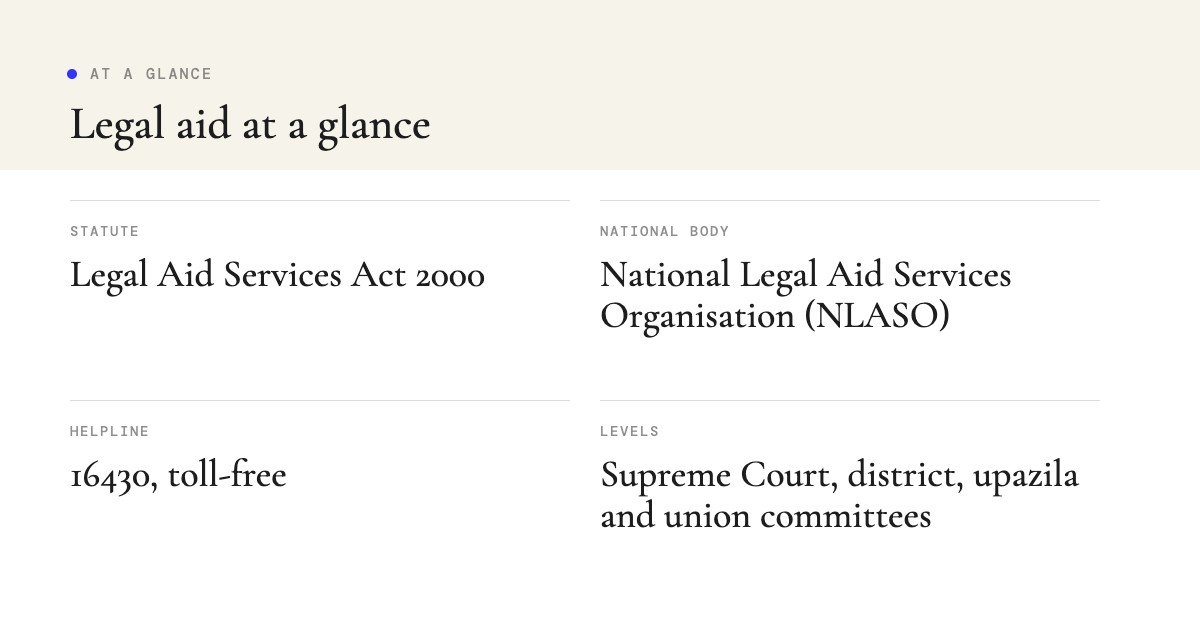
Justice should not depend on the ability to pay. Legal aid in Bangladesh is provided by the state under the Legal Aid Services Act 2000 through the National Legal Aid Services Organisation (NLASO), district legal aid offices, the Supreme Court Legal Aid Committee and local committees. Eligible people can receive free legal advice, a panel lawyer to represent them, court fees and expenses, and mediation to resolve disputes without going to court.
- The Legal Aid Services Act 2000 established a nationwide system of government legal aid administered by NLASO.
- Eligibility covers people with limited income and specified vulnerable groups, such as women and children victims of violence, people with disabilities and others named in the rules.
- Applications can be made at district legal aid offices, through the Supreme Court Legal Aid office, or with guidance from the toll-free 16430 helpline.
- Legal aid offices also conduct mediation, which resolves many disputes faster than litigation.
- Aid can cover lawyer’s fees, court fees, costs of documents and witnesses, and other expenses.
What legal aid in Bangladesh provides
Government legal aid offers free legal advice, representation by panel lawyers in civil, criminal and family cases, payment of court fees and related expenses, and alternative dispute resolution through mediation. It covers cases in subordinate courts, tribunals and the Supreme Court. Legal aid is also available to people in custody who cannot afford a lawyer, and to victims of serious crimes. The Legal Aid Services Act 2000 and its regulations are available on Laws of Bangladesh, and service information is published by NLASO.
Our firm, described on our about page, supports access to justice and can advise on whether legal aid or private representation best suits a case.
How legal aid in Bangladesh is organised
| Level | Body | Role |
|---|---|---|
| National | NLASO and its national board | Policy, budget, supervision and national helpline |
| Supreme Court | Supreme Court Legal Aid Committee | Aid for cases in the High Court Division and Appellate Division |
| District | District Legal Aid Committee and office, led by legal aid officers | Applications, panel lawyers, mediation |
| Upazila and union | Local legal aid committees | Awareness and referral |
| Specialised | Legal aid cells in labour courts and other forums | Aid for workers and specific groups |
Who qualifies for legal aid in Bangladesh
Eligibility is set by the Act and regulations made under it. Broadly, it covers people whose annual income is below the limit fixed by the regulations, which differs for subordinate courts and the Supreme Court, and certain categories regardless of income or on favourable terms. These categories include women and children who are victims of violence or trafficking, acid survivors, people with disabilities, destitute and elderly people, freedom fighters unable to pay, prisoners unable to engage a lawyer, and others listed in the regulations. Because income thresholds and categories are revised periodically, the legal aid office or helpline will confirm current criteria.
Applying for legal aid in Bangladesh step by step
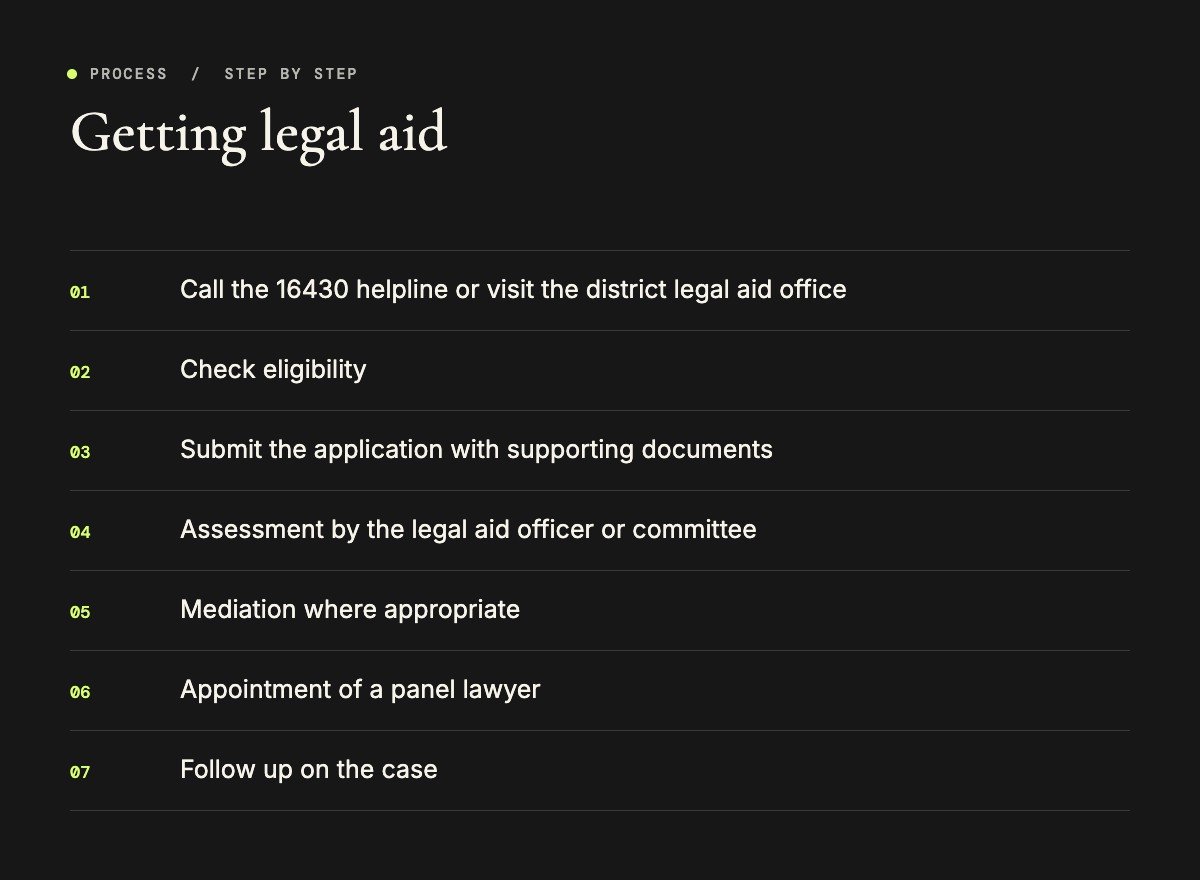
- Contact. Call the 16430 helpline for advice, or visit the district legal aid office at the district court.
- Eligibility. Discuss your income and situation with the legal aid officer.
- Application. Complete the application form with your details, the nature of the dispute and supporting documents.
- Assessment. The legal aid officer or committee assesses eligibility and merit.
- Mediation. Where suitable, the officer invites the other party to mediation.
- Panel lawyer. If litigation is needed, a panel lawyer is appointed to represent you.
- Follow-up. Stay in touch with your lawyer and the office, and report any problems.
Bring every document you have, even if it seems unimportant: identity card, income evidence, deeds, notices, court papers and medical records. Complete documents allow the legal aid officer to assess the case quickly and assign the right lawyer.
Mediation through legal aid in Bangladesh
District legal aid offices conduct mediation in family disputes, such as dower and maintenance claims, as well as land, money and other civil disputes. Mediation is free, confidential and often concluded within weeks. A settlement reached in mediation is recorded in writing and signed by the parties, and can be enforced. Mediation through legal aid offices has expanded substantially in recent years, and recent reforms have sought to give pre-case mediation a larger role in reducing court backlogs. Check with the local office for current procedures. Our mediation services page explains how mediation works more generally.
Supreme Court legal aid in Bangladesh
The Supreme Court Legal Aid Committee provides lawyers for eligible people in the High Court Division and the Appellate Division, including in criminal appeals, writ petitions, civil revisions and bail matters. Prisoners whose appeals are pending can apply through jail authorities. The Supreme Court legal aid office is located in the Supreme Court premises, and information is available from the Supreme Court of Bangladesh.
Legal aid in Bangladesh for prisoners
Many people remain in custody because they cannot afford lawyers for bail applications or trials. Legal aid offices work with jail authorities to identify such prisoners and assign panel lawyers. Families of prisoners can contact the district legal aid office or the helpline. Courts can also refer unrepresented accused persons to legal aid, and state defence lawyers are appointed in serious cases.
Legal aid in Bangladesh for workers
Workers with disputes over wages, termination or compensation can obtain help through legal aid cells associated with labour courts, as well as through district legal aid offices. Trade unions and NGOs also provide assistance. See our guide to termination of employment for workers’ rights.
Women and children
Women and children who are victims of violence, including domestic violence, dowry violence, rape and trafficking, are a priority group for legal aid. Legal aid offices can assign lawyers for cases before Nari O Shishu Nirjatan Daman Tribunals, applications under the Domestic Violence (Prevention and Protection) Act 2010, and family court claims for dower, maintenance and custody. One-Stop Crisis Centres in hospitals and the national helpline 109 can refer victims to legal aid.
NGO legal aid
Alongside government legal aid, several non-governmental organisations provide free legal services, often specialising in women’s rights, labour rights, land rights or human rights. Some work in partnership with district legal aid committees. People who do not qualify for government aid, or who need specialised help, may find NGO services useful.
What legal aid does not cover
Government legal aid is generally not available for commercial disputes between businesses, for applicants above the income limits who do not fall within a special category, or for cases the committee considers lacking in merit. Aid may be withdrawn if the applicant provided false information, fails to cooperate with the lawyer, or if their financial circumstances change significantly. Where aid is refused, the applicant can ask for reasons and, in appropriate cases, request reconsideration by the committee.
Working with a legal aid in Bangladesh panel lawyer
Panel lawyers are private advocates enrolled with the district or Supreme Court legal aid committee and paid by the state for legal aid cases. Clients should attend meetings with their lawyer, provide documents promptly, keep the lawyer informed of any changes, and attend court dates. If a client is dissatisfied with the lawyer’s performance, they can raise the concern with the legal aid officer, who can review the matter and, if needed, appoint another lawyer.
Legal aid clients should not be asked to pay the panel lawyer. Any demand for payment should be reported to the legal aid office.
Legal aid in family disputes
Family disputes are among the most common legal aid cases. Wives seeking dower and maintenance, mothers seeking custody of children, and women facing unlawful divorce or polygamy can obtain lawyers for family court cases, applications to arbitration councils and related criminal cases. Mediation often resolves maintenance and dower claims quickly, with written settlements that can be enforced if broken. See our guide to divorce under Muslim law.
Legal aid in Bangladesh for land disputes
Poor farmers and families facing land grabbing, boundary disputes or partition conflicts can seek legal aid for civil suits, injunctions and mediation. Legal aid lawyers can also help with land records issues, such as mutation errors, and with proceedings under land laws, where these involve court or tribunal proceedings.
Awareness and outreach
Many people who qualify for legal aid do not know it exists. NLASO and district committees run awareness campaigns, legal aid days and outreach in communities, schools and prisons. Community leaders, union parishad members and NGOs can help by referring people to the helpline or district office.
Documents to bring
When applying, bring your national identity card or birth certificate, any evidence of income or of belonging to a special category (such as a disability certificate or freedom fighter certificate), all documents relating to the dispute (deeds, kabinnama, notices, court papers, medical reports, police records), and contact details of the other party. If you do not have certain documents, the legal aid office can advise how to obtain certified copies.
Time limits still apply
Applying for legal aid does not stop limitation periods running. If a case must be filed by a deadline, such as an appeal or a suit to recover possession, tell the legal aid officer immediately so the application can be prioritised. Missing a deadline while waiting for aid can mean losing the right to bring the case.
Expatriates and migrant workers
Migrant workers and their families facing disputes in Bangladesh, such as recruitment fraud or family property conflicts, can approach district legal aid offices. Recruitment-related complaints may also be taken to the authorities responsible for overseas employment under the Overseas Employment and Migrants Act 2013. Families can apply on behalf of workers abroad with appropriate authorisation, such as a power of attorney or written consent.
Feedback and complaints
If you are unhappy with the service from a legal aid office or panel lawyer, raise the issue with the legal aid officer or the district committee chair, and if unresolved, with NLASO. Clear written complaints with dates, names and details are most effective, and keeping a copy helps if you need to escalate the matter further.
Frequently asked questions about legal aid in bangladesh
What is the legal aid helpline number?
16430, a toll-free national helpline.
Who is eligible?
People below the income limit and specified vulnerable groups set out in the regulations.
Where do I apply?
At the district legal aid office or the Supreme Court legal aid office.
Is mediation available?
Yes, legal aid offices offer free mediation for many disputes.
Does legal aid cover court fees?
Yes, along with lawyers’ fees and other approved expenses.
Can prisoners get legal aid?
Yes, through jail authorities and district legal aid offices.
How we can help
We explain options for legal aid in Bangladesh, help people prepare documents for applications, and provide private representation where clients are not eligible or prefer it. Learn more about our practice and our guide to types of civil cases.
Not sure where to turn?
We help you find the right route to justice.
Book a consultationAbout usPrimary sources: the Legal Aid Services Act 2000 and regulations on Laws of Bangladesh; service information from NLASO.
This article is general information about Bangladeshi law and practice as of October 2026 and is not legal advice. Confirm current eligibility with NLASO.

0 Comments