
Ship arrest in Bangladesh lets an unpaid claimant hold a vessel in Chattogram, Mongla or Payra until the owner provides security. The power comes from the Admiralty Court Act 2000 and is exercised by the High Court Division. Used quickly and correctly, it is often the fastest route to payment in a maritime dispute.
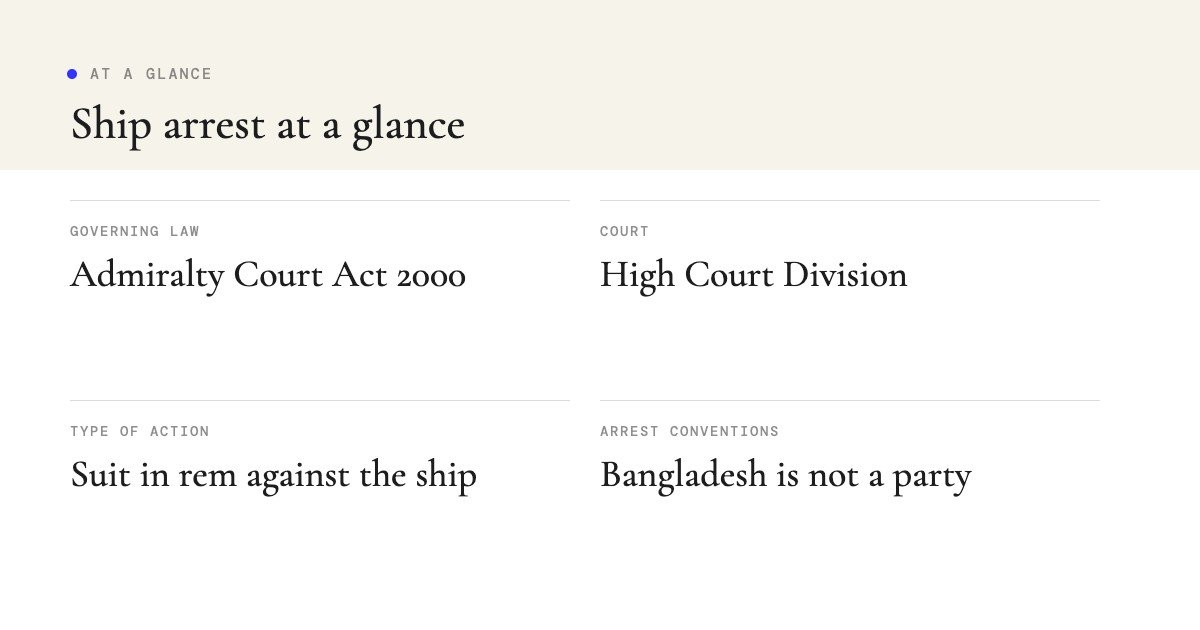
- Admiralty jurisdiction lies with the High Court Division of the Supreme Court under the Admiralty Court Act 2000.
- Arrest is available only for claims within the categories listed in the Act, and only where an action in rem lies against the ship or property concerned.
- Bangladesh is not a party to the 1952 or 1999 Arrest Conventions, so the domestic statute and case law govern.
- The owner usually secures release by a bank guarantee or an acceptable P&I club letter of undertaking.
- Arrest can be used to obtain security even where the merits will be decided in arbitration.
What ship arrest in Bangladesh means
Ship arrest in Bangladesh is the detention of a vessel by court order to secure a maritime claim. The claimant sues the ship itself in an action in rem, and the vessel cannot leave port until the court releases it, usually after the owner provides security for the claim, interest and costs.
Ship arrest in Bangladesh matters because shipowners are often foreign, their assets are mobile and they may have no other property in the country. Once a vessel sails, a claimant may be left chasing a single-ship company in a distant jurisdiction. Arrest converts that risk into a guarantee from a bank or insurer that can be enforced locally.
Who uses it
Typical claimants seeking ship arrest in Bangladesh include cargo interests with damage or shortage claims, bunker and necessaries suppliers, ship repairers, crew with unpaid wages, port and towage service providers, charterers and owners in charterparty disputes, and lenders enforcing ship mortgages.
The legal framework for ship arrest in Bangladesh
The Admiralty Court Act 2000 is the core statute. It makes the High Court Division the court of admiralty, lists the claims within admiralty jurisdiction and sets out when an action in rem may be brought. Admiralty matters are heard by a single judge of the High Court Division sitting as the Admiralty Bench in Dhaka.
Procedure follows the admiralty rules applied by the High Court Division, the Code of Civil Procedure 1908 where relevant, and established practice. Many of the Act's concepts are modelled on English admiralty law, so English authorities are frequently cited as persuasive.
International conventions
Bangladesh has not acceded to the International Convention Relating to the Arrest of Sea-Going Ships 1952 or the International Convention on Arrest of Ships 1999. Ship arrest in Bangladesh therefore depends entirely on the domestic statute and case law. In practice the results are often similar, but there is no treaty list of claims to fall back on.
Other detention powers
Ship arrest in Bangladesh should be distinguished from detention. Merchant shipping legislation, historically the Bangladesh Merchant Shipping Ordinance 1983, allows the maritime administration to detain unseaworthy ships and allows the court to detain foreign ships that have caused damage to the government or to Bangladeshi persons or companies. Port authorities also have powers under their own regulations to hold vessels for unpaid dues or damage. Check the current statute, as shipping legislation has been under review.
Claims that support ship arrest in Bangladesh
Not every claim connected with a ship justifies ship arrest in Bangladesh. Section 3 of the Admiralty Court Act 2000 lists the claims within admiralty jurisdiction. The list resembles the English model and covers the claims most often seen in practice.
| Category | Examples |
|---|---|
| Ownership and possession | Disputes over title, possession or co-ownership of a ship |
| Mortgages and charges | Enforcement of a ship mortgage or charge |
| Damage and collision | Damage done or received by a ship, collisions and personal injury |
| Cargo | Loss of or damage to goods carried, and claims under bills of lading |
| Charterparties | Claims arising from agreements for the use or hire of a ship |
| Salvage, towage and pilotage | Remuneration for salvage, towage and pilotage services |
| Supplies and repairs | Necessaries, bunkers, construction, repair and equipment |
| Crew | Wages and other sums due to master and crew |
| Disbursements and dues | Master's disbursements, port and harbour dues, general average |
Read the statutory wording carefully before filing. Whether a particular claim, such as a freight forwarder's charges or a claim for unpaid hire under a slot charter, falls within a listed category can be contested, and an arrest on a claim outside the list will be set aside.
Two tests, not one
To support ship arrest in Bangladesh, the claimant must show both that the claim falls within the listed categories and that an action in rem is available for it against the particular ship. Some claims, such as those based on a maritime lien, follow the ship into new ownership. Others, such as ordinary necessaries claims, generally require that the person liable still owns or controls the ship when the suit is filed.
Maritime liens, sister ships and change of ownership
The availability of ship arrest in Bangladesh against a particular vessel turns on its connection to the claim and the person liable. This is where most contested arrests are won or lost.
Maritime liens
A maritime lien is a privileged claim that attaches to the ship and survives a sale to a new owner. Traditionally, liens arise for salvage, collision damage, crew wages and master's disbursements. Because the lien travels with the ship, the claimant may arrest even after a change of ownership, subject to delay and other defences.
Statutory rights in rem
For most other claims, the right in rem is statutory. The claimant must usually show that the person who would be liable in personam was the owner, charterer or person in possession or control of the ship when the cause of action arose, and is the owner of the ship when the suit is filed. If the ship was sold before the claim was brought, arrest is normally unavailable.
Sister ships
Following the English model, a claimant may in some cases arrest another ship owned by the person liable instead of the ship in connection with which the claim arose. Proving beneficial ownership is the challenge, because many fleets use separate single-ship companies. Courts look at registered ownership first; piercing a one-ship structure requires strong evidence.
Check ownership on the day you file. Vessels heading to Bangladeshi breaking yards are often sold to cash buyers on their last voyage. If the sale completes before the suit is filed, a necessaries supplier may lose the right to arrest, while a crew wage lien may survive.
The procedure for ship arrest in Bangladesh
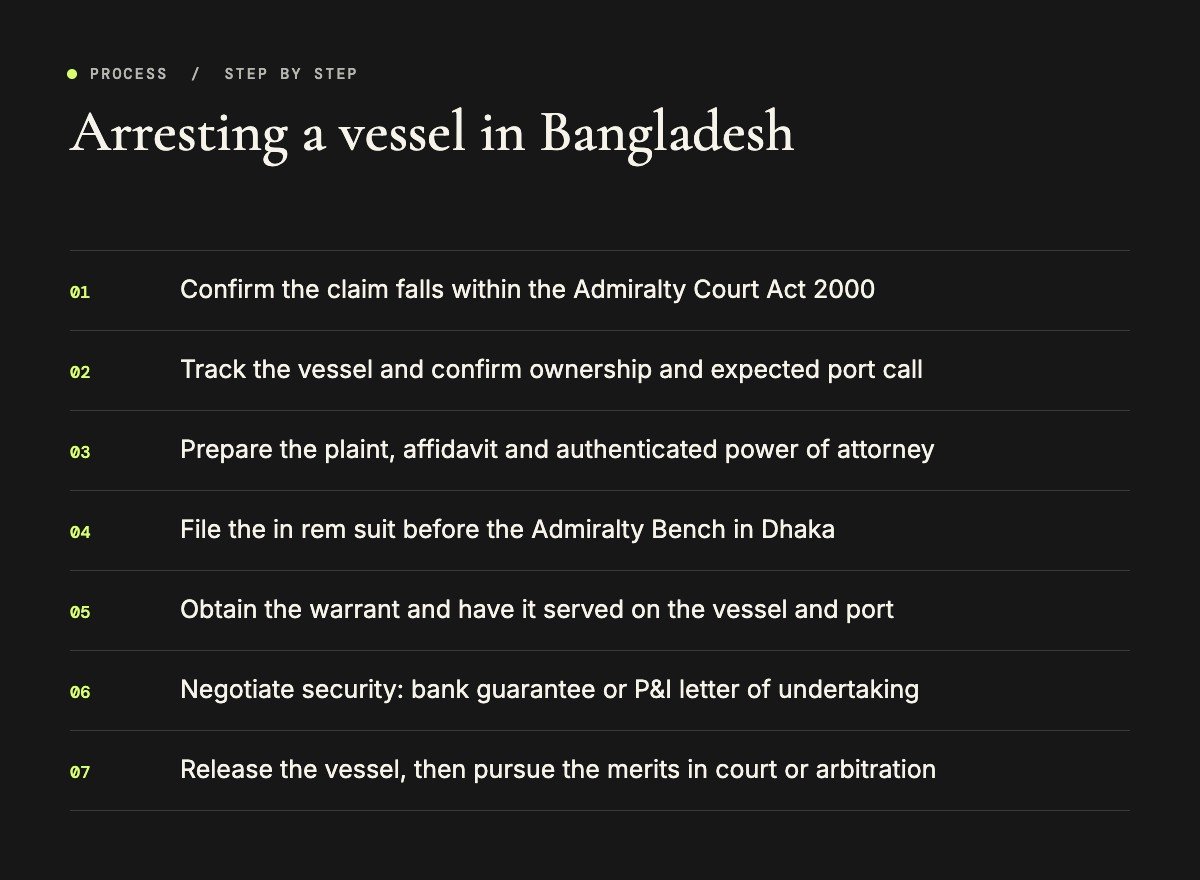
Speed matters in ship arrest in Bangladesh. Vessels may stay in Chattogram, Mongla or Payra only for a few days, and outer anchorage calls can be shorter still. A well-prepared claimant can move from instruction to warrant very quickly, but only if the documents are ready.
- Assess the claim. Confirm the claim falls within the Act, that an action in rem lies and that the target vessel is the right one.
- Track the vessel. Use AIS data and the local agent to confirm the expected arrival, berth and departure, and verify current registered ownership.
- Prepare the papers. Draft the plaint and a supporting affidavit identifying the vessel, the claim and the amount due. Gather contracts, invoices, bills of lading and correspondence.
- Authorise local counsel. A foreign claimant needs a power of attorney, notarised and authenticated, usually through the Bangladesh mission abroad. Courts may accept a scanned copy at the urgent stage, with originals to follow.
- File the in rem suit. File before the Admiralty Bench with the court fee and apply for a warrant of arrest. The court must be satisfied there is a prima facie case.
- Serve the warrant. The warrant is served on the vessel and communicated to the port authority and customs so the vessel is not cleared to sail.
- Negotiate security. The owner or its P&I club will usually offer security to obtain release, and the parties agree its amount and wording.
Court fees
Court fees in admiralty suits are set under the Court-fees Act 1870 as amended and can be significant for large claims. Check the current fee position with counsel before filing rather than relying on a figure from an older source.
Full and frank disclosure
The application for ship arrest in Bangladesh is usually heard without the owner present. The claimant must disclose all material facts, including facts that help the owner. Failure to do so is a ground for setting the arrest aside and may expose the claimant to costs.
Security and release of the vessel
The real purpose of ship arrest in Bangladesh is usually to obtain security, not to keep the ship detained. Once security is provided, the court releases the vessel and the claim proceeds against the security.
- Bank guarantee. A guarantee from a scheduled bank in Bangladesh, covering the claim, interest and costs, is the most widely accepted form.
- P&I letter of undertaking. Many claimants accept a letter of undertaking from an International Group P&I club, though the court may require a local guarantee if the parties cannot agree.
- Payment into court. The owner may deposit the amount with the court.
If the security demanded is excessive, the owner may apply to reduce it. The court will consider the claimant's reasonably arguable best case, plus interest and costs, but not inflated figures.
Release without security
An owner may apply to set aside the arrest altogether, for example where the claim falls outside the Act, the vessel was not owned by the person liable, or the claimant failed to disclose material facts. These applications are often heard quickly because a detained ship loses money every day.
Wrongful arrest and counter-security
A claimant who arrests in bad faith or with gross negligence may be liable in damages for wrongful arrest. Following the traditional English approach, damages are not awarded merely because the claim later fails; the owner must show bad faith or gross negligence.
Bangladeshi courts do not routinely require counter-security as a condition of ship arrest in Bangladesh, but they can impose conditions. Claimants should be confident of their claim and their evidence before arresting, and owners should keep records of losses caused by the detention in case a wrongful arrest claim becomes available.
Arresting a vessel loaded with perishable or time-critical cargo can create claims from cargo interests and charterers, as well as the owner. Factor those exposures into the decision to arrest and into the amount of security demanded.
Crew, port and cargo issues during detention
An arrested ship is still a working ship with people on board. During ship arrest in Bangladesh, the owner remains responsible for crew wages, provisions, safe manning and port charges. Where an owner abandons a vessel, crew welfare becomes urgent, and crew claims for wages carry a maritime lien that ranks highly against the ship.
Cargo on board an arrested ship raises separate questions. Cargo owners who are not party to the dispute may need court permission to discharge their goods, and the court can make directions for discharge, storage or transhipment. Port authorities may also require the vessel to move to an anchorage or lay-by berth while it is under arrest.
Arresting property other than the ship
The admiralty jurisdiction is not limited to the hull. Depending on the claim, an action in rem may lie against cargo, freight or other property connected with the claim. Where the claim is a pure money claim, a claimant may alternatively seek attachment before judgment under the Code of Civil Procedure 1908, although courts are cautious about attaching ships that are only casually within jurisdiction.
Judicial sale of an arrested ship
If the owner does not provide security or defend the suit, the vessel may stay under arrest for months. A ship deteriorates, crew must be fed and port charges accumulate. In those circumstances, the claimant may apply for sale of the vessel pending the suit.
The court may order the vessel to be appraised and sold by public auction, with the proceeds held in court. Claimants then prove their claims against the fund. Where the fund is insufficient, priorities between competing claimants are determined according to admiralty principles, generally following English law: costs of arrest and sale, maritime liens, mortgages, then other statutory claims.
Clean title for buyers
A judicial sale is intended to give the buyer title free of prior liens and encumbrances. Buyers, including ship recyclers, should still confirm that the sale order, bill of sale and deletion from the previous registry are in order before paying.
Ship arrest in Bangladesh and arbitration
Many charterparties and bills of lading contain arbitration clauses, often for London or Singapore. An arbitration clause does not prevent ship arrest in Bangladesh. The court may stay the merits of the in rem suit in favour of arbitration while keeping the security in place to satisfy any award.
The Arbitration Act 2001 also allows Bangladeshi courts to grant interim measures in support of arbitration, including orders for the detention or preservation of property. Bangladesh is a party to the New York Convention, so a foreign award can later be enforced against the security through the courts. Our arbitration guide explains the enforcement route.
Practical tips for claimants and owners
Ship arrest in Bangladesh is fast-moving, and preparation decides the outcome. These points come up in almost every matter we handle.
- Claimants: keep a ready file with the contract, invoices, statements of account and a signed power of attorney, so filing is possible within hours of a port call.
- Claimants: calculate the claim carefully, with interest and costs, and be ready to justify every element.
- Owners: notify the P&I club immediately and agree security wording early to keep detention short.
- Owners: lodge a caveat with the court where an arrest is anticipated, so that you are heard before or soon after any warrant issues.
- Both: coordinate with port agents in Chattogram and Mongla, who know how the warrant is communicated to the port and customs.
For wider shipping matters, including charterparty disputes and ship finance, see our shipping and maritime sector page.
Frequently asked questions about ship arrest in Bangladesh
Which court orders ship arrest in Bangladesh?
The High Court Division of the Supreme Court, sitting as the court of admiralty under the Admiralty Court Act 2000. Suits are filed in Dhaka even where the vessel is in Chattogram, Mongla or Payra.
Can a foreign-flagged ship be arrested?
Yes. Any ship within Bangladeshi waters may be arrested for a qualifying claim, regardless of flag, subject to the usual rules on ownership and connection to the claim.
How quickly can a vessel be arrested?
Where documents are ready and the court treats the matter as urgent, a warrant can issue very quickly, sometimes the same day. Delays usually come from missing papers or an unauthenticated power of attorney.
Is Bangladesh a party to the Arrest Conventions?
No. Bangladesh has not acceded to the 1952 or 1999 Arrest Conventions, so the Admiralty Court Act 2000 and case law apply.
Can I arrest a ship if my contract has a London arbitration clause?
Yes. The court can order arrest to obtain security and then stay the merits in favour of arbitration, keeping the security for any award.
How we can help
We act for cargo interests, suppliers, crew, charterers, owners, P&I clubs and banks in arrest, release and judicial sale proceedings before the Admiralty Bench. We can file urgently when a vessel is due in port, and negotiate security to keep ships moving. Learn more about our admiralty and maritime practice.
Vessel due in Bangladesh?
We assess your claim under the Admiralty Court Act 2000, prepare the suit and affidavit, and move for a warrant of arrest at short notice.
Book a consultationAdmiralty practicePrimary sources: the Admiralty Court Act 2000, Arbitration Act 2001 and Code of Civil Procedure 1908 on the Laws of Bangladesh portal; judgments and cause lists of the Supreme Court of Bangladesh; treaty status from the New York Convention resource.
This article is general information about Bangladeshi law as of 2026 and is not legal advice. Court fees, rules and procedures change; confirm current requirements with a qualified lawyer before acting.



0 Comments