
An environmental impact assessment in Bangladesh is the study a developer must complete, and the Department of Environment must accept, before a high-risk industrial unit or project can be built. Done well, it secures clearance and satisfies lenders; done badly, it delays construction or invites a court challenge.

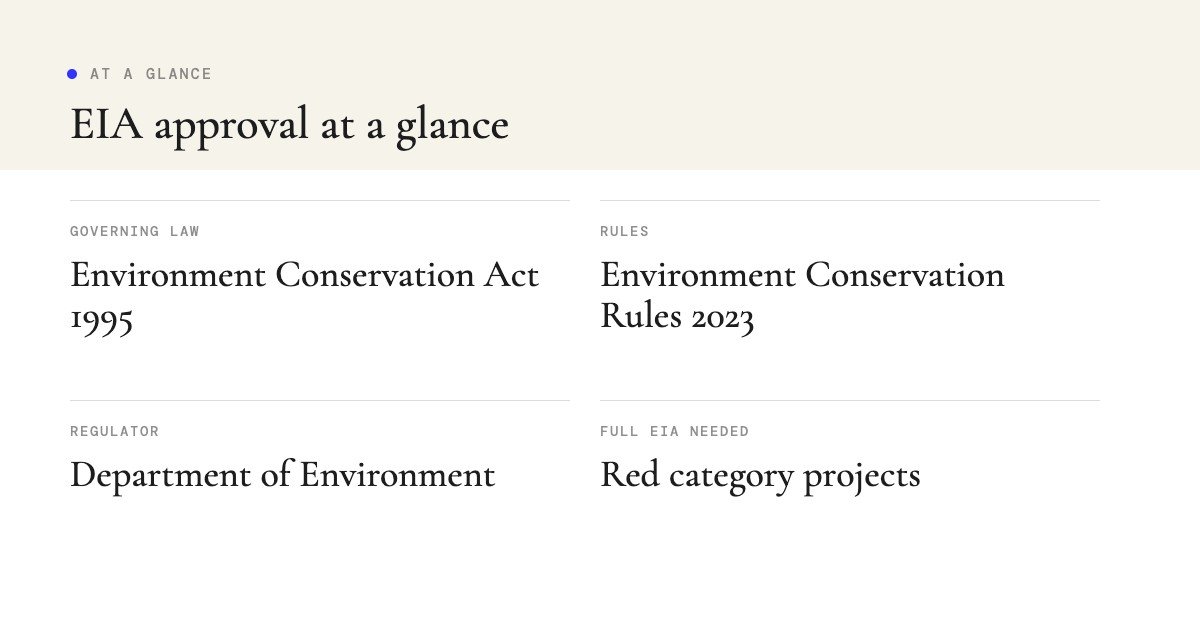
- Section 12 of the Environment Conservation Act 1995 prohibits establishing an industrial unit or project without an environmental clearance certificate from the Department of Environment (DoE).
- The Environment Conservation Rules 2023 (SRO 53, 5 March 2023) replaced the 1997 Rules and sort projects into green, yellow, orange and red categories.
- A full EIA with an environmental management plan is required for red category projects; orange projects generally need an initial environmental examination.
- Site clearance comes first, environmental clearance second. Building before clearance exposes the project to closure orders, penalties and lender default.
- International lenders usually apply their own standards on top of DoE requirements, so plan one study that satisfies both.
Under the Invest Bangladesh Act 2026, effective 23 August 2026, the Bangladesh Investment Development Authority (BIDA), the Bangladesh Economic Zones Authority (BEZA) and the PPP Authority were merged into a single body, Invest Bangladesh. References below to BIDA, BEZA or the PPP Authority should be read as references to Invest Bangladesh. BEPZA continues as a separate authority.
What environmental impact assessment in Bangladesh means
An EIA is a structured study of how a proposed project will affect air, water, soil, noise, ecology and the people who live nearby, together with the measures the developer will take to avoid, reduce or offset those effects. An environmental impact assessment in Bangladesh is not a voluntary exercise. It is a condition of the environmental clearance that the law requires before a regulated project can be established.
The process is run by the Department of Environment (DoE) under the Ministry of Environment, Forest and Climate Change. DoE reviews the assessment, inspects the site, attaches conditions and issues the clearance. Its divisional and district offices handle most applications, while large or sensitive projects are usually reviewed at head office.
Clearance, not just a report
Clients sometimes treat the written report as the end point of environmental impact assessment in Bangladesh. It is not. The goal is a clearance certificate with conditions the project can actually meet, and an environmental management plan that the operations team can follow for the life of the plant. A polished report with an unrealistic plan simply moves the problem to the first DoE inspection.
The legal framework for EIA
Environmental impact assessment in Bangladesh rests on a short statute, detailed rules and a set of guidelines. The key instruments are summarised below.
| Instrument | What it does | Practical relevance |
|---|---|---|
| Environment Conservation Act 1995 | Creates DoE, requires environmental clearance, allows ecologically critical areas and directions | The legal basis for every clearance and enforcement action |
| Environment Conservation (Amendment) Act 2010 | Strengthened controls on hill cutting, wetlands and hazardous waste and raised penalties | Relevant to site selection and earthworks |
| Environment Conservation Rules 2023 | Project categories, clearance procedure, standards for air, water, noise and effluent | Decides what study you need and what limits apply |
| DoE EIA guidelines | Guidance on content and method for industrial EIAs | Sets reviewers' expectations for the report |
| Environment Court Act 2010 | Special courts for environmental offences and compensation claims | Where prosecutions and claims are heard |
| Sector laws | Water, forest, wildlife, building and zone authority rules | May add separate consents alongside DoE clearance |
In late 2025 the interim government approved new ordinances on forest and tree conservation and on wildlife protection. Projects near forests or protected areas should check whether Parliament has since re-enacted them and how they interact with DoE clearance.
Project categories under the 2023 Rules
The 2023 Rules classify industrial units and projects by their likely environmental impact. The schedules list activities in each category, and DoE may place an unlisted activity in the category it considers appropriate. Getting the category right is the first decision in any environmental impact assessment in Bangladesh, and it determines the time, cost and evidence the application needs.
| Category | Typical risk | Usual clearance route |
|---|---|---|
| Green | Low impact | Environmental clearance applied for directly, without separate site clearance |
| Yellow | Moderate impact | Site clearance, then environmental clearance |
| Orange | Substantial impact | Site clearance supported by an initial environmental examination (IEE), then environmental clearance |
| Red | Severe impact | Site clearance on IEE and approved terms of reference, then a full EIA and environmental management plan before environmental clearance |
Clearance certificates are valid for a limited period that depends on the category, with higher-risk projects renewed more often. Because the periods and fees are set in the Rules and their schedules, confirm the current figures with DoE before planning your renewal calendar.
Do not argue your project down a category to save time. If DoE later decides the activity is red, an application filed on an IEE alone will be returned, and you will have lost months. Where the schedule is ambiguous, ask DoE for a view in writing before commissioning studies.
When environmental impact assessment in Bangladesh is required
A full EIA is required for red category projects. These are the activities with the greatest potential for pollution or ecological damage. The red list in the 2023 Rules covers, among others, power generation, oil refining, cement and fertiliser manufacture, chemicals, tanneries, large dyeing and washing units, and major infrastructure such as highways, ports, bridges and large housing or land development projects.
Orange category projects generally need an IEE rather than a full assessment, although DoE can require more if the site is sensitive. Green and yellow projects do not normally need an impact study, but they still need clearance and must still meet the discharge and emission standards in the Rules.
Sensitive locations
In environmental impact assessment in Bangladesh, location can matter as much as activity. Projects in or near ecologically critical areas, forests, wetlands, rivers, hills or dense settlements attract closer scrutiny. In declared ecologically critical areas, DoE can prohibit specified activities altogether, so a site in one of those areas should be checked before land is bought.
Expansion and change of process
Expanding capacity, adding a new product line or changing fuel can change the category or the impacts. Treat any significant change as a new clearance question and raise it with DoE before you build, not when you apply for renewal.
The approval process step by step
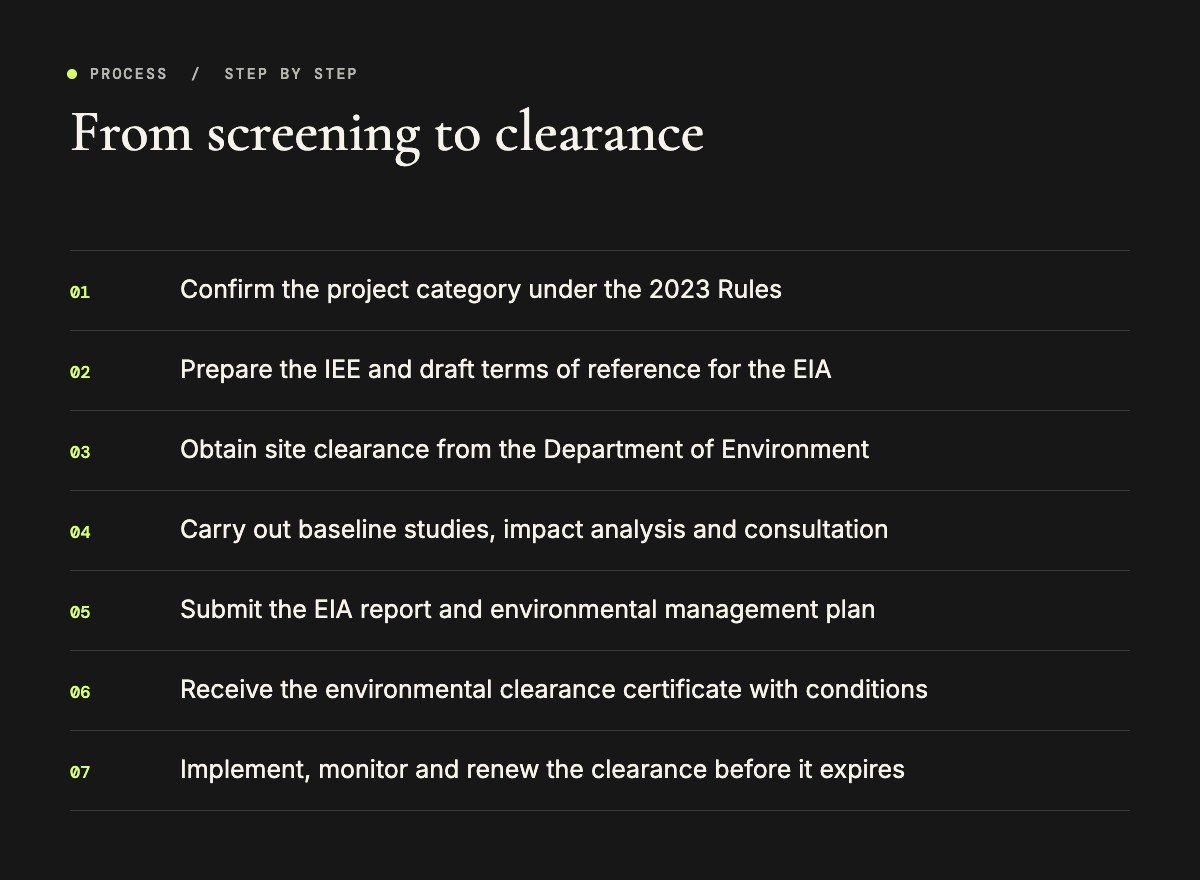
For a red category project, environmental impact assessment in Bangladesh follows a two-stage clearance path. Applications are made through DoE's online clearance system, with supporting documents uploaded and fees paid as the current schedule requires.
- Screening. Identify the activity in the schedules to the 2023 Rules, confirm the category and map sensitive receptors around the site.
- IEE and terms of reference. Prepare an initial environmental examination and a draft terms of reference describing what the full EIA will study and how.
- Site clearance. Apply for site (location) clearance with the IEE, draft terms of reference, land documents, layout plan, local authority no-objection and process description. DoE inspects the site and, if satisfied, approves the location and the terms of reference.
- Baseline and impact studies. Collect baseline data across seasons where needed, model emissions, effluent and noise, assess alternatives and identify mitigation.
- Consultation. Hold meetings with affected communities and local stakeholders, record their concerns and show how the design responds.
- EIA and EMP submission. Submit the EIA report, the environmental management plan, and designs for pollution control such as an effluent treatment plant.
- Environmental clearance. After review and any technical committee meeting, DoE issues the environmental clearance certificate with conditions, or asks for further information.
Site clearance generally permits land development and construction subject to its conditions. Operation should not start until the environmental clearance certificate itself has been issued and the pollution-control systems are built and tested.
What a strong EIA report contains
DoE reviewers and lenders read hundreds of reports on environmental impact assessment in Bangladesh. The ones that move quickly share the same structure and, more importantly, the same discipline: data that is recent and site-specific, impacts that are quantified, and mitigation that is costed.
| Chapter | What reviewers look for |
|---|---|
| Project description | Capacity, processes, raw materials, utilities, layout and construction schedule |
| Legal and policy framework | Correct laws, standards, permits and lender requirements |
| Baseline environment | Measured air, water, soil and noise data, ecology and socio-economic profile |
| Alternatives | Site, technology and design options considered, including no project |
| Impact assessment | Construction and operation impacts, modelled where possible, with significance ratings |
| Mitigation | Specific measures linked to each significant impact |
| Consultation | Who was consulted, what they said and how it changed the project |
| Environmental management plan | Responsibilities, monitoring parameters, frequency, budget and reporting |
| Emergency and risk | Spills, fire, chemical release, flood and community safety |
Common weaknesses
The faults we see most often are baseline data copied from another project, no assessment of cumulative impacts from neighbouring factories, vague mitigation such as "appropriate measures will be taken", and an environmental management plan with no budget or named responsible officer. Each invites a query letter.
Public consultation and community engagement
Meaningful consultation is central to environmental impact assessment in Bangladesh, and DoE's guidance expects it for high-impact projects. In practice, consultation is also the best protection against later complaints, protests and writ petitions.
Start early, while the design can still change. Hold meetings in the local language at times and places accessible to women, farmers and workers. Explain the project plainly, including its risks. Keep attendance sheets, photographs and minutes, and include a summary of concerns and responses in the report.
Where land acquisition or resettlement is involved, coordinate the consultation with the Deputy Commissioner's acquisition process under the Acquisition and Requisition of Immovable Property Act 2017. Communities rarely distinguish between the environmental and land teams, and inconsistent messages damage trust.
Environmental management plan and compliance
The environmental management plan (EMP) is the part of an environmental impact assessment in Bangladesh that lives on after clearance. DoE attaches conditions that reference it, inspectors check against it, and lenders monitor it through covenants.
- Pollution control. Effluent treatment plants, dust control, stack heights and noise barriers designed to meet the standards in the 2023 Rules.
- Monitoring. Parameters, sampling points and frequency for effluent, ambient air, noise and groundwater, with an accredited laboratory.
- Reporting. Periodic monitoring reports to DoE as the clearance conditions require.
- Waste. Handling, storage and disposal of hazardous and solid waste through authorised operators.
- Health and safety. Worker safety and community safety, coordinated with the Department of Inspection for Factories and Establishments and fire service requirements.
Running an effluent treatment plant only during inspections is a well-known enforcement target. DoE can use online monitoring, surprise sampling and complaints. Budget for continuous operation from day one.
Renewal, conditions and changes
Environmental clearance is not permanent, and environmental impact assessment in Bangladesh does not end when the certificate is issued. Apply for renewal before the certificate expires, with up-to-date monitoring results and evidence that the conditions have been met. An expired certificate can block banking facilities, export compliance audits and utility connections.
Keep a conditions register. List every condition in the site clearance and the environmental clearance, assign an owner, and record evidence of compliance. When DoE inspects, a clear register shortens the visit and supports renewal.
If you change the process, capacity, fuel or location of discharge points, tell DoE and seek an amendment. Operating a materially different plant on the old clearance is treated as operating without clearance.
Lenders, economic zones and international standards
Projects financed by development finance institutions, export credit agencies or international commercial banks usually have to meet international standards such as the IFC Performance Standards, the World Bank Environmental and Social Framework or the ADB Safeguard Policy Statement. These go further than the domestic rules on social impacts, labour, resettlement, biodiversity and disclosure.
For financed projects, environmental impact assessment in Bangladesh therefore has two audiences. The efficient approach is a single environmental and social impact assessment designed to satisfy both DoE and the lender. Scope it against the stricter standard, then present the DoE submission in the format the Rules and guidelines expect.
Economic zones and EPZs
Investors in zones run by BEZA or BEPZA deal with the zone authority for many permits, and zones often hold a master environmental clearance for the zone itself. Individual units still need to meet environmental requirements for their own activities, and a zone location does not remove the need for environmental impact assessment in Bangladesh where the unit itself is a red category activity. Confirm with the zone authority which clearances it issues and which remain with DoE. Our guide to business set-up requirements places environmental clearance among the other licences.
Planning the budget and timetable
The most expensive mistake in environmental impact assessment in Bangladesh is starting too late. Developers often commission the study after land is bought, equipment is ordered and financing is signed, and then discover that the site is sensitive or that baseline data must cover a dry and a wet season.
Build the assessment into the project schedule from the feasibility stage. A realistic plan allows time for screening and the IEE, DoE's site inspection and approval of the terms of reference, seasonal baseline monitoring, consultation, drafting, DoE review and responses to queries. Each of those stages can slip, so keep a buffer before the date on which construction or lender drawdown depends on clearance.
What drives cost
Costs depend mainly on the number of disciplines involved, the amount of field monitoring, modelling for air dispersion or hydrology, and the depth of social assessment. Projects that also need to satisfy international lenders typically need additional biodiversity, labour and resettlement work. Ask consultants to price by task so you can see where the money goes.
Contract terms with consultants
Treat the consultant agreement seriously. It should define the scope by reference to the approved terms of reference, require named experts, set out who responds to DoE queries and at what cost, and give the developer ownership of all data. A clean contract makes environmental impact assessment in Bangladesh easier to manage when DoE asks for supplementary studies late in the process.
Enforcement, penalties and challenges
Where environmental impact assessment in Bangladesh is skipped or its conditions ignored, the Environment Conservation Act 1995, as amended in 2010, gives DoE wide enforcement powers. It can enter and inspect premises, take samples, issue directions to stop or correct activities, order closure, require disconnection of utilities and assess compensation for environmental damage. Offences carry imprisonment, fines or both, with higher penalties for repeat offences.
Prosecutions and compensation claims are heard by the Environment Courts established under the Environment Court Act 2010. Directors and officers may face personal exposure where an offence is committed by a company, so environmental compliance belongs on the board agenda.
Appeals and judicial review
A developer aggrieved by a refusal, a condition or a direction can appeal to the appellate authority under the Act within the time the Act allows. Separately, any person aggrieved, including affected residents and public interest groups, may challenge an unlawful clearance in the High Court Division by writ petition under Article 102 of the Constitution. The High Court Division has heard many such challenges. We explain the writ jurisdiction in our guide to writs in Bangladesh.
Frequently asked questions about environmental impact assessment in Bangladesh
Does every factory need a full EIA?
No. Every regulated industrial unit or project needs environmental clearance, but a full EIA is required only for red category projects. Orange projects usually need an IEE, and green and yellow projects follow a simpler route.
Can construction start after site clearance?
Site clearance generally allows land development and construction subject to its conditions. Commercial operation should wait for the environmental clearance certificate. Read the conditions carefully, because some restrict specific works until later approvals.
Who can prepare the EIA report?
The developer appoints consultants to prepare it. DoE expects a competent multidisciplinary team, and lenders often require named experts. The developer remains responsible for the accuracy of the report.
How long does EIA approval take?
It depends heavily on the project, the season for baseline data and the completeness of the file. For a red category project, allow several months from screening to clearance and build that into the project schedule.
What happens if we operate without clearance?
DoE can order closure, disconnect utilities, impose penalties and claim compensation, and the matter can be prosecuted in an Environment Court. Lenders and buyers also treat missing clearance as a serious default.
Can residents challenge our clearance?
Yes. An aggrieved person or a public interest group can file a writ petition in the High Court Division challenging an unlawful clearance. A thorough assessment and genuine consultation are the best defence.
How we can help
We advise developers, investors and lenders on environmental impact assessment in Bangladesh: confirming the category, reviewing terms of reference and draft reports, managing DoE applications and conditions, aligning domestic clearance with lender standards, and defending enforcement actions and writ challenges. Learn more about our environment and ESG practice, or see our guide to obtaining an environmental clearance.
Planning a project that needs DoE clearance?
We review your category, study scope and application strategy before you commit to the timetable, and stay with you through clearance and renewal.
Book a consultationEnvironment and ESG practicePrimary sources: the Environment Conservation Act 1995 and Environment Court Act 2010 on the Laws of Bangladesh portal; the Environment Conservation Rules 2023 (SRO 53 of 5 March 2023) and clearance guidance from the Department of Environment; zone procedures from BEZA.
This article is general information about Bangladeshi law as of 2026 and is not legal advice. Categories, fees, validity periods and procedures change; confirm current requirements with the Department of Environment or a qualified lawyer before acting.




0 Comments