
Property due diligence in Bangladesh is the work a buyer does before paying a single taka: tracing who has owned the land, confirming the seller is the recorded owner, and finding any mortgage, claim or case attached to it. A registered deed alone does not prove good title, so the checking has to happen first.
- A registered deed is evidence of a transfer, not a guarantee that the seller had title. The buyer carries the risk of a defective chain.
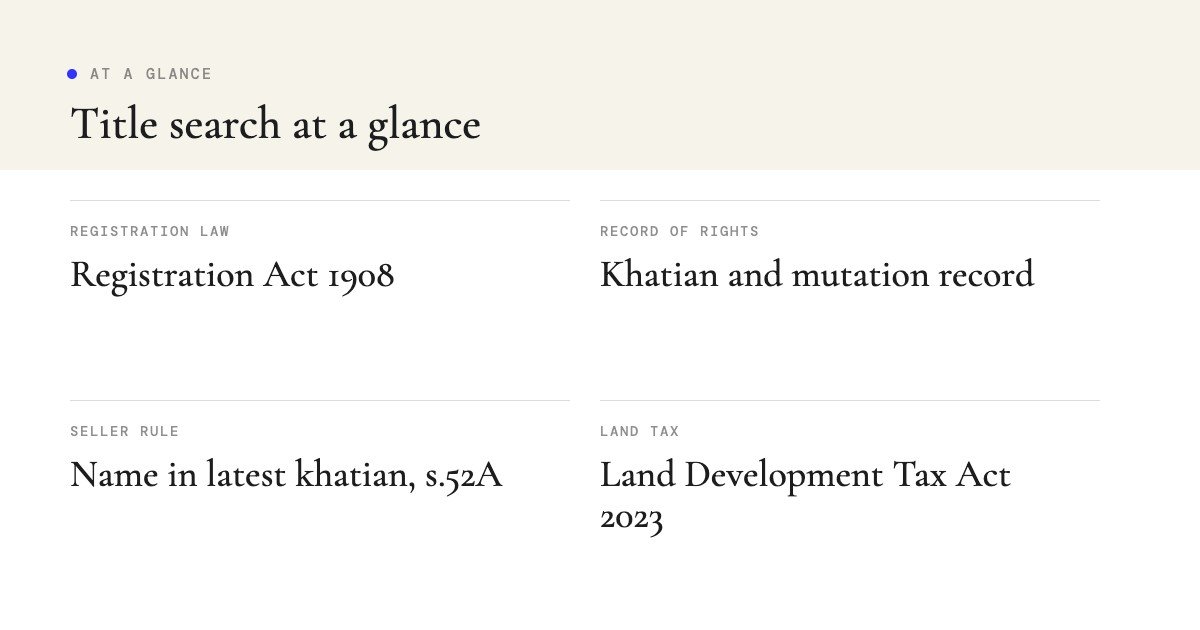
- Under section 52A of the Registration Act 1908, a sale deed cannot be registered unless the seller's name appears in the latest khatian, or the mutation khatian for inherited land.
- Since February 2025, inherited land is mutated jointly in all heirs' names; a single heir usually needs a registered partition deed before selling a defined plot alone.
- Search for mortgages, bank charges, certificate cases, civil suits, vested property listings and acquisition notices before signing anything.
- Forged deeds and selling land without authority are criminal offences under the Land Crime Prevention and Remedy Act 2023, but criminal remedies rarely return your money quickly.
Why property due diligence in Bangladesh matters
Land records in Bangladesh were built up in layers. The Cadastral Survey (CS) of the early twentieth century was followed by the State Acquisition (SA) records, the Revisional Survey (RS) and, in many districts, the Bangladesh Survey (BS) or city survey. Each survey produced its own khatian and its own plot (dag) numbers, and the same piece of land may carry a different number in each.
Ownership then moves between surveys through sale deeds, gifts, heba, inheritance, partition and court decrees. Not every change reaches the record of rights promptly. The result is that the person in possession, the person named in the latest khatian and the person holding the deeds are sometimes three different people.
Registration does not cure that problem, which is why property due diligence in Bangladesh has to happen before the deed, not after. A sub-registrar checks that the deed is properly executed, stamped and supported by the documents the law requires. The sub-registrar does not investigate whether the seller's title is good. If the seller had nothing to sell, the buyer usually receives nothing, and is left with a civil suit and, at best, a criminal complaint.
What a title search is trying to answer
Every check in property due diligence in Bangladesh serves four questions. Does the seller own the land, in full or as a defined share? Is anyone else entitled to it, whether a co-heir, a lender or the government? Can the land lawfully be used for what you intend? And can the transfer be registered and then mutated into your name without objection?
Documents to collect from the seller
Property due diligence in Bangladesh starts with paperwork: ask for copies of everything. A genuine seller will normally provide them; reluctance at this stage is itself information. Originals should be inspected before signing, and certified copies obtained independently from the record room or sub-registry so that you are not relying only on papers the seller hands you.
| Document | What it shows | What to check |
|---|---|---|
| Title deeds (current and previous) | How each owner acquired the land | Unbroken chain, matching plot numbers and areas, registration details |
| CS, SA, RS and BS or city khatians | The recorded owner in each survey | That the chain of deeds connects one record to the next |
| Mutation khatian and DCR | Current recorded owner after mutation | Seller's name, share, plot and area exactly as in the deed |
| Land development tax receipts | Tax paid in the seller's name | Up to date, matching holding number, no arrears |
| Mouza map | Location and boundaries of the plot | Plot exists where the seller says, access road shown |
| Inheritance papers | Who the heirs are and their shares | Warish certificate, family tree, partition deed if any |
| Power of attorney (if used) | Agent's authority to sell | Registered or authenticated, still valid, covers this plot |
| Approvals for developed land | Planning and building consents | Land use clearance, approved plan, occupancy where relevant |
For flats and developer projects, property due diligence in Bangladesh also covers the joint venture agreement between landowner and developer, the developer's registration and the approved building plan. We cover those extra layers in our guide to buying a house in Bangladesh.
Tracing the chain of title
The heart of property due diligence in Bangladesh is the chain of title: a continuous line of lawful transfers from a recorded owner in an earlier survey down to the person now selling. Each link must be a document the law recognises, usually a registered deed, a registered partition, a decree or an inheritance supported by evidence of the family.
Lay the documents out in date order. For each transfer, record the deed number, date, sub-registry, transferor, transferee, plot numbers in each survey, and the area transferred. Then check that the area going out never exceeds the area that came in. Over-selling by a co-sharer is one of the commonest defects we find.
How far back to go
There is no fixed statutory period for property due diligence in Bangladesh. In practice we trace back at least to the SA or RS record and, where the history is unclear, to the CS khatian. The aim is to reach a recorded owner whose title is not in doubt and to account for every share since.
Inheritance links
Inheritance is where chains break. Under Muslim law each heir takes a fixed share on death, and those shares must be accounted for before anyone can sell a specific plot. Check the death of each owner, the full list of heirs, and whether any heir has already sold. A succession certificate is about debts and securities rather than land, so do not mistake it for proof of title; our guide to succession certificates and warish papers explains the difference.
Checking the khatian and mutation record
No step in property due diligence in Bangladesh is more important than the record check. The khatian is the record of rights. It is not conclusive proof of title, but it is strong evidence of possession and ownership, and it now has direct legal consequences for a sale.
Section 52A of the Registration Act 1908 prevents a sub-registrar from registering a sale deed unless the seller's name appears in the latest record of rights, or in a mutation khatian where the seller acquired the land by inheritance. This is a mandatory requirement, not a matter of buyer preference. A seller who says the mutation is pending is telling you the deed cannot yet be registered.
Certified copies of khatians can be ordered online through the eporcha portal, and mutation status can be checked through the Ministry of Land's online services. Compare the online record with the paper copy the seller supplied. Differences in names, shares or plot numbers must be explained before you go further.
A Ministry of Land notification of 11 February 2025 requires inherited land to be mutated jointly in the names of all heirs in one khatian. A separate khatian for one heir is now possible only on the basis of a registered partition deed (bontonnama) or registered compromise deed. If you are buying a defined plot from one heir, insist on seeing that registered partition first.
Reading the khatian properly
Check the owner's name and father's or husband's name, the share column, each plot number and its area, and the land class. A share recorded as a fraction of the whole plot is not the same as a demarcated portion. If the seller holds an undivided share, you are buying an undivided share, and possession of a particular corner depends on the co-sharers' agreement or a partition.
Searching for mortgages, charges and liens
Good title can still be burdened, so property due diligence in Bangladesh always includes an encumbrance search. Before paying, establish whether the land is mortgaged to a bank, charged as security for a company loan, attached in a decree or subject to a certificate case for unpaid public dues.
The standard tool is a search (tallashi) at the sub-registry and district registry covering the relevant mouza and plots. It reveals registered deeds of mortgage, sale agreements and other instruments affecting the land. Ask for the search over a long period, ideally back to the seller's own acquisition, and repeat a short search just before registration.
Bank and company encumbrances
Where the seller is a company, search its charges at RJSC as well. Section 159 of the Companies Act 1994 requires charges to be registered within 21 days of creation, so a properly secured lender will appear there. Where the seller is an individual borrower, ask directly whether the title deeds are held by any bank.
Also ask about money-loan suits under the Artha Rin Adalat Ain 2003 and certificate cases under the Public Demands Recovery Act 1913. A property already attached in such proceedings may be sold only with the court's or the certificate officer's involvement.
Litigation and government interest checks
Property due diligence in Bangladesh must also cover claims that do not appear in any deed. The three that most often surprise buyers are pending civil suits, government land and acquisition proceedings.
Pending civil suits
Ask the seller in writing to confirm that no suit is pending, then verify locally. Partition suits, declaration of title suits and pre-emption claims are common. A sale made while a suit about the same land is pending is subject to the outcome of that suit, so a buyer can be bound by a decree in a case they never knew about. Our overview of civil cases in Bangladesh explains how these suits work.
Khas, vested and public land
Check at the Assistant Commissioner (Land) office and the Deputy Commissioner's office whether the plot is recorded as khas land, government land or public-use land. Also check whether it appears on the published lists under the Vested Property Return Act 2001. Property due diligence in Bangladesh should treat any such listing as a stop sign: land in those categories cannot be bought from a private seller without first resolving the government's position.
Acquisition and requisition
Land within a planned road, railway, economic zone or other public project may be subject to proceedings under the Acquisition and Requisition of Immovable Property Act 2017. As part of property due diligence in Bangladesh, enquire at the DC's land acquisition branch and look for public notices in the area. Once acquisition is notified, private dealings in the land are restricted and compensation goes to the recorded owner.
Physical verification and possession
Paper checks must be matched on the ground; property due diligence in Bangladesh that skips the site visit is incomplete. Many disputes arise because the plot shown on the mouza map is not the plot the buyer was shown.
- Hire a licensed surveyor (amin). Have the plot measured against the mouza map and the deed area, and boundary pillars fixed.
- Confirm possession. Visit at different times. Speak with neighbours and the local union parishad or ward office about who occupies and uses the land.
- Check access. A private path across a neighbour's land is not a legal right of way unless it is granted or established.
- Look for occupants. Tenants, sharecroppers or relatives living on the land must leave or be dealt with before completion.
Land use, planning and ownership limits
Good title to land you cannot use as intended is a poor bargain, so property due diligence in Bangladesh also looks forward to how the land will be used. Check the land class in the khatian, because agricultural land, homestead and commercial land are treated differently for tax, development and conversion.
In Dhaka, the Detailed Area Plan administered by RAJUK controls land use and building height, and a land use clearance is needed before a building plan can be approved. Low-lying land designated as a flood flow zone or wetland may not be filled or built on at all.
Also note the ownership ceiling. The Land Reform Act 2023 retains the limit of 60 standard bighas of agricultural land for a family. A buyer who already holds substantial agricultural land should check that the purchase does not take them over the limit.
Property due diligence in Bangladesh: the step-by-step process
We follow the same order on every matter, so costly steps such as surveying come after cheap checks have ruled out obvious defects.
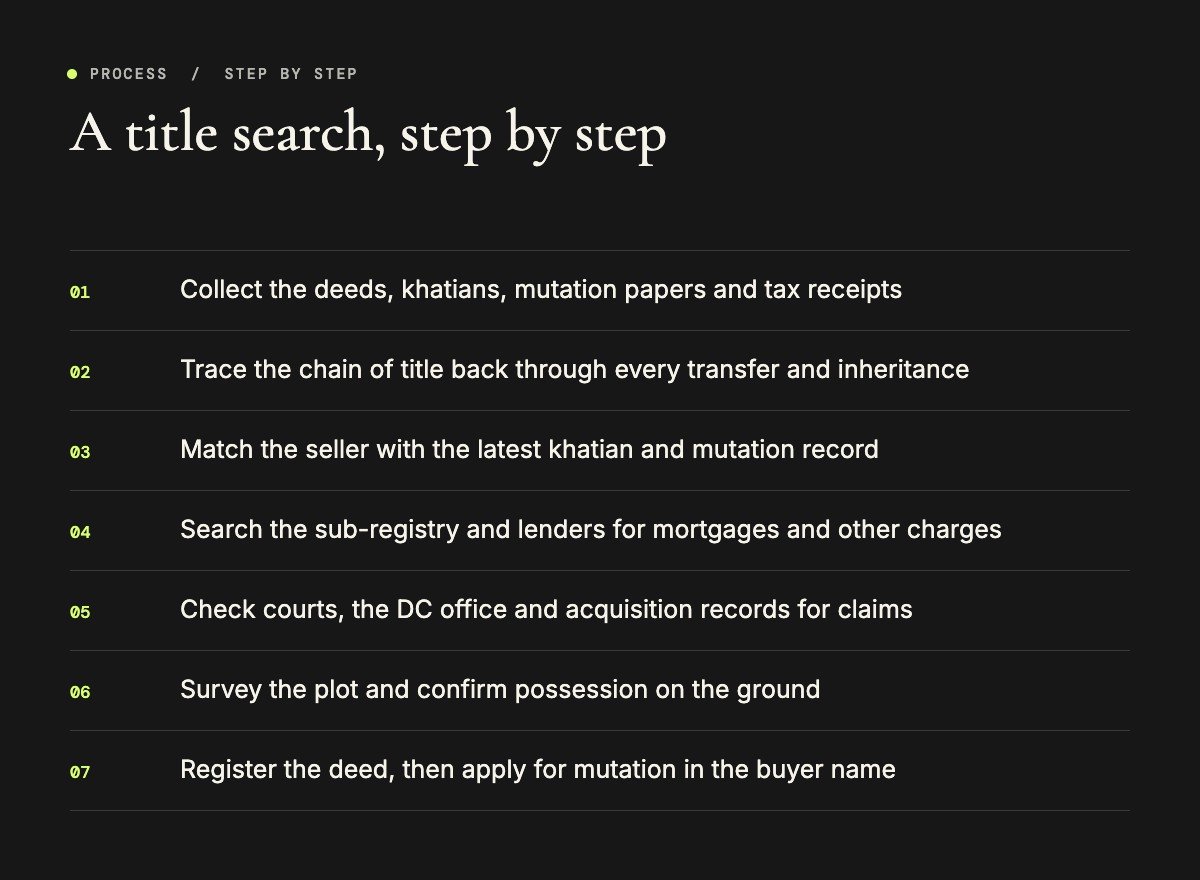
- Initial review. Collect copies of all deeds, khatians, mutation papers, tax receipts and the mouza map from the seller and note any gaps.
- Independent records. Obtain certified khatian copies online or from the record room and certified deed copies from the sub-registry.
- Chain analysis. Prepare a title tree showing every transfer and inheritance, with areas and plot numbers in each survey.
- Encumbrance search. Run the sub-registry search and RJSC search where relevant, and request bank no-objection letters.
- Claims check. Enquire at the AC (Land), DC office and local courts about khas status, vested property, acquisition and pending suits.
- Site survey. Measure the plot, fix boundaries and confirm possession and access.
- Report and contract. Record the findings in a written title report, then negotiate the agreement for sale with conditions and warranties that reflect them.
For a plot with clean records, this work typically takes two to four weeks; inherited land or land with gaps between surveys takes longer.
Special cases: attorneys and non-resident buyers
Sales by attorney
Many sellers abroad act through an attorney. Under the Power of Attorney Act 2012, a power of attorney to sell immovable property must be registered; one executed abroad must be authenticated in the manner the Act and the 2015 Rules prescribe after it arrives in Bangladesh. Check that the power covers this land, has not been revoked and that the donor is alive. Our guide to powers of attorney in Bangladesh covers the formalities.
Non-resident buyers
Bangladeshi nationals living abroad commonly buy through an attorney at home. Property due diligence in Bangladesh matters even more here, because the buyer cannot visit the land. Funds should come through banking channels so the purchase price can be documented for tax and any later repatriation. Foreign nationals and foreign-owned companies face additional regulatory questions and should take specific advice before contracting.
Red flags that should stop a purchase
Some findings in property due diligence in Bangladesh are serious enough to pause the transaction until resolved:
- The seller's name is not in the latest khatian or mutation record.
- The deed area is larger than the area in the khatian or the previous deed.
- Original deeds are "lost" or held by a third party.
- Land development tax has not been paid for years, or is paid in someone else's name.
- Pressure to pay a large advance in cash before documents are shown.
- Someone else is in possession, or neighbours describe a dispute.
- The plot is near a notified project or recorded as khas.
The Land Crime Prevention and Remedy Act 2023 makes it an offence to create a false deed, to transfer land one does not own, or to take payment and refuse to transfer. Those offences are cognizable. They give leverage against a fraudulent seller, but they do not replace careful checking, because recovering money through a criminal case is slow.
Registration and steps after purchase
Once property due diligence in Bangladesh is complete and the agreement for sale is signed, the deed is executed and presented at the sub-registry. The agreement for sale itself must be registered under section 17A of the Registration Act 1908 if you want it to be enforceable.
The registration framework was amended in 2025–26. The Registration (Amendment) Ordinance approved in December 2025 introduced electronic registration, longer time limits for some documents, fuller disclosures in sale deeds and deadlines for registrars to decide appeals. It has since been replaced by the Registration (Amendment) Act 2026. Check the current text on the laws portal before relying on any particular time limit.
After registration, apply for mutation in your name without delay and start paying land development tax through the online LD tax portal. A purchase that is registered but never mutated leaves you exposed when you later want to sell or mortgage. Our land registration guide walks through the registration day itself.
Frequently asked questions about property due diligence in Bangladesh
Does a registered deed prove the seller owned the land?
No. Registration records that a transfer took place in the proper form. It does not confirm the transferor had title. That is why the chain of deeds and the record of rights must be checked independently.
Can I buy land if the seller's mutation is still pending?
Under section 52A of the Registration Act 1908, the sale deed cannot be registered unless the seller is named in the latest khatian or mutation khatian. You can sign an agreement for sale conditional on mutation, but do not pay the full price until it is done.
How do I check for a bank mortgage?
Run a search at the sub-registry for registered mortgage deeds, ask whether original deeds are held by a lender, search RJSC charges if the seller is a company, and obtain a written no-objection or release from any bank involved.
What can I do if I discover fraud after buying?
You may bring a civil suit for declaration and cancellation of the deed, claim the price back, and file a complaint under the Land Crime Prevention and Remedy Act 2023. Act quickly and keep every document and payment record.
How we can help
We carry out property due diligence in Bangladesh for individuals, non-resident buyers, developers and lenders: collecting records, tracing title, running encumbrance and litigation checks, coordinating surveys and preparing a written title report before you commit. We then draft the agreement for sale and manage registration and mutation. Learn more about our real estate practice.
Buying land or a flat?
Send us the seller's documents and we will tell you what is missing, what needs checking and what it will take to complete safely.
Book a consultationReal estate practicePrimary sources: the Registration Act 1908, Land Reform Act 2023 and Land Crime Prevention and Remedy Act 2023 on the Laws of Bangladesh portal; land records and mutation services from the Ministry of Land; certified khatians through eporcha; land development tax via ldtax.gov.bd.
This article is general information about Bangladeshi law as of 2026 and is not legal advice. Land records, fees and procedures change and vary by district; confirm current requirements with the relevant land office or a qualified lawyer before acting.


0 Comments