
Copyright registration in Bangladesh is voluntary, because copyright arises automatically when an original work is created. But when a song is copied, software is cloned or a design appears on a competitor's packaging, a registration certificate from the Copyright Office is often the fastest way to prove who owns the work and since when.
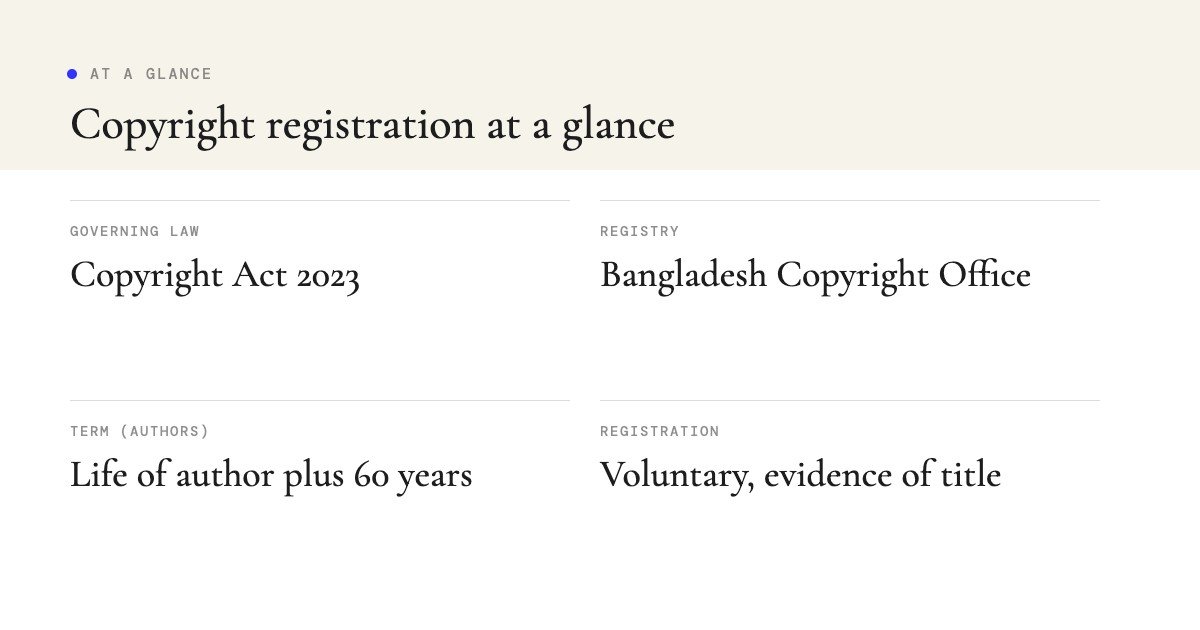
- The Copyright Act 2023 replaced the Copyright Act 2000 and now governs ownership, registration and enforcement of copyright in Bangladesh.
- Registration is not required for protection, but the certificate and the entry in the Register of Copyrights are strong evidence of authorship and ownership in court.
- Applications are filed online with the Bangladesh Copyright Office, followed by signed hard copies and copies of the work within the time the system specifies.
- A waiting period allows third parties to object; contested applications go to a hearing before the Registrar, with appeal to the Copyright Board.
- For most works by individual authors, protection lasts for the author's life plus 60 years.
Why copyright registration in Bangladesh matters
Copyright protects original literary, artistic, musical and dramatic works, films, sound recordings and computer programs. In Bangladesh, as in other Berne Convention countries, protection begins the moment an original work is fixed in some form. No filing, notice or © symbol is needed for the right to exist.
So why consider copyright registration in Bangladesh at all? Because disputes are about proof. When two people claim the same song, script or software, the court has to decide who created it first and who owns it now. A registration certificate, backed by the entry in the Register of Copyrights kept by the Copyright Office, is treated as prima facie evidence of the particulars it records. The other side must then disprove it.
Practical benefits
- Evidence. A dated, official record of authorship and ownership.
- Enforcement. Police, customs and online platforms act faster when shown a certificate.
- Commercial deals. Investors, publishers, broadcasters and licensees often ask for registration before signing.
- Deterrence. A registered work, publicly recorded, discourages copying.
The Copyright Act 2023: what changed
Parliament passed the Copyright Act 2023 to replace the Copyright Act 2000. The new Act keeps the familiar structure, with a Registrar of Copyrights, a Copyright Office under the Ministry of Cultural Affairs and a Copyright Board, but modernises the law for digital content.
The main changes relevant to copyright registration in Bangladesh are:
- Digital works. Clearer coverage of computer programs, databases and works created or exploited online.
- Folklore. Protection for folk songs, folk music and other traditional cultural expressions for the first time.
- Collective management. A framework for collective management organisations that license and collect royalties for music and other rights.
- Accessibility. Exceptions for accessible formats for visually impaired people, in line with the Marrakesh Treaty.
- Enforcement. Tougher penalties, particularly for film piracy, and provision for an enforcement task force.
Rules under the 2023 Act and the Copyright Office's online procedures continue to be updated. Check the current forms and fee schedule on the Copyright Office website before filing.
What can be registered
Copyright registration in Bangladesh is open to any original work that falls within a protected category. Ideas, facts, methods, names and short slogans cannot; brand names belong to trademark law and product shapes usually to design law.
| Category | Examples | What is usually filed |
|---|---|---|
| Literary works | Books, articles, poems, scripts, manuals, website text | Printed or digital copies of the text |
| Computer programs and databases | Software, mobile apps, compiled databases | Description, screenshots and a copy of the source code, as the Office requires |
| Artistic works | Paintings, drawings, logos, photographs, architecture plans | Images or prints of the work |
| Musical works and lyrics | Compositions, songs | Lyrics and notation or an audio recording |
| Sound recordings | Albums, singles, podcasts | Audio files with track details |
| Cinematographic works | Feature films, dramas, documentaries, web series | Copy of the film and details of producer and contributors |
| Dramatic works | Plays, choreography | Script or recorded performance |
Logos: copyright or trademark?
A logo is both an artistic work and, if used in trade, a trademark. Many businesses register the logo as copyright for quick proof of creation and also apply for a trademark with DPDT for brand protection. Our trademark registration guide explains the second route.
Who owns the work and who can apply
The author is normally the first owner of copyright. The exceptions matter when preparing an application, because the applicant must be the owner or someone authorised by the owner.
- Employees. A work made in the course of employment generally belongs to the employer, unless the contract says otherwise.
- Commissioned works. For certain commissioned works, such as photographs, portraits and films made for payment, the commissioning party is generally the first owner, again subject to contrary agreement.
- Assignees. Copyright can be assigned in writing, wholly or partly, for all or some rights, territories and periods. The assignee can register in its own name.
- Foreign authors. As a member of the Berne Convention and the WTO TRIPS Agreement, Bangladesh protects works of foreign nationals from member countries, and they can also register.
Joint authors and co-owners
Where two or more people contribute to a work and their contributions cannot be separated, they are joint authors. For copyright registration in Bangladesh, every joint author should be named in the application, and the shares of ownership should be agreed in writing. A co-owner who is left out is the most likely person to object, and an unresolved co-ownership dispute can stall both the registration and any later licence of the work.
Software companies frequently discover, during due diligence, that code was written by freelancers who never signed an assignment. Fix the chain of title first. Copyright registration in Bangladesh records ownership, but it cannot create ownership that the paperwork does not support.
Documents for copyright registration in Bangladesh
Document requirements for copyright registration in Bangladesh differ by applicant type and category of work. As a working checklist, prepare the following:
Individual applicants
- National ID card or passport and a recent photograph.
- Copies of the work in the format the Office requires.
- A declaration of originality signed by the author.
- If the applicant is not the author, the written assignment or a no-objection certificate from the author.
Companies and other organisations
- Trade licence, certificate of incorporation, memorandum and articles, and TIN certificate.
- Board resolution or authority letter for the person signing.
- Employment contracts or assignments showing how the company acquired the work.
- Power of attorney if filing through a lawyer or agent.
Documents in a language other than Bangla or English should be translated, and documents signed abroad may need notarisation and attestation. Gather everything before you start the online form; incomplete files are the most common cause of delay.
The step-by-step registration procedure
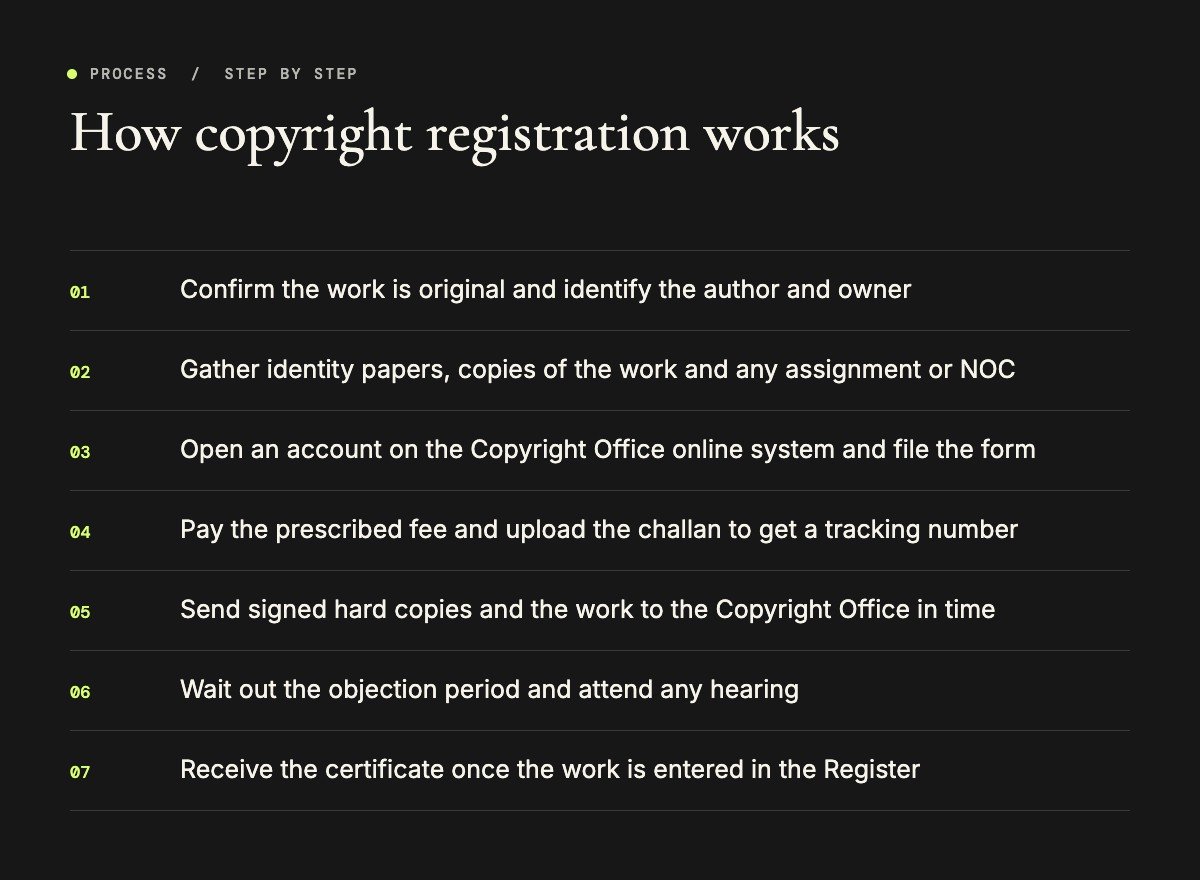
The Copyright Office now takes applications through its online system (bcoecopyright.gov.bd), linked from the official Copyright Office website. The process for copyright registration in Bangladesh generally runs as follows:
- Check originality and ownership. Confirm who the author is, who owns the copyright today and whether any assignment or licence affects the application.
- Prepare documents and copies. Assemble identity and corporate papers, the work itself, the declaration of originality and any assignment or NOC.
- File online. Create an account, complete the application form in Bangla or English and upload the supporting documents and a digital copy of the work.
- Pay the fee. Pay the prescribed government fee, which depends on the type of work, by the method shown on the portal, and upload the payment proof. The system issues a tracking number.
- Submit hard copies. Within the period the system specifies, currently reported as 15 days, send the signed application, payment proof, copies of the work and the originality undertaking to the Copyright Office in Agargaon, Dhaka, by hand or courier.
- Examination and objections. The Office examines the file and allows a waiting period, generally 30 days, for any objection. If someone objects, both sides are heard.
- Registration and certificate. If there is no objection, or the objection is rejected, the particulars are entered in the Register of Copyrights and the certificate is issued.
Filing through a lawyer or agent
Applicants can file themselves, but many use a lawyer or authorised agent, especially foreign owners and companies with several works. The agent files under a power of attorney, handles queries from the Office, tracks the application and represents the owner at any objection hearing. For copyright registration in Bangladesh by an overseas owner, the power of attorney is usually signed abroad, notarised and attested before it is used.
Government fees
The fee is set by the current schedule under the Copyright Act 2023 and its rules, and varies by type of work. Pay only through the official channel shown on the portal and keep the proof, because the hard-copy submission must include it.
Timing varies with workload and the type of work. Practitioners commonly plan for about three to six months from filing to certificate for uncontested applications.
Objections, refusals and appeals
Objections usually come from someone who claims to be the true author, a co-author who was left out, or a publisher or producer who holds an assignment. The Registrar can call for evidence, hear both parties and decide whether to register, refuse or register with corrections.
Applications are also refused for lack of originality, for subject matter that copyright does not protect, for works in the public domain, and for missing or inconsistent information. A refusal is not the end: the applicant can correct defects and refile, or appeal. Appeals against the Registrar's decisions lie to the Copyright Board, and further challenges go to the High Court Division. If you face an objection, treat it like litigation and assemble drafts, emails, metadata and witness statements that prove the history of the work.
Correcting or cancelling an entry
The Register can be rectified if an entry is wrong, for example on application by a person aggrieved by a registration made without their consent. That is why an honest, accurate application matters: a registration obtained on false information can be cancelled and may expose the applicant to liability.
Registering software, apps and databases
Software is protected as a literary work, and copyright registration in Bangladesh is increasingly used by local tech companies and foreign investors to document ownership. Expect the Office to ask for a functional description of the program, screenshots of the interface, details of the version and a copy of the source code, typically on a storage device.
Many companies worry about disclosing source code. Discuss with your lawyer how much code must be deposited and how trade secrets can be protected, for example by depositing identifying portions where the Office permits. Register major versions separately where the changes are substantial, and keep version-control records that prove when each part was written.
Copyright protects code and its expression, not the underlying functionality or algorithm. For technical inventions, consider whether a patent is available; our patent registration guide covers that route.
Music, film and online content
For the music and film industries, copyright registration in Bangladesh has become central to monetising content on streaming platforms. YouTube and other platforms ask rights holders to prove ownership before acting on claims, and a Bangladeshi certificate is persuasive evidence in those processes.
A song usually involves several rights: the lyrics, the composition, the sound recording and the performers' related rights. Each can belong to a different person. Register the right that you actually own, and keep written agreements with lyricists, composers, singers and producers. The 2023 Act's framework for collective management organisations is meant to make licensing and royalty collection more systematic.
Registering a catalogue
Labels, publishers and production houses often hold hundreds of works. Copyright registration in Bangladesh is filed work by work, so prioritise: register the most valuable and most copied titles first, then work through the back catalogue. Keep a master schedule linking each title to its contracts, registration number and certificate date, which buyers and licensees will ask to see in any catalogue sale.
Film producers should register the cinematographic work and keep agreements with the director, script writer, music composer and performers. Film piracy attracts some of the heaviest penalties under the 2023 Act.
Enforcing your rights after registration
Once registered, the owner is in a much stronger position to act. Remedies include:
- Civil action. A suit in the District Court for an injunction, damages or an account of profits, and delivery up of infringing copies.
- Criminal complaint. Infringement is also an offence under the Copyright Act 2023, punishable with imprisonment, fines or both; penalties are heavier for films and repeat offences.
- Border measures. Applications to customs to detain imported infringing goods.
- Online takedowns. Notices to platforms and, where needed, complaints to the authorities to block infringing content.
Building an evidence file
Courts and platforms decide on evidence. Alongside the certificate from copyright registration in Bangladesh, keep dated drafts, source files with metadata, emails sharing early versions, contracts with contributors, and screenshots or test purchases showing the infringement, with dates and URLs. Notarised or witnessed captures of online infringement are harder for the other side to challenge.
Act quickly. Delay can weaken a claim for an interim injunction, and infringing content spreads fast online. Our technology and digital practice regularly handles platform takedowns alongside court action.
Common mistakes to avoid
- Wrong applicant. A company applying for work created by a freelancer with no written assignment.
- Vague description. A title and description so general that the certificate does not clearly identify the work.
- Missing co-authors. Leaving out a co-writer, which invites objections and later disputes.
- Late hard copies. Missing the deadline to submit physical documents after the online filing.
- One filing for everything. Combining separate works, or several software versions, in a single application.
- Relying only on copyright. Ignoring trademark protection for brands and logos used in trade.
Frequently asked questions about copyright registration in Bangladesh
Is copyright registration in Bangladesh mandatory?
No. Copyright arises automatically when an original work is created. Registration is voluntary, but the certificate is strong evidence of authorship and ownership and makes enforcement much easier.
How long does registration take?
Allow for a waiting period of about 30 days for objections, plus examination time. Uncontested applications commonly take around three to six months; contested ones take longer.
How long does copyright last?
For most works by an individual author, the life of the author plus 60 years. For works such as films, sound recordings and works of organisations, the term is generally counted from publication.
Can a foreign company register copyright in Bangladesh?
Yes. Works from Berne Convention and WTO member countries are protected, and foreign owners can register through a local lawyer or authorised agent using a power of attorney.
Can I register a website or app?
Yes. The code can be registered as a computer program, and text, graphics and other content as literary or artistic works. The Office will usually ask for a description, screenshots and source code.
How we can help
We handle copyright registration in Bangladesh for authors, musicians, film producers, software companies and foreign rights holders: checking ownership and assignments, preparing and filing applications, answering objections, and enforcing rights through takedowns, civil suits and criminal complaints. Learn more about our intellectual property practice.
Want to register or protect your work?
We review ownership, prepare the filing and manage the process with the Copyright Office through to certificate.
Book a consultationIP practicePrimary sources: the Copyright Act 2023 on the Laws of Bangladesh portal; filing guidance from the Bangladesh Copyright Office; trademark filings with the Department of Patents, Designs and Trademarks.
This article is general information about Bangladeshi law as of October 2026 and is not legal advice. Forms, fees and procedures change; confirm current requirements with the Copyright Office or a qualified lawyer before filing.




0 Comments