
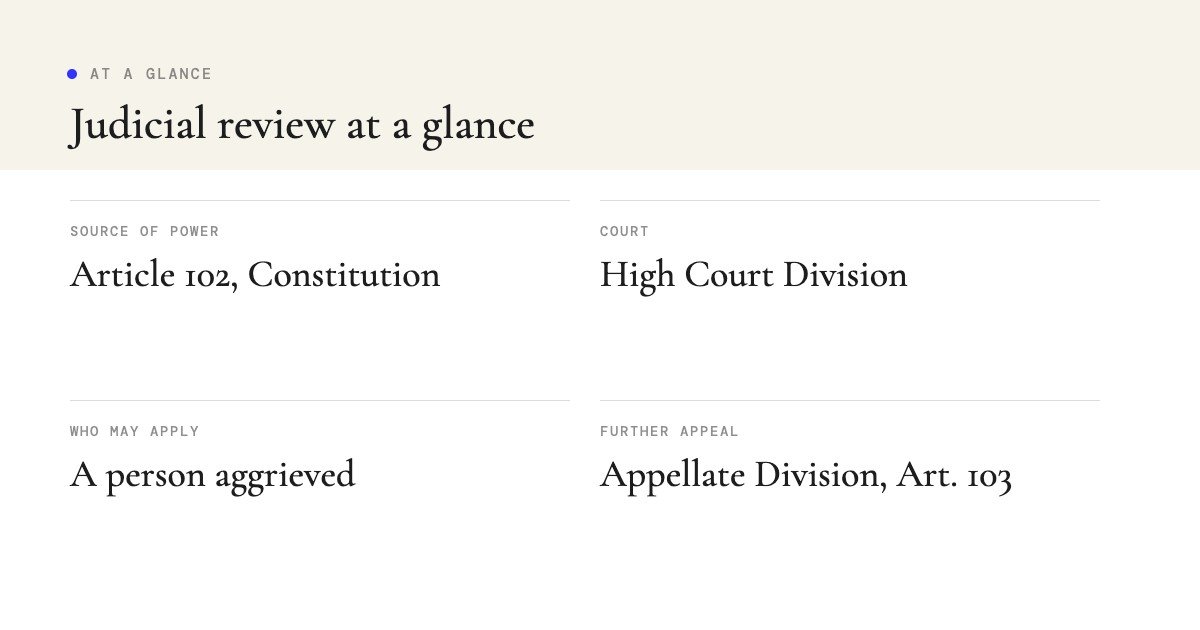
Judicial review in Bangladesh lets a person or business ask the High Court Division to examine whether a government body acted lawfully, fairly and within its powers. Under Article 102 of the Constitution, the court can quash unlawful decisions, compel officials to act and protect fundamental rights.
- Article 102 of the Constitution gives the High Court Division power to review the acts of public authorities and to enforce fundamental rights.
- Judicial review examines how a decision was made, not whether the court would have made the same decision.
- Except for habeas corpus and quo warranto, the applicant must be a "person aggrieved" and must usually show that no other equally efficacious remedy is available.
- There is no fixed limitation period, but unexplained delay can defeat a petition. Move quickly.
- Service matters of public servants generally belong to the Administrative Tribunals under Article 117, not the writ jurisdiction.
What judicial review in Bangladesh is
Judicial review in Bangladesh is the power of the superior courts to check that public power is used lawfully. That power sits with the High Court Division of the Supreme Court and comes directly from Article 102 of the Constitution. Proceedings are brought by a writ petition, which is why practitioners often simply call it "writ jurisdiction".
In judicial review in Bangladesh, the court is not an appeal body. It does not ask whether the minister, regulator or officer made the best decision. It asks whether the decision-maker had power to act, followed a fair procedure, considered the right matters and reached a conclusion a reasonable authority could reach. If not, the court can set the decision aside and, in some cases, direct the authority to decide again according to law.
Why it matters to businesses and individuals
Most people meet public power in ordinary ways: a licence refused, a tender rejected, a bank account frozen, a demand from a tax office, a building plan cancelled, or a name placed on a travel restriction list. Judicial review in Bangladesh is often the only route to an independent court when the statute gives no appeal, or when the authority has acted so far outside its powers that an internal appeal would be pointless.
The constitutional basis: Article 102
Every application for judicial review in Bangladesh starts from Article 102, which has two parts. The first allows the High Court Division, on the application of any person aggrieved, to give directions or orders to any person or authority to enforce the fundamental rights in Part III of the Constitution. The second sets out the classic writs, available where no other equally efficacious remedy is provided by law.
| Writ | What it does | Typical use |
|---|---|---|
| Certiorari | Declares an act or proceeding done without lawful authority and of no legal effect | Quashing a licence cancellation or an unlawful order |
| Mandamus | Directs a public authority to do what the law requires it to do | Compelling issue of a renewal or decision on a pending application |
| Prohibition | Restrains an authority from doing something it is not permitted to do | Stopping a proceeding without jurisdiction |
| Habeas corpus | Requires a detained person to be brought before the court to test the legality of detention | Unlawful arrest or preventive detention |
| Quo warranto | Requires a holder of public office to show by what authority they hold it | Challenging an unlawful appointment |
Article 102(5) defines the bodies amenable to the writs. "Person" includes a statutory public authority, and the jurisdiction covers persons performing functions in connection with the affairs of the Republic. Purely private companies are generally outside it, although bodies created by statute or exercising public functions can be reached. For a fuller description of each writ, see our guide to writs and writ cases in Bangladesh.
Grounds for judicial review in Bangladesh
Courts in Bangladesh draw on the common law grounds developed in England and across South Asia, adapted to a written constitution with enforceable fundamental rights. A strong petition usually relies on more than one ground.
- Lack of jurisdiction. The authority acted without power under its statute, or delegated power it was not allowed to delegate.
- Error of law. The authority misread the statute or applied the wrong legal test.
- Procedural unfairness. The person affected was not given notice, a chance to respond or a fair hearing, contrary to natural justice.
- Irrelevant or ignored considerations. The authority took into account something it should not have, or ignored something it had to consider.
- Unreasonableness. The decision is so unreasonable that no reasonable authority could have made it.
- Malice or improper purpose. The power was used for a purpose other than the one for which it was given, or in bad faith.
- Legitimate expectation. The authority went back on a clear promise or established practice without good reason or a fair process.
- Violation of fundamental rights. The decision infringes a right such as equality before the law, freedom of profession or trade, or protection of property, without lawful justification.
Reasons and the record
Many applications for judicial review in Bangladesh succeed or fail on the paper trail. If the authority gave no reasons, or its reasons do not match the record, that gap often supports an argument that relevant matters were ignored. Obtain every notice, order and piece of correspondence before drafting, and ask in writing for the reasons if none were given.
Who can apply: standing
Except for habeas corpus and quo warranto, which any person may seek, the applicant must be a "person aggrieved". The Appellate Division gave that phrase a broad meaning in Dr Mohiuddin Farooque v Bangladesh (1997), holding that a person or organisation acting bona fide in the public interest can have standing where a public wrong affects many people.
That decision opened judicial review in Bangladesh to public interest litigation on the environment, consumer protection, public health and human rights. For businesses, standing is usually straightforward: a company whose licence, tender, account or property is directly affected is plainly aggrieved. Trade associations can sometimes bring petitions on behalf of members, but a petition brought in the names of directly affected companies is safer.
Public interest standing is not a licence to pursue a private dispute through the writ court. Where a petition is really a commercial quarrel with a competitor, the court may reject it as an abuse, and costs can follow.
Limits on judicial review in Bangladesh
The writ jurisdiction is wide but not unlimited. Before filing, check each of the following.
Alternative remedies
The classic writs are available only where no other equally efficacious remedy is provided by law. If a statute gives an appeal, for example to a tax appellate tribunal or to a review panel under the Public Procurement Act 2006, the court will usually expect it to be used first. The courts have recognised exceptions where the authority acted wholly without jurisdiction, in bad faith or in violation of fundamental rights, or where the alternative remedy is illusory.
Service matters and Article 117
Disputes about the terms and conditions of service of persons in the service of the Republic generally go to the Administrative Tribunals under Article 117 of the Constitution and the Administrative Tribunals Act 1980. The writ court will usually decline such petitions unless the matter falls outside the tribunal's jurisdiction.
Delay
No statute fixes a limitation period for writ petitions, but the court can refuse relief where the petitioner delayed without explanation and others have relied on the decision in the meantime. As a working rule, file within weeks of the decision, not months, and explain any delay in the petition.
Disputed facts and contracts
Judicial review in Bangladesh is decided on affidavits. Where the case turns on seriously disputed facts that need witness evidence, the court may direct the parties to a civil suit. Purely contractual disputes with a public body, such as a claim for unpaid invoices, also usually belong in the civil courts or arbitration, unless a public law element such as arbitrariness in awarding or cancelling a contract is involved.
Common business uses of judicial review
In our experience, the decisions businesses most often bring to judicial review in Bangladesh are these:
| Decision | Typical authority | Usual ground |
|---|---|---|
| Licence refusal, suspension or cancellation | Sector regulators and licensing offices | No hearing, no power, irrelevant considerations |
| Tender disqualification or award | Procuring entities | Breach of procurement rules, arbitrariness |
| Freezing or attachment of accounts | Investigating and revenue authorities | Lack of statutory basis, disproportion, no notice |
| Tax or duty demands | NBR field offices | No jurisdiction, natural justice, limitation |
| Closure or utility disconnection orders | Environmental and local authorities | Procedural unfairness, no prior notice |
| Land acquisition and requisition | Deputy Commissioners | Non-compliance with statutory procedure |
| Travel restrictions and blacklisting | Government agencies | No legal basis, no hearing |
Tax challenges need particular care, because the tax statutes contain detailed appeal routes and the court often insists that they be used. The writ court remains available where the demand is made without jurisdiction or in clear breach of natural justice.
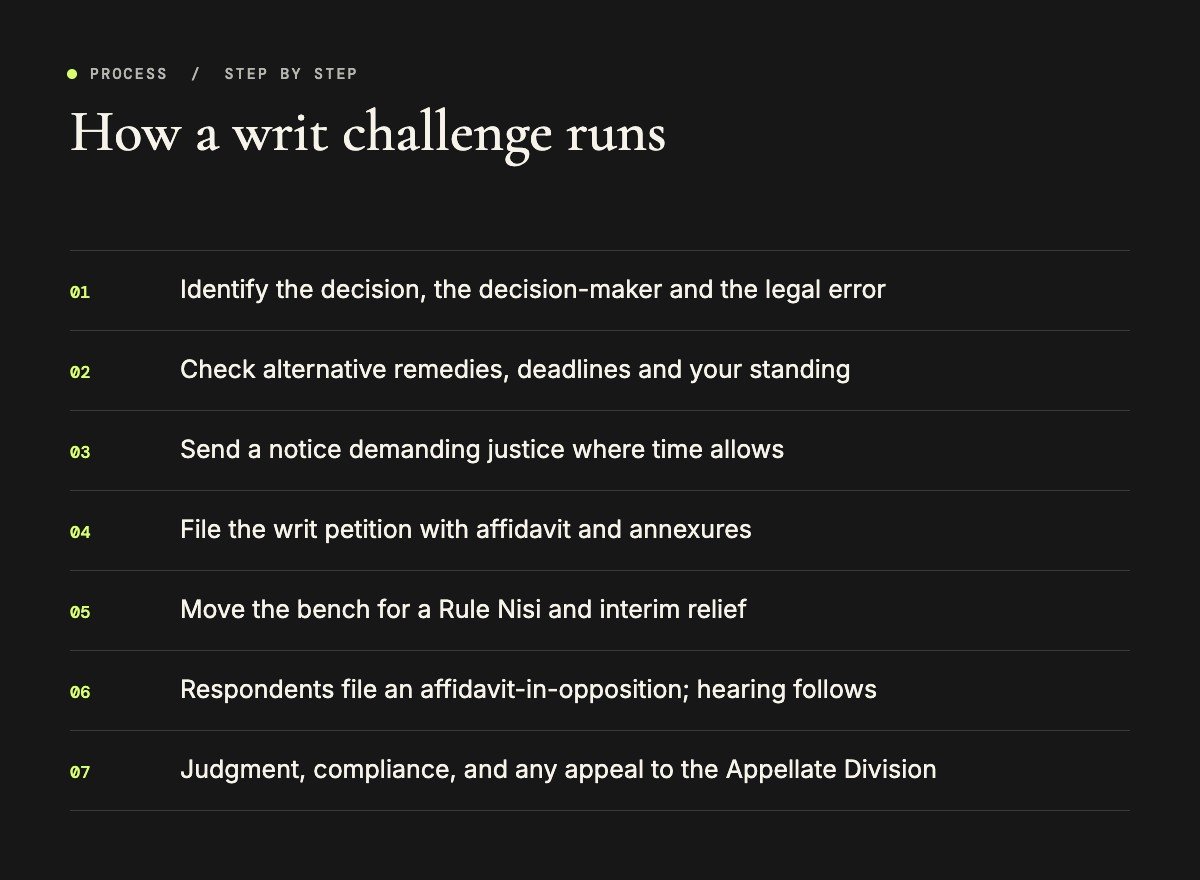
The writ process step by step
Judicial review in Bangladesh follows a well-established sequence in the High Court Division. The Supreme Court's own procedural rules and the Chief Justice's allocation of benches govern the details, so confirm which bench currently hears the type of writ you are filing.
- Assess the case. Identify the exact decision, the authority, the statutory power relied on and the legal errors. Collect every document.
- Check preconditions. Consider standing, alternative remedies, delay and whether Article 117 or another bar applies.
- Notice demanding justice. Where time allows, write to the authority setting out the error and asking it to correct the decision. A refusal or silence strengthens the petition, especially for mandamus.
- Draft and file. Prepare the writ petition, verified by affidavit, with the impugned decision and supporting documents annexed, and file it with the High Court Division.
- Motion hearing. Move the petition before the bench. If the court finds an arguable case, it issues a Rule Nisi calling on the respondents to show cause, and may grant interim relief such as a stay.
- Opposition and hearing. The respondents, represented by the Attorney General's office or their own counsel, file an affidavit-in-opposition. The petitioner may reply, and the Rule is heard.
- Judgment and compliance. The court makes the Rule absolute, granting relief, or discharges it. A party may then seek leave to appeal to the Appellate Division under Article 103.
Interim relief
In judicial review in Bangladesh, a stay or an interim direction can be decisive, because a licence cancelled or an account frozen for a year may destroy the business before the final hearing. Article 102(4) restricts interim orders that could prejudice development work or otherwise harm the public interest unless the Attorney General has been given notice and an opportunity to be heard. Prepare to show urgency, a strong prima facie case and that the balance of convenience favours relief.
Appeals and enforcing the judgment
A party dissatisfied with the High Court Division's decision can file a civil petition for leave to appeal in the Appellate Division within the time fixed by the Appellate Division rules. If leave is granted, the appeal is heard in full. The government frequently appeals adverse writ judgments, so a successful petitioner should plan for that stage too.
Judgments are binding on the authorities named. If an authority ignores an order, the petitioner can apply for contempt under the Supreme Court's constitutional power to punish contempt in Article 108. In practice, a respectful letter enclosing the certified judgment and asking for compliance often resolves matters without contempt proceedings. Our overview of the structure of the Supreme Court explains how the two Divisions relate.
Recent developments to watch
The 2024 to 2026 period brought significant change around the judiciary, with possible consequences for judicial review in Bangladesh. On 9 April 2026 Parliament passed the Supreme Court Judge Appointment (Repeal) Bill 2026, revoking the 2025 ordinance that had set up a judicial appointment council, while saving appointments already made under it. The February 2026 referendum endorsed the July National Charter, which proposes High Court Division benches in each division and stronger guarantees of judicial independence.
Those reforms require constitutional amendments, which were still being worked through at the time of writing. Article 102 itself has not been reported as changed, but where and how writ petitions are heard could change if permanent divisional benches are created. Check the current position before filing outside Dhaka.
Preparing a strong petition
Good judicial review in Bangladesh is won on preparation. The petitions that obtain a Rule and interim relief at the first hearing share a few features:
- A clear target. One identified decision, quoted accurately, with the date and the authority named correctly.
- The statute in front of the judge. The empowering provision and any rules annexed or quoted, showing exactly where the authority went wrong.
- A complete record. Every notice, reply and order in date order, so the bench can see the chronology at a glance.
- Proportionate relief. Relief that the court can realistically grant, such as quashing and remitting for fresh decision, rather than asking the court to make the decision itself.
- Candour. Full disclosure of facts, including unhelpful ones and any parallel proceedings. Concealment can lead to discharge of the Rule.
We also advise clients to keep dealing politely with the authority while the case is pending. A negotiated fresh decision, recorded before the court, is often the quickest and cheapest outcome.
Frequently asked questions about judicial review in Bangladesh
Can a private company be challenged by writ?
Generally no. The writs lie against the Republic, statutory public authorities and persons performing functions in connection with the affairs of the Republic. A private company may be reached only where it exercises public functions under statute.
Is there a time limit for filing?
There is no statutory limitation period, but unexplained delay can lead the court to refuse relief. File promptly and explain any delay in the petition.
Can the court substitute its own decision?
Usually not. The court quashes an unlawful decision and may direct the authority to decide again according to law. It will direct a specific outcome only where the law allows just one lawful answer.
Do I need to appeal within the department first?
Where a statute provides an equally efficacious appeal, the court normally expects it to be used. Exceptions exist where the authority acted without jurisdiction, in bad faith or in breach of fundamental rights.
Can I get a stay quickly?
The court can grant interim relief at the first hearing if the case is urgent and arguable. Where the order may affect development work or the public interest, the Attorney General must first be given notice and a hearing.
Can a public servant challenge a transfer or dismissal by writ?
Usually not. Matters relating to the terms and conditions of service of persons in the service of the Republic generally go to the Administrative Tribunal under Article 117.
How we can help
We advise companies, investors and individuals on judicial review in Bangladesh, from the first assessment of a regulator's decision through the notice demanding justice, the writ petition, interim relief and any appeal in the Appellate Division. We also help clients use statutory appeals and negotiated solutions where they are faster. Learn more about our public and administrative law practice.
Facing an unlawful government decision?
Send us the decision and the correspondence. We will tell you quickly whether a writ, a statutory appeal or a negotiated route is the best next step.
Book a consultationPublic and administrative lawPrimary sources: the Constitution of the People's Republic of Bangladesh and the Administrative Tribunals Act 1980 on the Laws of Bangladesh portal; cause lists, rules and judgments of the Supreme Court of Bangladesh.
This article is general information about Bangladeshi law as of 2026 and is not legal advice. Court practice, bench allocations and constitutional provisions may change; confirm the current position with a qualified lawyer before acting.

0 Comments