
A green bond in Bangladesh raises debt for projects that deliver environmental benefits, such as renewable energy, energy efficiency, clean transport, green buildings, water and waste management or climate adaptation. BSEC approved the country's first green bond in 2021 under its debt securities framework, and Bangladesh Bank has built policies to channel bank and investor funds into sustainable projects. Here is how the legal framework works and what issuers must do.
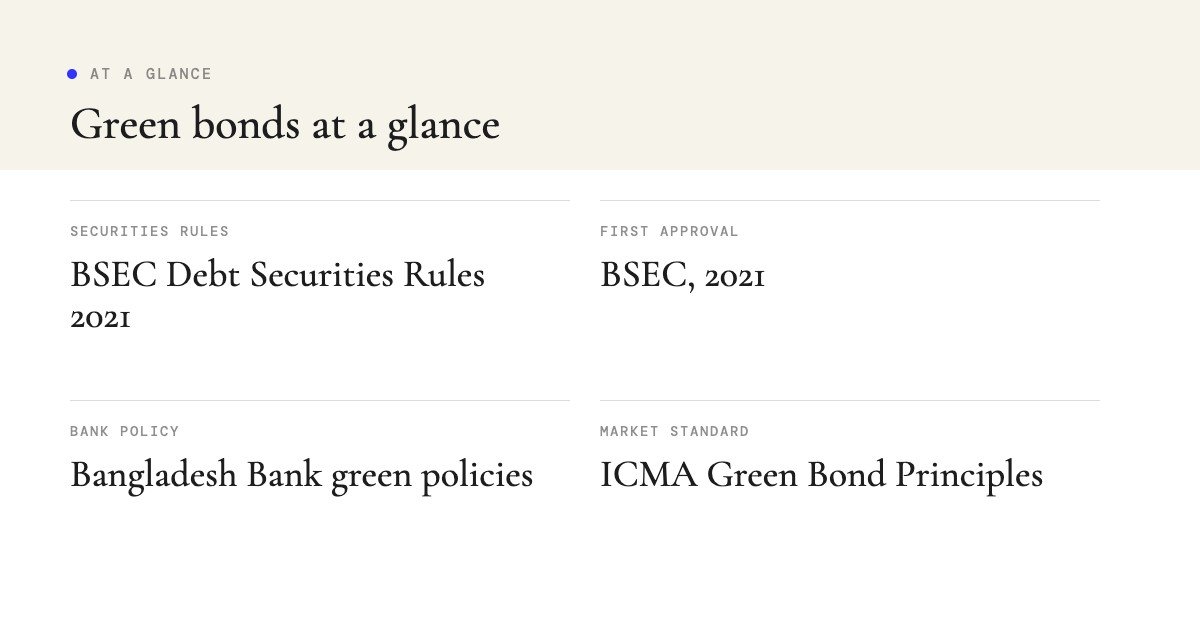
- Green bonds are issued under the BSEC (Debt Securities) Rules 2021, which provide for green and other thematic bonds alongside ordinary bonds.
- BSEC approved the first green bond in Bangladesh in April 2021, and the market remains small but growing.
- Bangladesh Bank's sustainable finance policies and its green bond financing policy for banks and finance companies encourage investment in green bonds.
- Issuers should follow internationally recognised standards such as the ICMA Green Bond Principles, with a green bond framework and external review.
- Use of proceeds, allocation tracking and regular impact reporting are central to credibility and to regulatory compliance.
What a green bond in Bangladesh is
A green bond is a debt security whose proceeds are used exclusively to finance or refinance eligible green projects. Apart from the use of proceeds, it works like any other bond: investors receive interest and repayment of principal according to the terms. What makes a green bond in Bangladesh different is the commitment to allocate funds to green projects, to manage and track the proceeds, and to report to investors on allocation and environmental impact.
Bangladesh faces severe climate risks, including floods, cyclones, salinity and heat, and has large investment needs in renewable energy, efficient industry and climate-resilient infrastructure. Green bonds offer a way to mobilise local and international capital for these needs. Our debt capital markets practice advises issuers and investors on structuring and approvals.
The legal framework
| Source | Role |
|---|---|
| Securities and Exchange Ordinance 1969 and BSEC Act 1993 | Foundation for BSEC's regulation of securities |
| BSEC (Debt Securities) Rules 2021, as amended | Issuance of bonds, including green and other thematic bonds, by public offer or private placement |
| BSEC listing and disclosure rules | Listing on the stock exchanges and continuing disclosure |
| Bangladesh Bank sustainable finance policies | Guidance for banks and finance companies on green finance, taxonomy and investment |
| Bangladesh Bank green bond financing policy | Framework for banks and finance companies investing in and issuing green bonds |
| International standards | ICMA Green Bond Principles and Climate Bonds Standard |
BSEC has consulted on amendments to the Debt Securities Rules, including in 2025, so issuers should check the current version of the rules before structuring a green bond in Bangladesh.
Who can issue
Companies, banks, finance companies, NGOs and microfinance institutions with suitable legal capacity, and government entities, can issue bonds subject to applicable rules. Corporate issuers need BSEC consent under the Debt Securities Rules, whether the bond is offered to the public or placed privately with institutional investors. Banks and finance companies also need Bangladesh Bank clearance where their capital or funding rules are involved. The first green bond approved by BSEC in 2021 was issued by an NGO-microfinance institution, showing that the market is open to a range of issuers.
Eligible green projects
Under international principles and Bangladesh Bank's sustainable finance taxonomy, eligible categories usually include:
- Renewable energy, such as solar parks, rooftop solar and wind.
- Energy efficiency in factories, buildings and equipment.
- Clean transport, including electric vehicles and mass transit.
- Green buildings certified under recognised standards.
- Sustainable water and wastewater management, including effluent treatment.
- Pollution prevention, waste management and recycling.
- Climate adaptation, such as resilient infrastructure and flood protection.
- Sustainable agriculture and land use.
Projects should be clearly defined, with measurable environmental benefits. An issuer of a green bond in Bangladesh should avoid financing activities that are excluded under the taxonomy or that would expose it to accusations of greenwashing.
The green bond framework
A green bond framework is a public document explaining how the issuer will apply the four core components of the Green Bond Principles: use of proceeds, process for project evaluation and selection, management of proceeds, and reporting. It also explains the issuer's environmental strategy and how the bond fits into it. BSEC and investors expect a clear framework, and it forms the basis of the external review.
External review
Most green bond issuers obtain a second party opinion from an independent reviewer confirming that the framework aligns with recognised principles. Some also obtain certification or post-issuance verification. External review is a strong signal to investors and supports the credibility of a green bond in Bangladesh, particularly for international investors.
Write the framework so that it can be applied in practice. Over-ambitious commitments on eligible projects or reporting that the issuer cannot meet create legal and reputational risk. Align the framework with the issuer's actual pipeline and data systems.
Issuing a green bond in Bangladesh: the process
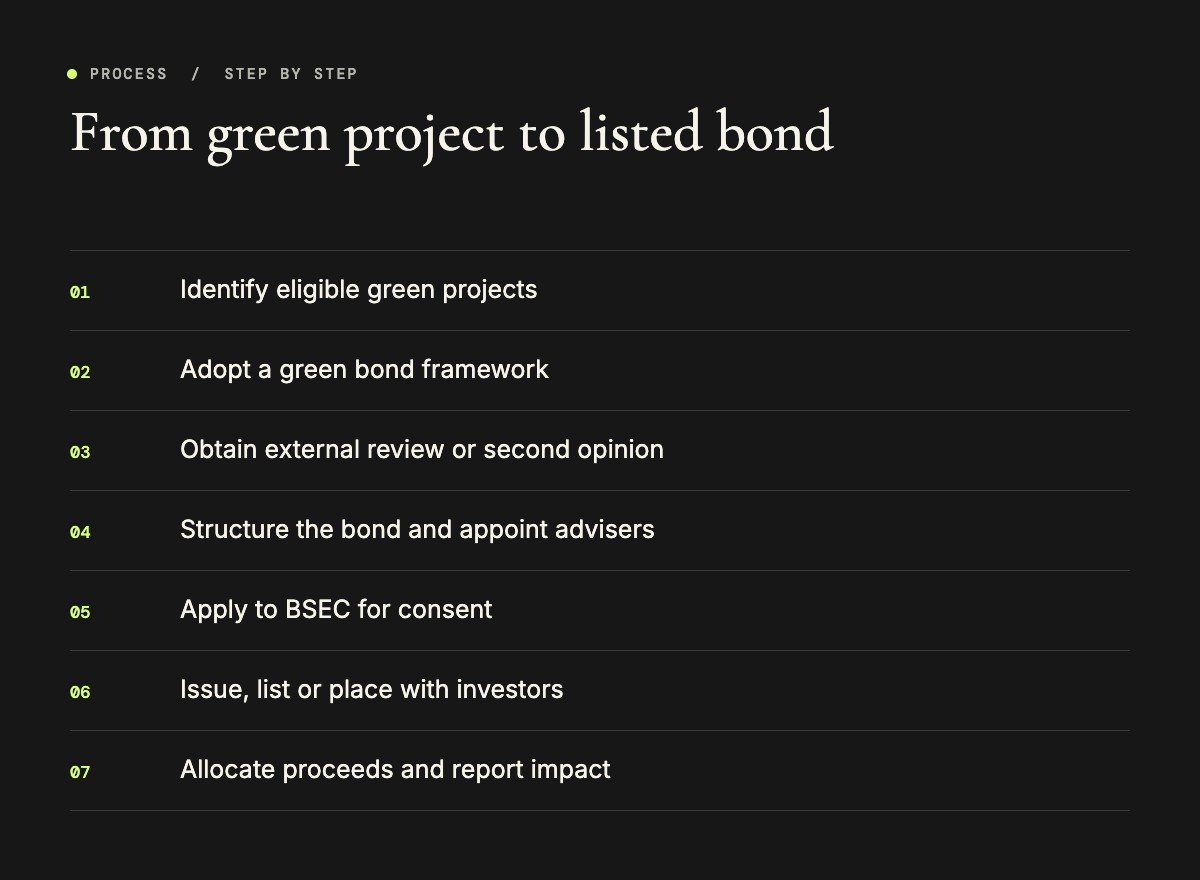
- Project identification. Identify eligible projects and estimate funding needs and environmental benefits.
- Framework and review. Prepare the green bond framework and obtain an external review.
- Structuring. Decide on public offer or private placement, tenor, coupon, security, credit enhancement and rating.
- Appointments. Appoint an arranger, trustee, credit rating agency, legal counsel and, for listed bonds, an issue manager.
- Documentation. Prepare the information memorandum or prospectus, trust deed and subscription agreements.
- Regulatory approvals. Apply to BSEC for consent and obtain any Bangladesh Bank or other approvals required.
- Issuance and listing. Place the bond with investors and list on the stock exchange if planned.
- Post-issuance. Track proceeds, allocate to projects and publish allocation and impact reports.
Investors and incentives
The investor base for a green bond in Bangladesh includes banks, finance companies, insurance companies, mutual funds, provident funds and development finance institutions are potential investors. Bangladesh Bank's green finance policies encourage banks and finance companies to support green projects, including through investment in green bonds, and green finance performance is monitored as part of sustainability reporting. International investors such as development banks and impact funds may invest, subject to foreign exchange rules for portfolio or debt investment.
Tax treatment of bond income follows the general rules of the Income Tax Act 2023, and the government has at times offered incentives for capital market and green investments. Issuers should confirm the current tax position when marketing a green bond in Bangladesh.
Reporting and continuing obligations
After issuance, every green bond in Bangladesh carries continuing duties. Issuers must comply with BSEC disclosure requirements, trustee reporting and listing rules. In addition, green bond issuers should publish allocation reports showing how proceeds have been used and impact reports with indicators such as renewable energy capacity installed, emissions avoided or water saved. Reports should continue until proceeds are fully allocated and, ideally, through the life of the bond.
If proceeds are not used as promised, investors may claim breach of the trust deed or misrepresentation, and BSEC can take regulatory action. Strong internal controls and clear documentation protect the issuer.
Sustainability-linked and social bonds
Besides green bonds, issuers can consider social bonds for projects like affordable housing or financial inclusion, sustainability bonds that combine green and social projects, and sustainability-linked bonds where the coupon depends on meeting sustainability targets. The Debt Securities Rules and international principles accommodate these structures, giving issuers flexibility beyond a pure green bond in Bangladesh.
Greenwashing risk and legal liability
Greenwashing means presenting a bond or project as more environmentally beneficial than it really is. As investor scrutiny grows, so does the legal risk. In Bangladesh, misleading statements in a prospectus or information memorandum can lead to liability under securities laws, BSEC enforcement and civil claims by investors. Outside the securities framework, misleading environmental claims to consumers can also breach consumer protection rules.
To manage this risk, an issuer of a green bond in Bangladesh should use precise language, support claims with data, avoid vague terms such as "eco-friendly" without explanation, disclose risks such as project delays or changes in eligibility, and update investors if circumstances change. Directors should understand the framework they are approving, because they may be personally responsible for disclosures.
Credit rating and credit enhancement
Bonds offered to the public must be rated by a credit rating company registered with BSEC, and many privately placed bonds are rated too because institutional investors require it. A green label does not improve credit quality by itself; investors still assess the issuer's financial strength, cash flows and security. Credit enhancement, such as guarantees from development finance institutions or credit guarantee facilities, can improve ratings and widen the investor base. Several development partners have supported guarantee structures for infrastructure and green finance in South Asia, and such support can make a first green bond in Bangladesh more marketable.
Security, trustees and investor protection
Bonds may be secured by charges over assets, receivables or project accounts, or issued unsecured. A trustee registered with BSEC holds the security and acts for bondholders under a trust deed, monitors compliance with covenants and can take enforcement steps on default. For green bonds, the trust deed and the framework should work together: the trustee may receive allocation reports and confirm that proceeds sit in a designated account or are tracked in the issuer's systems. Charges created by companies must be registered with RJSC within the statutory period to be effective against creditors.
Project finance and green bonds
Large renewable energy and infrastructure projects are usually financed with long-term loans from banks and development finance institutions. Once a project is operating, refinancing those loans through a green bond can lower costs and free bank capacity for new projects. This model, common internationally, is beginning to be explored locally. It requires careful coordination with existing lenders, intercreditor arrangements and power purchase or concession agreements. Our project finance practice advises sponsors on these structures, including refinancing through a green bond in Bangladesh.
Practical tips for first-time issuers
- Start with a realistic pipeline of eligible projects and clear data on their environmental benefits.
- Engage BSEC and potential investors early to understand expectations.
- Budget time and cost for the external review and impact reporting.
- Build internal systems to track proceeds before issuance, not after.
- Keep disclosure accurate and conservative to avoid greenwashing claims.
Costs and timeline
The cost of a green bond in Bangladesh includes the usual bond issuance costs, such as arranger and issue manager fees, legal fees, trustee fees, credit rating fees, BSEC and stock exchange fees and printing, plus green-specific costs for the framework, external review and ongoing impact reporting. For a first issuance, the green-specific costs are a modest share of the total, and they can be offset if the green label attracts a wider investor base or better pricing.
Timelines depend on readiness. An issuer with audited accounts, a clear project pipeline and an existing rating can move from mandate to BSEC application in a few months, with approval and placement following. A first green bond in Bangladesh often takes longer because the framework and review are new to the issuer and to some investors.
Market outlook
The market for a green bond in Bangladesh is still at an early stage compared with regional markets, but several trends support growth: national climate commitments, Bangladesh Bank's sustainability ratings for banks, growing ESG requirements from export buyers and lenders, and the need to finance renewable energy targets. A deeper local bond market, clearer tax incentives and a pipeline of bankable green projects would help further. For issuers that prepare well, a green bond in Bangladesh can diversify funding, signal environmental leadership and connect with a growing pool of sustainable investors at home and abroad.
Frequently asked questions about green bond in bangladesh
Which rules govern green bonds?
The BSEC (Debt Securities) Rules 2021, as amended, together with BSEC listing and disclosure rules and Bangladesh Bank sustainable finance policies.
When was the first green bond approved?
BSEC approved the first green bond in Bangladesh in April 2021.
Is external review mandatory?
Investors and market practice expect it, and it strongly supports credibility. Check current BSEC requirements for the specific issue.
Can banks invest in green bonds?
Yes, and Bangladesh Bank's green finance policies encourage banks and finance companies to support green projects.
What projects qualify?
Renewable energy, energy efficiency, clean transport, green buildings, water, waste, pollution control and climate adaptation, among others.
Can foreign investors buy green bonds?
Yes, subject to foreign exchange rules on portfolio or debt investment and the terms of the issue.
How we can help
We advise issuers, arrangers, trustees and investors on every green bond in Bangladesh: framework drafting, structuring, BSEC and Bangladesh Bank approvals, documentation, listing and post-issuance compliance. Learn more about our debt capital markets practice and our environment and ESG practice.
Planning a green or sustainability bond?
We design a credible framework, secure regulatory consent and prepare documents that investors trust.
Book a consultationDebt capital markets practicePrimary sources: the BSEC (Debt Securities) Rules 2021 and amendments published by BSEC; sustainable finance and green bond policies of Bangladesh Bank; securities laws on the Laws of Bangladesh portal.
This article is general information about Bangladeshi capital markets regulation as of October 2026 and is not legal or investment advice. Rules, tax treatment and policies change; confirm the current position with BSEC, Bangladesh Bank or a qualified lawyer before acting.




0 Comments