
Export financing in Bangladesh keeps the country's factories running between the day an order arrives and the day the buyer pays. Exporters rely on back-to-back letters of credit, pre-shipment credit, bill discounting and Bangladesh Bank refinance schemes such as the Export Development Fund and the Export Facilitation Pre-finance Fund. With IMF-linked reforms reshaping those schemes, exporters need to understand both the products and the legal rules behind them.
- Most export financing in Bangladesh is built on export letters of credit or firm contracts, with back-to-back LCs funding imported inputs.
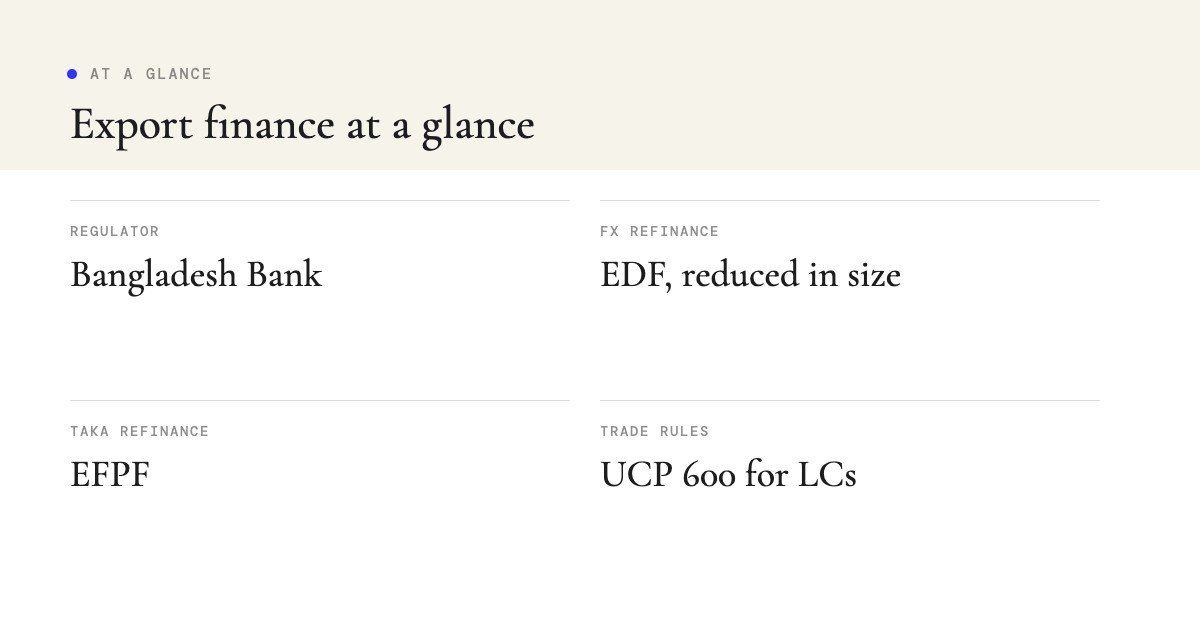
- Bangladesh Bank's Export Development Fund (EDF) provides foreign currency refinance, but it has been reduced in size under IMF programme commitments.
- The taka-based Export Facilitation Pre-finance Fund (EFPF), launched in 2023, supports pre-shipment finance through refinance to banks.
- Export proceeds must be repatriated within the period set by Bangladesh Bank's foreign exchange rules, and overdue proceeds create regulatory problems.
- Lenders take security over export documents, proceeds and assets, so exporters should understand the facility documents they sign.
How export financing in Bangladesh works
Export businesses need funding at each stage: to import raw materials and accessories, to pay wages and utilities during production, to ship goods and to bridge the period until the foreign buyer pays. Banks provide this through trade finance products governed by the Foreign Exchange Regulation Act 1947, Bangladesh Bank's Guidelines for Foreign Exchange Transactions, its circulars on export finance and international rules such as the ICC's UCP 600 for documentary credits.
The ready-made garment sector dominates exports, but leather, pharmaceuticals, agro products, light engineering, jute and ICT services also rely on export financing in Bangladesh. Our trade finance practice advises exporters and banks on structuring and disputes.
Main export finance products
| Product | Stage | How it works |
|---|---|---|
| Back-to-back LC | Input import | Bank opens an import LC for raw materials backed by the master export LC |
| Pre-shipment credit or packing credit | Production | Short-term loan to fund wages, materials and overheads against the export order |
| EDF refinance | Input import | Bangladesh Bank provides foreign currency funds to banks for lending to exporters |
| EFPF refinance | Pre-shipment | Taka refinance to banks for pre-shipment lending to exporters |
| Export bill negotiation or discounting | Post-shipment | Bank pays the exporter against compliant documents before the buyer pays |
| Export factoring | Post-shipment | Receivables purchased or financed, sometimes without recourse |
Exporters in bonded warehouses also benefit from duty-free import of inputs, which interacts closely with export financing in Bangladesh because customs bond rules and LC flows must match.
Back-to-back letters of credit
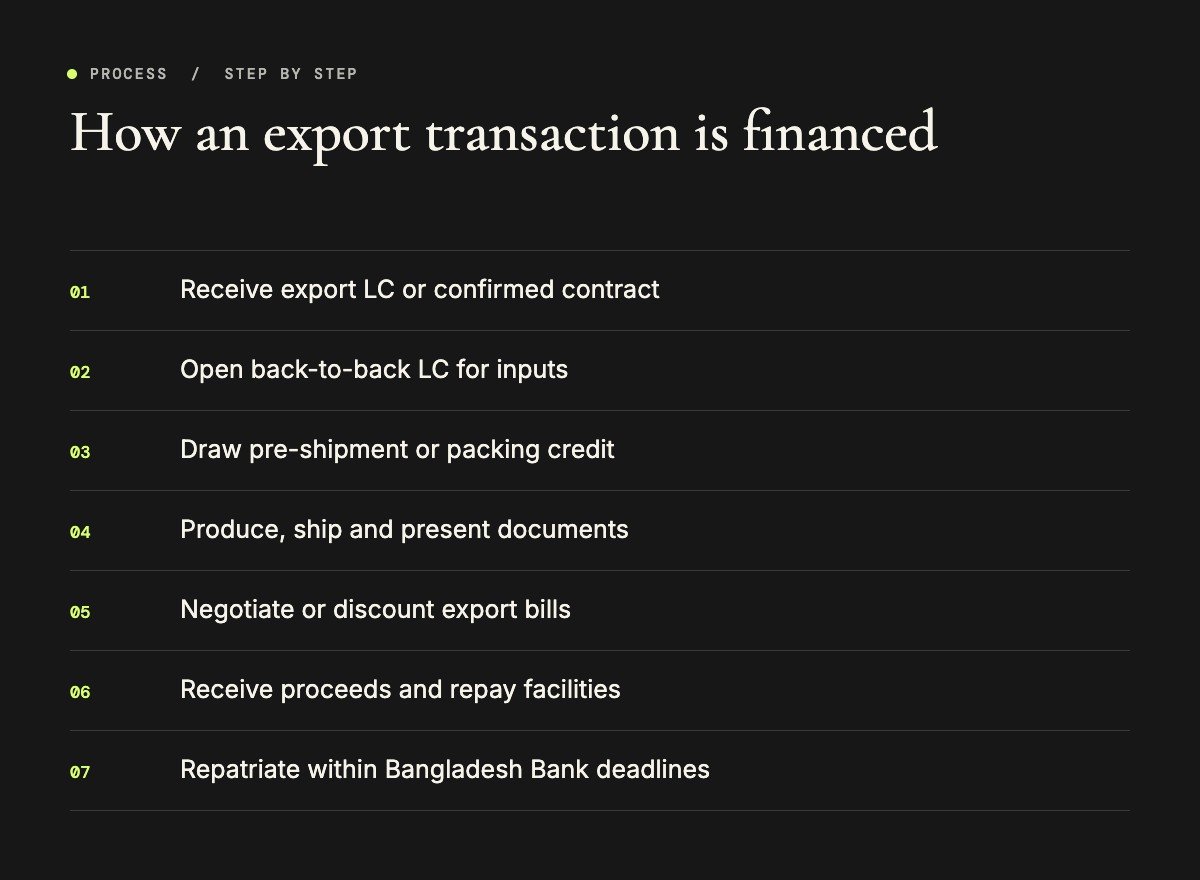
The back-to-back LC is the workhorse of garment export financing in Bangladesh. When a factory receives an export LC from a foreign buyer, its bank opens a second LC in favour of the fabric or accessories supplier, using the export LC as backing. When the exporter ships and the export proceeds arrive, the bank pays off the back-to-back LC. Bangladesh Bank rules limit back-to-back LC value to a percentage of the export LC value, depending on the product and value addition.
Risks arise when the buyer cancels, discrepancies prevent payment under the export LC, or proceeds arrive late, leaving the bank exposed under the back-to-back LC and the exporter liable for forced loans. Careful document handling and buyer due diligence reduce these risks.
The Export Development Fund
The EDF, administered by Bangladesh Bank, provides foreign currency funds to banks at concessional rates for lending to exporters, mainly for importing raw materials under back-to-back LCs. For years it was a major source of export financing in Bangladesh and grew to several billion dollars. Since 2023, Bangladesh Bank has reduced the EDF in line with IMF programme commitments, because the fund was counted against reserves. Access limits, eligible sectors and interest rates have changed several times, so exporters should check current terms with their bank.
The Export Facilitation Pre-finance Fund
To offset the reduction of the EDF, Bangladesh Bank launched the taka-based Export Facilitation Pre-finance Fund in 2023 with an initial corpus of Tk 10,000 crore, and has since adjusted it. Banks lend to exporters for pre-shipment needs and obtain refinance from the fund. Eligibility, interest rates and limits are set by Bangladesh Bank circulars. For many exporters, the EFPF is now a key part of export financing in Bangladesh.
Refinance schemes are frequently revised. Before relying on EDF or EFPF funds in a cash-flow plan, ask your bank for the latest circular and confirm the rate, tenor and limit that apply to your sector.
Repatriation of export proceeds
Bangladesh Bank requires export proceeds to be repatriated within a prescribed period after shipment, generally 120 days unless an extension is approved. Exporters must also submit the EXP form and shipping documents through their bank. Overdue proceeds are reported, can block further export financing in Bangladesh for the exporter and may lead to enforcement under foreign exchange law. Disputes with buyers over quality or late delivery should therefore be resolved quickly, and any extensions or write-offs requested through the bank.
Proceeds are credited partly to the exporter's export retention quota account, as permitted, and the rest converted to taka. Retention quota rules allow exporters to keep a portion of earnings in foreign currency for business use.
Security and facility documents
Banks secure export financing in Bangladesh with a mix of security: lien on export LCs and contracts, assignment of export proceeds, hypothecation of stock and receivables, mortgages over land and buildings, personal guarantees of directors and cash margins. The facility documents set out drawing conditions, covenants and events of default. Charges created by a company must be registered with RJSC under the Companies Act 1994 within the statutory period to be effective against a liquidator and creditors.
Exporters should read facility letters carefully, especially cross-default, set-off and guarantee clauses. When a facility turns into a forced loan or defaults, banks can sue in the Artha Rin Adalat under the Artha Rin Adalat Ain 2003. Our banking and finance practice advises on negotiation, restructuring and recovery.
Documentary credit disputes
Disputes are an unavoidable part of export financing in Bangladesh. Under UCP 600, banks pay against documents that comply with the LC terms, not against the goods. Discrepancies in invoices, bills of lading, inspection certificates or dates can allow the issuing bank to refuse payment. Exporters should check documents strictly before presentation and respond quickly to discrepancy notices. Fraud exceptions and injunctions against payment are narrow in Bangladeshi courts, following international practice, so most disputes are resolved by negotiation, waiver or ICC DOCDEX rather than litigation.
Long-term finance for export industries
Working capital is only part of the picture. Exporters also need long-term funds for machinery, factory buildings and upgrades. Bangladesh Bank has operated long-term financing and green transformation facilities, often supported by development partners, that let banks lend in foreign currency or taka for capital machinery and environmentally friendly upgrades in export industries. Terms, eligibility and availability change, but these facilities are an important complement to short-term export financing in Bangladesh, particularly for factories investing in energy efficiency, effluent treatment and automation.
Capital machinery imports are usually financed through import LCs with deferred payment or term loans. Duty benefits for capital machinery and bonded status for inputs reduce costs, and investors in export processing zones and economic zones receive additional incentives under their zone regimes.
Export credit insurance and guarantees
Buyer insolvency, political events and payment delays can turn a profitable order into a loss. Export credit insurance and guarantees protect against these risks and can make banks more willing to extend export financing in Bangladesh on open account terms. Coverage has historically been limited locally, but international credit insurers, bank-provided guarantees, standby letters of credit and factoring without recourse offer alternatives. Exporters selling on open account to new buyers should consider such protection rather than relying on trust alone.
Open account and supply chain finance
Many large international buyers now prefer open account terms instead of LCs, paying 60, 90 or 120 days after shipment. This shifts risk to the exporter but opens access to buyer-led supply chain finance programmes, where a bank or platform pays the exporter early at a discount based on the buyer's credit rating once the buyer approves the invoice. These programmes can lower the cost of export financing in Bangladesh significantly. Exporters should check that payment periods fit within Bangladesh Bank's repatriation limits and that the programme documents comply with foreign exchange rules, with their bank handling reporting.
Restructuring and stressed exporters
Order cancellations, currency volatility, energy shortages and rising interest rates have put pressure on many exporters since 2022. When repayments become difficult, early engagement with the bank is essential. Bangladesh Bank has from time to time allowed rescheduling and restructuring of loans on special terms, including for export-oriented industries. A restructuring plan should be realistic, supported by order pipelines and cash-flow forecasts, and documented properly so that it complies with Bangladesh Bank loan classification rules. Defaults can lead to classification, loss of access to export financing in Bangladesh, Artha Rin Adalat suits and travel bans on directors, so negotiated solutions are usually better for everyone.
Practical tips for exporters
- Match each back-to-back LC and pre-shipment drawing to a specific export order and track them closely.
- Check export documents strictly against LC terms before presentation.
- Monitor repatriation deadlines for every shipment and request extensions early.
- Keep bonded warehouse records consistent with LC and customs data.
- Review guarantees and cross-default clauses before signing new facilities.
- Diversify banks and buyers to reduce concentration risk.
Following these steps keeps export financing in Bangladesh available when it is needed most and reduces the chance of regulatory or legal trouble.
Services exports and freelancers
ICT companies, BPO providers and freelancers also earn foreign currency, and export financing in Bangladesh increasingly covers services as well as goods. Service exporters must receive payments through banking channels or approved payment platforms, and they may be eligible for cash incentives and retention quota benefits set by Bangladesh Bank. Proper documentation of contracts and invoices is essential to claim these benefits and to show the source of funds when applying for loans.
Frequently asked questions about export financing in bangladesh
What is a back-to-back LC?
An import LC opened for inputs, backed by the exporter's master export LC, and repaid from export proceeds.
Is the Export Development Fund still available?
Yes, but it has been reduced in size under IMF commitments and terms have changed. Check current eligibility with your bank.
What is the EFPF?
A taka-based Bangladesh Bank refinance fund, launched in 2023, that supports pre-shipment lending to exporters.
How long do exporters have to repatriate proceeds?
Generally 120 days from shipment unless Bangladesh Bank allows an extension through the exporter's bank.
What happens if a buyer does not pay?
The bank may create a forced loan against the exporter, and overdue proceeds must be reported. Legal action against the buyer and claims under insurance or guarantees may follow.
Do charges need registration?
Yes. Charges created by companies must be registered with RJSC within the statutory period.
How we can help
We advise exporters, banks and buyers on export financing in Bangladesh: facility documentation, back-to-back LC structures, refinance scheme compliance, repatriation issues, documentary credit disputes, restructuring and Artha Rin Adalat recovery. Learn more about our trade finance practice.
Facing an export finance problem or negotiating new facilities?
We review your facilities and LCs and give you practical options that protect cash flow and relationships.
Book a consultationTrade finance practicePrimary sources: the Foreign Exchange Regulation Act 1947, Companies Act 1994 and Artha Rin Adalat Ain 2003 on the Laws of Bangladesh portal; export finance circulars and refinance schemes of Bangladesh Bank; documentary credit rules of the International Chamber of Commerce.
This article is general information about Bangladeshi export finance as of October 2026 and is not legal or financial advice. Refinance schemes, limits and repatriation rules change frequently; confirm the current position with your bank or a qualified lawyer before acting.


0 Comments