
Getting a business visa in Bangladesh right starts with one question: are you visiting, investing or working? Each purpose has its own category, the B, PI or E-type visa, and choosing the wrong one can mean refused extensions, tax problems or penalties for unauthorised work.
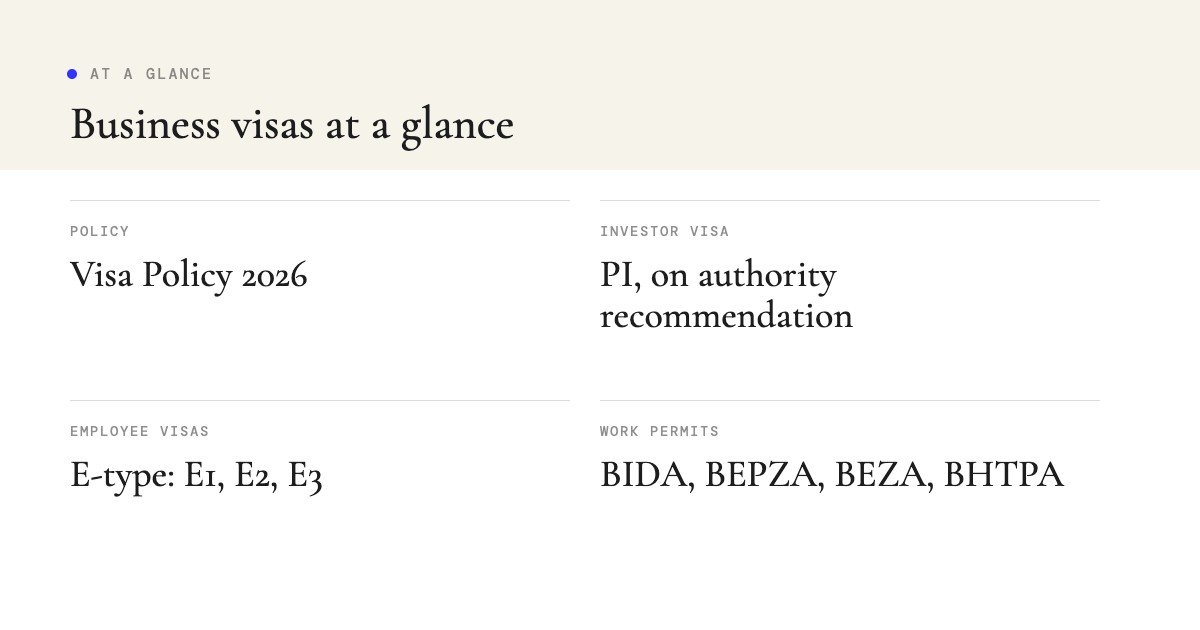
- A new Visa Policy 2026 took effect on 3 September 2026, replacing the Visa Policy 2006 and reorganising visa categories.
- The B visa is for short business visits such as meetings and negotiations. It does not permit employment in Bangladesh.
- The PI visa is for genuine foreign investors and is issued on the recommendation of BIDA or the relevant zone or park authority.
- E-type visas cover employment. Under the 2026 Policy the E category is split into E1, E2 and E3, and holders generally need a work permit.
- Security clearance for work permits moved online through the BIDA One Stop Service portal in late 2025.
Under the Invest Bangladesh Act 2026, effective 23 August 2026, the Bangladesh Investment Development Authority (BIDA), the Bangladesh Economic Zones Authority (BEZA) and the PPP Authority were merged into a single body, Invest Bangladesh. References below to BIDA, BEZA or the PPP Authority should be read as references to Invest Bangladesh. BEPZA continues as a separate authority.
Business visa in Bangladesh: the legal framework
Entry and stay of foreign nationals in Bangladesh are governed by the Foreigners Act 1946, the Passport Act 1920 and the Registration of Foreigners Act 1939, together with the government's visa policy. The policy sets out the categories for every business visa in Bangladesh, who may apply, how long each visa lasts and how it may be extended.
On 3 September 2026 the Ministry of Home Affairs issued an order bringing the Visa Policy 2026 into force and cancelling the Visa Policy 2006. The Cabinet had approved the draft on 10 August 2026. The new policy raises the number of categories from 33 to 34 and groups them into segments, including business and investment, employment, development partners, and family and dependants.
The policy is implemented by the Ministry of Home Affairs and its Security Services Division, the Department of Immigration and Passports, and Bangladesh missions abroad. Investment promotion agencies such as BIDA issue the recommendation letters that investors and employers need for PI and E-type visas.
Older circulars are being withdrawn and replaced, and some missions may take time to update their forms. If you applied before 3 September 2026 or hold a visa issued under the 2006 Policy, check how the transition rules treat your business visa in Bangladesh before the extension falls due.
Choosing the right category
The most common mistake we see with a business visa in Bangladesh is a visitor who arrives on one category and then starts doing work that belongs to another. The purpose of the trip decides the visa. Use the table as a first guide.
| Category | Who it is for | Can the holder work? |
|---|---|---|
| B (business) | Short visits for meetings, negotiations, trade fairs, market and investment research | No |
| PI (private investor) | Foreign investors in wholly foreign-owned or joint venture enterprises | Manages own investment; a work permit is needed for a salaried role |
| E1 | Personnel of development partners | Yes, within the programme |
| E2 | Foreign employees of companies, branch, liaison and representative offices and contractors | Yes, with a work permit |
| E3 | Experts and technicians for installation, maintenance, supervision or inspection | Yes, for the assignment, with the required permission |
| Visa on arrival | Eligible visitors arriving for business, investment or other permitted purposes | No, unless converted |
Dependants of PI and E-type visa holders apply under the family categories. The 2026 Policy splits the old FE dependant category to match E1, E2 and E3.
The B visa for business visitors
The B visa is the business visa in Bangladesh for people who come to do business with Bangladeshi parties rather than to work for them. Typical activities include meetings with buyers and suppliers, contract negotiations, factory and site visits, attending trade fairs and exploring investment opportunities.
Reports on the Cabinet-approved 2026 Policy indicate that the B visa allows a stay of up to 90 days per visit, up from the earlier limit, with multiple entry for up to one year and extension to a maximum of two years. The longer extensions on the same terms that the old policy allowed are reported to have been removed, and the new policy states expressly that B visa holders may not take employment. Confirm the final notified terms with the issuing mission before travel.
What a B visa does not cover
A B visa does not authorise drawing a salary from a Bangladeshi entity, running day-to-day operations of a local company, or working on a project site as a technician. Those activities need a PI or E-type visa and, usually, a work permit. Immigration officers and tax authorities look at what the person actually does, not the label on the invitation letter.
Typical documents
Missions set their own checklists, but an application for a B-category business visa in Bangladesh usually includes:
- Passport with sufficient remaining validity and blank pages.
- Completed visa application form and photographs.
- Invitation letter from the Bangladeshi company or organisation describing the purpose and length of visit.
- Letter from the applicant's employer confirming the business purpose and that costs are covered.
- Evidence of return or onward travel and accommodation.
The PI visa for investors
The PI visa is the business visa in Bangladesh designed for foreign nationals who invest in an industrial or commercial enterprise in Bangladesh, whether wholly foreign-owned or a joint venture with local partners. It lets the investor enter and stay to establish, supervise and protect the investment.
The key document is a recommendation from the authority that regulates the investment. For most companies that is BIDA. Investors in export processing zones obtain it from BEPZA, in economic zones from BEZA, and in hi-tech parks from the Bangladesh Hi-Tech Park Authority. The recommendation confirms that the applicant is a genuine investor in a registered enterprise.
Preparing the PI application
Expect to provide the company's incorporation documents, BIDA or zone registration, evidence of the investment, such as share certificates and the encashment certificate showing inward remittance of capital through banking channels, a short business plan describing activities and local employment, and the investor's passport. Capital that did not come through formal banking channels creates problems for the visa, for later repatriation and for tax.
Under the previous policy, PI visas were commonly issued for up to a year with multiple entry and extended for longer periods while the investment continued. Check how the 2026 Policy sets initial validity and extensions for your case.
Investors who also manage the company
Many foreign investors also serve as managing director and draw a salary. In that case the investor should obtain a work permit as well, so that the salary can be paid, taxed and remitted lawfully. Our foreign direct investment practice regularly advises on structuring that dual role.
E-type visas for employees
E-type visas cover foreign nationals who come to work. They are often loosely called a business visa in Bangladesh, but they are employment visas. The 2026 Policy splits the former E category into three:
- E1 for personnel of development partners, which previously sat largely in the A3 category.
- E2 for foreign nationals employed in Bangladesh by companies, branch, liaison and representative offices, and contractors, including on government projects.
- E3 for experts and technicians who come for machinery or software installation, maintenance, supervision or project inspection.
The first E-type visa normally requires a recommendation letter from the relevant authority: BIDA for most companies, branch and liaison offices, BEPZA, BEZA or the Hi-Tech Park Authority for zone enterprises, and the NGO Affairs Bureau for NGOs. BIDA states that a foreign national must hold a PI, E2 or E3 visa to apply for a work permit.
Plan the employer side first. A company that has not completed its incorporation, registration with BIDA or the zone authority, or opened its bank account cannot obtain the recommendation letter, and the employee's start date slips.
The step-by-step process for a business visa in Bangladesh
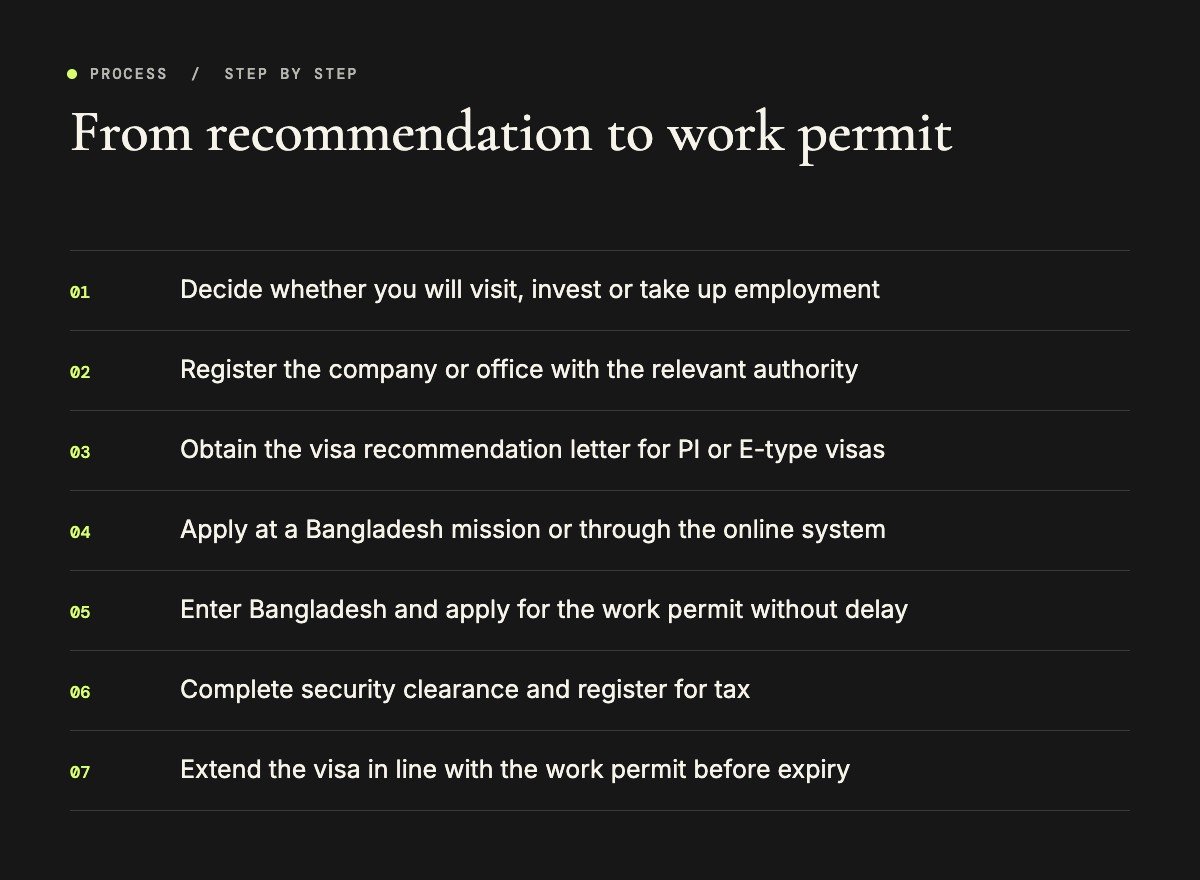
For an investor or employee applying for a business visa in Bangladesh with a view to relocating, the sequence below avoids most delays. Each authority publishes its own document checklist, so confirm the current list before filing.
- Define the purpose. Decide whether the person will visit, invest, manage, or work on a specific assignment, and pick the category accordingly.
- Prepare the entity. Incorporate the company or register the branch or liaison office, and complete registration with BIDA or the zone authority. Our guide to setting up a private limited company covers this stage.
- Obtain the recommendation. Apply online for the PI or E-type visa recommendation letter with the employment contract or investment evidence.
- Apply for the visa. Submit the application at the Bangladesh mission with the recommendation letter, or use the online facility where available.
- Apply for the work permit. After arrival, apply promptly. The long-standing practice is to apply within 15 days of arrival, and delay can complicate the application.
- Security clearance and tax. Security clearance is processed online through BIDA OSS. Obtain a tax identification number and register on payroll.
- Extend on time. Apply for visa extension in line with the work permit validity, well before the visa expires.
Work permits, security clearance and extensions
A work permit is the authorisation to work for a particular employer in a particular role. It is issued by BIDA for most companies and offices, by BEPZA, BEZA or the Hi-Tech Park Authority in their zones, and by the NGO Affairs Bureau for NGOs. Changing employer requires a new permission, and BIDA expects to be notified when a foreign employee starts with a new employer.
Security clearance from the Ministry of Home Affairs is part of the process. In September 2025 the government announced that security clearance for foreign investors and employees would be handled digitally through the BIDA One Stop Service portal, and the online process began in October 2025. Reports state that a complete application not cleared within 21 working days is treated as free of security objection and the visa is extended. Document requirements were also reduced.
Extensions
Visa extensions for work permit holders are now filed online with the supporting documents, including the valid work permit and evidence of tax compliance. Apply early, whatever business visa in Bangladesh you hold. An expired visa, even by a few days, can lead to fines at departure and complications at the next renewal.
Branch, liaison and representative offices
Foreign companies that are not ready to incorporate a subsidiary often start with a branch, liaison or representative office. These offices need prior permission from BIDA, and their staff need the same visa and work permit approvals as employees of a local company. The office's permission letter is one of the first documents an applicant for an employee's business visa in Bangladesh will be asked for.
A liaison or representative office is limited to promotional and coordination activities. It may not earn revenue in Bangladesh, and its expenses must be funded by inward remittances from the parent. A branch office may carry on the business permitted in its approval. Those limits matter for immigration: an employee of a liaison office who starts selling or signing contracts locally is working outside the scope of the office's permission, which puts both the office and the work permit at risk.
Number of foreign staff
Authorities look at whether foreign staff are genuinely needed and whether local hiring and training are planned. Keep a clear organisation chart, job descriptions and a succession plan for each expatriate role. These documents support the first recommendation for a business visa in Bangladesh and make later extensions smoother.
Permissions for branch and liaison offices are granted for a fixed period and must be renewed. Diarise the renewal alongside each employee's work permit and visa, because a lapsed office permission undermines every permit that depends on it.
Visa on arrival and conversion
Nationals of eligible countries arriving for business or investment may be granted a visa on arrival at the port of entry, generally for a short single stay. It is discretionary and not guaranteed, and it is no substitute for a proper business visa in Bangladesh for repeat or longer visits, so a visitor with firm plans should obtain a visa from a mission before travel.
BIDA states that a visa on arrival can be converted to a PI, E2 or E3 visa once the required documents are submitted. Conversion is handled by the Ministry of Home Affairs and has been the subject of complaints about delay, which the authorities said in 2025 they were addressing. For a planned relocation, entering on the correct visa avoids the conversion step entirely.
Tax and foreign exchange for foreign nationals
Holding a business visa in Bangladesh does not settle the tax position. Foreign employees working in Bangladesh are taxable on their Bangladesh-source salary under the Income Tax Act 2023. The employer withholds tax at source, and the employee must hold a tax identification number and file returns as required. Residence status for tax purposes depends on days spent in Bangladesh, so short-term assignees should take advice early.
Employers face consequences under the tax law for engaging foreign nationals without the necessary permission, including restrictions on deducting their remuneration, and penalties may apply. Salary remittances abroad must go through banking channels and are subject to Bangladesh Bank's foreign exchange rules. Rates and thresholds change with each Finance Act, so check the current position with your tax adviser.
For a wider view of the licences a new foreign-owned business needs, see our guide to legal requirements for business set-up.
Common mistakes and how to avoid them
These are the problems we see most often when reviewing a client's business visa in Bangladesh:
- Working on a B visa. Taking a salaried role, or running operations for months, on a business visitor visa.
- Late work permit applications. Waiting weeks after arrival before applying.
- Unregistered capital. Investing through informal channels, so there is no encashment certificate to support the PI visa or later repatriation.
- Changing jobs without permission. Moving to a new employer or group company on the old permit.
- Overstaying. Letting the visa lapse while an extension or conversion is pending, without a receipt or permission.
- Ignoring dependants. Family members arriving on tourist visas instead of the correct dependant category.
Each of these can usually be fixed if caught early. They become expensive when discovered at departure, in a tax audit or at the next extension.
Frequently asked questions about business visa in Bangladesh
Can I work in Bangladesh on a B visa?
No. The B visa covers business visits such as meetings and negotiations. The 2026 Policy states expressly that B visa holders may not take employment. Salaried work requires an E-type or PI visa and, usually, a work permit.
Is there a minimum investment for a PI visa?
The visa rules focus on whether the applicant is a genuine investor in a registered enterprise, as certified by BIDA or the relevant zone authority. Sector rules and the authority's own requirements may set expectations, so discuss the amount and structure with your adviser before applying.
Do PI visa holders need a work permit?
An investor overseeing their own investment may not, but an investor who takes a salaried role such as managing director should obtain a work permit so the salary can be paid, taxed and remitted lawfully.
How soon after arrival should I apply for a work permit?
Promptly. The long-standing practice is to apply within 15 days of arrival on an E-type or PI visa. Have the employer's documents ready before you travel.
Can a visa on arrival be converted?
BIDA states that a visa on arrival can be converted to a PI, E2 or E3 visa once the required documents are submitted. Conversion takes time, so entering on the correct visa is better.
Does the Visa Policy 2026 affect my existing visa?
A business visa in Bangladesh issued before 3 September 2026 normally remains valid for its stated term, but extensions after that date follow the new policy and categories. Check the transition position before your next extension.
How we can help
We advise investors, employers and expatriates on the right business visa in Bangladesh, prepare PI and E-type recommendation applications, handle work permits, security clearance and extensions, and align the immigration position with tax and foreign exchange rules. Learn more about our immigration law practice.
Bringing investors or staff to Bangladesh?
Tell us who is coming and what they will do. We will map the visa, recommendation and work permit route and the timeline before anyone books a flight.
Book a consultationImmigration law practicePrimary sources: visa recommendations and work permits from BIDA; visa extensions and passports from the Department of Immigration and Passports; zone procedures from BEPZA; mission information from the Ministry of Foreign Affairs.
This article is general information about Bangladeshi law as of 2026 and is not legal advice. The Visa Policy 2026 is new and its implementing circulars, fees and processing rules may change; confirm current requirements with the relevant mission, authority or a qualified lawyer before acting.

0 Comments