
Japanese investment in Bangladesh rests on three pillars: a dedicated economic zone at Araihazar, a 1998 investment treaty and a 1991 tax treaty, and since February 2026 a signed Economic Partnership Agreement. With BIDA and BEZA now merged into Invest Bangladesh, the approval route has also changed. This guide explains how Japanese companies set up, operate and protect their investment.
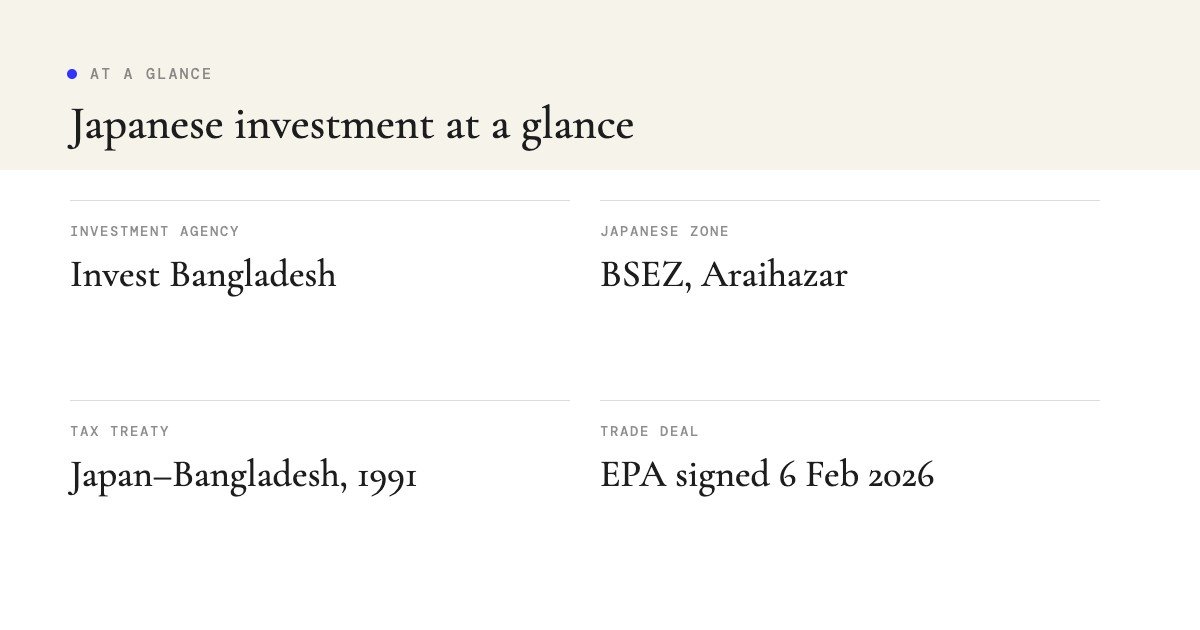
- Since 23 August 2026, Invest Bangladesh has replaced BIDA, BEZA and the PPP Authority as the single investment agency; existing registrations and services continue.
- The Bangladesh Special Economic Zone at Araihazar, Narayanganj, is a government-to-government zone for Japanese and other investors, developed by a company majority-owned by Sumitomo Corporation with BEZA as minority shareholder.
- Japan and Bangladesh signed their first Economic Partnership Agreement on 6 February 2026; check whether it has entered into force before relying on its tariff or investment terms.
- Under the 1991 tax treaty, Bangladeshi tax on dividends to a Japanese company holding at least 25% of the voting shares for six months is capped at 10%.
- Equity can be brought in and dividends repatriated without prior Bangladesh Bank approval, provided each step is reported through the bank.
Why Japanese investment in Bangladesh is growing
Japan has long been one of Bangladesh's most important development partners. JICA finance has supported landmark infrastructure such as the Dhaka Metro Rail and the Matarbari power and port complex. Private Japanese companies have followed, attracted by a large workforce, a growing consumer market and a strategic position between South and South-East Asia.
Today Japanese investment in Bangladesh covers garments and textiles, automobiles and motorcycles, electronics, chemicals, logistics, trading and increasingly IT services. Many investors start with a liaison or branch office, then move to a subsidiary and a factory once the market is proven.
The policy framework
Foreign investors are protected by the Foreign Private Investment (Promotion and Protection) Act 1980, which guarantees fair treatment, protection against expropriation without compensation and the right to repatriate capital and profits. Most sectors are open to 100% foreign ownership, although regulated sectors such as banking, insurance, telecommunications and media have their own licensing and ownership rules.
Invest Bangladesh: the new approval authority
The Invest Bangladesh Act 2026 merged the Bangladesh Investment Development Authority (BIDA), the Bangladesh Economic Zones Authority (BEZA) and the Public-Private Partnership Authority into a single body, Invest Bangladesh, under the Prime Minister's Office. It began work on 23 August 2026. Existing investment services continue, and the BanglaBiz platform remains the digital one-stop service for applications.
For Japanese investment in Bangladesh, this means one agency now handles investment registration outside the zones, economic zone approvals, work permits for foreign staff, approval of foreign loans and approval of certain royalty and fee remittances. The Bangladesh Export Processing Zones Authority (BEPZA) continues to administer export processing zones separately.
Approvals issued in the name of BIDA or BEZA before the merger remain valid. When you renew or amend them, expect the new forms and letterhead of Invest Bangladesh, and update the authority's name in contracts and bank documents.
Support for Japanese investors
BIDA set up a dedicated desk for Japanese investors, and the Japan External Trade Organization (JETRO) and the Japan-Bangladesh Chamber of Commerce and Industry in Dhaka are active sources of practical help. Check with Invest Bangladesh how the Japan desk operates after the merger.
The Japanese economic zone at Araihazar
The Bangladesh Special Economic Zone (BSEZ) at Araihazar in Narayanganj district, about an hour from Dhaka, was developed under a government-to-government arrangement between Bangladesh and Japan. It covers about 1,000 acres in two phases of roughly 500 acres each.
The zone is the flagship of Japanese investment in Bangladesh. It is developed and operated by a joint company in which Sumitomo Corporation, nominated by the Japanese government, holds 76% and BEZA (now part of Invest Bangladesh) holds 24%, with JICA also participating. Phase one has been built and plots handed over; a December 2025 news report said about eight companies were operating there, including the Bangladeshi company Singer.
The same report noted criticism from the Economic Relations Division of the ownership terms and delays in off-site infrastructure, a proposed extension of the infrastructure deadline to June 2027, and a JICA loan for phase two still under discussion. Investors should ask the zone developer for the current status of utilities, gas and road access before committing.
How investing in the zone works
A company that sets up in the zone signs a land lease or sub-lease with the zone developer and registers with the zone authority, now Invest Bangladesh. Zone investors benefit from one-stop services for approvals within the zone, and from the fiscal and non-fiscal incentives available to economic zone enterprises under the Bangladesh Economic Zones Act 2010 and the related tax and customs notifications.
Incentives such as tax holidays and duty-free import of capital machinery are set by NBR notifications and change over time. Confirm the current package for your sector with Invest Bangladesh and your tax adviser before finalising the business plan.
Choosing a structure for Japanese investment in Bangladesh
The right vehicle depends on what the Japanese company wants to do in Bangladesh. The table compares the main options.
| Vehicle | Best for | Key approval | Limits |
|---|---|---|---|
| Liaison office | Market research and liaison with the parent | Invest Bangladesh permission | Cannot earn local income |
| Branch office | Project work, trading or services for the parent's contracts | Invest Bangladesh permission and RJSC filing | Parent fully liable; stricter remittance rules |
| Private limited company | Manufacturing, sales and long-term operations | RJSC incorporation and Invest Bangladesh registration | Full corporate compliance |
| Joint venture company | Partnering a Bangladeshi group for market access | As for a company, plus a shareholders agreement | Governance and exit need careful drafting |
| Zone enterprise | Export-oriented or large manufacturing | Zone lease and Invest Bangladesh or BEPZA registration | Zone rules on sales into the domestic market |
For most manufacturing-led Japanese investment in Bangladesh, a wholly owned private limited company is the usual choice. Our guide to the company formation process explains incorporation with RJSC in detail.
Joint ventures with Bangladeshi partners
Japanese companies often prefer to start with a trusted local partner. A joint venture needs articles of association and a shareholders agreement that deal with board control, reserved matters, technology licensing, deadlock and exit, and that reflect the Japanese parent's internal approval process.
Step-by-step approvals
The sequence below reflects a typical manufacturing project and the approvals that Japanese investment in Bangladesh usually needs. Timelines vary by sector and location, so build in contingency.
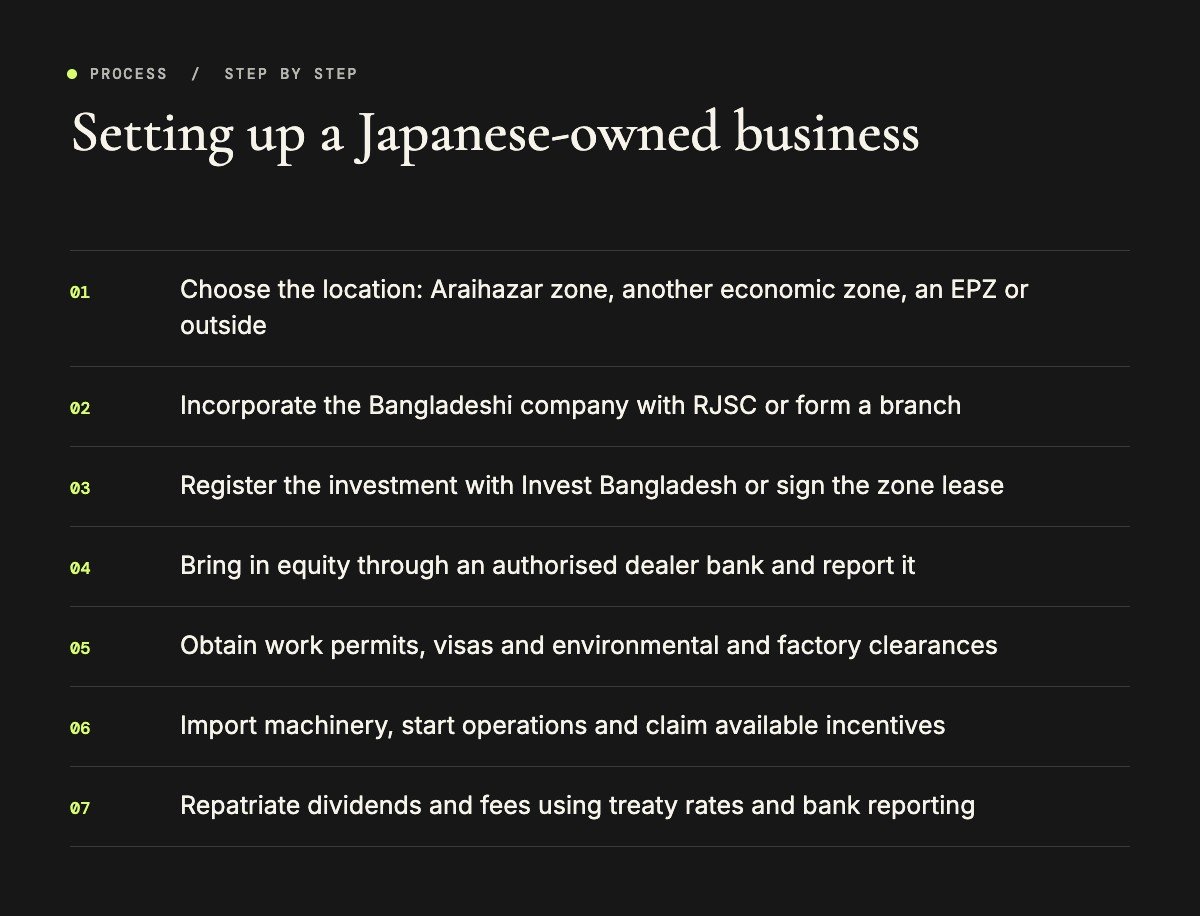
- Choose the location. Decide between Araihazar, another economic zone, an export processing zone or a site outside the zones. This decides which authority you deal with and which incentives apply.
- Incorporate the company. Clear the name and register the memorandum and articles with RJSC. Documents signed in Japan are normally notarised and attested by the Bangladesh Embassy in Tokyo.
- Register the investment. Register with Invest Bangladesh through BanglaBiz, or complete the zone registration and sign the lease with the developer.
- Bring in equity. Remit share capital through an authorised dealer bank, or import capital machinery as equity. Shares must be issued against funds actually received, and the bank reports the issue to Bangladesh Bank.
- Obtain permits for people. Apply for work permits for Japanese managers and engineers, followed by the appropriate visa under the Visa Policy 2026.
- Obtain site clearances. Secure environmental clearance under the Environment Conservation Rules 2023, fire and building approvals, and the factory licence from the Department of Inspection for Factories and Establishments.
- Start and stay compliant. Register for tax and VAT, file returns, keep statutory registers and renew licences on time.
For the environmental step, see our guide on how to get an environment licence in Bangladesh.
Tax treaty benefits for Japanese investors
The Agreement between Japan and Bangladesh for the avoidance of double taxation, signed in 1991, reduces Bangladeshi withholding tax on payments to Japanese residents. According to the PwC worldwide tax summary for Bangladesh reviewed in July 2026, the treaty caps are as follows.
- Dividends. 10% where the beneficial owner is a company holding at least 25% of the voting shares for the six months before the distribution; 15% otherwise.
- Interest. 10%.
- Royalties. 10%.
The domestic withholding rate on dividends to a non-resident company is higher, so a Japanese parent with a substantial holding should claim the treaty rate with a certificate of residence from the Japanese tax authority. This is one reason why direct Japanese investment in Bangladesh, without an intermediate holding company, can be more efficient for dividends than holding through a third country.
Transfer pricing
The Income Tax Act 2023 requires transactions between a Bangladeshi company and its Japanese parent or affiliates, such as purchases of components, royalties and service fees, to be priced at arm's length and documented. Japanese groups used to strict documentation at home usually adapt easily, but the Bangladeshi file must be prepared locally.
The 2026 Economic Partnership Agreement
On 6 February 2026, Japan and Bangladesh signed an Economic Partnership Agreement in Tokyo, Bangladesh's first such agreement with any country. According to reports at signing, Japan will give duty-free access to 7,379 Bangladeshi tariff lines, including garments, while Bangladesh will give duty-free or preferential access to 1,039 Japanese products, with its tariff cuts phased in over time. The agreement also covers services, investment and related rules.
The EPA takes effect only after both countries complete their domestic procedures. We have not been able to confirm an entry-into-force date, so check the current status with the Ministry of Commerce before pricing a contract on EPA tariffs. For Bangladesh, the agreement matters because its least developed country preferences in Japan would otherwise be affected by graduation, which the UN has been asked to defer to November 2029.
Preferential tariffs under the EPA will depend on meeting its rules of origin. Japanese buyers sourcing from Bangladesh should review their supply chain and origin documentation now rather than after entry into force.
Protecting Japanese investment in Bangladesh
Japanese investment in Bangladesh enjoys protection under the Agreement between Japan and Bangladesh concerning the Promotion and Protection of Investment, signed in 1998. Like other bilateral investment treaties, it protects against expropriation without compensation, guarantees free transfer of returns and gives investors access to international arbitration in disputes with the state.
For commercial disputes with Bangladeshi counterparties, the usual protection is a well-drafted arbitration clause. Both countries are parties to the New York Convention, so awards made in Japan, Singapore or elsewhere can generally be enforced in Bangladesh under the Arbitration Act 2001. Japanese investors often choose Singapore as a neutral seat, or the Japan Commercial Arbitration Association for disputes with closer ties to Japan.
Repatriating profits and capital
Dividends can be remitted without prior Bangladesh Bank approval once tax is deducted, provided the original share issue was reported. Sale proceeds of shares above set thresholds need a valuation report or Bangladesh Bank approval. Royalty and technical fee remittances are subject to limits in Bangladesh Bank's guidelines, with Invest Bangladesh approval above them.
Financing Japanese investment in Bangladesh
Many projects combine equity from the Japanese parent with debt. A shareholder loan or a loan from a Japanese bank to the Bangladeshi company is foreign borrowing, and long-term foreign loans to private companies are scrutinised by Invest Bangladesh and Bangladesh Bank for cost, tenor and purpose. Bangladesh Bank consolidated its foreign loan instructions in a 2025 circular, while economic zone and short-term borrowing follow separate rules. Settle the approval route before signing loan documents.
Japanese public finance can also support private Japanese investment in Bangladesh. The Japan Bank for International Cooperation offers overseas investment loans, and Nippon Export and Investment Insurance offers investment insurance against political and transfer risks. Lenders and insurers will require security, local legal opinions and evidence of approvals, so involve Bangladeshi counsel early.
Security for lenders
Charges created by a Bangladeshi company over its assets must be registered with RJSC within 21 days of creation under section 159 of the Companies Act 1994. Mortgages of land also require registration at the sub-registry. Missing the RJSC deadline can leave the lender unsecured against other creditors.
Practical tips for Japanese investors
Experience from Japanese investment in Bangladesh shows that legal rules are rarely the main obstacle; timing, documents and local coordination are. The following points save time.
- Plan for document legalisation. Corporate documents from Japan usually need notarisation and attestation by the Bangladesh Embassy in Tokyo. Prepare several originals at once.
- Check land title thoroughly. Outside the zones, land title in Bangladesh is often complex. A full title search, mutation check and physical survey are essential before buying or leasing.
- Align with the parent's approval cycle. Build Japanese head-office approvals into the project timetable, especially for board resolutions and powers of attorney.
- Use bilingual summaries. Contracts are usually in English, but short Japanese summaries of key terms help head-office reviewers and reduce misunderstandings.
- Appoint a local compliance owner. One person in Dhaka should own the licence and filing calendar.
Compliance risks Japanese companies should manage
Japanese companies bring strong compliance cultures, which is an advantage in Bangladesh. Even so, problems in Japanese investment in Bangladesh tend to cluster around the same local issues, which deserve particular attention.
- Anti-bribery. Bangladesh's Penal Code and the Anti-Corruption Commission Act 2004 apply locally, and Japan's Unfair Competition Prevention Act criminalises bribery of foreign public officials. Facilitation payments to speed up approvals carry real risk under both systems.
- Labour law. The Bangladesh Labour Act 2006, amended substantially in 2026, governs employment outside the export processing zones, which have their own labour law. Review contracts, leave, provident fund and trade union rules carefully.
- Licence renewals. Trade licences, factory licences, environmental clearances, fire licences and work permits all have renewal dates. Missing one can stop production.
- Foreign exchange reporting. Every share issue, transfer, loan and remittance must be reported through the bank. Gaps make later repatriation difficult.
Our foreign direct investment practice runs compliance calendars for foreign-owned companies so these deadlines are not missed.
Frequently asked questions about japanese investment in bangladesh
Can a Japanese company own 100% of a Bangladeshi company?
Yes, in most sectors. Regulated sectors such as banking, insurance, telecommunications and media have specific ownership and licensing rules that must be checked first.
Is the Araihazar zone only for Japanese companies?
It was developed for Japanese investors under a government-to-government arrangement, but companies from other countries, including Bangladeshi firms, also operate there.
Which authority approves Japanese investment in Bangladesh now?
Invest Bangladesh, which replaced BIDA and BEZA on 23 August 2026. BEPZA still handles export processing zones, and RJSC still registers companies.
What is the dividend withholding tax for a Japanese parent?
Under the 1991 treaty, it is capped at 10% if the Japanese company has held at least 25% of the voting shares for six months before the distribution, and 15% otherwise.
Is the Japan–Bangladesh EPA in force?
It was signed on 6 February 2026. It enters into force only after both countries complete their domestic procedures, so confirm the current status before relying on its terms.
Do Japanese staff need work permits?
Yes. Foreign nationals working in Bangladesh need a work permit from the relevant authority and the appropriate visa before starting work.
How we can help
We advise Japanese companies on market entry, zone leases, incorporation, joint ventures, Invest Bangladesh and Bangladesh Bank approvals, treaty claims and disputes, and we work with Japanese counsel and advisers to keep the parent company's approval process on track. Learn more about our Japan desk.
Planning to invest in Bangladesh from Japan?
We map the approvals, incentives and treaty benefits for your project and manage the filings from incorporation to first production.
Book a consultationJapan deskPrimary sources: investment services and zone approvals from Invest Bangladesh; foreign investment and repatriation procedures from Bangladesh Bank; company registration at RJSC; tax treaties via the National Board of Revenue; Japan Ministry of Foreign Affairs press release on the EPA (6 February 2026); PwC Worldwide Tax Summaries (Bangladesh, reviewed July 2026).
This article is general information about Bangladeshi law as of 2026 and is not legal or tax advice. Incentives, approvals and treaty application change; confirm current requirements with Invest Bangladesh, the NBR, Bangladesh Bank or a qualified lawyer before acting.

0 Comments