
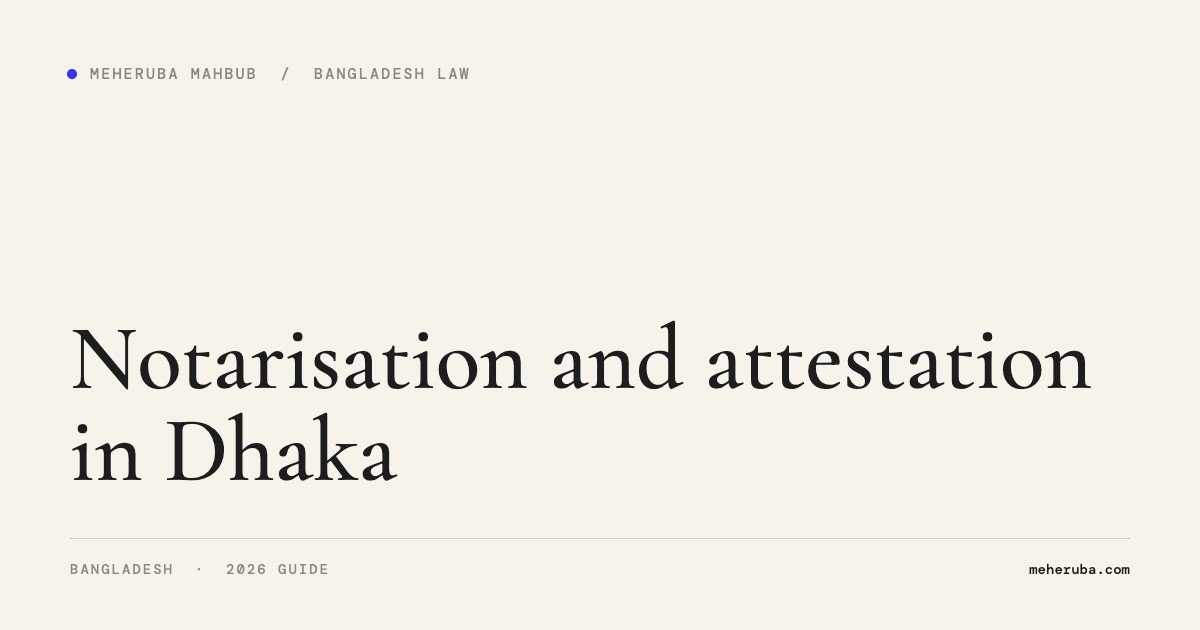
A notary public in Dhaka is often the first stop when a document must be sworn, certified or sent abroad: affidavits for name changes, attested copies for visa files, declarations for banks, or powers of attorney for relatives overseas. Notaries are appointed under the Notaries Ordinance 1961, and their stamp is often followed by ministry attestation and either a MOFA apostille or embassy legalisation. Knowing the correct order saves days of repeated visits.
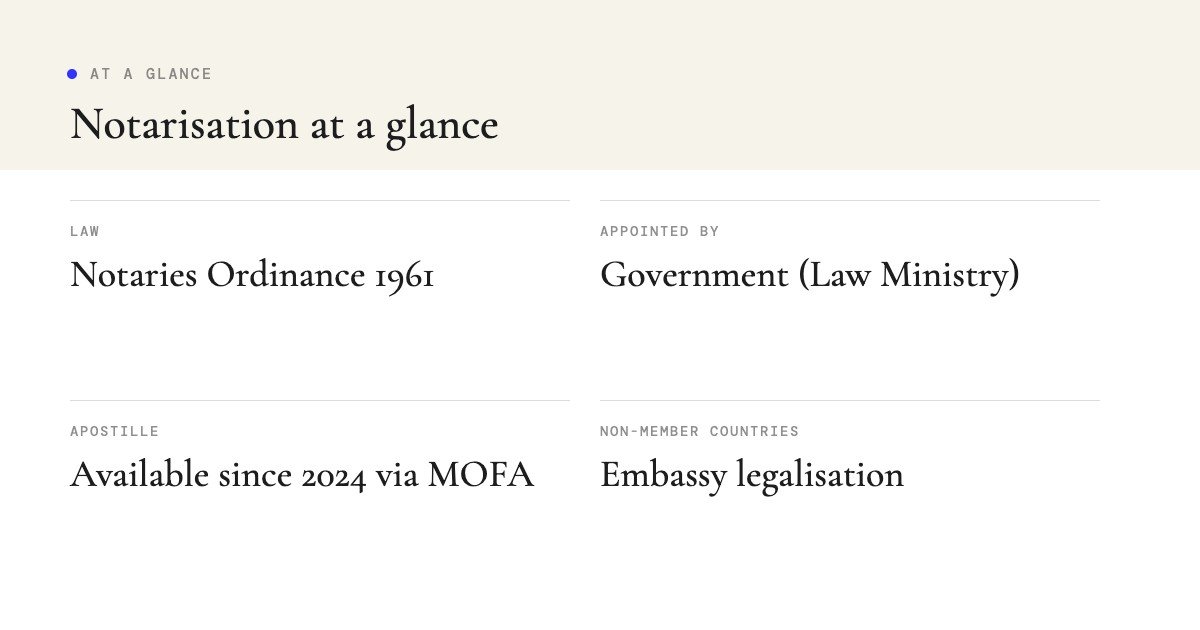
- Notaries in Bangladesh are appointed by the government under the Notaries Ordinance 1961 and may act only within their authorised area.
- Typical notarial acts include attesting signatures, certifying copies, administering oaths for affidavits and authenticating translations.
- Documents for use abroad usually need notarisation and ministry attestation before MOFA acts on them.
- Bangladesh joined the Hague Apostille Convention in 2024, so MOFA can issue an apostille for many countries; others still need embassy legalisation.
- Notarisation confirms execution or identity, not the truth of the contents or the legality of the transaction.
What a notary public in Dhaka does
A notary is a legal practitioner, usually an experienced advocate, appointed by the government to perform notarial acts. Under the Notaries Ordinance 1961 and the rules made under it, a notary public in Dhaka can verify, authenticate, certify or attest the execution of instruments; administer oaths and take affidavits; certify copies of documents; translate and verify translations; and note and protest bills of exchange, among other functions.
Notarisation gives a document added credibility, particularly when it will be used by a foreign authority, a bank or a court. It confirms that the person appearing signed the document or swore the affidavit in the notary's presence, after the notary checked identity. Our Dhaka office regularly assists clients with documents that need notarial and legal review.
Common documents notarised in Dhaka
| Document | Typical purpose |
|---|---|
| Affidavit for name or date-of-birth correction | Passports, NID, certificates |
| Affidavit of marital status or single status | Marriage abroad, visa applications |
| Certified copies of academic certificates | Admissions, jobs, immigration |
| Power of attorney | Property, banking, litigation |
| Consent letter for a child's travel | Travel with one parent |
| Translations of Bangla documents | Foreign authorities and embassies |
| Board resolutions and corporate documents | Foreign banks, investors and registries |
How to use a notary public in Dhaka
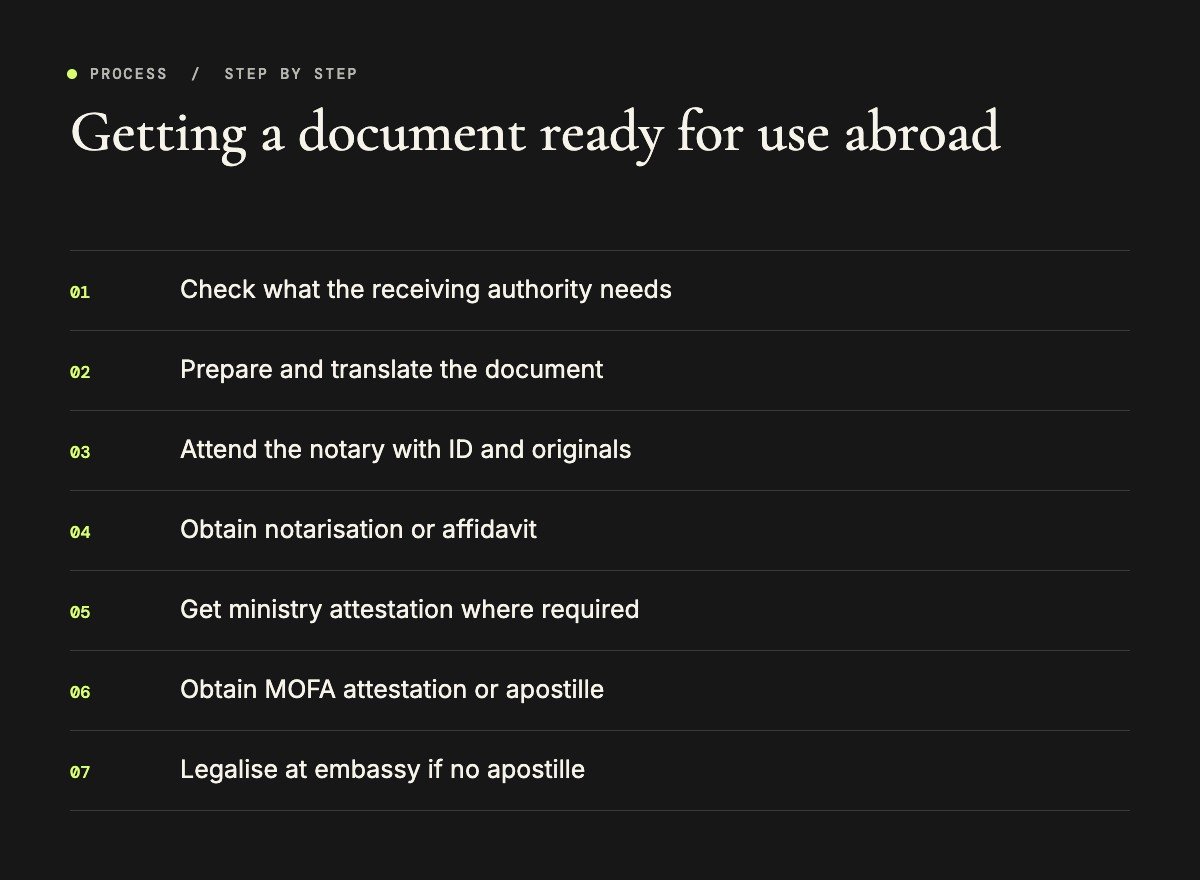
Before visiting, find out exactly what the receiving authority requires: original or copy, notarised or attested, translation or not, and whether further attestation is needed. Bring the original documents, the copies or drafts to be notarised, and a valid photo ID such as an NID card or passport. The person who signs or swears must usually appear in person.
The notary public in Dhaka will check identity, confirm the signer understands the document, witness the signature or administer the oath, and add a notarial seal, signature, registration number and date. Notaries maintain a register of notarial acts, and fees are prescribed by rules, though practice varies. Ask for a receipt and check that names and dates are correct before leaving.
Affidavits
Affidavits are sworn statements of fact. They are often prepared on non-judicial stamp paper of the required value, signed before a notary or a first class magistrate. A false affidavit can amount to an offence under the Penal Code, so the deponent must make sure the contents are true and complete.
Attestation for use abroad
Foreign authorities rarely accept a Bangladeshi document with only a notary's stamp. The usual chain is:
- Notarisation. A notary public in Dhaka notarises the document, copy or translation.
- Ministry attestation. Certain documents must first be attested by the relevant authority, such as education boards or the Ministry of Education for academic documents, or the Ministry of Law for some notarised documents.
- MOFA attestation or apostille. The Ministry of Foreign Affairs attests the signature and seal of the previous authority or, for a country that is a party to the Apostille Convention, issues an apostille.
- Embassy legalisation. If the destination country does not accept apostilles from Bangladesh, its embassy or high commission in Dhaka legalises the document.
Bangladesh acceded to the Apostille Convention on 29 July 2024, and the Convention entered into force for Bangladesh on 30 March 2025; MOFA now issues apostilles, including e-Apostilles. For documents going to other Convention countries, the apostille replaces embassy legalisation, which saves considerable time. Countries outside the Convention, or that have objected to Bangladesh's accession, still require the traditional chain, so check with the receiving authority before starting.
Start with the last step. Ask the destination authority or embassy exactly which attestations it will accept, then work backwards. Many delays happen because a document was notarised in a form the embassy will not legalise.
Powers of attorney
A power of attorney allows someone else to act on your behalf, for example to sell land, manage a bank account or conduct a case. In Bangladesh, the Power of Attorney Act 2012 and the Power of Attorney Rules 2015 govern powers of attorney, and powers relating to immovable property generally must be registered. A notary public in Dhaka can notarise a general power of attorney, but registration requirements and stamp duty must also be satisfied for property matters.
When a power of attorney is executed abroad for use in Bangladesh, it should be authenticated by the Bangladesh embassy or high commission or as the law requires, and then stamped and, where necessary, registered in Bangladesh within prescribed time limits after it arrives. See our detailed guide on power of attorney in Bangladesh.
Documents executed abroad for use in Bangladesh
Bangladeshis abroad often need to send affidavits, consents or powers of attorney home. These are usually notarised by a local notary in the foreign country and then attested by the Bangladesh mission there, or signed directly before a consular officer. On arrival, some documents need stamping under the Stamp Act 1899 within a set period. A notary public in Dhaka cannot notarise a document signed abroad without the signer appearing, so the process must start in the country where the signer is.
Limits of notarisation
A notary public in Dhaka confirms identity and execution, not the truth of statements or the validity of the transaction. A notarised sale agreement for land, for example, is not a registered deed and does not transfer ownership; registration with the sub-registrar is required. Similarly, a notarised affidavit cannot replace a court decree where the law requires one. Relying on notarisation alone for property or family matters is a common and costly mistake.
Choosing a notary
When choosing a notary public in Dhaka, use a notary whose appointment is current and who is authorised for the area. Check that the seal shows the notary's name, registration number and area. Be cautious of offices that offer to notarise without the signer present or to backdate documents; such practices are unlawful and can make the document worthless or expose you to criminal liability.
Corporate documents and foreign investors
Companies dealing with foreign banks, investors or registries often need certified copies of their certificate of incorporation, memorandum and articles, board resolutions and lists of directors. A notary public in Dhaka can certify these copies after checking them against the originals or RJSC records, and the documents can then go through MOFA and embassy legalisation. Foreign investors setting up in Bangladesh face the reverse process: their home-country corporate documents must usually be notarised and legalised abroad, and sometimes translated, before RJSC, Invest Bangladesh or banks will accept them. Planning this early avoids delays in incorporation and bank account opening. Our guide to company formation in Bangladesh explains the document requirements.
Translations
Most foreign authorities require Bangla documents to be translated into English or their own language. A translation is usually prepared by a qualified translator and then verified by a notary public in Dhaka, who confirms the translator's declaration or, where the notary is competent, the accuracy of the translation. Some embassies require translations by approved translators only. Names should be spelled consistently with the passport across every translated document, because inconsistent spellings are a frequent reason for rejection.
Fees and time
Notarial fees are prescribed by rules, but in practice charges vary depending on the document, the number of pages and urgency. A simple notarisation can often be completed the same day. The full chain of ministry attestation, MOFA apostille or attestation and any embassy legalisation can take from a few days to several weeks, depending on the destination country and the queue. Ask the notary public in Dhaka for a clear estimate and allow extra time for embassy appointments, especially during peak visa seasons.
Common mistakes to avoid
- Notarising a photocopy when the embassy wants the original attested.
- Using stamp paper of the wrong value for an affidavit.
- Inconsistent spellings of names and dates across documents.
- Assuming a notarised land agreement transfers ownership.
- Sending a power of attorney home without the required embassy authentication and stamping.
- Skipping ministry attestation before going to MOFA, or obtaining embassy legalisation when an apostille would have been enough.
Avoiding these errors means fewer return visits to the notary public in Dhaka and to MOFA, and faster acceptance abroad.
Notaries outside Dhaka
A notary public in Dhaka is not the only option. Notaries are appointed for specific areas across Bangladesh, including Chattogram, Sylhet, Rajshahi and Khulna. People living outside the capital can usually notarise documents locally, but MOFA attestation and most embassy legalisations take place in Dhaka. A trusted representative or law firm can often handle the Dhaka steps once the document has been notarised and signed. Choosing a notary public in Dhaka directly is convenient for those who will complete the whole chain in the capital.
Notarisation for court and government use
Within Bangladesh, courts and government offices sometimes require affidavits or certified copies. Courts generally accept affidavits sworn before a notary public in Dhaka or a magistrate, while certified copies of court records must be obtained from the court itself. Government offices such as the passport office, election commission and education boards publish their own requirements for supporting affidavits. Following those requirements exactly, including the stamp paper value and wording, avoids rejection.
Digital documents and e-signatures
Electronic signatures and digital certificates are recognised for certain purposes under the Information and Communication Technology Act 2006, and some government services now issue documents with QR codes for online verification. However, most foreign embassies and many local authorities still expect physical notarisation and attestation of paper documents. Until practice changes, it is safest to treat digital documents as needing printing, verification and notarisation where the receiving authority requires it.
Frequently asked questions about notary public in dhaka
Who appoints notaries in Bangladesh?
The government appoints notaries under the Notaries Ordinance 1961, usually experienced advocates, for specified areas.
Does a notarised document need MOFA attestation?
For use abroad, usually yes: MOFA either issues an apostille or attests the document for embassy legalisation, depending on the destination.
Can documents be apostilled in Bangladesh?
Yes. Bangladesh joined the Apostille Convention in 2024 and MOFA issues apostilles for documents going to other member countries; non-member countries still require embassy legalisation.
Must I attend in person?
Yes. The signer or deponent normally must appear before the notary with valid ID.
Does notarisation make a land agreement valid?
No. Land transfers and many agreements must be registered with the sub-registrar to be effective.
Can a notary translate documents?
Notaries can verify translations; many work with qualified translators and certify the translation's accuracy.
How we can help
We help clients prepare, review and attest documents with a notary public in Dhaka, including affidavits, powers of attorney, corporate documents and translations, and coordinate ministry attestation, MOFA apostilles and embassy legalisation. Learn more about our Dhaka office.
Need a document notarised or attested for use abroad?
We check the destination requirements, prepare the documents correctly and manage the attestation chain.
Book a consultationDhaka officePrimary sources: the Notaries Ordinance 1961, Power of Attorney Act 2012 and Stamp Act 1899 on the Laws of Bangladesh portal; attestation services of the Ministry of Foreign Affairs.
This article is general information about notarial practice in Bangladesh as of October 2026 and is not legal advice. Attestation requirements vary by country and change; confirm requirements with the receiving authority or a qualified lawyer before acting.

0 Comments