
Hindu marriage registration in Bangladesh became possible only with the Hindu Marriage Registration Act 2012. Registration is optional and an unregistered Hindu marriage remains valid, yet the certificate is often the only reliable proof a wife, husband or child has. This guide explains how registration works and why it is worth doing.
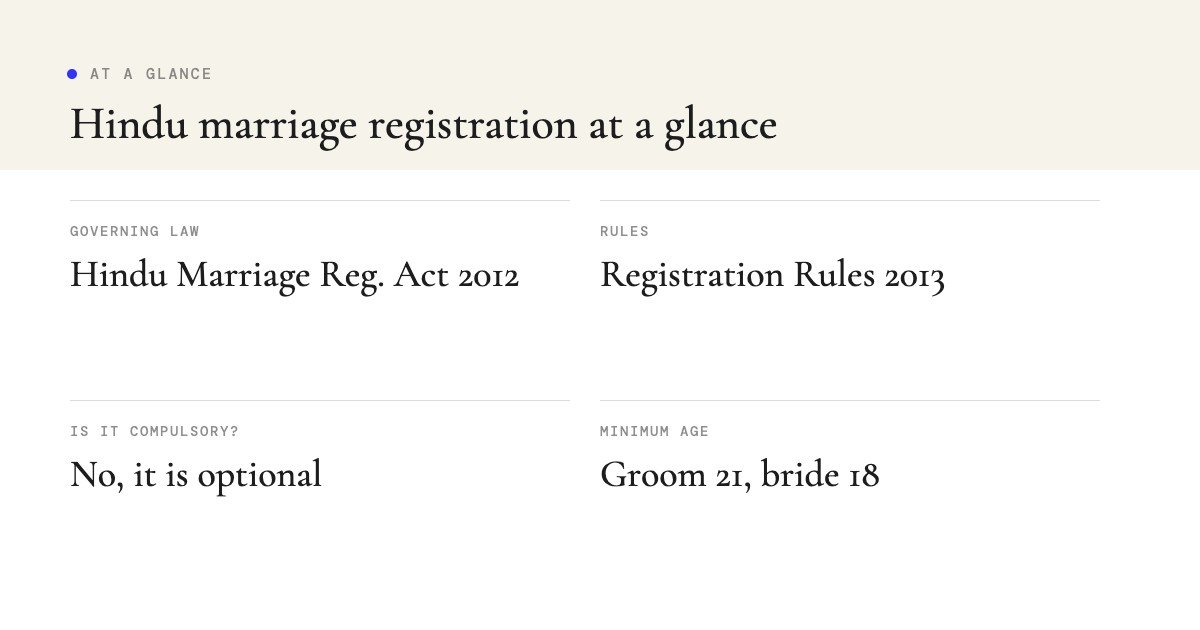
- The Hindu Marriage Registration Act 2012 allows, but does not require, Hindu marriages to be registered; section 3 makes clear that an unregistered marriage is still valid.
- Registration is done before a government-appointed Hindu Marriage Registrar, usually one per upazila and up to three in each city corporation area.
- Either spouse may apply, with photographs and proof of age; the groom must be at least 21 and the bride at least 18 under the Child Marriage Restraint Act 2017.
- Marriages held before the Act came into force can also be registered.
- A registration certificate is strong evidence for maintenance, inheritance, passports, visas and immigration abroad.
Why Hindu marriage registration in Bangladesh matters
Hindu marriage in Bangladesh is governed by uncodified Hindu personal law, largely of the Dayabhaga school, and is treated as a sacrament completed by religious rites. For generations there was no state record of the marriage at all. Proof depended on priests, relatives, photographs and the memory of witnesses.
That gap caused real hardship. Wives abandoned by their husbands struggled to prove they were married when claiming maintenance. Widows faced challenges from relatives when claiming inheritance. Couples applying for visas abroad had no official certificate to show. Hindu marriage registration in Bangladesh was introduced to solve these practical problems, not to change the religious nature of the marriage.
What the 2012 Act does and does not do
The Act creates a system for recording Hindu marriages and appointing registrars. It does not codify the substantive rules of Hindu marriage, does not introduce divorce, and does not change the rules on who may marry whom. Those questions are still answered by Hindu personal law and the few statutes that modify it.
The Hindu Marriage Registration Act 2012
Parliament passed the Hindu Marriage Registration Act in 2012 after years of advocacy by women's rights groups and legal aid organisations. The government then made the Hindu Marriage Registration Rules in January 2013, which were amended in September 2013. The Act and Rules are available on the official Laws of Bangladesh portal.
The central feature of the law is that registration is discretionary. Section 3 provides for registration so that documentary evidence of a Hindu marriage can be kept, and makes clear that a marriage which is not registered will still be valid. This was a deliberate compromise: community leaders were concerned that compulsory registration would cast doubt on the many existing marriages that had never been recorded.
Optional does not mean unimportant. In our experience, the families who later face disputes over maintenance, inheritance or immigration are disproportionately those who did not register. If you can register, do.
Retrospective registration
The Act does not limit registration to marriages solemnised after it came into force. Couples who married before 2012, or who married later but did not complete Hindu marriage registration in Bangladesh at the time, can apply to register their marriage now. Evidence of the ceremony becomes more important the older the marriage is.
Who can register and where
Hindu marriage registration in Bangladesh is handled by Hindu Marriage Registrars appointed by the government through the Law and Justice Division. According to the scheme described when the Rules were made, one registrar is appointed for each upazila, and between one and three registrars for each city corporation area.
For Hindu marriage registration in Bangladesh, the marriage is registered with the registrar for the area where the marriage took place. Either the husband or the wife may apply. Where one spouse is abroad or unavailable, the other can still apply, although the registrar will want to be satisfied that the marriage was properly conducted.
When a registrar is hard to find
Reports in 2025 and 2026 noted that registrars have not yet been appointed in every area, and that awareness of the service is low in some rural districts. If you cannot find a registrar for your upazila, ask the office of the district registrar or the Upazila Nirbahi Officer, or contact a lawyer or legal aid organisation for the current list.
Documents for Hindu marriage registration in Bangladesh
The documents needed are simple, but missing age proof is the most common reason for delay. Prepare the following before you visit the registrar.
| Document | Purpose | Notes |
|---|---|---|
| National ID cards of both spouses | Identity and age | The preferred proof of age |
| Birth registration certificate | Age, where no NID is available | Online birth registration can be verified |
| JSC, SSC or equivalent certificate | Alternative proof of age | Accepted where NID and birth certificate are missing |
| Affidavit of parents or guardians | Age, where no document exists | Used only as a last resort |
| Passport-size photographs of both | Attached to the application | Bring spares |
| Details of the ceremony | Date, place, priest and witnesses | Wedding card and photographs help |
The registrar will not register a marriage where either party is under the legal minimum age. Under the Child Marriage Restraint Act 2017, a man must be 21 and a woman 18. Registrars who register underage marriages risk penalties, and parents and organisers of child marriages commit offences under that Act.
Step-by-step registration
The procedure for Hindu marriage registration in Bangladesh under the 2013 Rules is straightforward. Most couples complete it in one or two visits.
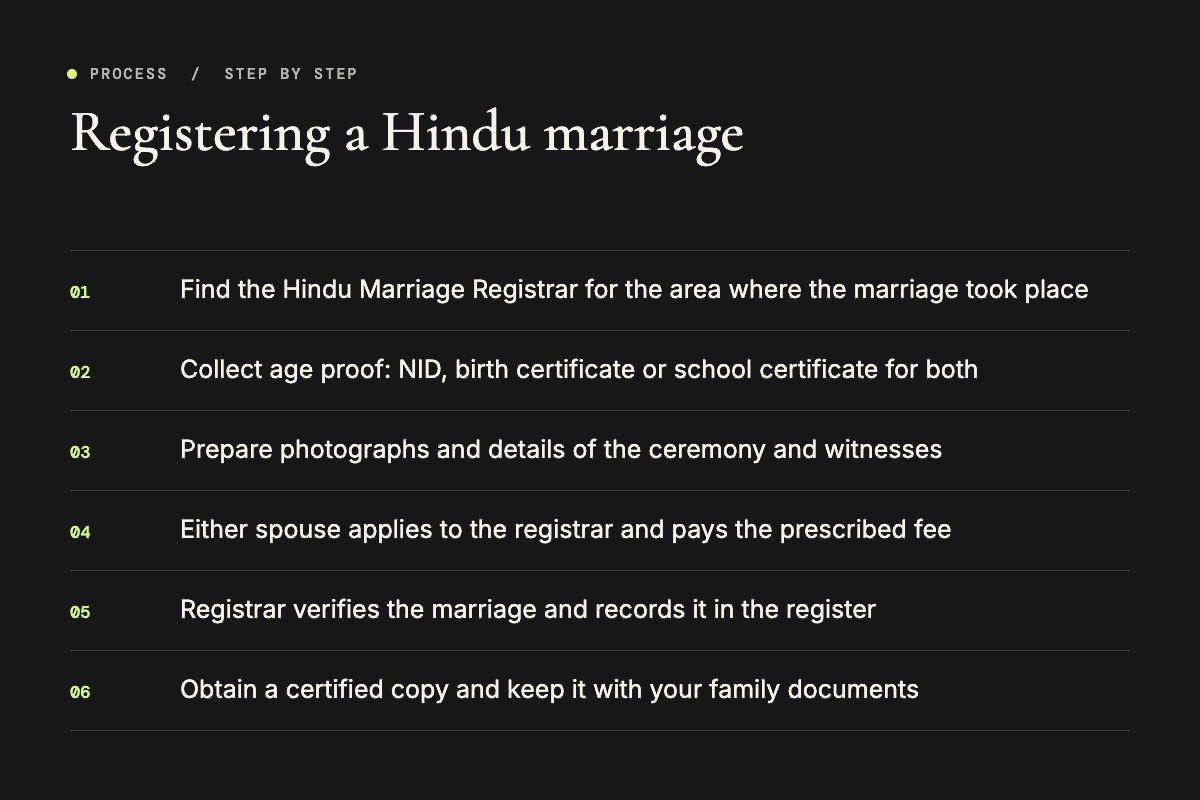
- Identify the registrar. Find the Hindu Marriage Registrar for the upazila or city corporation area where the marriage took place.
- Gather documents. Collect NID cards or other age proof, photographs and details of the ceremony, priest and witnesses.
- Submit the application. Either spouse submits the application in the prescribed form to the registrar.
- Pay the fee. Pay the registration fee set by the Rules. When the Rules were made, the fee was reported as Tk 1,000, payable by the groom, with Tk 100 for a copy; confirm the current amount with the registrar.
- Verification. The registrar checks the documents and satisfies himself or herself that the marriage was solemnised according to Hindu rites.
- Entry in the register. The registrar records the marriage in the official register.
- Collect the certificate. Obtain a certified copy of the entry. Keep the original safe and make attested copies for everyday use.
Correcting mistakes
Check the spelling of names, parents' names, dates and addresses before you leave. A mismatch between the marriage register and the NID or passport causes problems later, particularly in visa applications. If an error is found afterwards, apply to the registrar promptly for correction with supporting documents.
Validity of a Hindu marriage without registration
Because Hindu marriage registration in Bangladesh is optional, the validity of a Hindu marriage depends on Hindu personal law, not on the register. Broadly, the parties must both be Hindus, must not be within the prohibited degrees of relationship, and must complete the essential ceremonies of their community, which in most cases include the saptapadi, the seven steps before the sacred fire.
Inter-caste marriages are permitted under the Hindu Marriages Disabilities Removal Act 1946. Marriages between a Hindu and a person of another religion cannot be solemnised under Hindu law, and couples in that position usually marry under the Special Marriage Act 1872, which has its own registration system.
Proving an unregistered marriage
Where a marriage was never registered, it can still be proved in court by the evidence of the priest and witnesses, photographs, invitation cards, and the conduct of the parties, such as living together and being treated as husband and wife by the community. Courts may presume marriage from long cohabitation, but that presumption can be contested. Registration avoids the contest altogether.
Rights that registration helps protect
A registration certificate does not create new rights, but it makes existing rights far easier to enforce. That is the real value of Hindu marriage registration in Bangladesh.
- Maintenance. A Hindu wife can claim maintenance, and in certain circumstances separate residence with maintenance under the Hindu Married Women's Right to Separate Residence and Maintenance Act 1946, for example where the husband takes another wife or treats her with cruelty.
- Inheritance. A widow's rights in her husband's estate under Hindu law depend on proof of the marriage.
- Children. Proof of marriage supports the legitimacy, guardianship and inheritance rights of children.
- Official records. Changing a surname or adding a spouse in an NID or passport is easier with a certificate.
- Banking and insurance. Nominations, pensions and insurance claims often require proof of marriage.
For inheritance paperwork after a death, see our guide on succession certificates in Bangladesh.
Hindu personal law in Bangladesh still contains no statutory right to divorce, and it does not prohibit a husband from taking another wife. Separation agreements made by affidavit are widely used but have no clear legal basis. Take advice before signing one.
Family courts and Hindu family disputes
Family courts in Bangladesh, now governed by the Family Courts Act 2023 which replaced the Family Courts Ordinance 1985, hear disputes about restitution of conjugal rights, maintenance, dower, guardianship and custody. The High Court Division confirmed in 1998 that family courts have jurisdiction over such disputes for members of all communities, not only Muslims.
In a maintenance or custody case, the first question is often whether the parties were married. A certificate from Hindu marriage registration in Bangladesh answers that question at the outset, so the court can move straight to the real issues. Without it, months can be spent proving the marriage itself.
Legal aid is available for those who cannot afford a lawyer through the district legal aid offices of the National Legal Aid Services Organisation.
Using the certificate abroad
Many Bangladeshi Hindu families have members working or studying abroad, and foreign embassies routinely ask for a marriage certificate in spouse and family visa applications. A certificate from Hindu marriage registration in Bangladesh is far more persuasive to a foreign immigration officer than affidavits or photographs alone.
For use abroad, the certificate usually needs to be attested. The typical route is attestation of the certificate and an English translation by a notary public, followed by attestation by the Ministry of Foreign Affairs, and then by the embassy of the destination country if it requires it. Requirements differ by country and change from time to time, so check the embassy's current checklist before you start.
Updating records after Hindu marriage registration in Bangladesh
Once the marriage is registered, the certificate can support changes to other records. A wife who wishes to add her husband's name or change her surname in her passport can usually rely on the certificate, and the NID database can be updated through the Election Commission's correction process with supporting documents. Bank accounts, employer records, pension nominations and insurance policies should also be updated so that the spouse is recognised without dispute if something happens.
Marriages of Bangladeshis abroad
The Act is built around registrars in Bangladesh and the area where the marriage took place. Where a Bangladeshi Hindu couple marries abroad, the foreign marriage is normally registered under the law of the country where it took place. Take advice on how that marriage will be recognised and recorded in Bangladesh.
Common problems with Hindu marriage registration in Bangladesh
Most registrations go smoothly, but the same handful of problems appear again and again in the matters we see. Knowing them in advance saves time and, sometimes, a court case later.
One spouse refuses to cooperate
Because either spouse may apply, a wife whose husband refuses to register can apply alone. The registrar must still be satisfied that the marriage took place, so she should bring the strongest evidence she has: the priest's details, witnesses, photographs, the wedding card and any documents describing her as his wife. If the registrar refuses, the marriage can still be proved in a family court case, and a lawyer can advise whether a declaration is needed.
Requests for unofficial payments
The fee for Hindu marriage registration in Bangladesh is fixed by the Rules. Ask for a receipt for every payment. If a registrar demands more than the prescribed amount, you can complain to the district registrar or the Law and Justice Division.
Names that do not match other records
Many people use different spellings of their names, or a different surname after marriage, across their NID, passport and school certificates. Decide before registration which form of name will be used and make sure it matches the NID. Inconsistent records are the main reason foreign embassies query marriage certificates.
Pressure to register an underage marriage
Families sometimes ask registrars to record a marriage before the bride or groom reaches the legal age, or to accept a false age affidavit. A registrar who complies risks penalties, and the families involved commit offences under the Child Marriage Restraint Act 2017. A registration obtained on false age information also gives the couple little protection when it matters.
Reform debate and future changes
Since 2012, women's rights groups and legal aid organisations have argued that Hindu marriage registration in Bangladesh should be made compulsory, linked to the NID system to prevent child marriage, and accompanied by wider reform of Hindu family law on divorce, maintenance and inheritance. Others within the community oppose compulsory registration, arguing that a priest's certificate should be enough and that registration adds cost for ordinary families.
As of October 2026, we are not aware of any amendment making registration compulsory or introducing a statutory right of divorce for Hindus. Reform proposals have been discussed repeatedly but have not been enacted. If the law changes, existing registrations will remain valuable evidence.
Frequently asked questions about hindu marriage registration in bangladesh
Is it compulsory to register a Hindu marriage in Bangladesh?
No. Under section 3 of the Hindu Marriage Registration Act 2012, registration is optional and an unregistered Hindu marriage remains valid. Registration is still strongly advisable as proof.
Can we register a marriage that took place many years ago?
Yes. Marriages held before the Act, or not registered at the time, can be registered later with the registrar for the area where the marriage took place.
Can only one spouse apply?
Yes. Either the husband or the wife may apply, although the registrar must be satisfied that the marriage was properly conducted.
What is the minimum age for a Hindu marriage?
Under the Child Marriage Restraint Act 2017, the groom must be at least 21 and the bride at least 18. Registrars will not register a marriage below these ages.
Does registration allow a Hindu couple to divorce?
No. The 2012 Act deals only with registration. Hindu personal law in Bangladesh still has no statutory divorce, although a wife may seek separate residence and maintenance in certain cases.
Will an embassy accept the registration certificate?
Usually yes, once it is translated and attested as the embassy requires, typically by a notary and the Ministry of Foreign Affairs.
How we can help
We advise Hindu families on Hindu marriage registration in Bangladesh, proof of marriage, maintenance and separate residence claims, guardianship and inheritance, and on preparing marriage documents for visas and immigration abroad. We handle these matters with discretion and sensitivity. Learn more about our practice.
Need help registering or proving a marriage?
We guide you through registration, correct errors in records and prepare certificates for use in court or abroad.
Book a consultationAbout our practicePrimary sources: the Hindu Marriage Registration Act 2012, Child Marriage Restraint Act 2017 and Family Courts Act 2023 on the Laws of Bangladesh portal; birth registration via BDRIS; document attestation by the Ministry of Foreign Affairs; The Daily Star, Your Advocate column on the Act and 2013 Rules (2015).
This article is general information about Bangladeshi law as of 2026 and is not legal advice. Fees, registrar appointments and procedures change; confirm current requirements with the Hindu Marriage Registrar for your area or a qualified lawyer before acting.

0 Comments