
A work permit in Bangladesh is the authority a foreign national needs before taking paid work for a Bangladeshi company, branch, liaison office or project. Since August 2026 the main issuing body has changed its name, and the visa rules have been rewritten, so employers should check that their process still matches the law.
- Foreign nationals need both an employment visa and a work permit; the visa lets them enter, the permit lets them work.
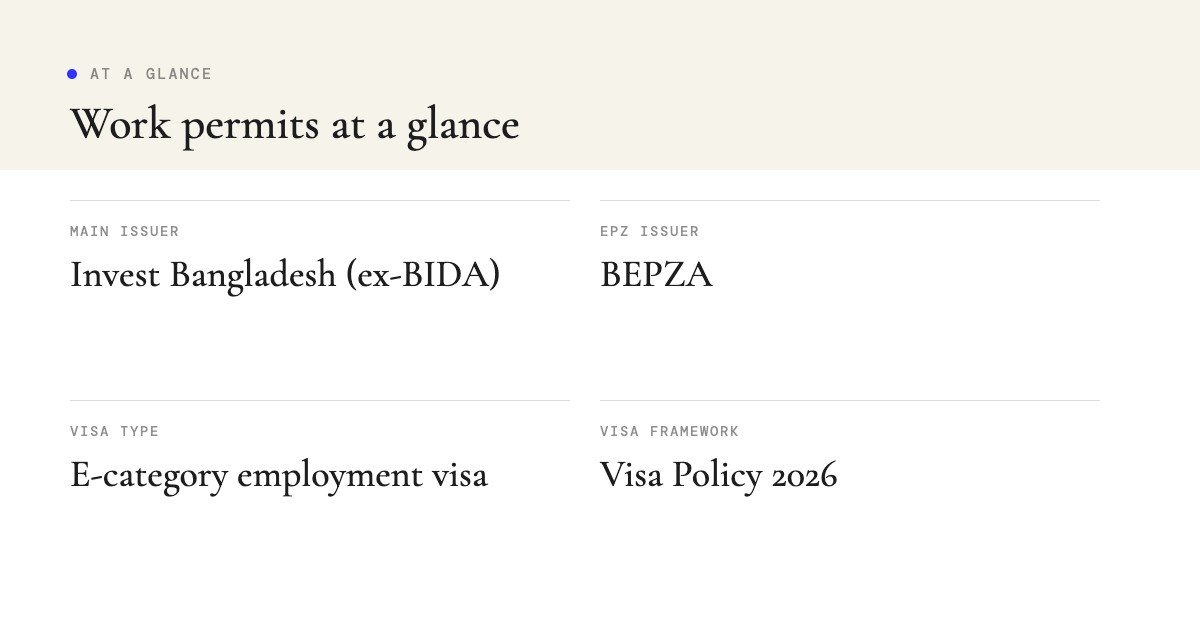
- BIDA, BEZA and the PPP Authority merged into Invest Bangladesh, which began operating on 23 August 2026; it now handles the work permits BIDA and BEZA used to issue.
- BEPZA still issues permits for export processing zones, and the NGO Affairs Bureau handles foreign staff of NGOs.
- Security clearance for new permits has been fully online since 1 October 2025, with clearance deemed granted if no objection is raised within 21 working days.
- Visa Policy 2026 took effect on 3 September 2026 and replaced the 2006 policy, so check the current visa category before applying.
What a work permit in Bangladesh is
Bangladesh separates permission to enter from permission to work. An employment visa, issued by a Bangladesh mission abroad or extended in-country by the Department of Immigration and Passports, controls entry and stay. A work permit, issued by an investment or zone authority, authorises the foreign national to be employed by a particular organisation in a particular position.
The two documents depend on each other. The visa recommendation is issued on the basis that a permit will follow, and the visa is later extended on the basis of the permit. If the permit lapses or is cancelled, the visa extension falls with it. A work permit in Bangladesh is also employer-specific: changing jobs means a new application, not a transfer.
Who needs one
Any foreign national taking up paid employment, including managing directors, country managers, engineers, technicians and consultants placed for long periods, needs a permit. Short business visits to attend meetings, inspect sites or negotiate contracts normally fall under business visas instead, but there is a clear line: once a person is doing the work of the organisation and being paid for it locally, a work permit in Bangladesh is required.
Who issues a work permit in Bangladesh after the 2026 merger
The issuing body depends on where the employer is registered and operates. The August 2026 reform simplified the map but did not merge every authority.
| Employer | Issuing body | Notes |
|---|---|---|
| Local and foreign-owned companies, branch and liaison offices, registered industrial and commercial projects | Invest Bangladesh (formerly BIDA) | The largest category; BIDA approved over 16,000 permits and renewals in FY 2022-23 |
| Enterprises in economic zones | Invest Bangladesh (formerly BEZA) | BEZA functions passed to Invest Bangladesh under the Invest Bangladesh Act 2026 |
| Enterprises in export processing zones | BEPZA | Reports on the merger did not include BEPZA; treat it as a separate issuer |
| NGOs and foreign-funded voluntary organisations | NGO Affairs Bureau | Under the Foreign Donations (Voluntary Activities) Regulation Act 2016 |
| Government and donor-funded projects | Relevant ministry or project authority, with security clearance | Check the project documents and the sponsoring ministry |
What the Invest Bangladesh merger means in practice
The Invest Bangladesh Act 2026 merged the Bangladesh Investment Development Authority, the Bangladesh Economic Zones Authority and the Public-Private Partnership Authority into a single agency under the Prime Minister's Office. It began work on 23 August 2026. Reports at launch said existing investment services would continue, staff would move across at equivalent positions, and BanglaBiz would remain the single digital platform for investment services.
For employers, the key practical point is continuity. Permits issued by BIDA or BEZA before the merger remain valid until they expire. New applications and renewals go to Invest Bangladesh. During the transition, check the current portal and form names on the Invest Bangladesh website before filing, because letterheads, portal addresses and fee accounts may change.
If a renewal falls due in late 2026, start early and keep evidence of the filing date. Transitional delays are not a defence to working without a valid permit, and the employer, not the employee, usually bears the regulatory and tax consequences.
Eligibility rules for a work permit in Bangladesh
The authorities apply a long-standing set of policy conditions, set out in their work permit guidelines rather than in a single statute. The conditions below have applied for many years under BIDA practice; confirm them against the current Invest Bangladesh guidelines.
- Need for foreign expertise. The position should require skills not readily available locally. The employer is expected to show it advertised the role in Bangladesh first.
- Minimum age. The applicant must be at least 18.
- Ratio of foreign staff. BIDA guidelines have long capped foreign employees at around 5% of the workforce in industrial enterprises and 20% in commercial ones, including senior management. Exceptions are possible but must be justified.
- Registered employer. The company, branch or office must be registered with the issuing authority and up to date with tax and filing obligations.
- Capital. Branch and liaison offices and foreign-owned companies are expected to have brought in the required minimum inward remittance; check the amount that applies to your structure.
- Security clearance. The applicant must clear security vetting by the Ministry of Home Affairs.
Positions that are hard to justify
Roles that local staff commonly fill, such as general administration, sales or junior accounting, are difficult to justify. Applications succeed when the job description is specific, the qualifications are evidenced and the business case is clear. A vague title such as "consultant" invites questions.
The E-visa and the Visa Policy 2026
The Ministry of Home Affairs brought Visa Policy 2026 into force on 3 September 2026, replacing the Visa Policy 2006. The Cabinet had approved the draft on 10 August 2026. The new policy consolidates the visa system into 34 categories and cancels earlier visa circulars.
Reports on the policy describe separate employment categories for donor-funded project staff, general employment and technical or installation experts, together with a dedicated investor category. Before applying, confirm which E-category matches the role and what documents the mission requires, as missions apply the new policy from its official text, not from summaries.
Visa recommendation
The usual starting point is a visa recommendation letter from the issuing authority, obtained by the employer through the online service portal. The employee takes the recommendation, appointment letter and passport to the Bangladesh mission and applies for the employment visa. Passports should have at least six months' validity.
Visa on arrival is not a substitute
Some nationals can obtain a visa on arrival for business purposes. That does not authorise employment. A person who enters on an on-arrival or tourist visa and then starts work is exposed to penalties and deportation, and the employer cannot regularise the position simply by applying for a permit afterwards.
Step-by-step process for a work permit in Bangladesh
The sequence below reflects the usual process for a foreign employee of a company registered with Invest Bangladesh. EPZ and NGO routes follow the same logic with their own forms.
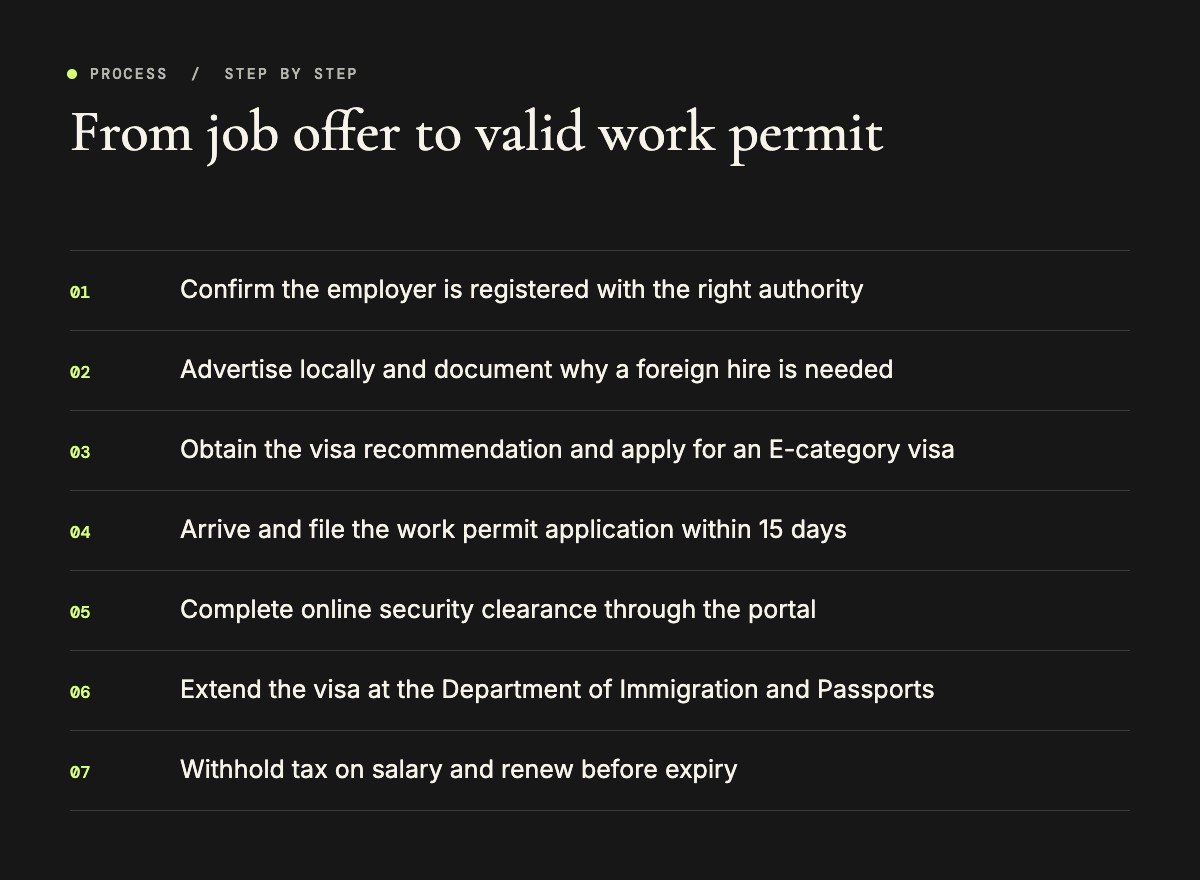
- Check employer registration. Confirm the company, branch or liaison office is registered with the right authority and that its trade licence, tax registration and returns are current.
- Prepare the business case. Advertise the role locally, keep copies of the advertisement and record why no suitable local candidate was found. Update the manpower statement to show the foreign-to-local ratio.
- Obtain the visa recommendation. Apply online with the incorporation documents, board resolution, appointment letter, passport copy, credentials and tax documents.
- Apply for the employment visa. The employee applies at the Bangladesh mission in their country of residence using the recommendation letter.
- Arrive and apply for the permit. File the work permit application within 15 days of arrival, with the visa and arrival stamp pages, attested documents and fee payment.
- Complete security clearance. Since 1 October 2025 security clearance for new permits is applied for online through the service portal; if no objection is raised within 21 working days, clearance is treated as granted.
- Extend the visa. With the permit and clearance, apply to the Department of Immigration and Passports to extend the visa to match the permit.
- Register for tax and payroll. Obtain a tax identification number for the employee and withhold tax from salary each month.
The authorities publish target processing times, but they vary with the volume of applications and with security clearance. Build a buffer of several weeks into any start date.
Security clearance for a work permit in Bangladesh
Security clearance used to be the slowest and least predictable part of the process. Following an inter-agency meeting on 2 September 2025, BIDA announced that from 1 October 2025 security clearance for new work permits would be fully digital, with applications made only through its One Stop Service portal.
Two points from that announcement matter most. First, if no objection is raised within 21 working days, clearance is deemed granted. Second, failure to apply within the time stated in the permit makes the permit invalid. Many employers had treated clearance as a formality that could wait; it can no longer wait.
A deemed clearance protects the employer only if the application was complete. Missing or inconsistent documents can restart the clock. Keep the portal acknowledgement and every query and response on file.
Documents for a work permit in Bangladesh
Most refusals and delays come from documents, not from policy. The authorities expect a consistent file in which the passport name, job title, salary and employer details match across every form. The table below shows what is typically requested at each stage; the issuing authority may ask for more.
| Stage | Typical documents | Common problem |
|---|---|---|
| Visa recommendation | Certificate of incorporation, memorandum and articles, trade licence, tax registration and proof of tax payment, board resolution, local advertisement, manpower statement, appointment letter, passport copy, photographs, academic and professional certificates | Job title in the board resolution differs from the appointment letter |
| Employment visa | Visa form, original passport, photographs, recommendation letter, appointment letter, fee receipt | Passport with less than six months' validity |
| Work permit | Application form, attested copies of the earlier documents, passport pages with the visa and arrival stamp, updated manpower statement, tax clearance, fee payment | Filed more than 15 days after arrival |
| Renewal | Previous permit, employee's tax return acknowledgement, employer's tax clearance, salary statements | Employee has not filed an income tax return |
Certificates issued abroad usually need to be attested in the issuing country and by the Bangladesh mission there. Translations should be certified. Allow time for this before the employee travels, because it is much harder to arrange once they are in Dhaka.
Keeping the file current after issue
Holding a valid work permit in Bangladesh is not the end of compliance. Employers should keep a register of every foreign employee with permit, visa and clearance expiry dates, review the foreign-to-local ratio whenever headcount changes, and diarise renewals at least two months ahead. A simple internal tracker avoids most lapses, and it is the first thing we ask to see when a client calls about a refused renewal.
Validity, renewal and changes
A work permit in Bangladesh is usually issued for one year at a time, sometimes for a longer period up to the contract term. Renewal applications must be filed before expiry with proof that the employee filed an income tax return and that the employer is current on tax.
Changing role or employer
Because a permit is tied to one employer and position, a promotion to a new designation may need an amendment, and a move to a different company needs a new permit. Expatriates moving between employers may also fall into a different visa category under the new visa policy, so check both documents.
Cancellation on departure
When the employment ends, the employer should apply to cancel the permit and obtain tax clearance for the departing employee. A foreign national who leaves without a final tax return can face problems at exit or on a later return, and the employer may be asked to account for withholding.
Tax consequences of employing foreign nationals
Income earned for work in Bangladesh is taxable in Bangladesh, whether paid locally or abroad. Employers must withhold tax from salary and report it, and the employee must file an annual return. The Income Tax Act 2023, which replaced the Income Tax Ordinance 1984, carries forward penalties for employers who engage foreign nationals without proper permission, and salary paid to an unauthorised foreign employee may not be deductible for the company.
Rates, thresholds and treaty relief change with each Finance Act. Check the current position with the National Board of Revenue and review any double tax treaty with the employee's home country. Salary and benefits paid abroad and recharged to the Bangladeshi entity raise transfer pricing and remittance questions; our tax practice can help structure them.
Remitting salary abroad
Foreign employees may remit a portion of their salary and savings abroad through the banking channel under Bangladesh Bank foreign exchange rules. Banks ask for the work permit, tax documents and employment contract. A lapsed permit can block remittance, which is one of the first signs many employees notice when renewal has been missed.
Common mistakes with a work permit in Bangladesh
These are the problems we see most often when advising employers and foreign staff:
- Working on the wrong visa. Starting work on a business or on-arrival visa while the permit is pending.
- Missing the 15-day window. Filing the permit application late after arrival, which complicates the visa extension.
- Ignoring security clearance. Assuming clearance follows automatically, when the permit can become invalid if clearance is not applied for in time.
- Ratio breaches. Adding foreign staff without checking the foreign-to-local ratio across the whole entity.
- Tax gaps. No withholding on salary paid abroad, or no final return on departure.
- Stale registrations. Applying while the employer's own trade licence, returns or registration are out of date.
Most of these can be corrected if caught early. Left unresolved, they can lead to refusal of renewal, tax penalties or, in serious cases, removal of the employee from Bangladesh.
Special cases: investors, directors and zone enterprises
Foreign investors and directors who take an active management role and draw a salary need a permit like any other employee. A shareholder who only attends board meetings and receives dividends normally does not, though frequent visits can blur the line. Investors may also qualify for the dedicated investor visa category under the new policy.
In export processing zones, BEPZA runs its own process and applies its own conditions on foreign staffing. Economic zone enterprises now deal with Invest Bangladesh for the functions BEZA used to perform. If your structure spans a zone and a mainland office, each workforce may need permits from a different authority. Our guide to legal requirements for a new business covers the registrations that come first.
Frequently asked questions about work permit in Bangladesh
Who issues a work permit in Bangladesh now that BIDA has merged?
Invest Bangladesh, which absorbed BIDA, BEZA and the PPP Authority and began work on 23 August 2026, handles permits BIDA and BEZA used to issue. BEPZA still handles export processing zones and the NGO Affairs Bureau handles NGOs.
Are permits issued by BIDA before the merger still valid?
Yes. Existing permits stay valid until they expire. Renewals and new applications go to Invest Bangladesh.
Can a foreigner start work while the permit is being processed?
It is safest not to. The employee should hold the correct employment visa and the permit application must be filed within 15 days of arrival, but working before the permit is issued carries risk for both sides.
How long does security clearance take?
Under the online system in place since 1 October 2025, clearance is deemed granted if no objection is raised within 21 working days of a complete application.
Is there a limit on the number of foreign employees?
Guidelines have long capped foreign staff at about 5% in industrial and 20% in commercial enterprises. Exceptions need justification. Confirm the current Invest Bangladesh guidelines before planning headcount.
How we can help
We handle the full work permit in Bangladesh process for foreign-owned companies, branch and liaison offices and zone enterprises: visa recommendations, permit applications, security clearance, renewals, tax registration and cancellations. Learn more about our foreign direct investment practice and our immigration law work.
Bringing foreign staff to Bangladesh?
We map the right authority, visa category and timeline for each hire, and manage filings with Invest Bangladesh, BEPZA and the immigration authorities.
Book a consultationForeign investment practicePrimary sources: Invest Bangladesh (including the BIDA press release of 30 September 2025 on digital security clearance); BEPZA; the Department of Immigration and Passports; reporting in The Financial Express (23 August 2026) and the Daily Observer (3 September 2026).
This article is general information about Bangladeshi law as of October 2026 and is not legal advice. Agencies, portals and visa rules changed in 2025 and 2026; confirm current requirements with the issuing authority or a qualified lawyer before acting.

0 Comments