
Venture capital in Bangladesh runs on the same instruments as anywhere else, term sheets, preference shares, option pools and fund vehicles, but it has to fit inside the Companies Act 1994, BSEC fund rules and Bangladesh Bank foreign exchange controls. The deals that close smoothly are the ones that plan for those rules from the first draft.
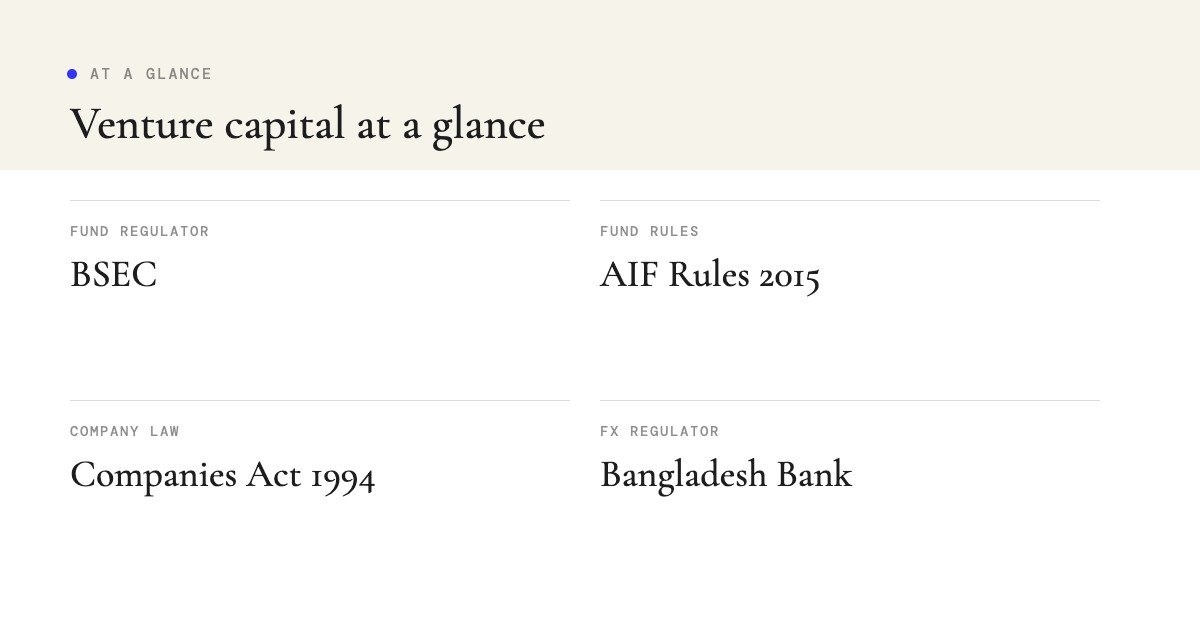
- Domestic VC and PE funds are regulated by BSEC under the Bangladesh Securities and Exchange Commission (Alternative Investment) Rules 2015; a draft amendment published in 2026 would widen the eligible investor base.
- Investor protections agreed in a term sheet only bind the company and future shareholders if they are written into the articles of association.
- Foreign investment must arrive through the banking channel, and transfers between residents and non-residents follow Bangladesh Bank valuation and reporting rules.
- Bangladesh has no dedicated ESOP statute for private companies, so option plans must be built from contract, the articles and careful tax planning.
- Since March 2025 Bangladesh Bank allows startups to set up entities abroad with up to USD 10,000 and will consider share-swap proposals, which opens a route to offshore holding structures.
Under the Invest Bangladesh Act 2026, effective 23 August 2026, the Bangladesh Investment Development Authority (BIDA), the Bangladesh Economic Zones Authority (BEZA) and the PPP Authority were merged into a single body, Invest Bangladesh. References below to BIDA, BEZA or the PPP Authority should be read as references to Invest Bangladesh. BEPZA continues as a separate authority.
The venture capital in Bangladesh landscape in 2026
Startup funding in Bangladesh has always depended on foreign money. Industry data published in July 2026 by LightCastle Partners with Startup Bangladesh Limited reported only about USD 6 million raised in the first half of 2026, across six deals, compared with around USD 120 million a year earlier. Almost all of that capital came from global investors.
At the same time, policy has moved. The FY2026-27 budget proposed a zero turnover tax and VAT relief for eligible startups, a new government-backed startup fund was announced, and Bangladesh Bank has made cross-border structuring easier. For founders and investors, that combination means fewer but more carefully negotiated deals, where legal structure is scrutinised closely.
Who invests
The investor base for venture capital in Bangladesh falls into four groups: foreign VC funds investing directly or through an offshore holding company; BSEC-registered domestic alternative investment funds; the state-backed Startup Bangladesh Limited, which co-invests in early-stage companies; and angels and corporate investors, including local conglomerates. Each brings different paperwork, approval needs and expectations.
How BSEC regulates venture capital funds
A pooled fund that raises money from investors to invest in unlisted companies in Bangladesh is an alternative investment fund (AIF). It is governed by the Bangladesh Securities and Exchange Commission (Alternative Investment) Rules 2015, which cover private equity funds, venture capital funds and impact funds.
In outline, an AIF is formed as a trust with a BSEC-registered fund manager, a trustee and a custodian. Units are offered privately to eligible investors, not to the public, and the fund invests according to its constitutive documents and investment committee decisions. The rules address sponsor commitments, fees, valuation, reporting and the fund's life.
The 2026 draft amendment
BSEC has published a draft amendment to the Alternative Investment Rules on its website. Among other things, the draft would broaden eligible investors to include banks, insurers, pension and provident funds, foreign funds, foreign individuals and high net worth residents and non-resident Bangladeshis. It would allow a performance fee of up to 20% of net annual profit above a hurdle rate, permit fund life to be extended by up to two years with a two-thirds vote of unit holders and BSEC approval, and move audits to International Standards on Auditing.
These are proposals. Until BSEC gazettes final rules, the 2015 rules as previously amended apply. Fund managers planning a 2026 or 2027 launch should track the final text on the BSEC website and build flexibility into fund documents.
Foreign funds investing directly into a Bangladeshi company are not AIFs under the BSEC rules simply because they invest here. The rules regulate funds set up and offered in Bangladesh. A foreign fund's direct investment is governed instead by company law, foreign exchange rules and, where relevant, Invest Bangladesh registration.
Term sheets for venture capital in Bangladesh
A term sheet sets out the commercial deal before lawyers draft the long-form documents. Most terms will look familiar to anyone who has seen a Silicon Valley or Singapore deal. The difference lies in how each term is implemented under Bangladeshi law.
| Term | What it does | Bangladesh implementation point |
|---|---|---|
| Valuation and price per share | Fixes pre-money valuation and the investor's percentage | Price for non-resident investors must respect Bangladesh Bank fair-value expectations |
| Preference shares | Gives investors priority on exit or liquidation | Rights must be set out in the articles; class rights can be varied only by the statutory process |
| Liquidation preference | Investor gets money back, often 1x, before ordinary shareholders | Works on a sale through the shareholders agreement and articles; in a winding up, statutory priorities apply first |
| Anti-dilution | Adjusts the investor's price if later shares are issued cheaper | Usually implemented by issuing bonus or additional shares, which needs authorised capital headroom |
| Board seat and reserved matters | Gives the investor a director and veto rights | Must be in the articles to bind the company |
| Pre-emption and pro-rata | Lets investors keep their percentage in later rounds | Private companies set this in the articles |
| Drag-along and tag-along | Forces or allows minority shareholders to join a sale | Needs a clear transfer mechanism in the articles |
| Founder vesting | Founders earn their shares over time | No reverse vesting by company buy-back; use transfer to other shareholders or a trust |
Binding and non-binding terms
The commercial terms in a term sheet are normally non-binding. Exclusivity, confidentiality, costs and governing law are usually binding. Make that split explicit, because a Bangladeshi court will look at the words used to decide whether the parties intended to be bound.
Convertible notes and SAFEs
Convertible instruments are common abroad but awkward in Bangladesh. A convertible loan from a non-resident is foreign borrowing and engages Bangladesh Bank rules on external debt. A SAFE has no clear treatment under the Companies Act 1994. Many investors therefore prefer a priced round in the local company, or a SAFE at the offshore holding company level.
Structuring the investment: local company or offshore holding
The first structural question in venture capital in Bangladesh is where the investor will hold its shares. There are two main models.
Direct investment in the Bangladeshi company
The investor subscribes for shares in the local private limited company. Funds come in as foreign direct investment through a bank, which issues an encashment certificate. The company allots shares, files a return of allotment with RJSC and, where relevant, registers the investment with Invest Bangladesh (which absorbed BIDA in August 2026). This model is simple, but later exits and cross-border transfers involve Bangladesh Bank processes.
Offshore holding company
Many venture-backed startups now sit under a Singapore or Delaware holding company, with the Bangladeshi entity as a subsidiary. Investors invest at the holding level under familiar law. On 27 March 2025 Bangladesh Bank's Foreign Exchange Investment Department allowed startups to remit up to USD 10,000 to set up a legal entity abroad, with reporting within one month of incorporation, and said it would consider share-swap proposals by resident companies where the swap ratio follows global practice.
That circular makes the "flip" more practical, but each step still needs care: the swap itself, valuation, reporting to the authorised dealer bank, tax on the transfer and the ongoing obligations of residents who hold foreign shares. A founder who flips without approvals can find that dividends or sale proceeds cannot lawfully be brought home.
An offshore structure does not remove Bangladeshi rules from the operating company. Transfer pricing, withholding tax on service fees, data localisation in some sectors and Bangladesh Bank reporting all continue to apply to the local subsidiary.
Closing a venture capital in Bangladesh round
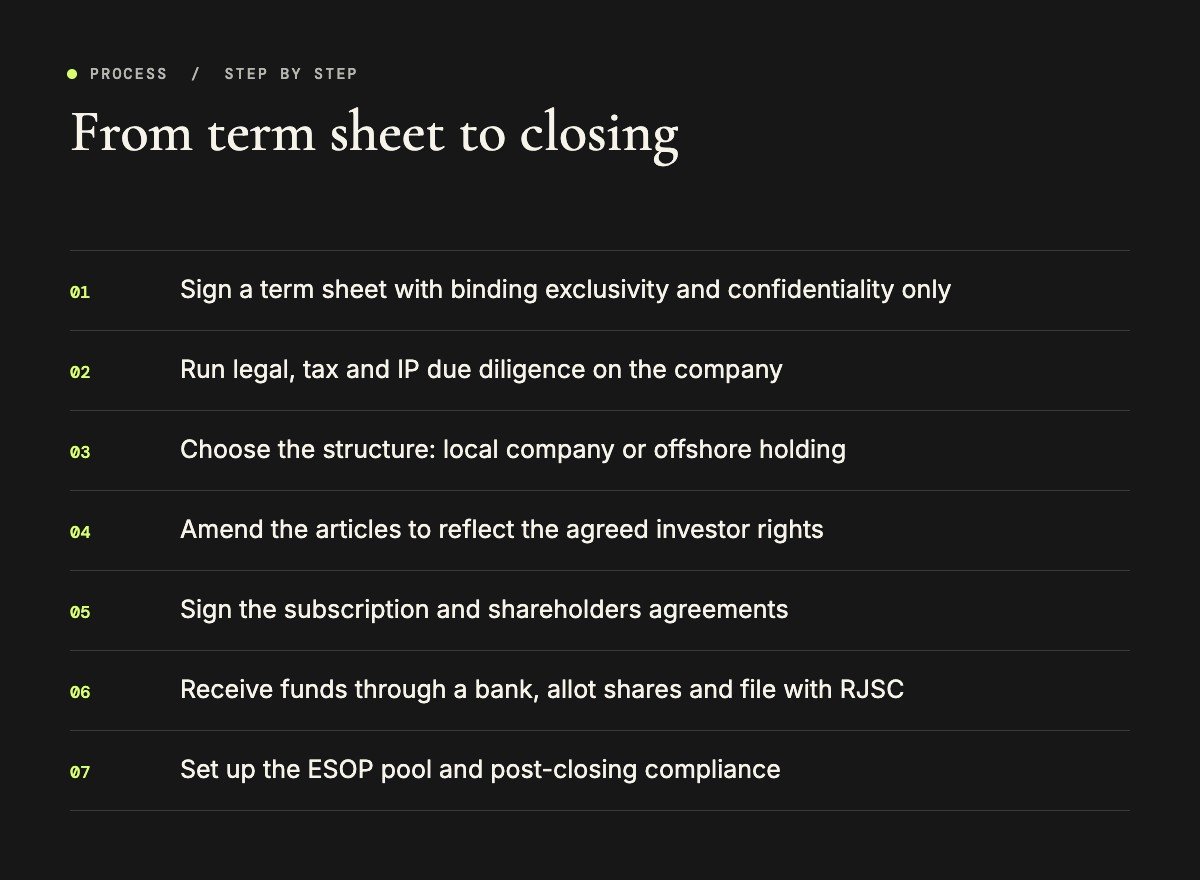
Once terms are agreed, a priced round of venture capital in Bangladesh into a local company usually follows the sequence below. Allow several weeks for bank, RJSC and any regulatory steps, and more for a first foreign investment.
- Agree the term sheet. Settle valuation, round size, investor rights and the ESOP pool. Mark which clauses are binding.
- Run due diligence. Investors review incorporation documents, share history, licences, tax filings, employment contracts, IP ownership and material contracts. Gaps found here become conditions precedent.
- Decide the structure. Confirm whether investment goes into the local company or an offshore holding, and plan any approvals and tax filings.
- Prepare corporate approvals. Increase authorised capital if needed, create any new share class and amend the articles by special resolution.
- Sign the long-form documents. Typically a share subscription agreement, a shareholders agreement and disclosure letter, with the amended articles annexed.
- Receive funds and allot shares. Funds must arrive through a bank; the board allots shares, issues share certificates and files the allotment and amended articles with RJSC.
- Complete post-closing steps. Update registers, register the investment where required, adopt the ESOP plan and diarise reporting covenants.
Depending on the company's form and the size of the raise, a capital increase may also engage BSEC rules on issue of capital. Check this early with your adviser; our guide to share transfers covers related RJSC filings.
ESOPs for startups in Bangladesh
Employee share option plans are the main tool startups use to compete for talent against multinationals and banks. Yet Bangladesh has no specific ESOP statute for private companies, and that gap shapes how plans must be drafted.
Building an ESOP under the Companies Act 1994
A private company can grant contractual options to employees and issue shares on exercise, provided its articles allow it and authorised capital is reserved for the pool. The plan rules, a board resolution creating the pool and individual grant letters do the work that a statutory regime does elsewhere.
The biggest practical problem is leavers. Bangladeshi company law does not give private companies a general power to buy back their own shares. A plan that relies on the company repurchasing a leaver's shares will not work. Common solutions include granting options that lapse on departure if unvested, giving founders or other shareholders a call option over a leaver's shares, or holding the pool through an employee trust.
Phantom and offshore plans
Some startups use phantom equity, a cash bonus linked to share value, to avoid issuing shares at all. Others grant options in the offshore parent. A Bangladeshi resident employee acquiring shares in a foreign company engages foreign exchange rules, so offshore options need Bangladesh Bank clearance or a structure that fits current permissions.
Tax on options
The tax point and treatment of employee options under the Income Tax Act 2023 are not well settled in practice, and the FY2026-27 budget did not add a dedicated ESOP regime. Take tax advice before granting options, document the exercise price carefully and consider the employee's position at grant, vesting, exercise and sale. Our tax practice can help.
Foreign exchange rules for venture capital in Bangladesh
Foreign exchange is where many deals slow down. Three rules matter most for venture capital in Bangladesh:
- Inward remittance. Share capital from a non-resident must arrive through the banking channel. Keep the encashment certificate; it is needed for future repatriation.
- Pricing transfers. When a resident sells shares to a non-resident, or the reverse, banks apply Bangladesh Bank requirements on fair value, usually supported by a valuation from a chartered accountant.
- Repatriation. Dividends and sale proceeds can be remitted abroad through an authorised dealer bank with supporting documents and tax clearance. Bangladesh Bank has eased the process for share transfer proceeds in recent circulars; confirm current documentation with the bank.
For a wider view of investment registration and repatriation, see our foreign direct investment practice and the foreign exchange pages of Bangladesh Bank.
Due diligence issues in venture capital in Bangladesh
Diligence on a Bangladeshi startup tends to surface the same problems. Fixing them before a term sheet is signed keeps the valuation intact and shortens the closing timetable.
- Share history. Allotments not filed with RJSC, transfers without proper instruments or stamp duty, and informal promises of equity to early employees or advisers.
- IP ownership. Code, brand and designs created by founders or freelancers before incorporation and never assigned to the company. Trademark filings in a founder's personal name are common.
- Licences. Fintech, health, telecom-adjacent and e-commerce businesses may need sector licences or registrations; operating without them is a material risk for any investor.
- Tax and VAT. Missing withholding on payments to freelancers and foreign service providers, and VAT on imported services, which can create liabilities larger than the round.
- Employment. Staff engaged as consultants who are in substance employees, and no written confidentiality or invention assignment terms.
Investors in venture capital in Bangladesh usually deal with these points as conditions precedent or specific indemnities. Founders who run a short pre-diligence review with counsel before fundraising are in a much stronger negotiating position, and the cost is small compared with a delayed close.
Shareholders agreements and the articles
Founders often treat the shareholders agreement as the real deal and the articles as a formality. In Bangladesh that is risky. A shareholders agreement binds only the parties who sign it. The articles bind the company and every shareholder, present and future.
Every protection that matters to an investor in venture capital in Bangladesh, such as board rights, reserved matters, pre-emption, transfer restrictions, drag and tag and liquidation preference, should be mirrored in the articles. The shareholders agreement should then say that the parties will vote to amend the articles if the two documents conflict.
Disputes and governing law
Investors often want foreign law and arbitration in Singapore. A foreign governing law for the shareholders agreement is generally respected, but matters of corporate capacity and share registration remain subject to Bangladeshi law. An arbitration award from abroad must be enforced through the Bangladeshi courts under the Arbitration Act 2001.
Exits from venture capital in Bangladesh
Exits remain the weakest link in venture capital in Bangladesh. Trade sales to regional buyers are the most common route, usually at the offshore holding level. Domestic IPOs are possible on the SME platform or main board of the stock exchanges but remain rare for technology companies. Secondary sales to later-stage funds happen, but the market is thin.
Exit planning should start at the first round. Clean share records, a consistent cap table, IP assigned to the company and tax-compliant ESOP grants are what buyers check first. A Bangladeshi company that has followed RJSC and Bangladesh Bank processes at each round is far easier to sell than one that has not.
Frequently asked questions about venture capital in Bangladesh
Do foreign VC funds need a BSEC licence to invest in Bangladesh?
Not for direct investment in a company. BSEC's Alternative Investment Rules regulate funds set up and offered in Bangladesh. A foreign fund investing directly follows company law, foreign exchange rules and any investment registration requirements.
Can a Bangladeshi startup issue preference shares to investors?
Yes. The Companies Act 1994 allows preference shares, and their rights should be set out in the articles. Variation of class rights later requires the statutory process.
Is a Delaware or Singapore flip allowed?
Bangladesh Bank's March 2025 circular lets startups set up a foreign entity with up to USD 10,000 and says it will consider share-swap proposals. Each flip still needs proper reporting, valuation and tax analysis.
How should a startup handle shares of employees who leave?
Because private companies generally cannot buy back their own shares, plans usually let unvested options lapse and give founders, other shareholders or an employee trust a right to buy vested shares.
Are the 2026 BSEC changes to AIF rules in force?
At the time of writing they were published as a draft amendment. Check the BSEC website for the final gazetted text before relying on them.
How we can help
We act for founders, startups and investors on venture capital in Bangladesh: term sheets, due diligence, subscription and shareholders agreements, articles, ESOPs, offshore structuring and Bangladesh Bank filings. Learn more about our private equity and venture capital practice.
Raising or investing in a round?
We turn your term sheet into documents that work under the Companies Act 1994 and Bangladesh Bank rules, and manage the filings to closing.
Book a consultationPrivate equity practicePrimary sources: the Companies Act 1994 on the Laws of Bangladesh portal; the Alternative Investment Rules 2015 and 2026 draft amendment from BSEC; Foreign Exchange Investment Department circular of 27 March 2025 from Bangladesh Bank; LightCastle Partners H1 2026 startup investment data reported in the Dhaka Tribune (July 2026).
This article is general information about Bangladeshi law as of October 2026 and is not legal advice. Fund rules, foreign exchange circulars and tax incentives change frequently; confirm the current position with BSEC, Bangladesh Bank or a qualified lawyer before acting.


0 Comments