
A public private partnership in Bangladesh is a long-term contract in which a private company finances, builds or operates public infrastructure or services under the PPP Act 2015. Since August 2026 the PPP Authority has been part of Invest Bangladesh, so investors need to know both the settled legal framework and what the merger has changed.
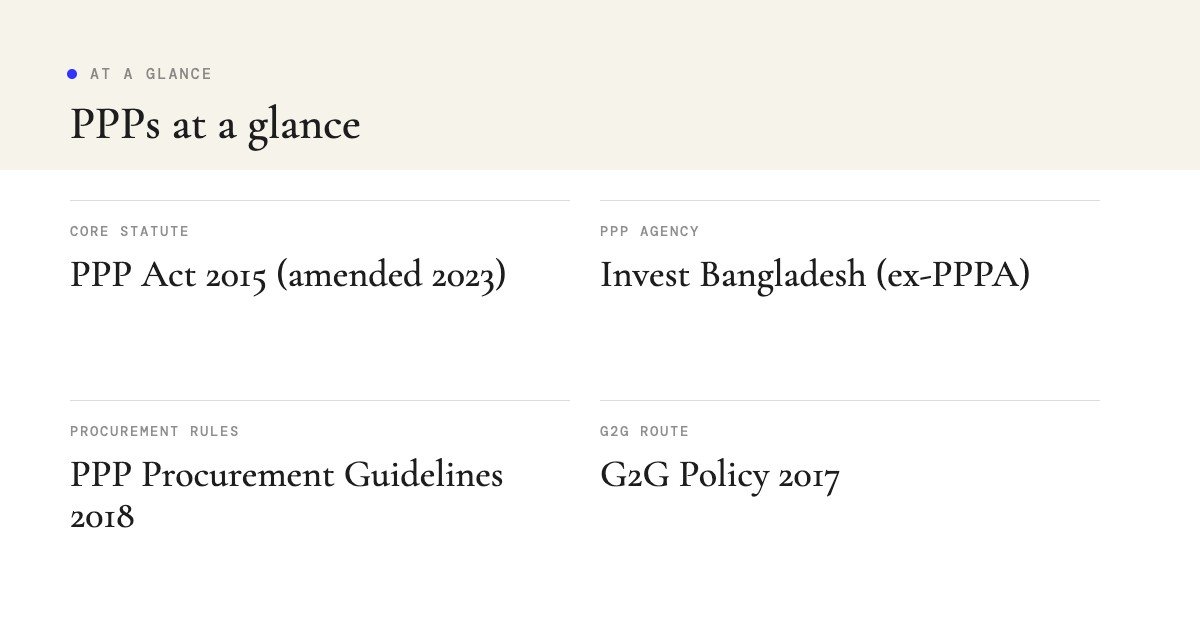
- The PPP Act 2015, amended in 2023, remains the governing statute, supported by the 2018 procurement and unsolicited-proposal guidelines and the G2G Policy 2017.
- The Invest Bangladesh Act 2026 merged the PPP Authority with BIDA and BEZA; the Act was gazetted on 20 August 2026 and the new agency began work on 23 August 2026.
- The PPP Authority's assets, records, contracts and staff moved to Invest Bangladesh, so existing projects continue, and the new law provides simpler approval routes for small PPP projects.
- Viability gap financing, the PPP technical assistance fund and tax and VAT exemptions are the main forms of state support.
- Recent deals, such as the Laldia container terminal concession signed in November 2025, show the G2G route in action and the political scrutiny that follows.
What a public private partnership in Bangladesh is
The Bangladesh Public-Private Partnership Act 2015 provides the legal basis for PPPs. It allows a ministry, division or public body, called the contracting authority, to enter into a long-term contract with a private partner to deliver infrastructure or a public service. The private partner usually raises finance, builds or upgrades the asset, operates it for a set period and earns revenue from users, from the state, or from both.
A public private partnership in Bangladesh is different from ordinary public procurement. In a normal works contract the government pays a contractor to build and then owns and runs the asset. In a PPP, the private partner takes on long-term performance risk and is paid according to how well the asset works over decades.
Common PPP models
The Act is flexible about structure. Projects have used build-operate-transfer, build-own-operate, build-own-operate-transfer, concessions of existing assets, lease and operation and maintenance models. Sectors that have used a public private partnership in Bangladesh include ports, roads and expressways, power, economic zones, health, water, waste and urban transport.
Public private partnership in Bangladesh after the Invest Bangladesh merger
The most significant institutional change in a decade came in August 2026. The Invest Bangladesh Act 2026 merged the Bangladesh Investment Development Authority, the Bangladesh Economic Zones Authority and the Public-Private Partnership Authority into one agency under the Prime Minister's Office. The Act was gazetted on 20 August 2026, and Invest Bangladesh began work on 23 August 2026 under its chairman, Ashik Chowdhury.
What moved across
Reports on the new law state that the assets, records, contracts, liabilities and employees of the three bodies transferred to Invest Bangladesh, with regular staff moving to equivalent posts. Invest Bangladesh's own announcement describes PPP support as one of its core functions and says the Act provides clearer approval frameworks for PPPs, including simpler routes for small projects. BanglaBiz remains the single digital platform for investment services.
What has not changed
The PPP Act 2015 still governs how a public private partnership in Bangladesh is identified, procured, approved and contracted. Contracting authorities remain the line ministries and agencies. Signed concession agreements remain binding, and contracts to which the PPP Authority was party transferred to Invest Bangladesh.
The full text of the consequential changes to the PPP Act 2015 and its guidelines was not widely available when this article was written. Until it is, read references to the PPP Authority in contracts and guidelines as references to Invest Bangladesh, and confirm with the agency which officers and committees now handle screening, approvals and support funds for your project.
The legal framework for PPP projects
Several instruments work together. The table below lists the main ones and what each covers.
| Instrument | What it covers |
|---|---|
| PPP Act 2015 | Definitions, contracting authorities, project approval, procurement principles, support mechanisms, disputes |
| PPP (Amendment) Act 2023 | Changes to the governance of the PPP Authority |
| Invest Bangladesh Act 2026 | Merger of the PPP Authority into Invest Bangladesh; simpler routes for small PPPs |
| Procurement Guidelines for PPP Projects 2018 | Competitive procurement stages, evaluation and award |
| Guidelines for Unsolicited Proposals 2018 | When and how a privately originated proposal can be considered |
| Policy for G2G Partnership 2017 | Projects with partners nominated by a foreign government |
| Viability Gap Financing Rules 2018 | Government grants to make socially valuable projects financially viable |
| PPP Technical Assistance Financing Rules 2018 | Funding for feasibility studies and transaction advisers |
| PPP Project Screening Manual 2020 | Tests for whether a project suits PPP |
Sector laws apply alongside. A power PPP also engages the BERC Act 2003 and the Electricity Act 2018; a port PPP engages the port authority's own legislation; any project with environmental impact needs clearance under the Environment Conservation Act 1995 and the Environment Conservation Rules 2023. The texts of the statutes are on the Laws of Bangladesh portal, and the guidelines have been published on the PPP Authority website.
The PPP project lifecycle
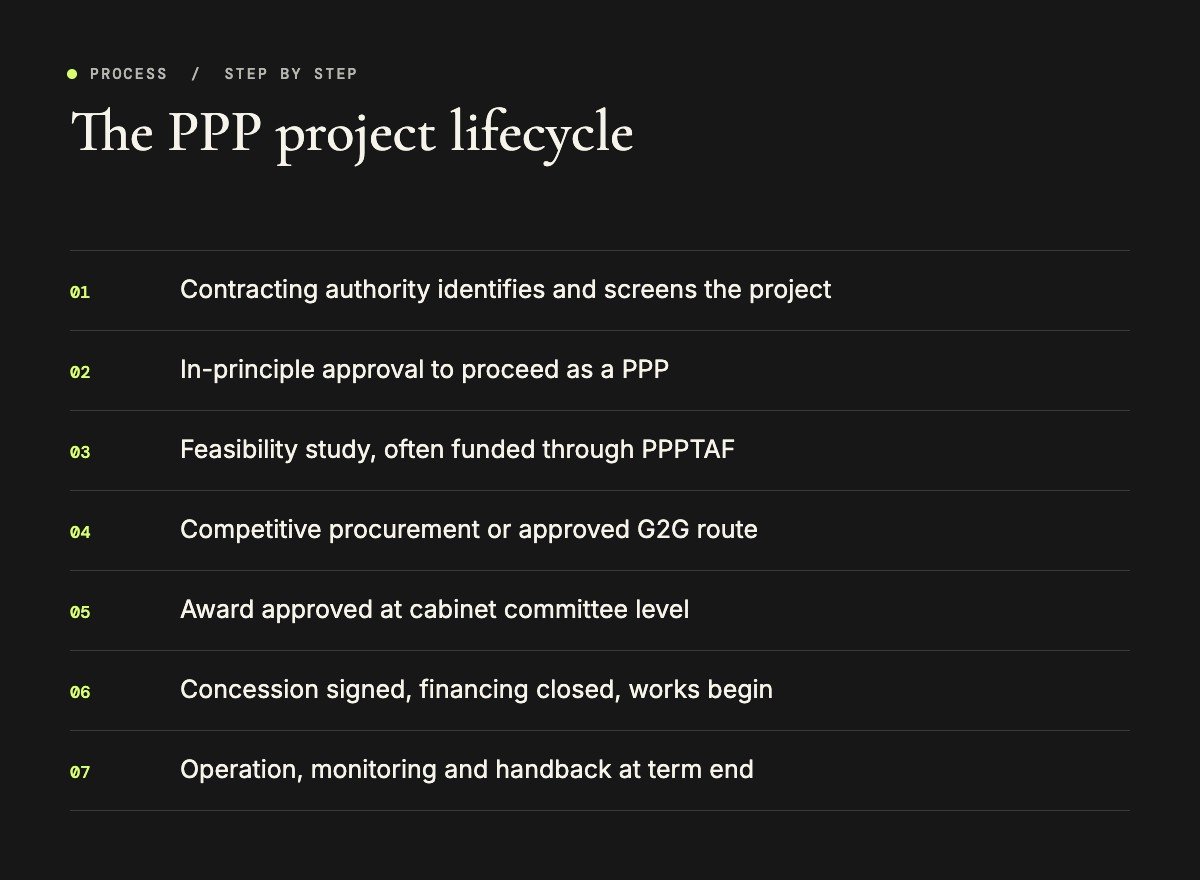
Every public private partnership in Bangladesh moves through broadly the same stages. Knowing where a project sits tells an investor what can still be negotiated and what is fixed.
- Identification and screening. The contracting authority proposes the project and it is screened against the PPP Project Screening Manual to test whether PPP is the right delivery model.
- In-principle approval. The project receives approval at the highest executive level to proceed as a PPP and enters the pipeline.
- Feasibility and structuring. Technical, financial, legal and environmental studies are carried out, often funded through the technical assistance scheme, and transaction advisers are appointed.
- Procurement. The project is tendered, usually through qualification and then request for proposals, or follows the approved G2G or unsolicited route.
- Award approval. The preferred bidder is approved by the cabinet committee on economic affairs before the letter of award issues.
- Contract and financial close. The concession agreement and related documents are signed, conditions precedent are met and lenders disburse.
- Construction, operation and handback. The private partner builds and operates under performance standards and transfers the asset at the end of the term where the model requires it.
The Laldia terminal illustrates the final approval steps: the economic affairs committee approved the deal on 12 November 2025, the head of government approved it on 16 November, and the concession and letter of award were signed on 17 November 2025.
Monitoring, variations and handback
Signing is the start of a relationship that may last thirty years or more. During operation, the contracting authority monitors performance against the output specification, applies deductions for failures and approves tariff adjustments under the agreed formula. Independent engineers often certify construction milestones and operational performance.
Variations are inevitable over such a long term. A good concession sets out who may propose a change, how cost and time effects are valued and how disputes over valuation are resolved. At the end of the term, handback provisions require the asset to be returned in a defined condition, usually backed by a handback survey several years before expiry and a maintenance reserve or retention. Investors who ignore handback until the final years often face expensive claims.
Procurement routes: open tender, unsolicited and G2G
The default route for a public private partnership in Bangladesh is open, competitive procurement under the 2018 Procurement Guidelines. Qualification narrows the field, a request for proposals sets the draft contract and output specification, and bids are evaluated on technical and financial criteria.
Unsolicited proposals
The PPP Act 2015 allows unsolicited proposals in limited circumstances, and the Guidelines for Unsolicited Proposals 2018 set out how they are assessed. After the 2024 experience with directly negotiated power contracts, any unsolicited proposal now attracts close scrutiny. Expect the authority to test value for money carefully and to favour competition wherever it is practicable.
Government-to-government partnerships
Under the G2G Policy 2017, Bangladesh may sign a framework with a foreign government, which then nominates companies to develop specific projects. The Laldia container terminal at Chattogram is a recent example: the Chittagong Port Authority signed a concession with APM Terminals, part of the Maersk group, under the PPP Act 2015, the G2G Policy 2017 and the 2018 Procurement Guidelines. The deal involves an investment of about USD 550 million over a three-year construction period and a thirty-year operating term.
In July 2026 the shipping minister told Parliament the government had no plan to cancel or renegotiate it. That statement is useful, but it also shows that G2G deals face political questions about transparency long after signing.
Government support for a public private partnership in Bangladesh
The state supports PPPs in several ways. Investors should identify early which forms of support the project needs, because each has its own application process and timetable.
- Viability gap financing. A capital or annuity grant under the 2018 Rules for projects that are economically justified but cannot earn enough revenue to attract private finance on their own.
- Technical assistance financing. Funding for feasibility studies and transaction advisers, usually repaid by the successful bidder at financial close.
- Infrastructure finance. Long-term local currency lending through the Bangladesh Infrastructure Finance Fund, subject to its own criteria.
- Tax and duty exemptions. VAT and customs exemptions for qualifying PPP projects have been granted by orders and SROs; confirm that the exemption applies to your project and has not been withdrawn by a later Finance Act.
- Contractual support. Land provision, minimum revenue arrangements, availability payments and termination compensation, negotiated project by project.
Treat every support measure as something to be documented in the concession agreement, not assumed from policy. Policies can be revised; signed contractual commitments are far harder to withdraw.
Key terms in a PPP concession agreement
The concession agreement is the heart of any public private partnership in Bangladesh. The table summarises how the main risks are usually shared and what investors and lenders look for.
| Risk or term | Usual allocation | What to check |
|---|---|---|
| Land and site access | Contracting authority | Clear title, delivery dates and compensation for late handover |
| Design and construction | Private partner | Long-stop dates, delay damages and change procedures |
| Demand and revenue | Depends on model: user-pay or availability | Tariff setting, indexation and any minimum revenue support |
| Operation and performance | Private partner | Measurable key performance indicators and deduction regime |
| Change in law | Usually shared or public | Definition of law and compensation formula |
| Foreign exchange | Often private, sometimes shared | Currency of tariff, convertibility and repatriation rights |
| Force majeure | Shared; political events usually public | Relief, extension and termination compensation |
| Termination | Depends on cause | Compensation on authority default, private default and prolonged force majeure |
Lender protections
Project lenders need a direct agreement with the contracting authority that gives notice of defaults, extra cure time and the right to step in or substitute the operator. They also need assurance that termination compensation covers outstanding senior debt in most scenarios. Foreign-currency loans must meet Bangladesh Bank requirements, and our project finance team regularly negotiates these terms.
Practical risks for investors in 2026
A public private partnership in Bangladesh operates in a changing political and institutional environment. The main practical risks today are:
- Institutional transition. Teams, committees and approval routes inside Invest Bangladesh are being formed gradually, so timelines for pending approvals may slip.
- Review of past deals. After the 2024 changes, contracts awarded without competition are being reviewed, especially in power and energy. Investors in legacy projects should keep their award file complete.
- Land and resettlement. Delays in land acquisition and resettlement remain the most common cause of PPP delay.
- Currency. Taka depreciation since 2022 has made tariff currency and indexation central to bankability.
- Coordination. Projects that cross several agencies, such as a port with road and rail links, depend on others meeting their obligations.
None of these risks is a reason to avoid a public private partnership in Bangladesh. They are reasons to negotiate the concession carefully, keep a complete record of the award process and build realistic buffers into the timetable and financial model.
Preparing a bid for a public private partnership in Bangladesh
Winning a PPP tender is less about price than about credibility. Evaluation committees look for a consortium that can finance, build and operate the asset for decades, and for a bid that accepts the draft contract with as few deviations as possible. From our experience advising bidders, these points make the difference.
Consortium and local partner
Most tenders set qualification thresholds for technical experience and financial capacity, which the consortium meets together. Agree roles, equity shares, lock-in periods and exit rights in a consortium agreement before qualification, not after award. Where a Bangladeshi partner is involved, check its standing, tax compliance and any past disputes with the contracting authority.
Reading the draft concession
The draft contract issued with the request for proposals is the real offer. Mark every clause that lenders will not accept, especially termination compensation, change in law and currency, and raise them through formal pre-bid queries. Clarifications issued to all bidders become part of the tender; side conversations do not.
Financing plan
Bidders for a public private partnership in Bangladesh are usually asked for evidence of committed or highly confident finance. Engage lenders before submission, share the draft concession with them and record their key conditions. A bid that lenders later refuse to support will not reach financial close, and the bid security may be forfeited.
Special purpose company
The successful bidder normally incorporates a project company in Bangladesh to sign the concession. Plan its articles, shareholding, board and foreign investment registration early. Our company formation guide explains the incorporation steps.
Disputes under PPP contracts
Contracts for a public private partnership in Bangladesh normally provide a tiered process: negotiation between senior representatives, then an independent expert or dispute board for technical issues, then arbitration. Domestic projects often choose arbitration seated in Dhaka under the Arbitration Act 2001. Larger projects, particularly G2G deals and those with foreign lenders, may choose a foreign seat and institutional rules.
Whichever route is chosen, include a waiver of sovereign immunity for the contracting authority, a clear mechanism for interim relief and an agreed approach to enforcement in Bangladesh. Our international arbitration practice advises on these clauses before signing and on disputes afterwards.
Frequently asked questions about public private partnership in Bangladesh
Does the PPP Authority still exist?
No. It merged with BIDA and BEZA into Invest Bangladesh under the Invest Bangladesh Act 2026. Invest Bangladesh began work on 23 August 2026 and now performs the PPP functions.
Is the PPP Act 2015 still in force?
Yes. The PPP Act 2015, amended in 2023, still governs PPP projects. The merger changed the institution, not the basic statutory framework. Check whether consequential amendments affect your project.
Are existing PPP contracts affected by the merger?
Contracts of the PPP Authority transferred to Invest Bangladesh, and contracts signed by contracting authorities remain binding. Existing concession agreements continue in force.
Can a private company propose a PPP project itself?
Yes, through an unsolicited proposal, but only in limited circumstances under the PPP Act 2015 and the 2018 guidelines. Expect close scrutiny and a strong preference for competition.
Who gives final approval to a PPP award?
The award is approved at cabinet committee level before the letter of award issues, as the Laldia terminal approvals in November 2025 illustrate.
How we can help
We advise sponsors, lenders, contractors and public bodies on every stage of a public private partnership in Bangladesh: screening and bid strategy, concession negotiation, financing, approvals with Invest Bangladesh and disputes. Learn more about our infrastructure and energy practice.
Bidding for or managing a PPP project?
We review tender documents and concession agreements, map the approvals after the Invest Bangladesh merger, and protect your position through financial close and beyond.
Book a consultationInfrastructure and energyPrimary sources: the PPP Act 2015 on the Laws of Bangladesh portal; PPP guidelines and rules published by the PPP Authority; the launch announcement of Invest Bangladesh (August 2026); reporting in the Daily Observer (21 August 2026) and UNB (13 July 2026).
This article is general information about Bangladeshi law as of October 2026 and is not legal advice. Institutional arrangements for PPPs are in transition after the Invest Bangladesh merger; confirm current procedures with Invest Bangladesh or a qualified lawyer before acting.




0 Comments