
Bribery law in Bangladesh rests on two old but powerful statutes, the Penal Code 1860 and the Prevention of Corruption Act 1947, enforced mainly by the Anti-Corruption Commission. For businesses, the practical risk lies in everyday dealings with officials: licences, inspections, customs, tax and land records, where informal payments are often requested.
- Sections 161 to 165A of the Penal Code 1860 make it an offence for a public servant to take, and for anyone to give or abet, gratification other than legal remuneration for official acts.
- The Prevention of Corruption Act 1947 creates the offence of criminal misconduct by public servants, punishable by imprisonment of up to seven years and fine.
- The Anti-Corruption Commission investigates and prosecutes under the ACC Act 2004; a December 2025 amendment ordinance lapsed in April 2026, and a new commission took office in August 2026.
- Bangladeshi law has no exemption for facilitation payments, and private-to-private bribery is addressed indirectly through offences such as criminal breach of trust and money laundering.
- Multinationals also face foreign laws such as the US FCPA and UK Bribery Act for conduct in Bangladesh.
The landscape of bribery law in Bangladesh
Corruption has long been identified as a major cost of doing business in Bangladesh, and anti-corruption has been central to reform debates since 2024. For a company, the question is not abstract. Licences, permits, inspections, tax assessments, customs clearance, utility connections and land records all involve public officials with discretion, and requests for unofficial payments are not unusual.
Bribery law in Bangladesh treats both sides of the transaction seriously. The official who demands or accepts, and the person who offers or pays, can both be prosecuted. Company directors and managers who authorise or tolerate payments by staff or agents face personal exposure, and the payments can also be treated as proceeds of crime under money laundering law.
Key statutes
| Law | What it covers |
|---|---|
| Penal Code 1860, sections 161 to 165A | Public servants taking gratification; taking gratification to influence officials; abetment; obtaining valuable things without consideration |
| Prevention of Corruption Act 1947 | Criminal misconduct by public servants, including disproportionate assets |
| Anti-Corruption Commission Act 2004 | Establishes the ACC, its powers of inquiry, investigation and prosecution, and asset declaration orders |
| Criminal Law Amendment Act 1958 | Special Judges' courts to try corruption offences |
| Money Laundering Prevention Act 2012 | Treats corruption and bribery as predicate offences; allows freezing and confiscation |
| Public Interest Information Disclosure (Provide Protection) Act 2011 | Protection for whistleblowers who disclose wrongdoing in good faith |
Penal Code offences
Section 161 of the Penal Code makes it an offence for a public servant, or a person expecting to be one, to accept or obtain, or agree or attempt to obtain, any gratification other than legal remuneration as a motive or reward for doing or forbearing to do an official act, or for showing favour or disfavour. The definition of gratification is broad and is not limited to money.
Sections 162 and 163 cover taking gratification to influence a public servant by corrupt or illegal means, or by personal influence. Section 164 punishes a public servant who abets these offences. Section 165 covers a public servant obtaining a valuable thing without consideration from a person concerned in proceedings or business with them. Section 165A punishes abetment of offences under sections 161 and 165, which is the provision most directly relevant to the person who offers or gives a bribe.
Who is a public servant
The Penal Code defines public servant widely. It covers government officers, judges, police, officers of local authorities and many employees of statutory corporations and government-owned companies. Officials of state banks, utilities and port authorities are often within the definition, as are certain officers of bodies that receive substantial public funding. When in doubt, treat the counterparty as a public servant under bribery law in Bangladesh.
The Prevention of Corruption Act 1947
The Prevention of Corruption Act 1947 creates the offence of criminal misconduct in the discharge of official duty. A public servant commits criminal misconduct by habitually accepting gratification, obtaining valuable things without adequate consideration, dishonestly misappropriating property entrusted to them, abusing their position to obtain advantage for themselves or another, or possessing assets disproportionate to known sources of income that they cannot satisfactorily account for.
Criminal misconduct is punishable with imprisonment of up to seven years and fine, and property obtained through the offence may be confiscated. Cases are tried by Special Judges under the Criminal Law Amendment Act 1958. The disproportionate assets provision is frequently used in ACC cases against officials and, by extension, can implicate those who funded the assets.
Payments routed through relatives of officials, consultancy agreements with officials' associates or "gifts" to family members are treated the same as direct payments. Investigators follow the money, not the label. A contract with a well-connected consultant who provides no real service is a common route to prosecution.
The Anti-Corruption Commission
The Anti-Corruption Commission (ACC), established under the ACC Act 2004, is the principal authority for inquiring into, investigating and prosecuting corruption offences under the Penal Code, the Prevention of Corruption Act and certain money laundering offences. It can summon persons, require production of documents, order asset declarations, seek court orders to freeze property and file charge sheets.
The ACC's framework has changed recently. An ACC amendment ordinance made in December 2025 lapsed on 11 April 2026 when it was not enacted by Parliament, so the ACC Act 2004 applies as it stood before. A new commission took office on 19 August 2026. Companies should expect active enforcement, including high-profile asset recovery work begun since 2024. Information about the Commission is on the ACC website.
How ACC cases start
- Complaints from the public, including anonymous complaints.
- Referrals from other agencies, audit reports and media investigations.
- Intelligence from the BFIU on suspicious transactions.
- Trap cases, where an official is caught accepting a marked payment.
Facilitation payments and gifts
Some foreign laws, such as the US Foreign Corrupt Practices Act, contain a narrow exception for small facilitation payments to speed up routine government action. Bribery law in Bangladesh contains no such exception. A small payment to a clerk to process a licence faster is gratification under the Penal Code. Companies should therefore prohibit facilitation payments entirely, with a narrow exception for payments made under threat to personal safety, recorded and reported immediately.
Gifts and hospitality
Modest gifts and hospitality are part of business culture, especially around festivals. The risk is that gifts to officials, particularly those with pending matters, are treated as gratification. A sensible policy:
- Prohibits cash and cash equivalents to public officials in all cases.
- Sets a low value limit for gifts and requires approval and recording above it.
- Bans gifts and hospitality to officials while they are deciding a matter affecting the company.
- Keeps hospitality reasonable, business-related and transparent.
- Records all gifts given and received in a register reviewed by compliance.
Public servants are themselves subject to conduct rules that restrict accepting gifts. A company that pushes gifts on officials puts both the official and itself at risk under bribery law in Bangladesh.
Private sector bribery
Bangladesh does not have a general statutory offence of commercial bribery between private parties comparable to section 1 of the UK Bribery Act. That does not make private bribery lawful. Depending on the facts, it may amount to criminal breach of trust, cheating, conspiracy or other Penal Code offences, and the proceeds may be laundered funds under the Money Laundering Prevention Act. Employees who take kickbacks from suppliers breach their duties and can be dismissed and sued.
Many companies therefore apply one standard: no bribes, to anyone. A single policy covering both public and private bribery is simpler to explain and enforce, and it satisfies foreign laws that apply to multinationals.
Foreign anti-bribery laws
Foreign companies and their Bangladeshi subsidiaries often fall under foreign law. The US Foreign Corrupt Practices Act applies to US issuers, US persons and conduct with a US nexus, and the UK Bribery Act 2010 applies to companies that carry on business in the UK, including a corporate offence of failing to prevent bribery by associated persons, with a defence of adequate procedures. Other countries have similar laws.
For these groups, bribery law in Bangladesh is the floor, not the ceiling. Their compliance programmes must meet the stricter of the local and foreign standards, and local managers must understand that a payment considered "normal" locally can trigger enforcement abroad.

Agents, consultants and third parties
Most cases under bribery law in Bangladesh involve intermediaries. Customs agents, clearing and forwarding agents, licensing consultants, land brokers and local partners interact with officials on the company's behalf. If they pay bribes, the company can be implicated, both under bribery law in Bangladesh and under foreign laws.
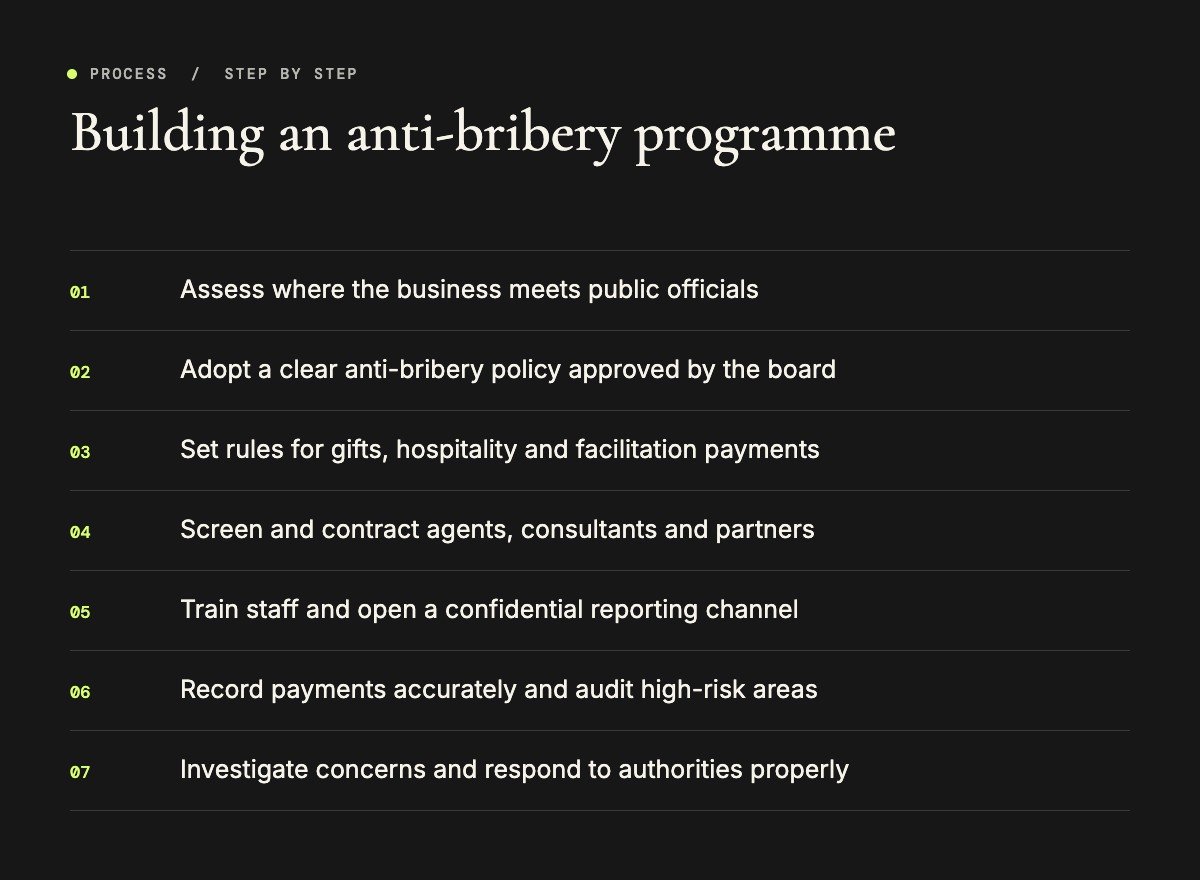
- Need. Confirm there is a genuine business need for the intermediary and a clear scope of work.
- Due diligence. Check ownership, reputation, connections to officials, past allegations and qualifications.
- Fair fees. Make sure compensation is reasonable for the services, paid by bank transfer to an account in the intermediary's name.
- Contract. Include anti-bribery warranties, audit rights, termination rights and a duty to report requests for payments.
- Training. Brief the intermediary on the company's policy and obtain written certification.
- Monitoring. Review invoices and supporting documents, and watch for red flags such as vague "expenses" or urgent cash requests.
- Response. Investigate concerns promptly and suspend payments if necessary.
Bribery law in Bangladesh and public procurement
Public procurement is one of the highest-risk areas. The Public Procurement Act 2006 and the Public Procurement Rules 2025, in force since 28 September 2025, define corrupt, fraudulent, collusive and coercive practices and allow procuring entities to reject bids, cancel contracts and debar suppliers. The 2025 Rules provide for debarment of up to two years, with a Debarment Review Board to hear challenges.
Debarment is an administrative sanction separate from prosecution under bribery law in Bangladesh, so a company can lose public business even if no criminal case is filed. Bidders should keep records of every meeting with procurement officials, avoid informal contact during evaluation and make sure agents and joint venture partners sign anti-corruption undertakings. Development partner-funded projects add the sanction regimes of lenders such as the World Bank and Asian Development Bank, which can debar companies across many countries.
Customs, tax and licensing
Day-to-day exposure is highest at customs, tax offices, land offices and licensing authorities. Digitisation, such as online applications and e-payment of fees, reduces discretion and contact points. Using official online channels wherever possible, paying all fees through banks and keeping receipts is one of the most effective practical controls under bribery law in Bangladesh.
Responding to a request for a bribe
Under bribery law in Bangladesh, staff and managers need practical guidance for the moment a request is made. A good policy tells them to decline politely, avoid making any commitment, report the request immediately to a manager or compliance, and record the details. The company can then decide how to proceed: escalate within the authority, use official complaint channels, or seek legal advice on reporting to the ACC.
Where a request blocks an essential approval, document the delay and the steps taken through official channels. In some cases, a writ petition or formal complaint is the only lawful route. Our guide to writ cases in Bangladesh explains how unlawful refusals by authorities can be challenged.
Do not "solve" a request by having an agent pay it and invoice the company for a fictitious service. That compounds the offence with false accounting and makes the company's records evidence against it.
Books and records
Accurate accounting is a core control. Every payment to an agent, consultant or official body should be supported by an invoice, a contract and evidence of the service received. Vague entries such as "miscellaneous expenses", "speed money" or round-sum cash advances are classic red flags for auditors and investigators. Companies should require finance teams to reject undocumented payments and escalate repeated requests from the same business unit. Under the Companies Act 1994, directors must keep proper books of account, and false entries can create separate liability alongside any offence under bribery law in Bangladesh.
Investigations and ACC inquiries
If the ACC or another agency contacts the company about bribery law in Bangladesh, take legal advice before responding. Preserve documents, suspend routine deletion, and identify the individuals and transactions involved. Internal investigations should be run under legal supervision so that findings and interviews are handled properly. Employees summoned individually may need separate counsel.
Cooperation can be valuable, but statements should be accurate and considered. Under the Code of Criminal Procedure 1898 and the ACC Act, individuals have rights in questioning, and documents produced can be used in proceedings. Bail and anticipatory bail issues often arise quickly in corruption cases.
Frequently asked questions about bribery law in bangladesh
Is it a crime to pay a bribe in Bangladesh, or only to receive one?
Both. Public servants who take gratification commit offences under the Penal Code and the Prevention of Corruption Act, and those who give or offer bribes can be prosecuted for abetment under section 165A of the Penal Code.
Are small facilitation payments allowed?
No. Bangladeshi law has no facilitation payment exception. Any gratification beyond legal remuneration for an official act is an offence.
Who investigates bribery?
Mainly the Anti-Corruption Commission under the ACC Act 2004. Cases are tried by Special Judges.
Is private-to-private bribery illegal?
There is no general commercial bribery offence, but such conduct can amount to criminal breach of trust, cheating or money laundering, and breaches employment and contract duties.
Can a company be liable for bribes paid by its agent?
Yes, practically and legally. Directors and managers who authorise or knowingly allow payments can be implicated, and foreign laws may impose corporate liability.
Are whistleblowers protected?
The Public Interest Information Disclosure (Provide Protection) Act 2011 offers protection for good-faith disclosures to competent authorities. Companies should also protect internal reporters.
How we can help
We advise companies on bribery law in Bangladesh: risk assessments, policies, gifts and hospitality rules, third-party due diligence, training, internal investigations and representation in ACC inquiries and prosecutions. Learn more about our anti-corruption and bribery practice.
Strengthening your anti-bribery controls?
We build programmes that fit Bangladeshi law and foreign requirements, and we act quickly when an investigation begins.
Book a consultationAnti-corruption practicePrimary sources: the Penal Code 1860, Prevention of Corruption Act 1947, Anti-Corruption Commission Act 2004, Criminal Law Amendment Act 1958 and Money Laundering Prevention Act 2012 on the Laws of Bangladesh portal; information from the Anti-Corruption Commission and the BFIU.
This article is general information about Bangladeshi anti-corruption law as of October 2026 and is not legal advice. The ACC's legal framework changed in 2025 and 2026; confirm the current position with a qualified lawyer before acting.

0 Comments