
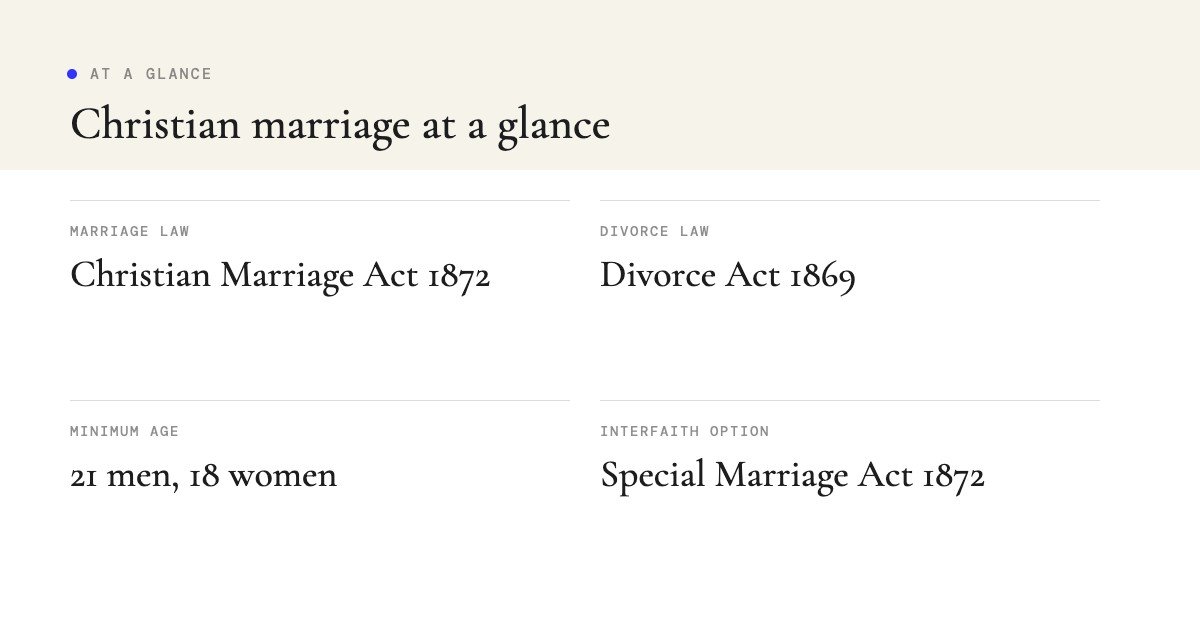
Christian marriage in Bangladesh is governed by the Christian Marriage Act 1872, a colonial-era law that still sets out who may solemnise a marriage, how notice is given and how marriages are registered. Divorce is governed by the Divorce Act 1869. For couples, families and churches, following these formalities matters: a properly solemnised and registered marriage is easier to prove for inheritance, immigration, children's documents and any later family dispute.
- A marriage where one or both parties are Christian must be solemnised under the Christian Marriage Act 1872 to be valid as a Christian marriage.
- Marriages may be solemnised by ordained ministers, licensed ministers or government-appointed Marriage Registrars, following the Act's notice and registration rules.
- The Child Marriage Restraint Act 2017 sets the minimum age at 21 for men and 18 for women for all communities.
- Registration creates the official record; certified copies serve as proof for passports, visas, inheritance and court cases.
- Divorce for Christians is governed by the Divorce Act 1869, which has restrictive grounds that have not been modernised in Bangladesh.
The law governing Christian marriage in Bangladesh
Bangladesh follows a system of personal laws for family matters. For Christians, the Christian Marriage Act 1872 regulates the formation of marriage, and the Divorce Act 1869 regulates divorce, judicial separation and nullity. Other general laws apply alongside them, including the Child Marriage Restraint Act 2017, the Guardians and Wards Act 1890 for children, and the Family Courts Act 2023 for certain family disputes. Christian marriage in Bangladesh therefore sits at the intersection of an old personal law and modern general legislation.
Bangladesh's Christian community, including Catholic, Baptist, Anglican and other denominations, follows church practices as well as the statute. Churches typically combine religious requirements, such as marriage preparation and banns, with the Act's legal formalities. Our family law team advises couples and churches on these requirements.
Who can solemnise a Christian marriage
| Person | Basis of authority | Notes |
|---|---|---|
| Ordained ministers of churches recognised under the Act | Episcopal ordination or church rules | Must follow the Act's formalities |
| Ministers licensed by the government | Licence under the Act | Common for Protestant churches |
| Marriage Registrars appointed under the Act | Government appointment | Civil solemnisation option |
| Licensed persons for certain communities | Licence under specific provisions | Historic provisions for local converts |
A marriage solemnised by someone without authority under the Act may be invalid, so couples should confirm the officiant's authority in advance.
Notice and waiting period
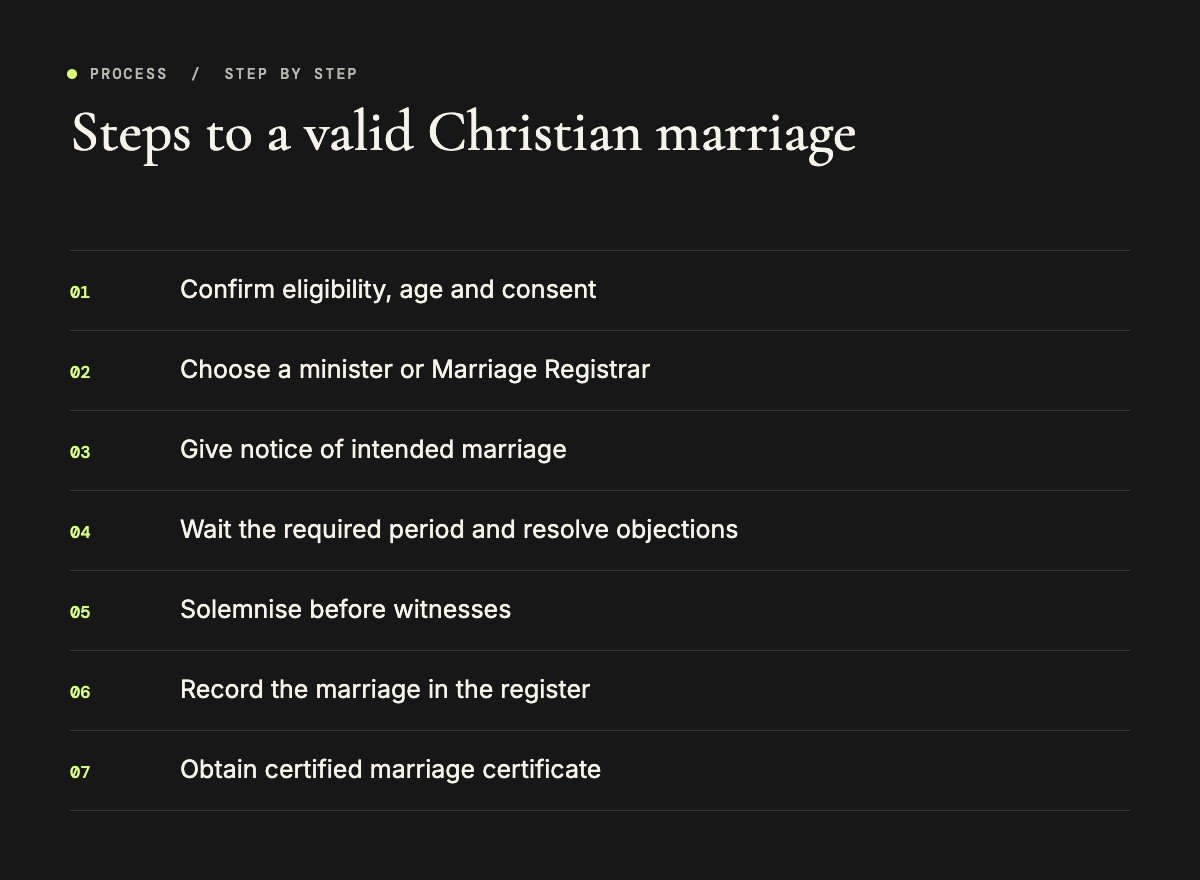
Notice is a core formality of Christian marriage in Bangladesh. The Act requires notice of the intended marriage to be given to the minister or Marriage Registrar, who displays or publishes it as required. The notice allows anyone with a lawful objection, such as an existing marriage or a prohibited relationship, to raise it. After the prescribed period, and if no valid objection is made, the marriage can proceed. Where a party is under the age of majority, parental consent rules historically applied, but today the Child Marriage Restraint Act 2017 prohibits marriage below the minimum ages in any case.
Start the process early. Church requirements, notice periods and document checks can take several weeks, especially if one party is a foreign national or previously married.
Solemnisation and registration
The marriage is solemnised in the presence of the minister or registrar and at least two witnesses, using the form of ceremony of the church or the declarations prescribed by the Act for civil marriages. Immediately afterwards, the details are entered in the marriage register and signed by the parties, the officiant and the witnesses. Copies of entries are sent to the government registrar as required, and the couple receives a marriage certificate. Registration is the legal backbone of Christian marriage in Bangladesh.
If the original certificate is lost, a certified copy can be obtained from the church or the registrar who holds the register. Couples should keep both the church certificate and any government-issued copy safely.
Documents needed
- National ID cards or passports of both parties.
- Birth certificates showing age.
- Baptism or church membership certificates where the church requires them.
- Evidence of the end of any previous marriage, such as a divorce decree or death certificate.
- For foreign nationals, a certificate of no impediment or similar document, translated and legalised or apostilled.
- Photographs and witnesses' identity documents.
Interfaith marriages
When a Christian marries a person of another faith, the couple can marry under the Christian Marriage Act if the requirements are met, but the non-Christian partner's personal law and community expectations should also be considered. Alternatively, the Special Marriage Act 1872 allows a civil marriage, but historically it required parties to declare that they do not profess certain religions, which raises practical difficulties. Interfaith Christian marriage in Bangladesh needs careful advice on validity, inheritance and the religion of children.
Divorce under the Divorce Act 1869
Ending a Christian marriage in Bangladesh is difficult. Christian divorce remains governed by the Divorce Act 1869. Grounds are limited and reflect nineteenth-century attitudes: historically, a husband could seek divorce for adultery, while a wife had to prove adultery coupled with another ground such as cruelty or desertion, or specified matrimonial offences. These provisions have been reformed in India but not in Bangladesh, and they are widely criticised. The Act also provides for judicial separation, nullity, alimony and custody. Divorce petitions are heard by the District Judge, and decrees of dissolution may require confirmation by the High Court Division under the Act. Reform proposals have been discussed for years.
Maintenance, custody and property
Financial rights follow from a valid Christian marriage in Bangladesh. Christian spouses can seek alimony under the Divorce Act and maintenance through other legal routes, including section 488 of the Code of Criminal Procedure for wives and children. Custody and guardianship disputes are decided under the Guardians and Wards Act 1890, with the child's welfare as the paramount consideration. Inheritance among Christians is governed by the Succession Act 1925, which gives widows and daughters defined shares. A valid, registered Christian marriage in Bangladesh is essential to claim these rights.
Foreign nationals marrying in Bangladesh
When one partner is a foreign national, Christian marriage in Bangladesh involves extra steps. The foreign partner usually needs a valid passport and visa, proof of single status such as a certificate of no impediment from their embassy or home authority, and, if previously married, proof of divorce or a spouse's death. These documents must generally be translated into English or Bangla and apostilled or legalised, depending on the issuing country. Some churches also require evidence of baptism or a letter from the foreign partner's home parish.
After the wedding, the couple may need the marriage certificate apostilled by the Ministry of Foreign Affairs for use abroad, for example for a spouse visa. Ensuring that names are spelled exactly as in passports prevents problems later.
Prohibited relationships and void marriages
The Christian Marriage Act requires that neither party has a living spouse and that the parties are not within prohibited degrees of relationship under the law applicable to them. A marriage that breaches these rules may be void. Bigamy is also an offence under the Penal Code. Before the wedding, the minister or registrar will check these points, and the notice procedure allows others to object. Honest disclosure of previous marriages protects the validity of a Christian marriage in Bangladesh.
Church rules and civil law
Churches may have additional requirements, such as marriage preparation courses, banns read on several Sundays, or restrictions on remarriage after divorce. These are matters of church discipline rather than civil law, but they affect whether a particular church will solemnise the marriage. Where church and civil requirements differ, couples can choose a civil ceremony before a Marriage Registrar or another authorised officiant. Understanding both sets of rules helps couples plan a Christian marriage in Bangladesh without surprises.
Proving a marriage years later
Many family disputes and inheritance cases require proof of a marriage that took place decades ago. Certified copies from church registers are usually the best evidence. Where registers are lost or damaged, courts may accept other evidence, such as witnesses, photographs, baptism records of children and long cohabitation as husband and wife. Families should preserve marriage certificates carefully, because proving a Christian marriage in Bangladesh without records can be difficult and expensive.
Reform debates
Christian community organisations and women's rights groups have long called for reform of the Divorce Act 1869 and modernisation of the Christian Marriage Act. Proposals have included equal grounds for divorce for men and women, mutual consent divorce and better maintenance rights. Any reform would require legislation, so couples should follow developments and take advice on the law as it stands. For now, Christian marriage in Bangladesh and its dissolution continue to be governed by the nineteenth-century statutes.
Practical checklist for couples
- Speak to your church or a Marriage Registrar several weeks before the planned date.
- Collect identity, age and civil status documents for both partners.
- Give notice and allow the full waiting period.
- Confirm that the officiant is authorised to solemnise a Christian marriage in Bangladesh.
- Check every detail in the register before signing.
- Obtain the certificate and a certified copy, and store them safely.
Following this checklist makes a Christian marriage in Bangladesh straightforward to prove whenever it matters, whether for a child's passport, a visa or an inheritance.
Children and legitimacy
Children born of a valid marriage are legitimate, and section 112 of the Evidence Act 1872 presumes legitimacy for a child born during a valid marriage or within a set period after its dissolution. Legitimacy affects inheritance under the Succession Act 1925 and the details recorded in birth registration and passports. A properly registered marriage avoids disputes over children's status and rights, and it simplifies applications for national identity documents later in life.
Getting help
Couples unsure about formalities can ask their parish office, a Marriage Registrar or a family lawyer. Those with limited means can seek free advice through district legal aid offices. Early advice is especially useful for interfaith couples, foreign partners and anyone previously married, so that a Christian marriage in Bangladesh is valid from the start.
Frequently asked questions about christian marriage in bangladesh
Which law governs Christian marriages?
The Christian Marriage Act 1872, with divorce under the Divorce Act 1869.
Who can perform the marriage?
Ordained or licensed ministers and government-appointed Marriage Registrars, following the Act's formalities.
What is the minimum age?
Under the Child Marriage Restraint Act 2017, 21 for men and 18 for women.
Is registration required?
Yes. Marriages are entered in a register and copies sent to the government registrar; certificates prove the marriage.
Can a Christian marry a non-Christian?
Yes, subject to legal requirements; take advice on the best route and its consequences.
How do Christians divorce?
By petition under the Divorce Act 1869 on limited grounds, heard by the District Judge.
How we can help
We advise couples, families and churches on Christian marriage in Bangladesh: formalities, documents for foreign nationals, interfaith marriages, certified copies, divorce and separation, maintenance, custody and inheritance. Learn more about our family law team.
Planning a Christian wedding or facing a family dispute?
We make sure your marriage is valid and registered, and protect your rights if problems arise.
Book a consultationAbout usPrimary sources: the Christian Marriage Act 1872, Divorce Act 1869, Special Marriage Act 1872, Child Marriage Restraint Act 2017 and Succession Act 1925 on the Laws of Bangladesh portal; free legal aid information from the National Legal Aid Services Organisation.
This article is general information about Bangladeshi family law as of October 2026 and is not legal advice. Church requirements and procedures vary; take advice from a qualified lawyer and your church before acting.

0 Comments