
With millions of Bangladeshis working in the Emirates and growing trade between the two countries, UAE judgment enforcement in Bangladesh is a practical question for banks, employers, investors and families. A judgment from a Dubai or Abu Dhabi court does not enforce itself in Dhaka. Depending on whether you hold a court judgment or an arbitral award, Bangladeshi law offers different routes, each with its own documents, defences and timelines.
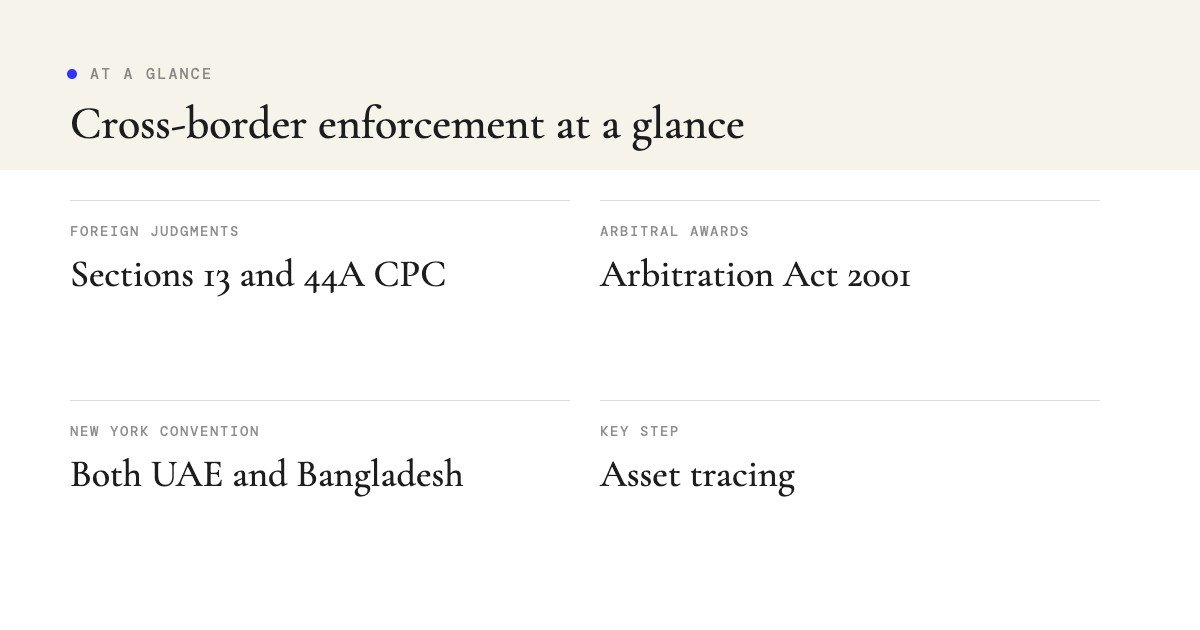
- Foreign judgments can be executed directly in Bangladesh only if the foreign country is notified as a reciprocating territory under section 44A of the Code of Civil Procedure; otherwise a fresh suit on the judgment is needed.
- Under section 13 CPC, a foreign judgment is conclusive between the parties unless one of the statutory exceptions applies, such as lack of jurisdiction, fraud or breach of natural justice.
- Arbitral awards made in the UAE are generally easier to enforce, because both countries are parties to the New York Convention and the Arbitration Act 2001 provides an enforcement route.
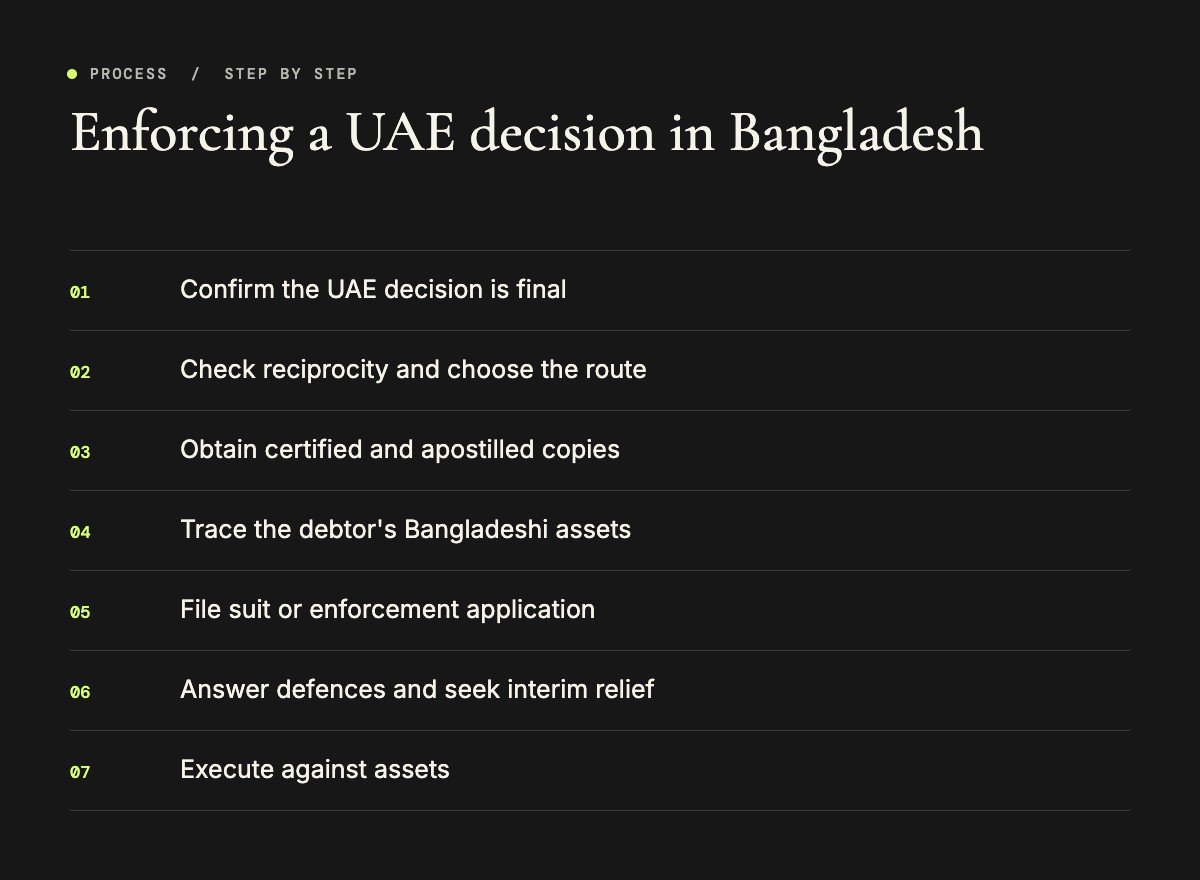
- Certified, translated and apostilled or legalised copies of the UAE decision are essential.
- Enforcement succeeds only where the debtor has assets in Bangladesh, so asset tracing should start early.
The starting point: judgment or award?
The first question in UAE judgment enforcement in Bangladesh is what kind of decision you hold. A judgment of a UAE onshore court, a judgment of the DIFC or ADGM courts, and an arbitral award from DIAC, ADCCAC or another institution are treated differently. Court judgments rely on the Code of Civil Procedure 1908, while arbitral awards rely on the Arbitration Act 2001 and the New York Convention. Choosing the right route at the outset saves time and cost.
Our UAE desk works with UAE counsel to plan enforcement before, during and after proceedings in the Emirates.
Section 44A: reciprocating territories
Section 44A CPC allows a decree of a superior court of a reciprocating territory to be executed in Bangladesh as if it were a local decree, by filing a certified copy with the District Court. Only countries notified by the government qualify. As far as published notifications show, the UAE has not been notified as a reciprocating territory, so UAE judgment enforcement in Bangladesh usually cannot use this direct execution route. Parties should confirm the current list of notified territories before deciding.
Section 13: suing on the UAE judgment
Where section 44A does not apply, the judgment creditor files a fresh suit in Bangladesh based on the foreign judgment. Under section 13 CPC, the foreign judgment is conclusive on matters directly adjudicated between the same parties, except where:
- It was not pronounced by a court of competent jurisdiction.
- It was not given on the merits of the case.
- It appears on its face to be founded on an incorrect view of international law or a refusal to recognise Bangladeshi law where applicable.
- The proceedings were opposed to natural justice.
- It was obtained by fraud.
- It sustains a claim founded on a breach of any law in force in Bangladesh.
Section 14 CPC presumes that a certified copy of a foreign judgment was pronounced by a court of competent jurisdiction unless the contrary appears. In practice, a suit on the judgment for UAE judgment enforcement in Bangladesh focuses on whether any exception applies, rather than re-arguing the original dispute.
Default judgments are vulnerable. If the defendant was not properly served in the UAE or the judgment was not on the merits, a Bangladeshi court may refuse to treat it as conclusive. Keep evidence of service and of the defendant's participation.
Enforcing UAE arbitral awards
Arbitral awards offer a stronger route for UAE judgment enforcement in Bangladesh. Both the UAE and Bangladesh are parties to the 1958 New York Convention. Under the Arbitration Act 2001, a foreign arbitral award from a Convention country can be enforced in Bangladesh by application to the court, and recognition may be refused only on limited grounds similar to those in the Convention, such as incapacity, invalid arbitration agreement, lack of proper notice, excess of jurisdiction, improper tribunal composition, non-arbitrability or public policy. This makes arbitration the stronger route for many commercial parties planning UAE judgment enforcement in Bangladesh. See our enforcement of awards practice.
Documents you will need
- A certified copy of the UAE judgment or award and proof that it is final.
- Evidence of service on the defendant and of the defendant's participation or default.
- For awards, the original or certified arbitration agreement.
- Certified English translations of Arabic documents.
- Legalisation or apostille as required; the UAE is not a party to the Apostille Convention, so UAE documents generally need UAE ministry attestation and Bangladesh mission attestation.
- Information about the debtor's identity and assets in Bangladesh.
Asset tracing in Bangladesh
A judgment is worth only what can be recovered, and asset tracing is central to UAE judgment enforcement in Bangladesh. Before filing, creditors should identify the debtor's Bangladeshi assets, such as land and flats, bank accounts, shares in companies, vehicles and business interests. Land records, RJSC company records and court records can reveal holdings. Many debtors who worked in the UAE invested in land in their home districts. Early asset tracing determines whether UAE judgment enforcement in Bangladesh is commercially worthwhile.
Interim relief
In UAE judgment enforcement in Bangladesh, once proceedings are filed, creditors can apply for temporary injunctions or attachment before judgment under the Code of Civil Procedure to stop the debtor from selling or moving assets. In award enforcement, courts can grant interim measures in support. Interim relief is often the turning point, because it gives the debtor a strong incentive to settle.
Timelines and costs
Timing matters in UAE judgment enforcement in Bangladesh. A suit on a foreign judgment proceeds like other civil suits, and may take considerable time if contested, while award enforcement can be quicker when objections are weak. Court fees are ad valorem for money suits. Translation, attestation and expert costs add up. Creditors should weigh these against the value of recoverable assets and consider settlement at every stage of UAE judgment enforcement in Bangladesh.
DIFC and ADGM court judgments
The Dubai International Financial Centre and Abu Dhabi Global Market have their own common law courts. Their judgments are judgments of UAE courts, so the same Bangladeshi rules apply: unless section 44A is available, a suit on the judgment is needed. Because DIFC and ADGM courts follow common law procedure and give reasoned judgments in English, a Bangladeshi court may find it easier to assess whether a section 13 exception applies. That can make UAE judgment enforcement in Bangladesh smoother when the decision comes from these courts.
Employment and personal debt cases
Many UAE judgments involve personal loans, credit cards or employment disputes against Bangladeshi workers who have returned home. Banks in the UAE sometimes seek to recover these debts in Bangladesh. The economics are often difficult, because the amounts may be modest and the debtor's assets limited. Bangladeshi courts also scrutinise whether the debtor received proper notice of UAE proceedings. Debtors facing such claims should take advice early, as defences based on lack of service or natural justice may be available. Creditors should evaluate recoverable assets before investing in UAE judgment enforcement in Bangladesh for consumer debts.
Commercial disputes and guarantees
Trade between the UAE and Bangladesh includes re-export trade, construction, manpower services and investment. Commercial creditors may hold UAE judgments against Bangladeshi companies or against individual guarantors. Where the contract contained an arbitration clause, enforcing the award is usually the better path. Where only a court judgment exists, the creditor should combine a suit on the judgment with immediate interim relief against identified assets. Corporate debtors' shareholdings and receivables in Bangladesh can be valuable targets for UAE judgment enforcement in Bangladesh.
Defending an enforcement action
A debtor sued in Bangladesh on a UAE judgment can rely on the section 13 exceptions, challenge the authenticity or finality of the judgment, raise limitation and argue that the claim contravenes Bangladeshi law. In award cases, objections must fit within the limited statutory grounds. Debtors should collect evidence about service in the UAE, any lack of opportunity to defend and any irregularities. A well-prepared defence can significantly change the outcome of UAE judgment enforcement in Bangladesh, or create room for a fair settlement.
Practical tips for creditors
- Include arbitration clauses in contracts with Bangladeshi parties where possible.
- Ensure proper service and keep proof during UAE proceedings.
- Obtain certified, translated and attested copies promptly after judgment.
- Trace assets in Bangladesh before filing.
- Seek interim relief immediately after filing.
- Remain open to negotiated settlement throughout.
Following these steps gives UAE judgment enforcement in Bangladesh the best chance of actual recovery.
Bangladeshi judgments in the UAE
The reverse question also arises: can a Bangladeshi judgment be enforced in the UAE? UAE law allows enforcement of foreign judgments subject to conditions, including reciprocity and compliance with UAE public order, and the UAE has its own treaty network. Parties planning cross-border litigation should consider enforcement in both directions before choosing a forum. Where the counterparty's assets are mainly in Bangladesh, choosing arbitration or Bangladeshi courts from the start may avoid the need for UAE judgment enforcement in Bangladesh altogether.
Settlement agreements reached in the UAE can also be drafted to include Bangladeshi security, such as registered mortgages or guarantees, giving the creditor direct remedies in Bangladesh if payments stop.
Choosing local counsel
Select lawyers with experience in both foreign judgment suits and arbitration enforcement, and with the ability to trace assets in the debtor's home district. Good coordination with UAE counsel on documents and evidence makes UAE judgment enforcement in Bangladesh faster and more predictable.
Currency and interest
UAE judgments are usually expressed in dirhams. Bangladeshi courts may convert the amount into taka at an appropriate exchange rate, and questions arise about post-judgment interest. Remitting recovered funds abroad requires compliance with Bangladesh Bank foreign exchange rules, so creditors should plan for conversion and remittance from the outset.
Frequently asked questions about uae judgment enforcement in bangladesh
Can a Dubai court judgment be executed directly in Bangladesh?
Generally no, unless the UAE is notified as a reciprocating territory under section 44A CPC. Usually a suit on the judgment is required.
Is a UAE judgment conclusive in Bangladesh?
Yes under section 13 CPC, unless an exception applies, such as lack of jurisdiction, fraud or breach of natural justice.
Are UAE arbitral awards easier to enforce?
Usually yes, because both countries are New York Convention parties and the Arbitration Act 2001 provides a direct enforcement route.
Do UAE documents need an apostille?
No apostille is available from the UAE; documents generally need UAE attestation and Bangladesh mission attestation.
Can I freeze the debtor's assets?
Yes, by applying for injunctions or attachment before judgment once proceedings are filed.
Is there a time limit?
Limitation rules apply to suits on foreign judgments and to award enforcement, so act promptly.
How we can help
We act for banks, companies and individuals in UAE judgment enforcement in Bangladesh: route selection, document preparation, asset tracing, suits on foreign judgments, award enforcement, interim relief and execution. Learn more about our UAE desk.
Holding a UAE judgment or award against a Bangladeshi party?
We assess recoverability, trace assets and pursue enforcement efficiently.
Book a consultationUAE deskPrimary sources: the Code of Civil Procedure 1908 and Arbitration Act 2001 on the Laws of Bangladesh portal; the text and contracting states of the New York Convention.
This article is general information about cross-border enforcement in Bangladesh as of October 2026 and is not legal advice. Reciprocity notifications and procedures change; confirm the current position with a qualified lawyer before acting.



0 Comments