
For traders, importers, shipping lines and manufacturers in Bangladesh's port city, knowing how the Chittagong commercial court system works is essential. The Commercial Court Ordinance 2026 set out a framework of dedicated commercial courts with pre-suit mediation, alongside existing forums such as the civil courts, the Artha Rin Adalat for bank recovery, the High Court Division's admiralty jurisdiction and arbitration. This guide explains where Chattogram business disputes go and how to run them well.
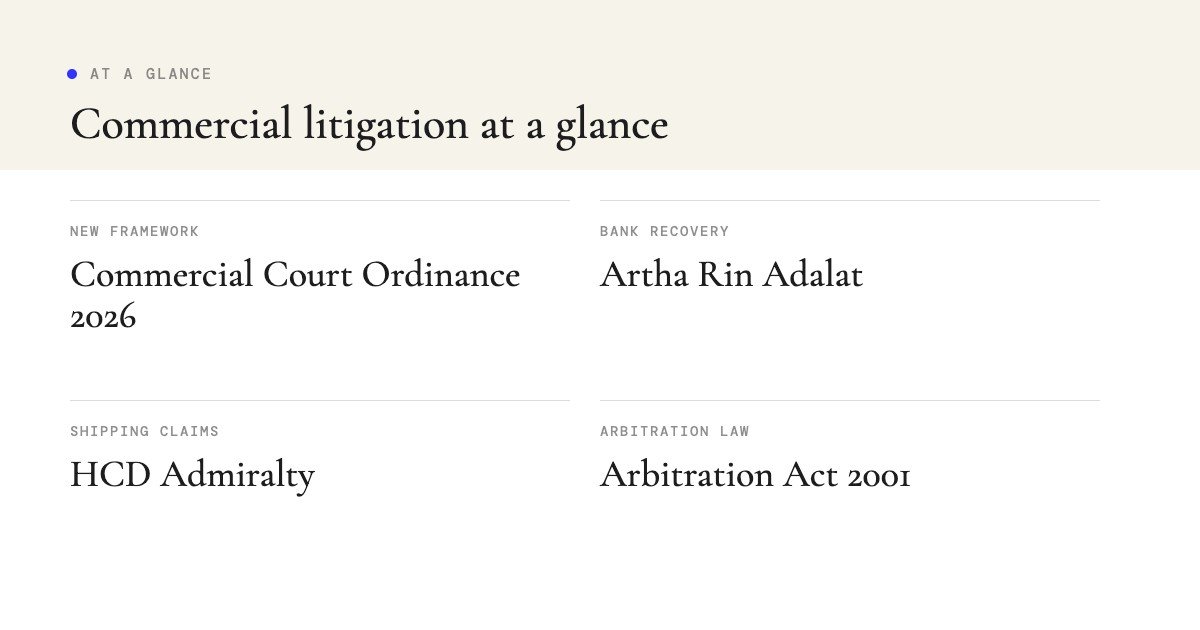
- The Commercial Court Ordinance 2026 provides for commercial courts at district level, commercial appellate benches in the High Court Division and pre-suit mediation; whether Parliament has re-enacted it should be confirmed before relying on it.
- Bank and financial institution recovery claims go to the Artha Rin Adalat under the Artha Rin Adalat Ain 2003, not to ordinary commercial courts.
- Maritime claims against ships, common in Chattogram, fall under the High Court Division's admiralty jurisdiction.
- Arbitration clauses usually oust court jurisdiction over the merits, but courts in Chattogram can grant interim relief and enforce awards.
- Interim measures, such as injunctions and attachment before judgment, are often decisive in commercial cases.
Why a Chittagong commercial court matters
Chattogram handles most of Bangladesh's seaborne trade and hosts the country's main port, export processing zones, steel and cement plants, shipbreaking yards and a dense network of importers, indenting agents and freight forwarders. Disputes over unpaid invoices, letters of credit, supply contracts, cargo damage, leases and partnerships arise every day. A Chittagong commercial court, together with the city's civil courts and specialised forums, is where many of these disputes are resolved.
Historically, commercial cases were heard as ordinary civil suits and could take many years. Reform has aimed to speed up business litigation through dedicated courts, case management and mediation. Our Chattogram practice represents local and international businesses in these forums.
The Commercial Court Ordinance 2026
In early 2026, the Commercial Court Ordinance 2026 was promulgated to establish commercial courts in districts, create commercial appellate benches in the High Court Division and require pre-suit mediation for many commercial disputes. The aim is faster resolution, specialised judges and stronger case management. The framework would cover a Chittagong commercial court for disputes arising in the district above a specified value.
Under the Constitution, an ordinance must be laid before Parliament and lapses if not approved within the prescribed time after Parliament first meets. Parliament met after the February 2026 election, so the continuing status of the Ordinance, or any replacement Act, must be checked before filing. Practitioners should confirm whether the commercial courts are operating in Chattogram and which cases they accept.
Do not assume a dispute belongs in a Chittagong commercial court without checking the current statute, the value threshold and any mandatory mediation requirement. Filing in the wrong forum or skipping a mandatory step can lead to rejection of the plaint and lost time.
Which forum hears which dispute
| Dispute | Usual forum in Chattogram |
|---|---|
| Commercial contract and supply disputes | Commercial court where operating, otherwise civil courts (Joint District Judge or Assistant Judge by value) |
| Bank or finance company loan recovery | Artha Rin Adalat |
| Claims against ships, cargo and charter disputes | High Court Division (Admiralty) |
| Cheque dishonour | Magistrate court under section 138 of the Negotiable Instruments Act 1881 |
| Company winding up and shareholder oppression | High Court Division (Company Bench) |
| Disputes with arbitration clause | Arbitral tribunal, with court support |
Pre-suit mediation
A central feature of the 2026 framework is mediation before filing. Parties to many commercial disputes must attempt mediation through a court-connected or recognised mediator before a suit can proceed. Mediation is confidential and, if successful, produces a settlement that can be enforced. Even outside the Ordinance, the Code of Civil Procedure 1908 encourages alternative dispute resolution, and many disputes heading for a Chittagong commercial court settle at this stage.
Businesses should prepare for mediation as seriously as for trial: clear documents, a realistic view of the claim's value and authority to settle. Our mediation and ADR practice represents clients in commercial mediations.
Bringing a claim: practical steps
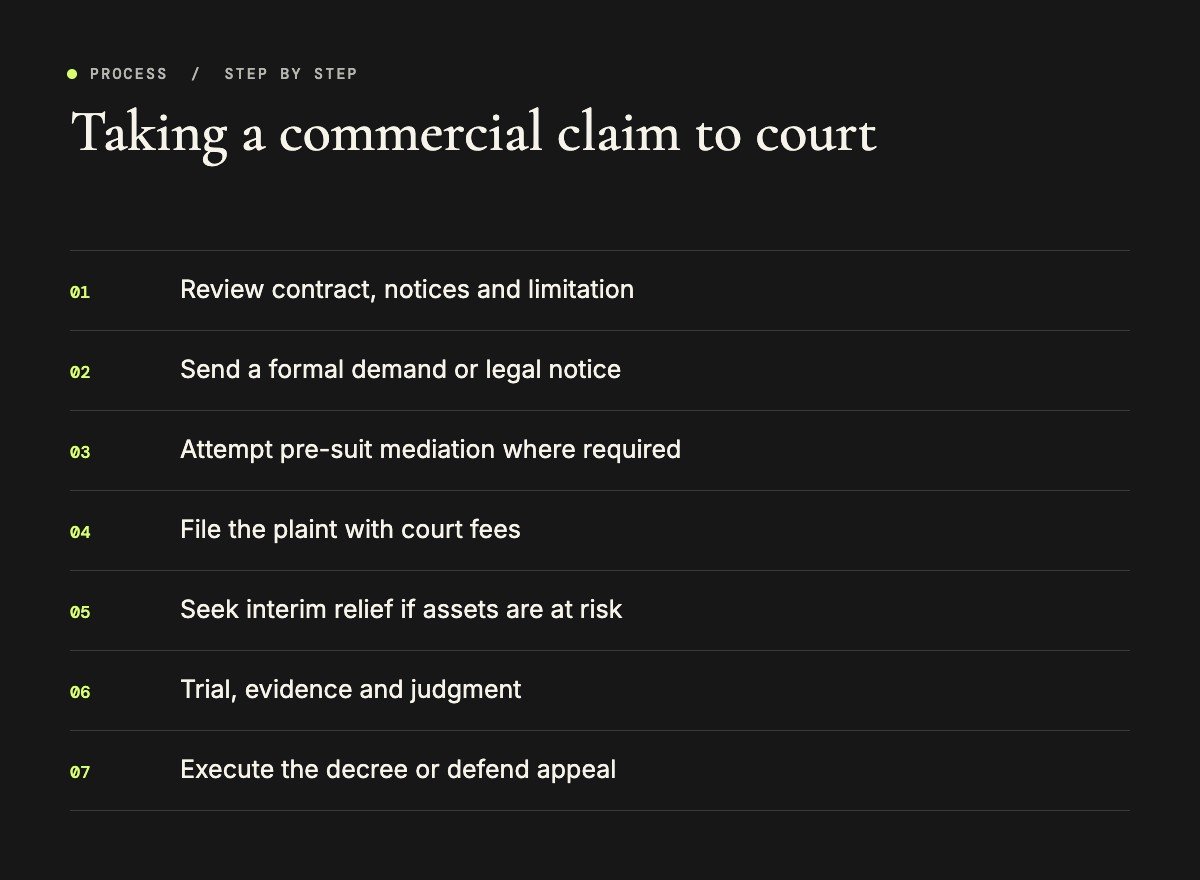
- Review the documents. Contracts, purchase orders, invoices, delivery records, emails and payment history.
- Check limitation. Most contract claims must be filed within three years under the Limitation Act 1908, but specific periods vary.
- Send a legal notice. A clear demand often prompts payment or negotiation and is useful evidence.
- Mediate where required. Comply with any mandatory pre-suit mediation.
- File the plaint. Pay ad valorem court fees under the Court-fees Act 1870 and file in the correct forum.
- Interim relief. Apply for injunctions or attachment before judgment if the defendant may move assets.
- Trial and decree. Present evidence, obtain judgment and move promptly to execution.
Interim relief: protecting assets early
Interim relief is often the turning point in a Chittagong commercial court case. In commercial cases, the defendant may try to sell goods, move money or leave the country. Under the Code of Civil Procedure, a Chittagong commercial court or civil court can grant temporary injunctions, attachment before judgment, appointment of receivers and orders to preserve evidence. Applicants must usually show a prima facie case, risk of irreparable harm and balance of convenience. For goods stuck at Chattogram port, urgent orders may be needed to prevent release or auction. Early interim relief often brings defendants to settlement.
Bank recovery: Artha Rin Adalat
Banks and financial institutions recover loans through the Artha Rin Adalat, which has exclusive jurisdiction over such claims. Borrowers and guarantors in Chattogram face suits in the local Artha Rin Adalat, and the Ain requires a deposit before appeals. Settlement and rescheduling under Bangladesh Bank policies are common alternatives. Defending these claims requires careful review of facility documents, security and interest calculations.
Shipping and port disputes
Claims against vessels, including arrest of ships for cargo damage, unpaid bunkers, crew wages or collision, fall under the admiralty jurisdiction of the High Court Division under the Admiralty Court Act 2000. Even though the ship is in Chattogram, the case is filed in the High Court Division. Disputes between importers and shipping agents, freight forwarders or port service providers may go to the civil or commercial courts, depending on the claim. Our shipping and maritime practice handles ship arrests and cargo claims.
Arbitration and enforcement
Arbitration often runs alongside a Chittagong commercial court. Many commercial contracts, especially with foreign parties, contain arbitration clauses. Under the Arbitration Act 2001, courts must refer parties to arbitration where a valid clause exists, but they can still grant interim measures under section 7A. Domestic and foreign awards can be enforced through the District Judge's court, so a Chittagong commercial court or district court may become the enforcement forum for an award against a local company.
Executing a decree
Winning a judgment in a Chittagong commercial court is only half the job. Execution proceedings under the Code of Civil Procedure allow attachment and sale of property, garnishment of bank accounts and, in some cases, civil detention. Identifying the debtor's assets early, including land, vehicles, bank accounts and receivables, makes execution far more effective.
Evidence and electronic records
Commercial cases are won on documents. A Chittagong commercial court will expect the claimant to prove the contract, performance and the amount due. Emails, WhatsApp messages, scanned invoices and accounting records are increasingly used, and the Evidence Act 1872, as amended in 2022, addresses digital records. Businesses should keep original files, metadata and a clear chain of custody for electronic evidence. Witnesses who handled the transaction, such as sales managers or accountants, should be identified early.
Costs and timelines
Court fees in money suits are ad valorem, so larger claims carry higher fees. Lawyers' fees, translation, expert reports and travel add to the cost. Timelines remain the biggest concern for litigants in Chattogram. The commercial court reforms are intended to shorten them through case management and limits on adjournments, but backlogs in civil courts are significant. A realistic strategy weighs the time and cost of a Chittagong commercial court case against mediation, arbitration or negotiated settlement.
Foreign parties in Chattogram disputes
Foreign suppliers, buyers and shipping companies often face disputes with Chattogram businesses. They can sue or be sued in Bangladeshi courts, appointing local counsel under a power of attorney that is notarised and apostilled or legalised as required. Foreign judgments are generally not directly enforceable in Bangladesh unless from a reciprocating territory under section 44A of the Code of Civil Procedure, so many foreign parties prefer arbitration. Where litigation is unavoidable, a Chittagong commercial court case should be planned with attention to evidence from abroad and enforcement against local assets.
Defending a claim
Defendants should act quickly when served with a summons. Missing the deadline for a written statement can lead to an ex parte decree. A good defence examines jurisdiction, limitation, arbitration clauses, the claimant's documents and any counterclaim. Where an arbitration clause exists, the defendant should apply promptly for a stay of the suit. Defendants in a Chittagong commercial court case can also use mediation to negotiate payment plans or set-offs.
Practical tips for Chattogram businesses
- Use written contracts with clear payment terms, governing law and dispute resolution clauses.
- Keep complete records of deliveries, invoices and communications.
- Send prompt written notices when a counterparty defaults.
- Act within limitation periods and do not let disputes drift.
- Consider whether a Chittagong commercial court, Artha Rin Adalat, admiralty court or arbitration is the right forum before filing.
Appeals
Under the 2026 framework, appeals from a Chittagong commercial court go to commercial appellate benches of the High Court Division, with time limits designed to keep cases moving. In ordinary civil suits, appeals lie to the District Judge or the High Court Division depending on value. Appeals from the Artha Rin Adalat require a deposit of part of the decretal amount. Planning for a possible appeal from the outset, including preserving objections, strengthens the overall case.
Frequently asked questions about chittagong commercial court
Is there a dedicated commercial court in Chattogram?
The Commercial Court Ordinance 2026 provides for district commercial courts. Confirm whether the court is operating and the Ordinance remains in force before filing.
Is mediation compulsory?
Under the 2026 framework, pre-suit mediation is required for many commercial disputes. Check the current rules for your claim.
Where do banks sue borrowers?
In the Artha Rin Adalat, which has exclusive jurisdiction over financial institution recovery claims.
Where are ship arrest cases filed?
In the High Court Division's admiralty jurisdiction, even if the ship is at Chattogram port.
Can I sue if my contract has an arbitration clause?
Generally the dispute must go to arbitration, but courts can grant interim relief and later enforce the award.
What is the limitation period for contract claims?
Usually three years under the Limitation Act 1908, though specific claims may differ.
How we can help
We represent businesses in every forum connected with a Chittagong commercial court case: pre-suit mediation, commercial and civil suits, interim relief, Artha Rin Adalat matters, ship arrests, arbitration and enforcement. Learn more about our Chattogram practice and our commercial litigation practice.
Facing a commercial dispute in Chattogram?
We assess the right forum, protect your assets quickly and pursue recovery through settlement, trial or enforcement.
Book a consultationChattogram practicePrimary sources: the Code of Civil Procedure 1908, Limitation Act 1908, Artha Rin Adalat Ain 2003, Admiralty Court Act 2000 and Arbitration Act 2001 on the Laws of Bangladesh portal; court information from the Supreme Court of Bangladesh.
This article is general information about commercial litigation in Bangladesh as of October 2026 and is not legal advice. The status of the Commercial Court Ordinance 2026 and court practice may change; confirm the current position with a qualified lawyer before acting.


0 Comments