
Mobile money has transformed payments in Bangladesh, with tens of millions of people using MFS accounts to send money, pay bills and receive salaries and remittances. The MFS regulations in Bangladesh, issued by Bangladesh Bank in February 2022, set out who can offer these services, how much capital they need, how customer funds are protected and how agents must be managed.
- The Bangladesh Mobile Financial Services Regulations 2022 replaced the 2018 regulations and took effect immediately on issue in February 2022.
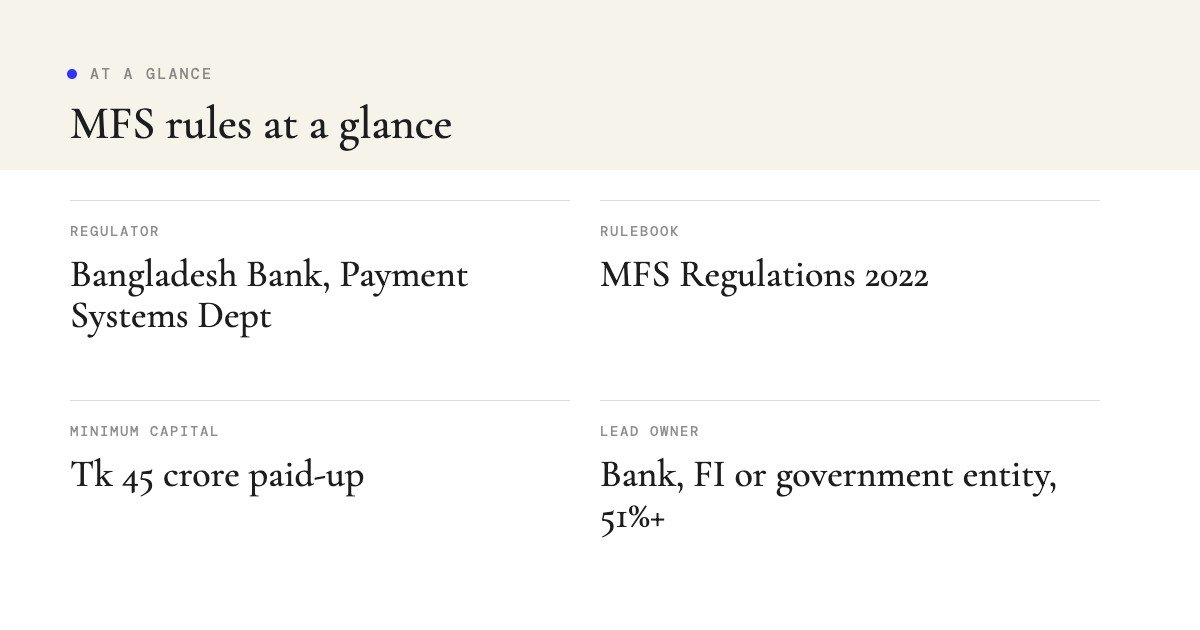
- MFS must be offered through a subsidiary led by a scheduled bank, financial institution or government entity holding at least 51% of the equity.
- Mobile network operators cannot hold equity in an MFS provider, and an investor may hold equity in only one MFS subsidiary.
- Minimum paid-up capital is Tk 45 crore, and licensing happens in two stages: a no objection certificate and then a licence to operate.
- Customer money must be held in trust cum settlement accounts, with at least 25% invested in government securities.
The legal framework for MFS regulations in Bangladesh
Bangladesh Bank regulates mobile financial services through its Payment Systems Department. The MFS Regulations 2022 were issued under the Bangladesh Bank Order 1972 and the Bank Company Act 1991, and operate alongside the Bangladesh Payment and Settlement Systems Regulations 2014, trust fund guidelines and anti-money laundering directives from the Bangladesh Financial Intelligence Unit.
The MFS regulations in Bangladesh follow a bank-led model. Unlike some countries where telecom operators run mobile money directly, Bangladesh requires a regulated financial institution to sit at the centre. Our banking and financial services practice advises fintechs, banks and investors on this framework.
Who can provide MFS
| Requirement | Rule under the 2022 regulations |
|---|---|
| Lead entity | Scheduled commercial bank, financial institution or government entity |
| Structure | Must operate through a subsidiary company |
| Lead shareholding | At least 51% equity and board control |
| Other equity partners | Banks, FIs, government entities, NGOs, investment companies and fintechs, local or foreign |
| Excluded investors | Mobile network operators |
| Multiple holdings | One MFS subsidiary per investor |
Foreign investment companies and fintechs may participate as minority equity partners, which has allowed international payment groups to invest in Bangladeshi MFS providers. Investors should also consider foreign exchange approvals for capital inflows.
Capital requirements under MFS regulations in Bangladesh
The MFS regulations in Bangladesh require paid-up capital of at least Tk 45 crore, and total capital must never fall below that level. Providers must also build a capital reserve equal to paid-up capital by transferring at least 10% of after-tax profit each year.
If losses erode capital, shareholders must inject fresh funds to restore the minimum. Bangladesh Bank may impose higher capital requirements and can penalise or cancel licences for non-compliance.
The licensing process
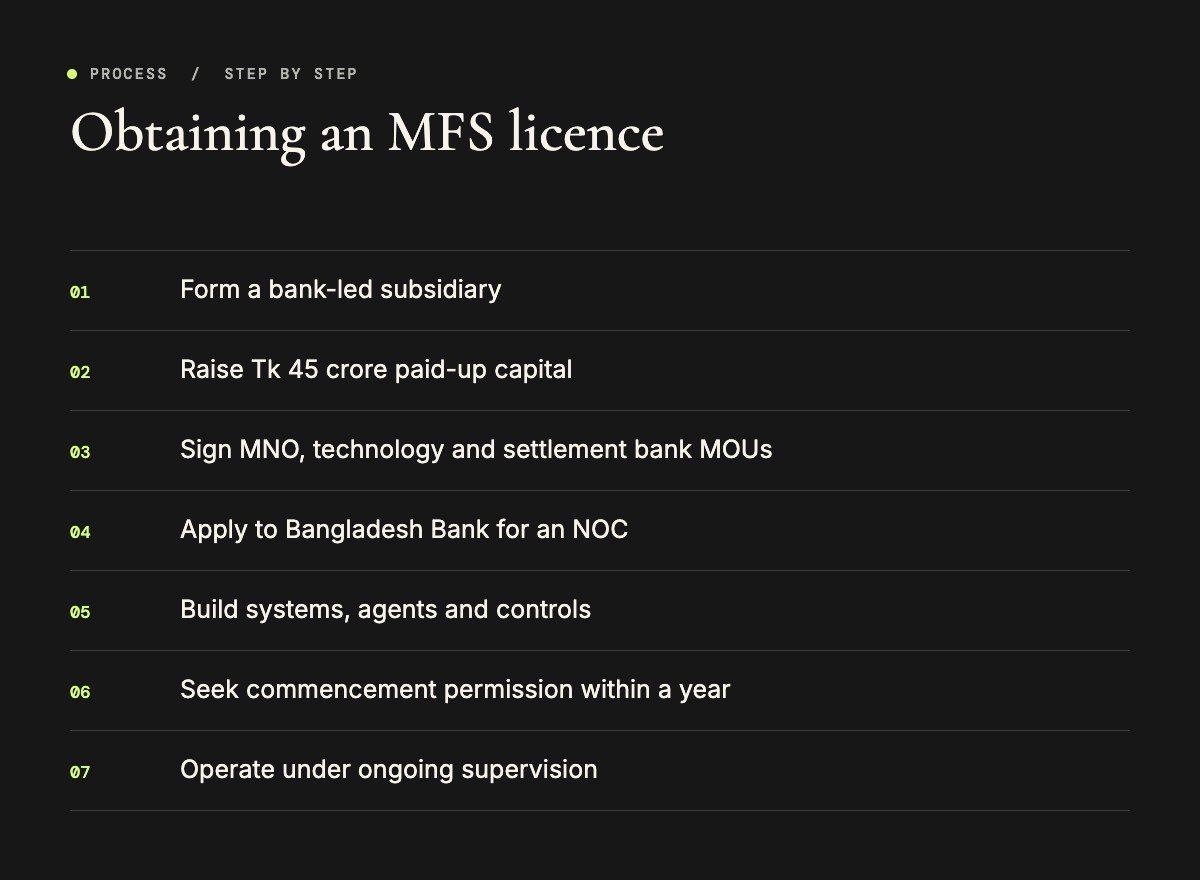
- Form the subsidiary. Incorporate the company with the lead institution holding at least 51%.
- Raise capital. Fund paid-up capital of at least Tk 45 crore.
- Sign partner agreements. Prepare MOUs with mobile network operators, technology partners and settlement banks.
- Apply for an NOC. Submit the application, business plan, agent agreement specimens and service-level agreements to Bangladesh Bank.
- Build infrastructure. Set up systems, security, agent networks, call centres and compliance functions.
- Seek commencement. Apply for permission to commence operations within one year of the NOC.
- Operate under supervision. Comply with reporting, audit and inspection requirements.
The one-year window between NOC and commencement is tight for a new provider building technology, agent networks and compliance teams from scratch. Plan the build in parallel with the application, and keep Bangladesh Bank informed of progress.
Protecting customer funds
Customer money is the heart of the MFS regulations in Bangladesh. At the end of each day, total e-money issued must not exceed the cash held in trust cum settlement accounts plus investments in government securities. Any shortfall must be reported to the Payment Systems Department immediately.
Providers must invest at least 25% of the physical cash in government securities, measured at the end of June and December, and keep the rest with settlement banks. Trust funds must be kept separate from operational accounts, and no loan may be taken against them.
Permitted and prohibited activities
- Permitted: cash-in, cash-out, person-to-person transfers, merchant payments, bill payments, salary disbursement, government payments and inward remittance disbursement.
- Prohibited: taking deposits or lending from the provider's own funds, outward and cross-border payments, and paying inward remittances in foreign currency.
Inward remittances must be received through nostro account credits and paid out only in taka. Partnerships with banks allow MFS customers to access credit and savings products offered by the bank, rather than the MFS provider itself.
Agents and distributors under the MFS regulations in Bangladesh
Agents are the face of MFS for most customers. The regulations require distributors and super agents to be appointed by written contract under documented selection policies. Selection criteria include technical competence, financial soundness, internal controls and a declaration of no criminal record.
Agents may only perform cash-in, cash-out and other approved transactions, and transfers involving third-party accounts are prohibited. Providers must train agents on anti-money laundering risks and monitor them for suspicious activity. Under the MFS regulations in Bangladesh, the provider remains responsible for its agents' conduct.
KYC, AML and record-keeping
Every MFS account requires know-your-customer checks and customer due diligence in line with BFIU directives. Providers must keep KYC records accurate and up to date and retain records for at least six years. Suspicious transaction reporting obligations under the Money Laundering Prevention Act 2012 apply in full. More detail is available from the Bangladesh Financial Intelligence Unit.
Interoperability
The 2022 regulations require providers to link MFS accounts with bank accounts where possible and to support interoperable transfers between MFS accounts of different providers and between MFS and bank accounts. Bangladesh Bank's national payment switch and the Binimoy interoperable platform support these transfers.
Interoperability is a core policy goal of the MFS regulations in Bangladesh, intended to increase competition and convenience for customers.
Customer complaints
Consumer protection is a central theme of the MFS regulations in Bangladesh. Providers must run a call centre open 24 hours a day, accepting complaints by phone, SMS, IVR and mail, and each dispute must be resolved within ten working days. Customers can escalate unresolved complaints to Bangladesh Bank's Customers' Interest Protection Centre. Agent disputes go first to the distributor and then to the provider.
Practical issues for investors
Investors considering an MFS venture should look beyond the headline requirements of the MFS regulations in Bangladesh and examine the commercial and legal structure in detail, including:
- The identity and commitment of the lead bank, FI or government entity.
- Shareholder agreement terms on board control, reserved matters and exit.
- Foreign exchange approvals for share subscriptions and repatriation of dividends.
- Tax treatment of MFS charges and agent commissions.
- Data protection, cyber security and outsourcing arrangements.
Our technology and digital practice and foreign investment team regularly advise on these points.
How MFS regulations in Bangladesh evolved
Bangladesh Bank first issued guidelines on mobile financial services in 2011, allowing banks to offer mobile money through their own channels or subsidiaries. Rapid growth followed, and the central bank replaced the guidelines with formal regulations in 2018. The 2022 regulations refined that framework, tightened rules on trust funds and agents, and clarified ownership.
Each stage of the MFS regulations in Bangladesh has kept the bank-led model while widening the pool of permitted investors. Understanding this history helps investors interpret how Bangladesh Bank is likely to approach new products and partnerships.
MFS, PSPs and digital banks compared
| Licence type | Main activity | Key distinction |
|---|---|---|
| MFS provider | E-money accounts, cash-in and cash-out through agents | Bank-led subsidiary; agent network |
| Payment service provider (PSP) | Wallets and payment services without cash-out agents | Licensed under payment systems rules |
| Payment system operator (PSO) | Payment infrastructure and gateways | Operates systems used by others |
| Digital bank | Full banking without physical branches | Bank licence; can take deposits and lend |
Choosing the right licence is often the first strategic question for a fintech. A business that does not need cash-out agents may fit better as a PSP than under the MFS regulations in Bangladesh, with lower capital and simpler ownership rules.
Transaction limits and charges
Bangladesh Bank sets daily and monthly transaction limits for personal, merchant and agent accounts by circular, and has revised them several times as the market has grown. The central bank has also intervened on cash-out charges and promoted free or low-cost person-to-person transfers below certain thresholds.
Because limits change by circular rather than by amendment of the MFS regulations in Bangladesh, providers and business users should check the latest Payment Systems Department circulars before designing products or pricing.
Cyber security and data protection
MFS providers handle sensitive personal and financial data. Bangladesh Bank's ICT security guidelines apply, and providers must maintain secure systems, business continuity plans and incident reporting procedures. Bangladesh’s cyber security legislation and personal data protection rules add further obligations. See our data protection practice for guidance.
Outsourcing technology to foreign vendors requires careful contracts covering data location, audit rights and regulator access. Compliance with the MFS regulations in Bangladesh therefore extends well beyond the licence itself.
Enforcement and penalties
Bangladesh Bank can inspect MFS providers, demand information, impose fines, restrict activities, remove directors or senior officers and, in serious cases, cancel the licence. Breaches of anti-money laundering rules can also lead to action by the BFIU and criminal liability under the Money Laundering Prevention Act 2012.
A strong compliance culture is the best protection. Providers should treat the MFS regulations in Bangladesh as a living rulebook, with regular board-level review of compliance, audit findings and regulatory correspondence.
MFS for businesses and employers
Businesses use MFS to pay salaries, collect from customers and make supplier payments. Factories in the garment sector, for example, have widely adopted MFS payroll. Employers should check that salary payments through MFS comply with the Bangladesh Labour Act 2006 and wage payment rules, and that workers have consented to the method.
Merchants accepting MFS payments sign merchant agreements with providers. Those agreements should be reviewed for settlement timelines, charge-backs, fees and termination rights, all of which operate within the MFS regulations in Bangladesh.
Frequently asked questions about mfs regulations in bangladesh
Who regulates MFS in Bangladesh?
Bangladesh Bank, through its Payment Systems Department.
Can a telecom company own an MFS provider?
No. Mobile network operators cannot hold equity under the 2022 regulations.
What is the minimum capital?
Tk 45 crore paid-up capital, which must be maintained at all times.
Can foreign investors invest in MFS?
Yes, foreign investment companies and fintechs can be minority equity partners.
Can MFS providers give loans?
No. Lending from the provider's own funds is prohibited; credit is offered through partner banks.
How quickly must complaints be resolved?
Within ten working days of receipt by the call centre.
How we can help
We advise on MFS regulations in Bangladesh for applicants, banks, fintechs and investors, including licensing, shareholder structures, agent agreements and regulatory compliance. Learn more about our banking and financial services practice.
Planning a mobile money venture?
We guide you from structure to licence and launch.
Book a consultationFinancial services practicePrimary sources: MFS Regulations and payment systems circulars from Bangladesh Bank; the Bank Company Act 1991 and Money Laundering Prevention Act 2012 on the Laws of Bangladesh portal.
This article is general information about Bangladeshi financial regulation as of October 2026 and is not legal advice. Bangladesh Bank updates MFS rules and transaction limits by circular; check the latest position.



0 Comments