
Bangladesh largely governs marriage through religious personal laws, which creates difficulties when partners follow different faiths. The Special Marriage Act in Bangladesh, dating from 1872, provides a civil route to marriage outside religious ceremonies. It is used mainly by inter-faith couples, but it carries important conditions and consequences for divorce, children and inheritance.
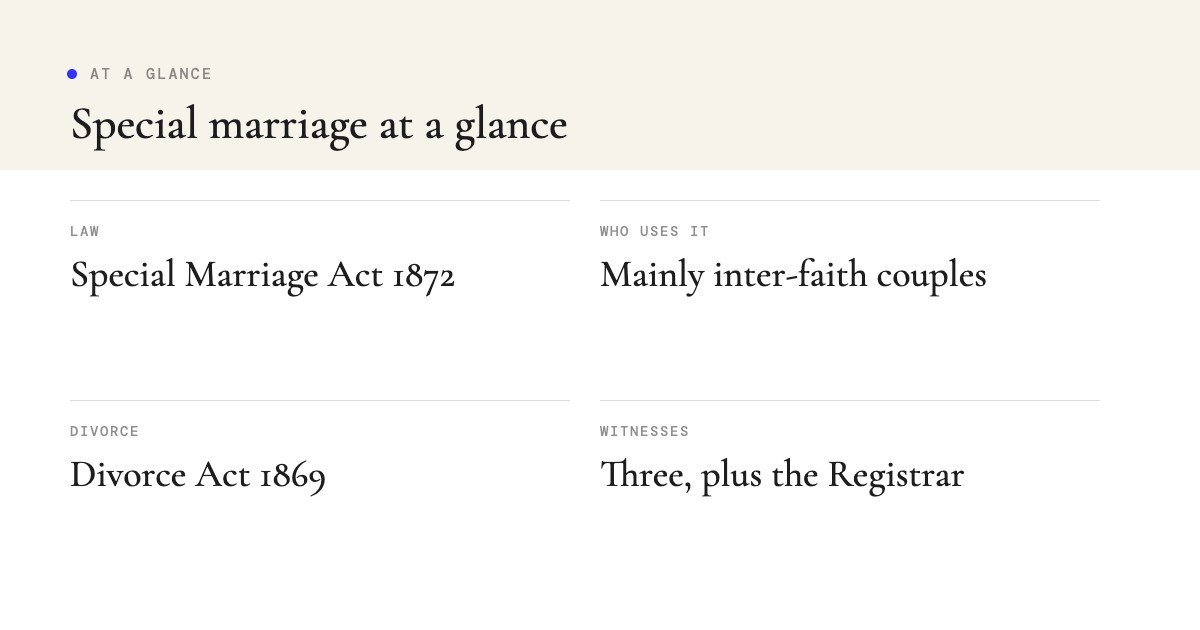
- The Special Marriage Act 1872 allows a civil marriage before a Marriage Registrar appointed under the Act.
- Under the Act, parties generally declare that they do not profess the Christian, Jewish, Hindu, Muslim, Parsi, Buddhist, Sikh or Jaina religion, with a separate route for marriages between Hindus, Buddhists, Sikhs and Jainas.
- Neither party may have a living spouse, and the parties must meet minimum age requirements, now read with the Child Marriage Restraint Act 2017.
- Divorce for marriages under the Act is governed by the Divorce Act 1869.
- Marriage under the Act can affect inheritance and family property rights, so couples should take advice before marrying.
Why the Special Marriage Act exists
In Bangladesh, Muslims marry under Muslim law and register under the Muslim Marriages and Divorces (Registration) Act 1974, Hindus marry under Hindu law with optional registration under the Hindu Marriage Registration Act 2012, and Christians marry under the Christian Marriage Act 1872. These systems generally assume that both parties share the same faith.
The Special Marriage Act in Bangladesh fills the gap for couples who cannot or do not wish to marry under a religious law. It provides a secular, registered marriage recognised by the state. Our family law team, introduced on our about page, regularly advises couples on these choices.
Who can marry under the Special Marriage Act in Bangladesh
The Act was originally enacted for persons who do not profess any of the listed religions. In practice, an inter-faith couple, for example a Muslim and a Hindu, can marry under the Act only if both declare that they do not profess the Christian, Jewish, Hindu, Muslim, Parsi, Buddhist, Sikh or Jaina religion. This declaration has significant personal and legal consequences.
A 1923 amendment added a separate route for marriages between persons each of whom professes the Hindu, Buddhist, Sikh or Jaina religion. Couples within that group can marry under the Act without renouncing their religion, although some different consequences apply.
Conditions for a valid marriage
| Condition | Requirement |
|---|---|
| Marital status | Neither party has a living husband or wife |
| Age | Minimum ages under the Act, read with the Child Marriage Restraint Act 2017 (21 for men, 18 for women) |
| Prohibited relationships | Parties must not be related within prohibited degrees of consanguinity or affinity |
| Consent of guardian | Historically required where a party was under 21; check current practice |
| Declaration | Signed by both parties and three witnesses before the Registrar |
A marriage under the Special Marriage Act in Bangladesh that breaches these conditions may be void. Couples should check their documents carefully, especially proof of age and evidence that any earlier marriage has been lawfully dissolved.
Registration under the Special Marriage Act in Bangladesh
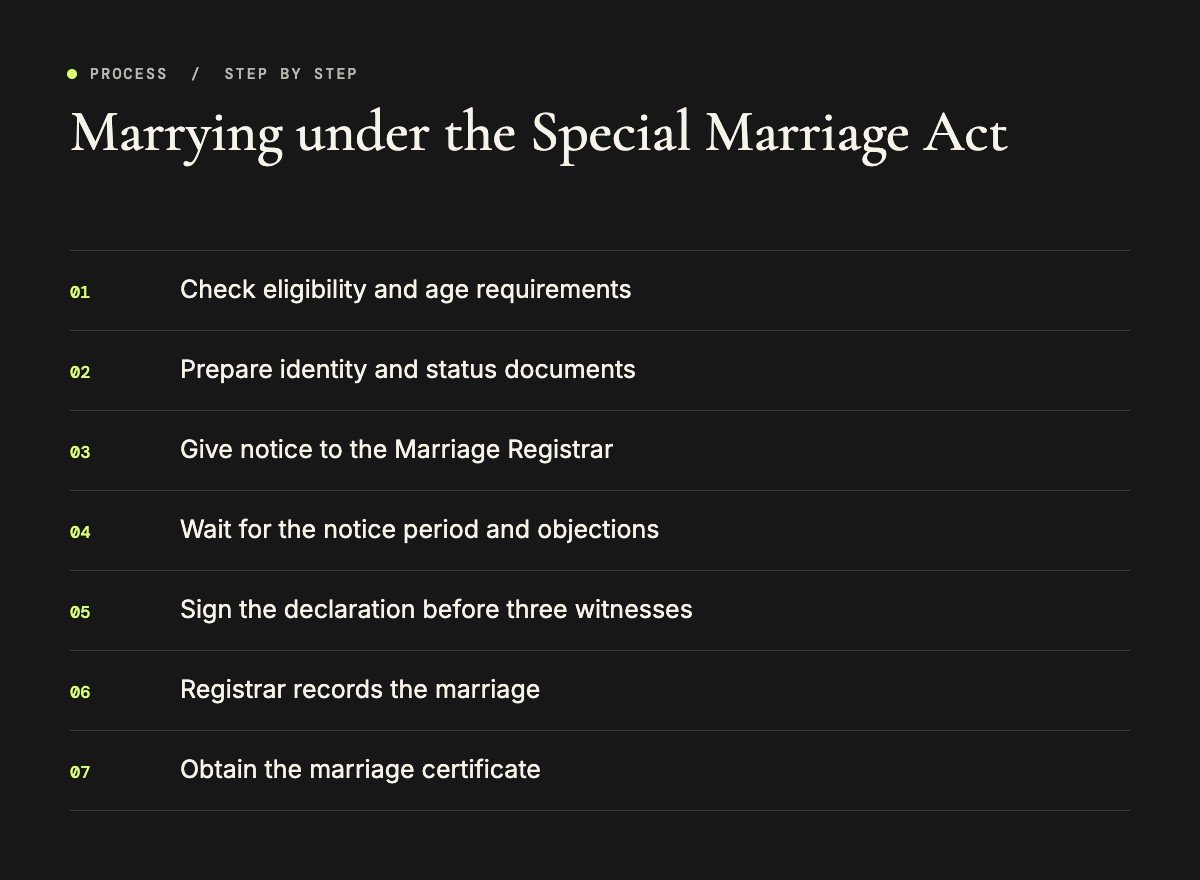
- Check eligibility. Confirm both parties meet the age, status and relationship conditions.
- Prepare documents. National ID cards or passports, birth certificates, photographs and, if previously married, divorce or death certificates.
- Give notice. One party gives written notice to the Marriage Registrar of the district where at least one party has lived for the required period.
- Notice period. The Registrar publishes the notice, and the marriage cannot take place until fourteen days have passed.
- Objections. Any person may object on the ground that a condition is not met; the Registrar must decide objections before proceeding.
- Declaration. Both parties and three witnesses sign the declaration in the form set by the Act before the Registrar.
- Certificate. The Registrar records the marriage in the marriage certificate book, signed by the parties and witnesses.
Locating a Special Marriage Registrar can take time, as there are few of them. Contact the Registrar well in advance, confirm the documents required and the fee, and keep copies of the notice and receipts.
Consequences for religion and family
Where a couple marries under the original route, each declares that they do not profess any of the listed religions. This declaration may affect a person's standing within their religious community and family, and can have legal consequences under personal law, particularly for inheritance from relatives who remain bound by religious law.
For Hindus, Buddhists, Sikhs and Jainas who marry under the Act, the Act provides that the marriage may effect a severance from the undivided family. Couples should understand these consequences before choosing the Special Marriage Act in Bangladesh.
Divorce under the Special Marriage Act in Bangladesh
Marriages under the Act are dissolved under the Divorce Act 1869, which sets out grounds such as adultery, cruelty and desertion and requires court proceedings. This is very different from Muslim law, where talaq and khula operate under the Muslim Family Laws Ordinance 1961, and from Hindu law in Bangladesh, which offers limited divorce options.
Because divorce under the Divorce Act requires proof of specific grounds, ending a marriage under the Special Marriage Act in Bangladesh can be slower and more formal than couples expect. See our guide to divorce under Muslim law for comparison.
Children under the Special Marriage Act in Bangladesh
Children of a marriage under the Act are legitimate. Custody and guardianship disputes are generally decided under the Guardians and Wards Act 1890, with the welfare of the child as the paramount consideration. Questions about a child's religion, education and upbringing can become contentious, so couples may wish to discuss them in advance.
Maintenance claims can be brought under the general law, including the Code of Criminal Procedure and the Divorce Act provisions on alimony.
Inheritance and succession
Succession to the property of persons married under the Act is generally governed by the Succession Act 1925 rather than religious personal law, although the precise position depends on the route used and the parties' circumstances. Spouses and children may inherit under the Succession Act's rules, which differ significantly from Muslim or Hindu law.
Inheritance from relatives who remain governed by religious law may be affected by the declaration. Couples should consider making wills and other estate planning arrangements, and take legal advice on how marriage under the Special Marriage Act in Bangladesh will affect their family property.
Foreign nationals
A Bangladeshi citizen marrying a foreign national of a different faith may also use the Act. The foreign party should provide a passport, proof of single status from their embassy or home authority, and any documents required by the Registrar. The couple should check whether the marriage will be recognised in the foreign party's country and what documents are needed for spouse visas.
Documents issued abroad may need an apostille or legalisation. Our immigration law practice can help with related visa and residence questions.
Common misunderstandings
Many couples assume that the Special Marriage Act in Bangladesh lets each partner keep their religion while marrying across faiths. Under the original route, that is not the case: the declaration requires both parties to state that they do not profess the listed religions. Others assume that a court marriage affidavit before a notary creates a valid marriage. It does not. An affidavit is only a sworn statement, and only registration before a Marriage Registrar under the Act creates a marriage under it.
Some couples instead convert so that both share a religion and then marry under that religion's law. That is a personal decision with its own legal consequences, including for inheritance and divorce, and it should be made freely.
Privacy and safety
Inter-faith marriages can attract family or community opposition. Couples using the Special Marriage Act in Bangladesh should know that the notice is published, so family members may learn of the planned marriage. Where there are safety concerns, couples can seek protection from the police and, if necessary, the courts. Adults have the right to choose their spouse, and the High Court Division has intervened in cases of unlawful confinement of adult women prevented from living with their chosen partners.
Proving the marriage later
The marriage certificate issued under the Act is the primary proof of marriage for passports, national ID updates, visas, bank accounts and inheritance claims. Keep the original safely and obtain certified copies as needed. If the certificate is lost, the Registrar's records can be used to obtain a copy, which is another reason to complete registration properly rather than relying on informal arrangements.
Is reform likely?
Commentators and rights groups have long called for a modern civil marriage law that allows inter-faith couples to marry without renouncing religion. Proposals have been discussed at various times, but the Special Marriage Act in Bangladesh remains the governing law. Couples should check whether any reform has been enacted before relying on this guide.
Checklist before you apply
Before giving notice under the Special Marriage Act in Bangladesh, make sure both partners have valid identity documents, proof of age and proof of single status. Identify three adult witnesses who can attend on the day. Discuss with your partner how you will approach religion, children's upbringing and property. Consider drafting wills at the same time, because the Special Marriage Act in Bangladesh changes how succession works. Finally, ask the Registrar about fees, timing and any additional documents, so the ceremony is not delayed by a missing paper.
Careful preparation turns what can feel like an intimidating legal process into a straightforward civil ceremony.
Marriages abroad
Some Bangladeshi inter-faith couples marry abroad in a civil ceremony, for example in the UK or another country with secular marriage laws. Such marriages may be recognised in Bangladesh if valid where celebrated and if the parties had capacity under their personal laws, but recognition questions can be complex, particularly for inheritance and later divorce. Couples who marry abroad should keep certified and apostilled copies of the certificate and take advice on registration or recognition in Bangladesh before relying on the marriage for property or family matters here.
Frequently asked questions about special marriage act in bangladesh
Can a Muslim and a Hindu marry in Bangladesh?
Under the Special Marriage Act 1872, generally only if both declare they do not profess any of the listed religions.
What is the minimum age?
Read with the Child Marriage Restraint Act 2017, 21 for men and 18 for women.
How long is the notice period?
The marriage cannot take place until fourteen days after notice is given.
How many witnesses are needed?
Three witnesses, in addition to the Registrar.
Which law governs divorce?
The Divorce Act 1869, which requires court proceedings on specified grounds.
Does the marriage affect inheritance?
Yes. Succession is generally governed by the Succession Act 1925, and inheritance from relatives may be affected.
How we can help
We advise couples on the Special Marriage Act in Bangladesh, from eligibility and documentation to registration, foreign spouse issues, wills and later family disputes. Learn more on our about page and our guide to the Muslim Family Laws Ordinance.
Planning an inter-faith marriage?
We explain your options confidentially and guide you through registration.
Book a consultationAbout our chamberPrimary sources: the Special Marriage Act 1872, Divorce Act 1869, Child Marriage Restraint Act 2017 and Succession Act 1925 on the Laws of Bangladesh portal; birth registration through the birth and death registration portal.
This article is general information about Bangladeshi family law as of October 2026 and is not legal advice. Personal and family consequences vary; take confidential advice before deciding.

0 Comments